Wednesday, October 21, 2009
This week's piece "Bunch of Dicks" had its genesis after I saw this KGUN-9 News report last week that was so riddled with phony statements, mistakes and moments of unintentional humor that I almost thought it was an audition for The Daily Show. Anne-Marie Russell should consider running it as a performance-art hit piece during the first installation at MOCA's new headquarters.
It was so bad that reporter Joel Waldman had to do a follow-up that contradicts a number of points he didn't check out in this original piece.
Here are my favorite moments:
1:12: Joel refers to the political committee as “Tucson Vision Community” even as the camera shows a “Tucson Vision Committee” tag.
1:34: Joel tells us an ad is “set to run in next week’s Tucson Citizen.” That’s the paper that stopped publishing six months ago.
1:39: Republican National Committeeman Bruce Ash alleges that the Tucson City Council “"authorized the expenditure of a lot of dollars on a piece work called 'Big Dick No. 1.'" ("Dick" is bleeped out.)
Fact check: The show that included “Big Dicks No. 1” was in 2005, when Republicans controlled the city council. No tax dollars were spent on the artwork, which was borrowed as part of a show at MOCA. MOCA has not gotten any TPAC dollars since 2006, when it got about $500.
1:50: Joel shows a picture of “Big Dicks No. 1,” completely blurred out. Nothing inaccurate here, but it struck me as something straight out of Monty Python.
2:05: Joel reports that Ash has told him
Tags: KGUN 9 , Big Dick , City Election 2009
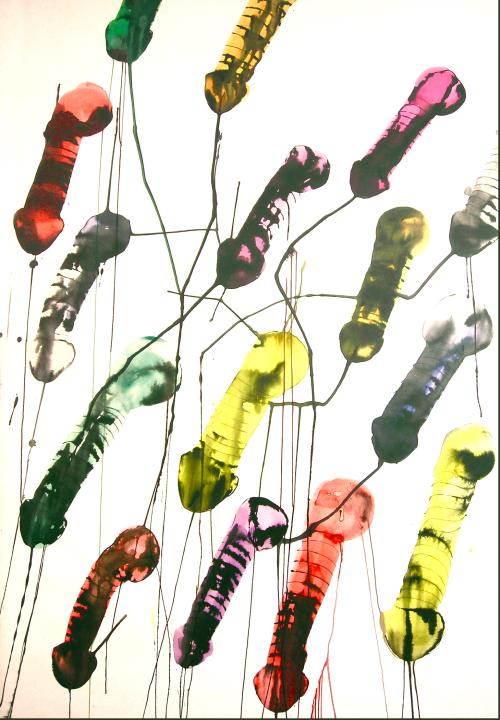
For those of you who are wondering what all the fuss is about regarding "Big Dick No. 1," here's a full-color look at the piece in question, courtesy of artist Jaime Scholnick.

In a long-rumored power play, Tucson Electric Power has formally announced that it is opposing the Public Safety First Initiative that city voters will decide on Nov. 3.
"We have all the support in the world for local first responders," says TEP spokesman Joe Salkowski. "But this proposition amounts to an unfunded mandate that would draw resources from other areas where the city desperately needs to invest."
Salkowski says Prop 200 doesn't include any way of paying for the estimated $63 million a year that the initiative will cost once it's fully implemented in five years.
"That doesn't seem like a smart way to manage a city budget, particularly at a time when economic stresses are so high," Salkowski says.
Our reasons to oppose Prop 200 here.
More on crime rates city politics and the cost of Prop 200 here.
Tags: Public Safety First Initiative , Tucson , City Election 2009

If you have a medical marijuana card in Denver, you could get a job working for the city's alternative weekly, Westword, reviewing the different offerings in the city's growing number of medical MJ dispensaries.
According to an article in today's Telegraph, the paper had been running reviews by a staff writer using the pseudonym Mae Coleman, a Reefer Madness character.
However, the writer “wanted to return to the day job”, according to the paper, so the position was opened up to the public.The job application involved writing a short essay on “What Marijuana Means To Me”. Apparently, the first response came within five minutes — “fast work for a stoner”, as Westword notes wrily.
A few minutes later, the first enquiry from the media arrived. “Really fast work for a journalist”, says Westword.
According to Westword's Patty Calhoun, their ad for a medical marijuana dispensary reviewer asked potential critics to write a brief essay on "What Marijuana Means to Me." First reply came in five minutes, and the media attention regarding the ad came a few minutes later.
Our first applicant replied within five minutes — fast work for a stoner. Our first media response came a few minutes later — really fast work for a journalist.A week later, our quest has been captured by everyone from the Wall Street Journal to the New York Times, and the essays continue to pour in — some silly, some actually spelled correctly (many potheads don't seem to care for punctuation), some very sincere. A sampling:
From an engineer who started with the great line "Hey, Joe, whatcha doin with that doob in your hand...What Mary Jane means to me: As a 'burner' of more than 14 years, I have spent many an hour pondering the importance of herb in my life... among other things. Recently, however, I have realized a new herbal importance to my overall quality of life. I am an outdoor sporting enthusiast and have experienced my share of injuries throughout the years, as many of us do. As I have aged (elegantly, damnit!), I have developed a couple of recurring conditions that have allowed me to legally indulge myself as an alternative to prescribed narcotics and the dangerous longterm effects. Long story short... (TOO LATE!) I have been frequenting many of our local dispensaries with mixed experiences. Most places are kind and professional. Others, though, are simply drug dealers that check your ID. I think that you have a great idea — a service, rather, that will help your readers make educated decisions and enjoy their 'medication' experience to the fullest..."
Just think of the possibilities if the Tucson Weekly was able to hire its own MMJ critic (Medical Mary Jane), allowing us to join in this... fun. Maybe it's a possibility if medical marijuana advocates get their way. Folks with the Arizona Medical Marijuana Policy Project are currently gathering the needed 153,365 signatures to get another measure on the ballot next year.
Arizonans have been here before when a measure was passed in 1996 with 65 percent of the vote. That initiative said patients could use marijuna with a doctor's prescription, but federal law prohibits doctors from writing prescriptions for harmful drugs without medical value - although seven other state allow patients to receive marijuana through a prescription. In 1997, the Legislature overturned the initiative anyway and in 1998 a referendum reinstated the measure and then Arizona voters passed the Voter Protection Alliance Act, to prevent the guys in Phoenix from undoing voter-passed measures. Arizona's ongoing saga with the drug continued when another initiative was defeated in 2002.
Proving, even back then, that Democrats and those in chronic pain will never get a break with our state government.
There's a huge X factor in this year's city election: Pima County's permanent early-voter list. In previous city elections, voters had to ask for a mail-in ballot. In this election, more than 62,000 early ballots went out automatically to city voters when early voting started on Oct. 8. There are roughly 224,000 registered voters in Tucson.
Whether all those voters will care enough to mail ballots back in remains to be seen, but the numbers we got from Pima County Recorder F. Ann Rodriguez suggest that most Tucsonans aren't in a rush to cast a ballot.
Here's the breakdown, as of yesterday morning:
A total of 65,635 ballots had been mailed to city voters. Of those, 14,376 ballots had been returned, which comes out to roughly 22 percent.
Party breakdown:
• 31,780 of those ballots went to Democrats; 7,270 of those ballots had been cast, for a return rate of roughly 23 percent.
• 20,021 of those ballots went to Republicans; 4,567 of those ballots had been cast, for a return rate of roughly 23 percent.
• 355 of those ballots went to Libertarians; 63 of those ballots had been cast, for a return rate of roughly 18 percent.
• 160 of those ballots went to Greens; 35 of those ballots had been cast, for a return rate of roughly 22 percent.
• 13,319 ballots had been sent to people who aren't registered with any of the above parties; 2,441 had been cast, for a return rate of roughly 18 percent.
The slow return of ballots bodes well for opponents of Prop 200, as momentum seems to be moving their way as more members of the business community come out against the Public Safety First initiative because they fear it will drive up taxes and result in a financial disaster for the city.
The big question: Are people waiting to vote because they still haven't made up their minds or because they just don't care and won't be returning their ballot at all?
My predictions: The number of early ballots not sent back will reach an all-time high percentage, but so will the number of people casting ballots by mail. Turn-out on Election Day will be light as a percentage of voters.
Turn-out in city elections tends to run about 25 percent, although it got up to about 40 percent in 2003. I explored the reasons for low turnout earlier this year.
Monday, October 19, 2009

I recall the first time I met Alan Ward early last year at the downtown farmers' market in front of the Main Library. I liked him instantly. I met with him to talk about the market's troubles with that troublesome Mexican flag-burning bozo the Tucson Weekly calls Asshat. Ward was manager of the market that rotated from the Presidio to the library two-days a week. He died yesterday, Sunday, Oct. 18 in hospice care at Tucson Medical Center.
Ward came down ill Oct. 8, and his friends Bob & Dianne Lichtenberg took him to the hospital and took over managing the market, hoping Ward would get better and return. This Wednesday, market vendors will meet to discuss how the market will be managed with Ward absent from the scene.
Bob told me this afternoon that he and his wife are happy to be involved, and there is some discussion that Alan's son may be interested. A memorial is being planned, although Bob said there isn't a date or location set. Bob said Alan is survived by his son, Cody, and his sister and mother, who are from Michigan. I imagine many of the vendors, past and present, can be listed as survivors, too.
"We’re Alan’s friends, but he was a friend to everybody... I’ve known where he hasn’t charged somebody because they weren’t selling anything and they were hurting for money... He was one of the most decent human beings I have known. He’d just helped people.One of the vendors is in a wheelchair travels by bus to get down there. Alan lugged his table around with him, so he didn’t have to lug it on the bus. Alan also had extra tables for people who didn’t have one. He had market umbrellas for people who didn’t have tents, so they didn’t cook up in the sun.
When asked if Alan gone means the future of the market is in question, Bob replied:
"I don’t know. I think the market should go on. If it wasn’t working the vendors wouldn’t come down, and they do. We had 16 vendors last Wednesday. It’s an important place for artists to go and sell, and even see if they want to sell. I had a teacher last Thursday come down and sell his art work rather than teach. He sat for the day and got a feel for what it was like to see if wanted to do it again. At the end of day I did what Alan would have done - I didn't charge him."
When I interviewed Alan, he was struggling with getting the city to pay attention to complaints he had that Asshat was causing a major disturbance at the market, especially to his vendors who were there just trying to make a living while listening to Asshat's bullhorn rants. Alan made a difference, but it seemed when students from City High got hurt arguing with Asshat, the Tucson Police Department finally intervened. Alan won, and peace was restored to the market and his vendors. Back then he described them to me as "fearless."
He worked hard with the city to establish a market downtown. I'm sure when the vendors get together on Wednesday, they may use the word fearless to describe Alan. After first meeting him last year, I always stopped to talk with him when I was downtown and passing the market. He'd share story ideas with me and never hesitated to call if he thought one of his vendors was be treated unfairly by the city. When I'd go downtown for record searches, I loved seeing his old green and white VW bus - that meant Alan was around helping his vendors put up tables and get booths set up. Sometimes, I felt especially lucky when I'd see him and his bus at an out-of-town festival, where Alan set-up his own booth selling his silver creations from old spoons and forks.
"He was looking for something to give to the city," Bob said.
Thank goodness. Hopefully, there are few more gems like Alan ready to take his place.
Saturday, October 17, 2009
ArtNet checks in on Tucson's Big Dick #1 art scandal that's become a swelling controversy in this year's City Council race:
It is easily the most pathetic attempt to restart the Culture Wars yet. Republican politicians in Tucson, Az., have put the local Museum of Contemporary Art in their crosshairs, attacking what they call a "sweetheart" deal the museum has with the city as it prepares to move into a new space in a repurposed firehouse. To whip up conservative ire, these same critics have resorted to that old standby, demonizing contemporary art as "pornographic" — though their chief example is a single work in a group show featured at the museum more than four years ago.
Tags: Tucson Election 2009 , Big Dicks , MOCA Tucson
Friday, October 16, 2009
State agencies are reporting the impacts of a 15 percent budget cut back to Gov. Jan Brewer. The cuts may be necessary since the state is facing a budget shortfall of $1.5 million, according to the Joint Legislative Budget Committee.
State agencies are proposing early release of convicted felons, eliminating health care for children of the working poor and ending programs to help students pass the AIMS test so they don't drop out as measures they would have to take if lawmakers balance the budget with sharp mid-year spending cuts.
The plans, made public today are in response to estimates by the governor's budget office that, even with already enacted spending cuts, revenues will still fall about $1 billion short of what is needed. As a result, Eileen Klein, director of the governor's Office of Strategic Planning and Budgeting, asked state agencies to detail how they would deal with a 15 percent reduction in state funds.
Some of the most dramatic changes would be in the state prison system which would have to slash more than $153 million to take a 15 percent cut.
Corrections Director Charles Ryan said he can get some savings through administrative spending reductions. But Ryan said the real money gets saved by having fewer people behind bars.
Another takeaway:
The Arizona Health Care Cost Containment System proposes to eliminate the Kids Care program which provides nearly free health care for more than 46,000 children of parents who earn too much to qualify for free coverage. For a family of three, that figure is $36,620 a year.
You can read the reports yourself here.
So are Republicans sure they'll hang onto control of the Legislature in 2010?
Tags: Arizona budget crisis , Jan Brewer
Crime rates are dropping, for the most part, in Tucson, according to TPD stats.
But Republicans seeking seats on the City Council and supporters of the Public Safety First Initiative say crime is out of control. And they say they've got polling that shows that people believe it.
Ryan Sager at Neuroworld looks at some numbers that show the public almost always believes crime is on the rise, no matter what the actual crime trends are:
With the exception of 2001 and 2002 (9/11 effect?), between 52% and 89% of Americans every year since 1990 have thought that crime is on the rise. That’s a pretty remarkable statistic, given that crime declined steadily nationally throughout the 1990s and has remained essentially level in the 2000s. Whatever the year-to-year correspondence is, we know that people have gotten the big picture wildly wrong, year after year.That is, people pretty much always seem to think that this year is worse than last, regardless of the actual trends.
Does this sound like anything else to you? How about: This generation is so much stupider/lazier/ruder than the last; politics is so much dirtier these days; the world is going to hell in a hand basket.
For whatever reason, this seems to be the default human predisposition. Is it availability bias? You hear about some terrible things happening during the course of every year, and — slowly forgetting all the terrible things that happened the year before and the year before that and so on — you assume that this year must be the worst ever?