Thursday, January 28, 2010
Why in the hell is the top story on azstarnet.com, as of this writing, "Who serves the best cheesecake in town?"
I am out of town at this second at—of all things—a Web/media conference. Is it THAT slow of a news day back in Tucson?
El Coqui, the new Puerto Rican restaurant at 5443 E. 22nd St., is open for business. We just stopped in for a Malta India, some tostones rellenos (yummy stuffed and fried plantains) and a little private chair dancing to some wonderful hip-shaking music that had a few other heads in the place bobbing along too.
The place just opened, so don't expect seamless service. They were still trying to get the cash registers to work properly today. That said, we were treated like royalty. One employee, who wasn't even waiting on us, even took a few minutes to explain the use of plantains in Puerto Rican food and how our dish was prepared. What a guy!
Hours are 11 a.m. to 9 p.m., Tuesday through Sunday. Call 790-5357 for more information.
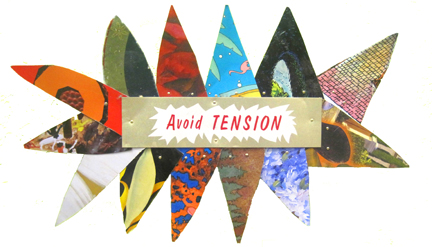
"Avoid Tension" by Rand Carlson, whose work is on display at Bohemia: An Artistans Emporium, 2920 E. Broadway.
Dave Devine brings us a bulletin from yesterday's meeting of the finance subcommittee of the Citizens' Water Advisory Committee:
Tucson Water customers—including those who live outside the city limits—may soon see a bump in their water bills to help bail out City Hall’s financially strapped general fund.As an enterprise utility, Tucson Water must generate enough revenue to pay its own expenses.
But as an agency of the city, the utility does not pay property tax on land and buildings owned by the company.
That may be about to change. At its Jan. 27 meeting, the finance subcommittee of the Citizens’ Water Advisory Committee (CWAC) recommended raising water rates substantially next year. This increase, in part, will be used to pay an in-lieu tax that would be imposed on the utility’s real property inside the city limits.
If that were done, approximately $1.6 million in new annual Tucson Water revenue would go to the city’s general fund beginning in July. That fund, which primarily pays for police, parks, and fire protection, is now projected to have a $23 million deficit before the City Council does more slashing in the next few months. Thus, if approved, the new in-lieu property tax would help the council bridge the shortfall.The subcommittee wasn’t unanimous in its support for the new tax. Some members thought it unfair to ask Pima County residents and businesses, who aren’t aware of the proposal but who are Tucson Water customers, to help solve the city’s general fund budget woes. By a 5-2 vote, however, the majority went along with the staff proposal.
The revenue-raising idea will next be presented to the entire CWAC committee and then make its way to the Tucson City Council.
Howie Fischer helps Owen Buz Mills make his media debut with a brief profile.
Like fellow GOP contenders John Munger and Dean Martin, Mills says there's no need for a tax increase in Arizona:
In an interview with Capitol Media Services, Mills specifically panned Brewer's idea of a temporary 1-cent hike in state sales taxes, a move the incumbent said is necessary to get the state through the recession without severe cuts in state services."We can't balance the books on the backs of the taxpayers," he said.
He does not have a specific plan for closing the gap between the approximately $6.3 billion in revenues this fiscal year and the more than $10 billion in spending. But he rejected the idea of borrowing money for operating expenses, a tactic even the Republican-controlled Legislature is using.
Mills said, though, there are programs and services the state should not be providing.
"We had a pretty free-wheeling time between '05 to '08 when we were flush with cash," he said. "And we committed ourselves to a lot of spending with the luxuries today we can't afford."
Those "luxuries," he said, include state-funded full-day kindergarten. Mills said most school districts offered it before 2006 when the state was providing cash for only half-day programs, using either local taxes or charging tuition to parents.
"The Legislature was rich with cash and said, 'Well, we'll pay for it,'" Mills said. "How dumb does that get to be?"
Wednesday, January 27, 2010
In our Sept. 6, 2007, issue, Margaret Regan wrote a story on Maurice Grossman, who died last week at the age of 82.
Here it is in its entirety.
———————————————————————
Maurice Grossman, Tucson's Mr. Ceramics, never intended to be a potter.
The founder of the UA's ceramics program way back in 1955, Grossman started out as a painter, studying watercolor and commercial art at Detroit's Wayne State University in the 1940s.
"But I fell in love with clay," he said one day last week, surrounded by 30 of his favorite pieces. "Clay took over my life."
That may be an understatement.
Grossman last Saturday opened a mini-retrospective representing a half-century of his ceramic work. Officially called Maurice Grossman: Along the Way, the retired professor jokingly renamed it Maurice's Pieces, because it exhibits the art he's kept—and lived with—in his home and studio.
"It's great to dust them off and make a show," he said. "This is a 50-year Tucson journey in clay."
And more than that, the show is "a history of ceramics" in the second half of the 20th century, said Dinnerware executive director David Aguirre. A ceramic artist himself, Aguirre said that Grossman helped transform the medium in the 1950s and 1960s.
The exhibition is the first at Dinnerware Artspace, the new Congress Street digs of the nonprofit formerly known as Dinnerware Contemporary Arts. Now in its 28th season, the gallery is making yet another new beginning.
After getting kicked out of the Steinfeld Warehouse at the end of July, Dinnerware has reconstituted itself in a former office space recently vacated by an architectural firm. Aguirre said the new Artspace hopes to run lectures, operate phantom galleries in empty storefronts and generally be a good, arty neighbor in what he hopes will be a revitalized downtown. A small gallery two doors up will exhibit emerging artists (the current show is a mixed-media installation by Iris Hutegger).
"I saw a sign that called this the Congress Street District," he said. "I want Dinnerware to change that to the Arts District."
Timed to coincide with Grossman's 80th birthday this month, Along the Way is a good match for Dinnerware's latest venture. In fact, the theme of both gallery and show could be reinvention.
The exhibition chronicles Grossman's changing techniques, as he shifted from early functional pots made on the potter's wheel to free-form sculptures that just happen to use clay as a material. Grossman had fairly traditional training, getting an MFA at Ohio State and studying in the summers at Alfred University, famed for its industrial bent. Ohio State was more aesthetically oriented, he said, but the ceramic studio was in a factory, and many grads went on to careers in industrial ceramics.
The oldest piece in the show, "Acrobats," from 1956, was inspired by practical wares used everyday. A tall, functional vessel, complete with a lid, it was made on the traditional potter's wheel. Its aesthetics, though, owe more to Grossman's 1954 Fulbright year in Japan than they do to the robust industry of Ohio. Toned in an Asian earth palette of beige and brown, the piece is etched with stylized dancers in dark brown cavorting around the pot's curves.
The most recent work, "The House Within," from 2004, is worlds away, in form, color and intention. No wheel was used: Grossman shaped slabs and coils of clay with his hands and created a shape that has nothing to do with a traditional pot. A small solid house, deeply colored in blue, is set inside a clay latticework that traces out a larger house. With its allusions to home and psyche, "The House Within" has metaphorical ambitions far beyond the ken of the simple functional pot.
Groundbreaking Los Angeles clay artist Peter Voulkos helped incite Grossman's clay revolution.
"He was a great inspiration," Grossman said. "He was breaking down the rules about pottery as a craft, and going into sculpture. He was an eye-opener. I started going into constructed pieces, using slabs of clay, and getting away from the wheel."
But Grossman felt free to mix his techniques, too. In between "Acrobats" and "House Within" are all manner of pieces, some of them solidly in the wheel or free-form camp, others hybrids treading the boundary between the two extremes. Quite a few are the result of a mixture of techniques, pairing wheel-thrown shapes with slabs of clay or forms created in molds.
"Owl," from the early '60s, is a whimsical abstraction of the nocturnal bird, in the quiet browns and beiges of earthenware pottery. But the owl's body was made in a mold, and the pedestal was thrown on the wheel.
With "Pagoda," made a few years later in the mid- to late-'60s, Grossman was still mixing techniques—this time wheel-throwing and slab—but he was ratcheting up his colors. The multi-layered architectural piece, with roof edges evoking a Japanese temple, abandons earth tones and veers into yellow.
By "Moon Shot," an early '70s work commemorating the 1969 moon landing, Grossman was reveling in a painterly palette of blue-purple and silver, tracing out glittery, wavy lines across the face of his moon. And the surface of the work was no longer sedate. Little bumps erupt all over.
Ceramic traditions from around the world also turn up in Grossman's art. He's traveled widely, to India, Mexico, Greece and Bali; everywhere, he finds himself "sucking up the energy and taking it home." He became a Buddhist during his time in Japan, and his works have had a spiritual dimension ever since. African textiles turn up in "Shaman Box," a tall, solemn work etched with geometric designs in ochre, brown and red.
The "overwhelming" stone shrines of Bali made their way into a series of upright pieces that radiate a quiet spiritual strength. He had a need for such clay shrines in the late '70s. His wife, Marilyn, died young of a stroke in 1979, leaving him with two children to raise. Her death also led him on a quest to create a vessel where he could put her ashes to rest.
Enamored with raku, a firing technique that leaves the clay burned and blackened, he made his late wife a modified sphere, scorched by fire and torn on the sides. A subsequent urn series allows space for the living to store ashes as well as letters to their dead. But even some of these demonstrate Grossman's famous playful side.
"Winged Box," a funerary pot in two sections, is "for people who don't want to be together," he said. And "Moon Dog," from the 1990s, represents a happy memory from Grossman's time as a single dad. At left is a crescent moon in profile, and at right is small dog talking to it. It came, he said, "out of stories I made up for my kids."
At almost 80, Grossman is still beloved by legions of former students, and he's a reliable supporter of artists in town, invariably turning up at openings and contributing his works to galleries big and small. And he's still working, lassoing ideas from all over the universe.
"Whenever I'm short of ideas," he said, "I go steal from the Tang dynasty."
We were unable to get this into the Tucson Weekly before going to press:
The memorial service for Maurice Grossman is going to be at 5:30 p.m., Sunday, Feb. 7, at the Tucson Museum of Art.
In this week's issue, you'll find a story about Maurice in our special pride section, and later today, we'll have a bit more online.
Tuesday, January 26, 2010
The latest bulletin from Rep. Steve Farley:
Howdy, Friends O'Farley…It's been a quiet week in State Wobegon...
Actually, it has been anything but a quiet week. More legislators are declaring their intentions to run for more offices, committees are pumping out some really suspect bills, House Republicans are trotting out their corporate-bailout deficit-expansion package, teachers and historic neighborhoods are under attack, rumors of yet another Special Session are in the air, and the Republicans are still not willing to work with Democrats on budget solutions.
But there is some good news.
First, one of the best U.S. Transportation Secretaries we have ever had, Ray LaHood, put in to effect today a ban on driving while texting for all interstate truck and bus drivers. Violators will be fined $2,750, so our roads will be a little safer as of today. I will fill you in on our latest efforts to ban DWT in AZ in a couple of weeks.
Second, in even better news, the efforts of the payday lending industry to stave off their imminent demise have failed
After the jump is a wonderful Arizona Public Media interview that ran last night about artist and LGBT activist Maurice Grossman, who died last week at age 82. The Tucson Weekly looks back at Grossman's life in our quarterly Pride issue this Thursday.
After speaking to a few people who knew Maurice well, I'm left wishing I had had a chance to count him as a friend or even an acquaintance. I first met him when I went to cover a Stonewall Democrats meeting. I saw him in action at a Pima County Nucleus Club debate. He let them have it.
The last time I saw him was last fall when he officiated a friend's wedding up in the hills near Vail. He had me in tears. It was one of the most beautiful weddings I ever attended. At the end, my son and I went up to him and introduced ourselves. We were up on one hill over looking the Empire Valley and Davidson Canyon. At the end of the ceremony we needed to walk down a rocky path and go up another hill for the reception. He asked if we could help him out a bit and figure out where we were all going.
My son took one elbow, and I took Maurice's other, and we talked a little. The conversation wasn't life-changing; it was just a little moment. But now, as I look back at that wedding, the people we met that night, and remembering Maurice's ceremony and blessing on my friends, I'm glad I had a chance to meander with him from one hill to the next.