
Friday, December 31, 2010
On Wedesday, Jan. 5 at 7 a.m., Bruce Ash will be hosting a debate about SB 1070's effectiveness at curbing illegal immigration.
Arguing for 1070 is Sen. Frank Antenori, and arguing against the bill will be Rep. Steve Farley.
The debate is part of the Off the Record Debate series. The cost is $40 per debate or $110 for the remainder of the season.
The Arizona Inn is located at 2200 E. Elm St. Breakfast will be provided from 7 to 7:30 a.m., and the debate will run from 7:30 to 8 a.m.
For reservations, e-mail David Foster at [email protected].
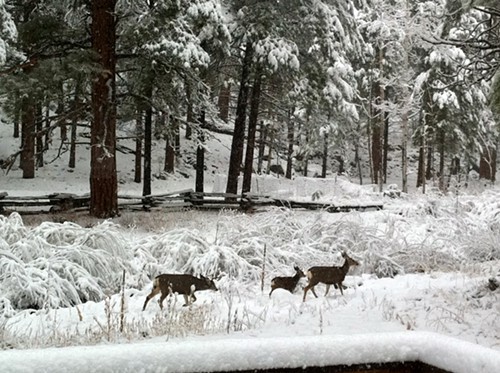
Well, it's cold outside, but I'm still waiting to get buried under all that snow that's supposed to be headed our way. In the meantime, here's a snowy pic I took up in Flagstaff last week as a family of deer trotted across the Hard Ranch's corral.
Happy New Year, everyone!

I sure do love the photos of Mars taken by the UA's HiRISE camera. Here's a final shot of a crater in light-toned layered bedrock south of Oyama Crater.
You can find more HiRISE photos here. And if you really dig them, you can order a 2011 HiRISE calender here.
HiRISE team member Livio L. Tornabene tells us about how the above image was created:
Who wants color? My preferred HiRISE color product uses all three color bands (i.e, wavelengths) that HiRISE can image — IRB, which refers to Infrared-Red-Blue/Green. Ever heard of R-G-B (Red-Blue-Green)? These three primary colors essentially combine to make all the perceived colors that we know of.By substituting a wavelength that is normally invisible to the human eye for one that is, like infrared for red, we are able to create a "false"-color image. The infrared is useful because its sensitive to iron-bearing minerals and their oxidation state (degree of "rusting"). Ferrous iron, the more oxidized variety, is what makes Mars so reddish. Basically, most of the materials on Mars are pretty oxidized/rusted, and therefore altered from the more original ferric iron state (the less oxidized iron common to volcanic minerals such as olivine and pyroxene). So in general, the bluer the materials in our IRB images the less
Grab your children and your cameras, as World War III is on the way for 2011.

At least that’s one of the predictions that kept popping up while researching the 10 worst things in store for the new year.
Psychic Linda Monroe, who claimed to have predicted a plane flying into a “Major City and lots of falling debree” on Sept. 11 and the equally accurate “death of a famous British male actor in 2001,” even says the next world war will involve weapons that shoot out “microwave type beams.”
Eek. We’ve all seen what happens to Peeps in the microwave. Imagine what happens to people.
But that’s OK, as Catholic Planet says at least the Big Apple will be spared from being microwaved as New York City is instead going to be hit by a nuclear bomb.
To make matters even scarier, the nuclear bomb attack is likely to be controlled by computer hackers, who already mussed up some Iranian top-secret stuff.
Yes, hackers and their malicious computer viruses will hit the 2011 scene with a vengeance, says MSNBC.com, going for bigger and more widespread mayhem. Reducing our personal little machines to expensive paperweights, like one did to my laptop last month, was just child’s play.
Computers are not the only thing that will be felled by viruses, as a sickness and death promises to infect living things as well.
Tags: 2011 predictions , new year predictions , worst predictions , ryn gargulinski column , new year promises
Thursday, December 30, 2010
What gives? The National Weather Service basically assured me that I’d be frolicking in a winter wonderland by now? Where are my winter flurries? Hello? Is anyone even listening?
Furthermore, I have been taunting nature all day, to no effect. I drank cold Coca Cola on a street corner just after sunrise. I walked around in a T-shirt while the rest of city bundled up against the low temperatures. I even went and bought two pints of gelato and ate it with my hands on what was supposed to be a severely cold day. And yet the sun came out, with no sign of snow on the horizon.
This is a major disappointment. If anyone needs me, I’ll be taking an ice bath until I either pass out or see some snowflakes.

Meet Ivan Lucchina, general manager of Allegro: Il Gelato Naturale at 446 N. Campbell Ave., Suite 120. He moved here all the way from Italy to make gelato and sorbet for you. He has cool rotating display cases and two degrees from Carpigiani Gelato University.
The fruit flavors are made with 50 percent fruit and actually taste like what they say they are. Flavors like carrot and fennel stand out against more traditional flavors like tiramisu and chocolate. There are 24 flavors in all, and Lucchina uses natural ingredients to make it all right there.
The interior design consists of cute little orange stools, glass tables and LED lights all over the place. It sparkles with an operating room’s cleanliness, and those rotating gelato cases give it a space-age feel. It’s smart, clean and hip and a very welcome addition to the offerings in the UA area.
Prices range from $3.50 to $5, and a pint to go is $10. There’s coffee, hot chocolate and other stuff. Hours are 10:30 a.m. to 10:30 p.m., Sunday through Thursday; and 10:30 a.m. to midnight, Friday and Saturday.
Call 207-1991 for more information.
(On a side note: I couldn't wait until I got home to try the tiramisu stuff, so I started spooning it into my mouth with my fingers on the drive home. I had to stop myself when I realized I was licking my hands like a crazy person at the stoplight at First Avenue and Grant Road. A woman in a blue coat looked at me from the crosswalk with a disgusted look on her face. Undeterred, I dug into the other pint of mango. Warning: This stuff is really freaking good. That is all.)
A new sushi restaurant called Sushi Cortaro opened this week at 8225 N. Courtney Page Way, in Marana. It’s in the same weird strip-mall thingy that houses the sole Tucson-area location of the national chain eatery Native New Yorker.
Hours are 11 a.m. to 10 p.m., Monday through Thursday; 11 a.m. to 10:30 p.m., Friday and Saturday; and noon to 9:30 p.m., Sunday. Call 572-8668 for more information.
From Tucson Velo:
The Tucson Police department was awarded another grant for targeted enforcement of bicycle and pedestrian laws.According to an email from Sergeant Jerry Skeenes, who ran the targeted enforcement that wrapped up in October, they will begin deploying officers in early January.
Skeenes said this enforcement campaign will be less intense because it will stretch over a longer period of time.
Tags: tucson velo , tucson bicyclists , tucson pedestrians , tucson police
Michael P. McDonald writes at HuffPost that Arizona's war on illegal immigration might have cost the state three-quarters of a billion dollars:
The federal government uses these population counts to distribute federal dollars to the states. According to Andrew Reamer at the Brookings Institution, in 2008 the federal government distributed $866.5 billion in funds to the states based on the census population counts. Your state gets its share of the federal pie based on the number of people that are counted by the census. If there were $866.5 billion in funds to disperse in 2010, each person would be worth $2,807 in federal money to your state.Note that I say "people" not "citizens." This is where Arizona may have lost as much as three-quarters of a billion dollars annually in federal funding. The Arizona state government could have easily put this money to good use, as according to the New York Times, the state faced a $2.6 billion shortfall in fiscal year 2011.
I come to this conclusion by comparing what the Census Bureau expected Arizona's population to be and what it really was — or at least who was counted. Throughout the decade, the Census Bureau demographers estimate each state's population. The most recent estimates give a sense of what the Census Bureau thought the April 1, 2010, population of Arizona would be.
So, the Census Bureau demographers projected Arizona's population to be 6,668,079 but the actual number was 6,392,017 or 276,062 fewer people than what the Census Bureau expected to find. This was the largest shortfall of any state in absolute numbers. Since Arizona is a
With 2010 wrapping up, it's easy to get to the point where you want to hear any good news about the economy at all, so the mildly positive information in the national unemployment claims announcement today is welcome, but it's a little early to start singing "Happy Days Are Here Again":
For the first time in more than two years, the number of Americans filing for their first week of unemployment benefits fell below 400,000 last week — a ray of hope in the one of the longest job droughts in U.S. history.The number of initial claims fell to 388,000 in the week ended Dec. 25, down 34,000 from the week before, the Labor Department said Thursday.
The report marks the first time claims have broken below 400,000 since July 2008 — two months before the financial crisis peaked with the Lehman Brothers bankruptcy.
"It's impressive to finally see unemployment claims fall below 400,000," said Stuart Hoffman, chief economist with PNC Financial Services, who said that if there were a magic number for unemployment claims, 400,000 would be it.
Though the figure is seasonally adjusted, Hoffman said the data can get distorted around the holiday period, and this week's number included the Christmas holiday.
"We need to see more evidence over the next few weeks, particularly in the early part of 2011, to know that this is a real downside breakout and fewer people are getting laid off," Hoffman said.
While it's just one component of a healthy job market, Hoffman said a downward trend in first-time unemployment claims would be a "major accomplishment."
Tags: unemployment claims , the economy , cnn , stuart hoffman