

Tuesday, January 13, 2015
The four design teams selected as finalists to create a permanent memorial commemorating the Jan. 8, 2011, shooting victims, families and the community's response to the tragedy are in town today, and they want to hear from you.
They're not here to present their design ideas, but to talk to us and get inspired. That constant community involvement has been at the forefront of the entire collaborative process between the January 8 Memorial Foundation and the Tucson Pima Arts Council.
"This tragedy affected every single person who lives in this city, everyone remembers exactly the place where they were at the time of the shooting," said Michelle Crow, the foundation's manager. "We feel it's very important that this be very open, for people to share their ideas, express their concerns, feelings. Ultimately, all those things help inform artists and designers."
The teams will be at the Arizona History Museum, 949 E. Second St., to chat with the public from 5:30 p.m. to 7:30 p.m.
This is the second stage of the design competition that started after summer last year. In the spring, designers are expected to present their ideas to Tucson, and then the selection panel will choose the final design team after a 30-day open public comment period.
The final team will also be heading the remodeling of El Presdio Park, where the memorial will live.
The four finalists:
Tags: January 8 Memorial Foundation , Tucson Pima Arts Council , El Presidio Park , Pima County Courthouse , Tucson , January 8 , 2011 , shooting , Gabby Giffords , design , Chee Salette Architecture Office , HOK , Chicago , Ibarra Rosano , Logan Simpson Design , Arizona History Museum , Michelle Crow
In her first week in office, Southern Arizona Congresswoman McSally voted with her GOP colleagues to advance a number of measures, including HR30, which would change the definition of a fulltime worker for the purposes of the Affordable Care Act from 30 hours a week to 40 hours a week.
That legislation puts two of McSally’s campaign promises at odds with each other. She had pledged to work to undo the Affordable Care Act but also bring federal spending under control. While the vote would bring changes to the ACA, the Congressional Budget Office estimated that it would cause a million Americans to lose their company-provided health insurance while expanding the deficit by nearly $54 billion over the next 10 years. The CBO forecast suggested that at least a half-million of those who lost their employment-based health insurance would end up being insured by Medicaid, at least in states that have expanded Medicaid under the ACA.
The Obama administration announced that the legislation was headed for a veto, should it pass Congress. The official statement from the White House said, in part, that the legislation “would significantly increase the deficit, reduce the number of Americans with employer-based health insurance coverage, and create incentives for employers to shift their employees to part-time work—causing the problem it intends to solve.”
McSally spokesman Patrick Ptak said McSally believed revising the ACA’s mandate would help employers avoid cutting hours for their workers.
“The 30-hour work week provision in Obamacare could have drastic effects on workers, significantly reducing their hours and wages,” Ptak said. “With workers already struggling throughout Southern Arizona, the last thing the government should be doing is incentivizing cutting their hours. The bipartisan bill passed in the House last week restores the work week to a more accurate 40-hours and allows employers to focus on hiring more workers instead of paying more in Obamacare penalties.”
But whether the current law is leading to more part-time workers is an open question. The Center on Budget and Policy Priorities notes:
Recent data provide scant evidence that health reform is causing a significant shift toward part-time work, contrary to the claims of critics. The number of part-time workers who would rather be working full time is shrinking. And there’s every reason to believe that health reform will have only a small effect on the part-time share of total employment.More important, raising the law’s threshold from 30 hours a week to 40 hours would make a shift toward part-time employment much more likely — not less so. That’s because only a small share of workers today — 7 percent — work 30 to 34 hours a week and thus are most at risk of having their hours cut below health reform’s threshold. In comparison, 44 percent of employees work 40 hours a week, and another several percent work 41 to 44 hours a week. Thus, raising the threshold to 40 hours would place many more workers at risk of having their hours reduced. In short, it’s the present legislation, not health reform, that threatens the traditional 40-hour work week the legislation’s sponsors say they want to protect.
However, the U.S. Chamber of Commerce supports the GOP's legislation:
The Arizona Craft Brewers Guild and local breweries like Dragoon have been soliciting Facebook followers and fans to sign a petition for the Arizona Beer Bill. The bill is looking to increase the current production limit placed on brewers so Arizona beer makers can try to compete with other breweries nationally.
Here's what the petition says in part:
The Arizona Beer Bill allows microbreweries to grow beyond the current 40,000 barrel limit without having to forfeit retail licenses they hold or let go employees. Doing so will promote growth in the industry while strengthening the three-tier regulatory system. The current microbrewery limits should be refined to reflect the incredible growth of this industry and the enormously positive economic impact of microbreweries. The Arizona Beer Bill ensures that microbreweries will not be penalized for their success.
According to the Arizona Beer Bill website, the bill's opponent is the Arizona Wine and Spirits Wholesale Association, which includes three of the state's beer, wine, and spirit wholesalers:
The AWSWA has cited concerns about how the bill would affect the integrity of the three-tier system, a concern they did not have when changes to the system last year positively affected farm wineries and microdistilleries, local industries that both the Guild and BWDA fully support.
If you're interested in signing, you can view the petition online. Initial voting on the bill is likely to occur in late January or early February, according to the bill's website.
Tags: arizona beer bill , arizona craft brewers guild , beer , arizona , tucson
One of the judges hearing the case cited a recent study concluding that students who took Mexican American Studies courses had greater increases in achievement and higher graduation rates than similar TUSD students who didn't take the courses. The lawyer for the state questioned whether the study was accurate, referring to the "purported effect" of the courses, but went on to say student achievement is irrelevant. Even if student achievement increased, that doesn't matter in this case.
One of the judges asked whether there's a problem with a class teaching students about their ethnic heritage and developing their sense of ethnic pride. The answer from the lawyer representing the state:
“I’m not sure it’s the purpose of the public school system to inculcate ethnic pride. I don’t know that there’s a constitutional right to classes that inculcate ethnic pride.”
To sum up: If the Mexican American Studies courses succeeded in increasing student achievement, but they violated a law that was created to make the courses illegal, the courses have to go. And if those same courses increased students' motivation to work hard in school by educating them about their history and culture (recent research has emphasized the huge role motivation plays in student achievement), but they violate the same law that was created to make the courses illegal, the courses have to go.
Is it any wonder the judges suspect the law "is intended with discriminatory intent," and the lawyers arguing against the law feel optimistic about their chances?
We've got an interesting scenario developing here. On the one hand, TUSD has until March 4 to make a deal with Ed Supe Douglas to keep her from deciding that the current Culturally Relevant Curriculum violates state law. On the other hand, the 9th Circuit Court could overturn that law, taking away Douglas' main weapon in her fight with TUSD. The district has every reason to say to Douglas, "We need to wait for the court's decision before making any changes to our current ethnic studies curriculum."
Tags: Mexican American Studies , 9th Circuit Court , TUSD , Ethnic pride , Student achievement
The hearing will decide the college's accreditation status, which has been on probation for the last two years following accusations of corruption at the top level. The college is expected to be pulled from probation, based on a recommendation filled after a recent visit to the college.
The college has seen many changes in the years since the issues arose, including a new leader in Lambert, two new faces elected the the governing board, and many new systems to protect employees and benefit students.
While these changes seem to have impressed the HLC visitors enough to recommend Pima be taken off probation, they did note that many of Pima's programs are still very new, and it will take time to see of they truly are working as well as they need to be. Pima will likely be taken off probation, but put On Notice—basically meaning the college's accreditation won't be in jeopardy, but the HLC will be following the college's progress closely.
This year will also mark the departure of CJ Karamargin, the PR guy lead Pima though several tough years in the public eye.
Here's hoping for good things in Pima's future. Affordable, quality education can only lead to good things.
Tags: Pima Community College , Lee Lambert , Institutional Actions Council Hearing Committee of the Higher Learning Commission , HLC , PCC
Monday, January 12, 2015
As reported earlier, Tucson Unified School District students Maya Arce, Korina Lopez and Nicolas Dominguez, as well as their attorneys, were down at the 9th Circuit Court of Appeals in San Francisco today making a case against A.R.S § 15-112, the law that pretty much made the Mexican American studies program illegal.
One of the minds in the students' defense team, Anjana Malhotra, who is formerly a clinical teaching fellow at the Korematsu Center and is now an associate professor at SUNY Buffalo Law School, said, in summary, that they did well.
"They were concerned that the law was enforced regardless of the positive effects on students," she said during a phone call a few hours after leaving the courtroom. The law got rid of MAS classes, "which accelerated students' achievement, and officials who enforced the law knew that it had positive results. Also, there is a disproportionate impact on a minority Mexican American community, the law creates this disproportionate impact, how can that not be evidence of discriminatory intent?"
From an email Malhotra wrote to me in the evening:
In defending the Arizona ethnic studies ban passed for the purpose and effect of exclusively targeting and eliminating the highly successful TUSD’s Mexican American Studies classes, Arziona made three major points in the Ninth Circuit argument today that undercut its argument that the law and its actions were unconstitutional.A huge question at the hearing was, if one portion of the law is invalidated, does that mean the entire thing is thrown out?
First, Arizona repeatedly argued that the substantial academic achievement Mexican American students gained from taking MAS classes was “irrelevant” to the facial and as-applied equal protection claims. To the contrary, and as the Judges correctly raised in questioning Arizona, the fact that the Arizona Legislature and Huppenthal exclusively eliminated classes that benefited Mexican Americans, and thus burdening Mexican Americans exclusively, is evidence of intentional discrimination supporting the argument that the statute and its enforcement violated the equal protection clause of the Fourteenth Amendment.
Second, Arizona argued that a Chinese American History class would violate the statute, regardless of content – demonstrating the impermissible and sweeping overbreadth, vagueness and equal protection problems with the law. This proposition gave the Court and the audience pause—and demonstrates how the statute gives the state unlimited power to enforce the law (and did) in an arbitrary and discriminatory manner violating the Supreme Court’s test for facial and as-applied vagueness. Further, given Tom Horne's and legislators’ express insistence that ARS 15-112’s use of the term “ethnic group” did not include to white or European ethnic groups such as Greeks and Romans, Arizona’s contention that it would ban Chinese American History, just as Mexican American classes regardless of content, establishes that the statute and enforcement is in direct violation of the equal protection clause of the Fourteenth Amendment by discriminating on the basis of race.
Malhotra said that if, for instance, the portion of the law banning classes for particular ethnic groups is found to be overbroad, then the entire law would be invalidated—the law doesn't have a clause stipulating that if one portion is invalidated, the rest of the law still survives. So, the team doesn't have to prove that ALL guidelines of the law are unconstitutional, but at least one of them is.
"Equal protection claims are hard because you have to show intentional discrimination, but it works well here because you have to show a law or government action was taken to single out a particular group, and that is exactly what this statute did," Malhotra said.
So, good news? We won't know for a while. In the mean time, TUSD still has to deal with the state saying its teachers are not implementing the culturally relevant curriculum in a Superintendent of Public Instruction Diane Douglas kind of way. If that's not fixed, the district faces more budget cuts.
Tags: TUSD , 9th circuit court of appeals , san francisco , mexican american studies , students , Anjana Malhotra , Maya Arce , Korina Lopez , Nicolas Dominguez , Arizona
In his State of the State address, Gov. Doug Ducey promised a new approach to government: “These next few weeks, we could all use the fresh outlook of newcomers, not trapped in the old ways of thinking about state spending, taxes, public education and the role of government in general. In government, just as in business, settled assumptions are not always correct assumptions. Conventional wisdom is not always wisdom.”
But he also stuck by a bedrock GOP article of faith: Taxes hikes are always bad. Ducey reiterated his opposition to new taxes or delaying planned corporate tax cuts that are projected to cost the state hundreds of millions of dollars as a way to address the state’s projected billion-dollar shortfall in the upcoming budget year. He also called for an income-tax cut of sorts, by pegging Arizona’s tax brackets to inflation. (Lawmakers passed a bill to do that last year, but Jan Brewer vetoed it.)
Ducey said he would look to cut state government to deal with the red ink, with the details coming when he releases his budget this Friday, Jan. 16.
Ducey called for a few other hard-to-argue-with initiatives in his speech—chasing down more deadbeat dads, reviewing the state’s regulations, volunteering at soup kitchens—but he put most of the emphasis on education: He wants get more money into the classroom, settle the lawsuit between schools and the Legislature over school funding, and make sure kids to learn basic civics.
Ducey also offered the idea of an “Arizona Public School Achievement District.” Details on the proposal remained sketchy as of our deadline, but the general idea is to allow successful public schools to use classrooms or entire shuttered schools.
We’re intrigued by the idea, but wonder how it’s going work. Would charter schools be able to open in closed public schools? Would they have to pay rent? Who covers the cost of utilities? Are principals at traditional schools interested in opening up branch campuses in certain classrooms of underperforming schools? This could be an innovative idea, or it could be a giveaway to charter-school owners. We won’t know until we see the details.
The lack of details also struck state Rep. Bruce Wheeler (D-Tucson), who said the speech was short on specifics.
“It was a pretty speech with no details,” said Wheeler, the Democrats’ assistant minority leader. “We’ll have the details on Friday and then we’ll see. … He wants to reach across and we’re willing to work with him where we can, but I don’t see how he’s going to accomplish what he wants without further cuts to education and the universities. What plans does he have for vouchers and how much of that will be at the expense of public schools?”
You can read Ducey's entire speech here.

The brand new bar in Reilly Craft Pizza's basement has been open less than two weeks, but is already creating a buzz around town. With a four page craft cocktail menu filled with inventive drinks, the bar has been packed most nights since it's opened.
However, the team at Tough Luck Club is hoping for an especially busy night on Wednesday, Jan. 14 because they're hosting a fundraiser to help out fellow bartender Erick Evans. The Scott & Co. employee tore his ACL at work and will be out of commission while it heals which unfortunately means no income.
TLC bartender Niklas Morris says he and Stephen Ott will be behind the bar at TLC on Wednesday night mixing up one of Evans' specialties: the Messi Situation. The proceeds from that drink, which combines cachaça, Fernet, Averna, and cinnamon, will go to Evans, as well as 100% of the two working bartenders' tips from that night.
You can stop by the bar from 5 p.m. until 2 a.m. on Wednesday to donate to Evans.
Tags: tough luck club , benefit , erick evans , bar , tucson , craft cocktails , niklas morris , Image
Today the U.S. Supreme Court heard arguments in a First Amendment case involving a small Gilbert church and the town's sign regulations.
These rules say directional signs can be no larger than 6 square feet, and they must be removed in the next 14 hours. By contrast, signs for political candidates can be up to 32 square feet and tend to remain in place for months.
The Clyde Reed of Good News Community Church is fighting that, because others, such as political candidates, do not have the same guidelines.
From a Becket Fund for Religious Liberty, a nonprofit, public-interest law firm that aims to protect "free expression of all religious traditions," press release:
Small houses of worship such as Good News Community Church rely on signs to invite people in the community to their service, since they have often do not have a permanent location and have limited means to share their message. Now they face fines and possible jail time for practicing their freedom of speech.
“The court should not let Gilbert get away with the excuse that it was ‘just chance’ that it treated churches much worse than political or commercial advertisers,” said Eric Rassbach, deputy general counsel of the Becket Fund for Religious Liberty, in a statement. “Gilbert’s rules don’t treat people equally, and that violates the First Amendment.”
From The Associated Press:
The National League of Cities and other associations of local officials are backing the town and warning that a ruling in favor of the church would make it "nearly impossible" for cities and towns to craft sign regulations that deal with a community's appearance and safety.
Tags: Gilbert , Arizona , religion , US Supreme Court , First Amendment , religious freedom , Clyde Reed of Good News Community Church
When you first walk into the brand new Street Taco and Beer Co. off of Congress Street north of Church, you can't ignore the similarity between the new locally-owned joint and the national chain Chipotle. After all, the light reclaimed wood and metal look is ever-present in both restaurants. While the big guys pretty much invented the term fast casual, initial tastes of the new downtown taco joint hint that the local guys can actually do it better.
If you've ordered at a Chipotle, you'll feel at home at Street Taco, which opened to the public today. A long line formed around lunchtime, nearly going out the door. However, the team behind the counter efficiently busted through orders meaning diners didn't wait longer than about five minutes in line.
The menu offers single street tacos with flour or corn tortillas for $2 to $3 and burritos for about $7 with al pastor, carne asada, pollo asado, carnitas, and veggie options. The restaurant also serves nachos, quesadillas, hot dogs, and $1 to $2 sides like beans, rice, elote, and calabacitas.
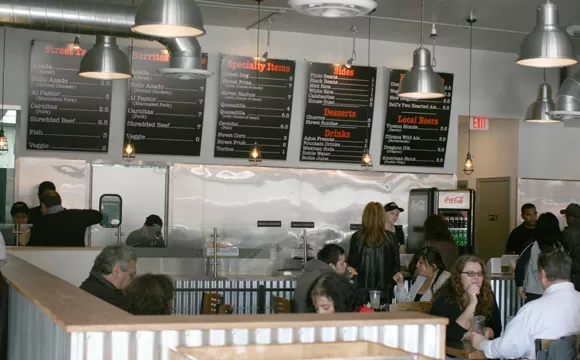
While the menu and restaurant are set up unmistakably similar to Chipotle, seeing meat and corn roasting on a spit in the back was the first sign that owners Dago Martinez and Amjaad Jhan were doing it better than their predecessor.
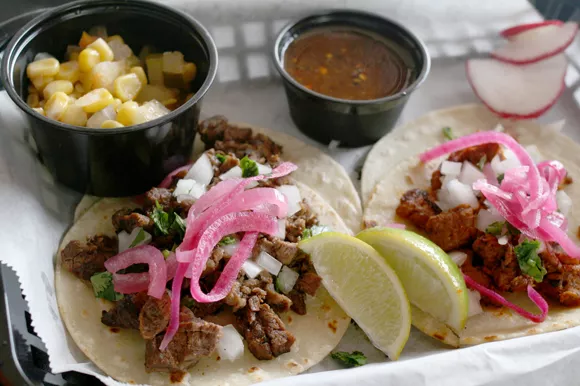
The next way Street Taco impressed was by offering free chips and a salsa bar—something that's additional if you opt for Chipotle instead. The salsa bar includes three red salsas, two green salsas, pico de gallo, pickled onion, fresh sliced radish, lime slices, and roasted jalapeños.
Once you take a bite, you'll notice well-marinated, flavorful, and tender proteins, grilled tortillas, and handmade sides. While the al pastor used spices to accentuate the meat, the carne asada showed simplicity and technique that let the meat sing on its own. Even the calabacitas were full of flavor in that salty, comforting way that they should be.
Despite being made on an assembly line, the food still has the soul and spice that Mexican cooking should have— especially after adding a few healthy dollops of the aptly labeled hot salsa.
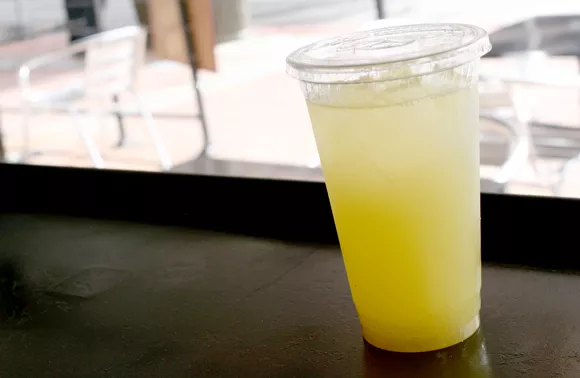
To cool off, the restaurant offers aguas frescas like horchata, jamaica, and piña with chunks of fresh pineapple. Street Taco also has a bar with local beer, draft beer, wine, and an array of tequila.
Overall, if you're looking for heat and authenticity, Street Taco has a lot to offer at comparable pricing to the competitors. Plus, the option to get single tacos, rather than a full meal, gives diners the choice to have a light lunch or to mix and match and create a taco plate.
You can follow the new restaurant via their Facebook page for updates and more information.
Tags: street taco and beer co. , tucson , new , restaurant , open , downtown , mexican , fast casual , dago martinez , amjaad jhan , Image

