

Friday, September 11, 2015
With Thursday's Senate vote, congressional opposition to the deal appears to be dead, although the some Republicans in the House of Representatives are considering suing the president.
Congresswoman Ann Kirkpatrick, who wants to challenge McCain next year, came out in favor of the deal earlier this week. Her statement:
After years of intense diplomacy, the Joint Comprehensive Plan of Action now provides a way forward. I’ve given the plan careful consideration, met with military and policy leaders, and listened to Arizonans across our state – and I have decided to support it. No approach to Iran is without risk, and the deal is not perfect, but the United States has an opportunity to lead the world on a historic and critical diplomatic course against danger and chaos.
Global conflicts and rapid change demand stronger and more durable protections for our nation and allies. The Iraq War took a tremendous toll on our country, and I believe we must do everything in our power, in concert with five of the world’s largest powers, to prevent a dangerous proliferation of nuclear weapons and a new war.
As an American and a supporter of Israel, I have backed tough sanctions against Iran, but now is the time to launch a new chapter of vigorous enforcement, oversight and accountability to prevent Iran from advancing its nuclear capabilities. I will remain vigilant and work to ensure that any violation of this agreement is met with a swift response from the United States and the international community. Our nation shares an unbreakable bond with Israel, so it is important that the U.S. also moves forward on long-term agreements with Israel that will strengthen and enhance their military capabilities.
I am grateful to the many Arizona constituents who provided thoughtful input on both sides of this important issue. This was a difficult decision, but ultimately, I will support this agreement because it blocks Iran’s path to a nuclear weapon, protects Israel and launches a historic diplomatic agreement that prepares us for the future in an increasingly volatile world.
Lorna Romero, McCain's 2016 campaign spokeswoman, called Kirkpatrick's support for the deal "dangerous and wrong":
With $9 billion in the state's general fund "and revenues increasing," Superintendent of Public Instruction Diane Douglas says Arizona can afford increasing funding to education. She's calling on the state Legislator and Gov. Doug Ducey to immediately appropriate at least $400 million that would specifically be invested on teachers in the classroom, according to a press release from Douglas' office.
The proposal is one of many Douglas plans to unveil during her "AZ Kids Can't Afford to Wait!" campaign.
“As I traveled the state during the campaign, and then for several months on my 'We Are Listening' tour, the number one concern I heard was the lack of funding and support for teachers,” Douglas said in a media statement. “After seeing revenues so far above forecasts just a few months into this fiscal year, I believe that Arizonans can no longer afford to wait to provide higher quality education to our children."
She suggests using Proposition 301 (in 2000, Arizona voters passed an initiative that allows for a sales tax to contribute to education funding. The money would go towards increasing teachers' salaries, reward "high performing" teachers, among other areas) to identify which teachers are "eligible recipients." The $400 million, she says, could be spent on teacher salaries, hiring more teachers to reduce classroom sizes, or a combination based on local needs.
“We don’t need court cases and lawsuits to fund our school system, we need commitment and leadership. I applaud the efforts of the Governor and the Legislature to increase overall funding and to focus on classroom spending. However, the 8-year-olds who were trying to read when the 'temporary' cut to the 2 percent increase was made in 2009 will all graduate or drop out before having their funding restored under all the current plans being considered," Douglas says. “We have an entire generation of children for whom over $1 billion dollars of education was not provided. We can never go back and provide that education to them. How many more children must suffer the same fate before the leaders of our state truly prioritize education?"
From the press release:
The proposal calls for $400 million from the general fund to be appropriated by the Legislature and the Governor in a special session. It does not count any current funding against that number, nor does it envision any changes to First Things First funding. If the Governor’s state land trust plan is approved by the Legislature and the people in some form, any land trust education revenues in excess of 2.5 percent would count toward the figure, so long as the State Treasurer verifies the expenditure would not deplete the corpus of the land trust.
The Superintendent will also be working with Arizona’s Congressional delegation over the next several years to return federal lands to our state, so that the state land trust corpus can grow through land use leases and the sale of new lands. However, the core of the proposal is that under any circumstances, the entire $400 million must be made available every year with no drop off in the future. Schools cannot hire teachers and make plans if they cannot count on having the money available.
Tags: diane douglas , az kids can't afford to wait , doug ducey , education , teachers
[Satire alert, in case anyone reading this thinks I'm being serious.]
The results are in, and the conclusions are clear. The Pew Research Center administered a test on science knowledge (you can take the test here), and it demonstrated a distinct difference in science knowledge based on people's age, gender and race. I've used those results to draw the following conclusions.
1. Science education in U.S. K-12 schools reached its peak during the years between 1980 and 2000. People between the ages of 30 and 49 earned the highest scores on the test, and they would have received their middle and high school science educations during the years roughly between 1980 and 2000. During those years, the Reagan administration's 1983 Nation at Risk report concluded that our schools were suffering from a "rising tide of mediocrity" and declared, "If an unfriendly foreign power had attempted to impose on America the mediocre educational performance that exists today, we might well have viewed it as an act of war." Peak science education continued through the post-Nation at Risk years when the improvement in our schools was said to be so minimal that we needed to impose a new educational model, No Child Left Behind, based on strict educational standards and yearly high stakes tests.
2. Science education in the U.S. has deteriorated since the advent of No Child Left Behind. People between the ages of 18 and 24, who received their middle and high school science educations since NCLB was passed in 2001, scored lower than people who went to school during the previous two decades. Whether that indicates a general deterioration of our schools or indicates that the increased emphasis on the tested subjects of reading, writing and math meant less emphasis on science instruction is unclear and will need to be examined further.
3. The worst time for post-World War II science education in K-12 schools was in the 1950s and 1960s, followed by the 1970s. The poorest performers on the test were people over 65, followed by people between the ages of 50 and 64.
4. More women attended failing schools and had poorly quality science teachers than men. Men scored higher on the test than women, indicating that women's science education was inferior to that received by men.
5. Science teachers in schools with predominantly African American and Hispanic students are inferior to teachers in schools with predominantly white students. Test takers who are African American and Hispanic scored lower than White test takers.
Someone better trained in statistics and polling than I may draw more sophisticated conclusions from this rich data source, but based on the quality of my analysis, the state's Department of Education should consider hiring me to help analyze the results of the AzMERIT tests.
Tags: Science test , Pew Research Center , AzMERIT test , No Child Left Behind
The folks who bring you such T.V.-based exclamatory oddities as Tim and Eric Awesome Show, Great Job! and Superjail! are touring the country this fall and Tucson's on the list of stops. Adult Swim is hosting a drive-in movie event at the Mercado San Agustin, and you're going to want to secure your spot soon.
The Adult Swim Drive-In isn't simply just screening re-runs of Children's Hospital (though that would be pretty cool, too), but, rather, showing off some unaired pilots and specials. Food trucks, trivia and prizes are all on the night's line-up as well, with vouchers for a free food truck meal handed out while supplies last. The AS crew recommends bringing your own blankets, pillows, chairs, slankets and blillows ... whatever that means.
All of that takes place on Saturday, Oct. 17 completely free. All you have to do is RSVP online via the Adult Swim website and you're good to go. It is an 18 and over event and is subject to capacity.
Until then, let's all take a moment on this lovely Friday to remember Adult Swim at its finest:
Tags: adult swim , drive in , movie , tucson , event , food trucks , mercado san agustin , Video
Story: A neatly dressed, well groomed 30-something man is standing outside a nice hotel in Manhattan, waiting quietly, a smile on his face. At the same time a sting operation is going down inside the hotel where the police are arresting some people who have been accused of identity theft. The man just standing there minding his own business is identified as looking like one of the people in the theft ring. Oh, and, by the way, the 30-something man is white.
How do the plainclothes officers outside the hotel respond? Do a few of them move in this man's direction, form a loose circle around him, show their police identification and tell him to put his hands up, then only take more aggressive action if he fails to comply? Or do they rush him without warning, pick him up, body slam him to the ground and cuff him? Either scenario is possible, but since he's only a suspect, not someone who they've seen commit a crime, since the crime he may have committed is a white collar, nonviolent crime, and since he's standing quietly in front of the hotel, I think good police work would mean refraining from the use of force unless it's necessary.
The incident I described unfolded Wednesday night in front of the Grand Hyatt Hotel in Manhattan, but one thing about the man is different than the way I described him. He's black. He's James Blake, the 35 year old tennis star who has retired from the tennis circuit but is still playing in the Champions Tour with the likes of John McEnroe and Jim Courier. When he was identified as one of the people possibly involved in the identity theft ring, he was waiting for a car that would take him to the U.S. Open where he was going to be interviewed. According to an interview Blake gave on ABC News, a plainclothes policeman wearing t shirt and shorts without a visible badge charged him.
"I saw someone from the street running directly at me. . . . He picked me up and body slammed me, put me on the ground, told me to turn over, shut my mouth, and he put the cuffs on me."Sure, it could've happened to any well dressed, 30-something guy standing quietly on the sidewalk outside a fancy hotel who the police thought had committed a crime, but the chances are far more likely that the aggressive take-down would happen to a black male than a white male who was similar in every way except for skin color. It can be dangerous to be Driving While Black, Walking While Black or Standing While Black.
Tags: James Blake , Arrest , Racism
Thursday, September 10, 2015
Until recently, The Feminist Wire—a pro-feminism, social justice publishing company—has exclusively shared content (from poetry and novels to political articles) online. Now, they're partnering up with the University of Arizona Press for a new book series that'll showcase critiques on anti-feminist representations in U.S. popular culture, media and politics.
The UA Department of Gender and Women's Studies plans to incorporate the book series into the classroom. The department is actually collaborating with the School of Journalism in developing an online master's program in social justice publishing, where students will learn about acquiring, editing, producing and marketing books, a press release from UA Press says.
"Activism. Policy work. Writing. The work that I do has always been about connecting to academic and nonacademic audiences," says Monica Casper, professor in the Department of Gender and Women's Studies and managing editor of The Feminist Wire, in a press release. "This partnership is just a logical extension of that. We are reaching across the university/public life divide."
There is going to be a celebration for the launch of this new project on Friday, Sept. 11 at noon at the UA Libraries Special Collections, 1510 E. University Blvd. Casper, co-founder of The Feminist Wire Tamura Lomax and Darnell Moore, senior editor at Mic will be among the speakers.
Tags: the feminist wire , university of arizona press , mic , social justice , feminism , monica casper , tamura lomax , darnell moore
Since Arizona doesn't have a statewide statute that protects lesbian, gay, bisexual and transgender people from discrimination in the workplace and other areas, several municipalities have taken it upon themselves to enact ordinances that prohibit discrimination in employment based on a person's sexual orientation and gender identity.
This week, Sedona approved an ordinance that protects LGBT people from discrimination in the workplace, housing and public accommodations, according to the American Civil Liberties Union of Arizona. Flagstaff, Tempe and Tucson also have similar rules in place.
Still, Arizona is among more than 30 states that the Human Rights Campaign has criticized for not having a statewide statute. In In the beginning of the year, the HRC put us in the "lowest performing category" in its "state equality index," because Arizona doesn't have an "explicit state-level workplace protections for all LGBT employees," there is inequality when it comes to the adoption process, employment benefits, not to mention a certain bill that made it to former governor Jan Brewer's desk that claimed to be protect "religious freedom," which would have allowed businesses deny service to LGBT people and others based on religious beliefs. Brewer ended up vetoing that last year, but mostly because major businesses threatened to cut ties with Arizona.
In September 2013, about a year before same-sex marriage became legal in Arizona, Sedona passed an ordinance that recognized same-sex civil unions.
Congratulations, Sedona.
Tags: sedona , lgbt , nondiscrimination , human rights campaign , arizona
Wednesday, September 9, 2015
Tens of thousands of words have been written about the Sun Tran strike, including in the Weekly and on The Range, covering it from all kinds of angles. Over at the Tucson Sentinel, Blake Morlock, not known as a man of few words, wrote 2,500 more in an article with the provocative headline, Subsidy express: Who gets a lift, and who does Sun Tran take for a ride? He comes up with some interesting answers to the question: Which riders get subsidized how much by Sun Tran?
Before I give you Morlock's figures, let's remember that public transportation is subsidized, almost by definition. It's a public service that's not supposed to pay for itself. And when we think "rider subsidy," we're most likely to picture people we see waiting at kiosks on Speedway or Alvernon or some other large urban street, lots of them low income. We don't think of the more well-heeled, less visible riders who use the system. But we should.
Here's what Morlock found. If you're looking for heavily subsidized bus lines, look at the routes that travel to and from the suburbs. For instance, an urban rider taking the No. 4 bus down Speedway is subsidized to the tune of $2.64, while a suburban rider on the Rita Ranch Express gets a $12.77 subsidy. The lowest subsidy Morlock lists is $1.78 per rider on the No. 11 that goes travels on Alvernon. The highest is — drum roll please — $25.98 per rider for the 202X from Oro Valley to Raytheon. That Oro Valley Raytheon employee who rides that express back and forth to work five days a week gets $259.80 worth of travel subsidized by the bus service.
Tags: Sun Tran , Bus strike , Tucson Sentinel , Blake Morlock , Fares , Subsidies
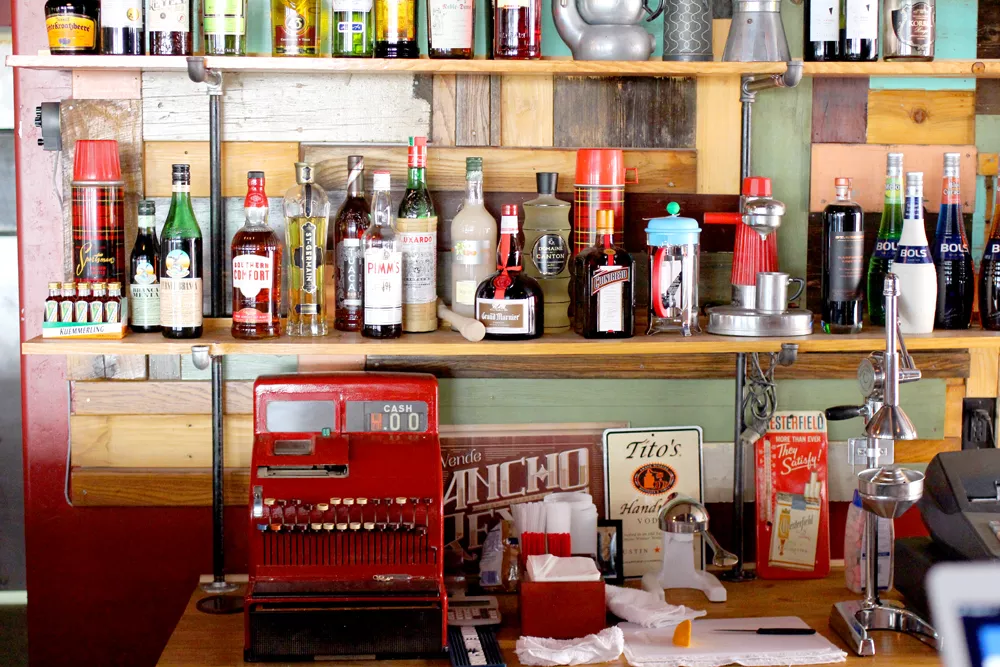
Saint Charles Tavern opened quietly last weekend on South Fourth Avenue to friends and Facebook followers. With a modest liquor selection, 18 taps and a growing bottled beer selection at reasonable prices, the new little south side bar is likely to become a go-to hang out for folks in the area.
The bar itself is set up pretty much like the kind of bar you could see yourself closing down regularly with a 100 CD jukebox full of classics and local favorites, kitschy decor, pool tables and a back patio area. The relaxed, but hip atmosphere comes courtesy of owners Elizabeth Menke and Churchill Brauninger who helped transform La Cocina into the beloved watering hole it is today. Now the couple aims to bring their aesthetic to a new part of town.
"This is the first time South Tucson has approved a bar in years," Menke says "There's a growing bohemian vibe in this neighborhood and we're hoping others follow in suit."
With a focus on beer, Menke admits Saint Charles Tavern isn't looking to be an upscale craft cocktail bar.
"We're not trying to shove mixology down people's throats," Menke says. "We'll focus on the classics."

And while a bar needs little more than nice folks, cold beer, a pool table and a jukebox to become a destination, Menke and Brauninger have much more in store for the space. After all, its previous iteration housed a bar, pizza place and convenience store before it closed.
The first of the changes will expand the patio, which already offers some seating and bike parking, into a 2000 square foot biergarten, complete with a stage for live music. Menke estimates that it will be ready in about two months. Menke and Brauninger are also on the hunt for an authentic shuffleboard table to add to the two pool tables they already have in the bar.
By next spring, maybe around May, the couple hopes to have the final stage of Saint Charles Tavern's plan completed—the kitchen. You can expect Southern-style comfort food like collard greens and mac and cheese from the menu. However, what's most important to Menke is a focus on simple, handmade freshness to the extent that she plans to have everything from mayonnaise to pickles made in house.
"It's not going to be a page turner—just a few items done right," Menke says.
For now, Saint Charles Tavern is serving up drinks at 1632 S. Fourth Ave. Sunday through Wednesday 10 a.m. until 12 a.m. and Thursday through Saturday 10 a.m. until 2 a.m.
More from inside Saint Charles Tavern:

Tags: saint charles tavern , bar , tucson , new , craft beer , pool tables , jukebox , southern food , biergarten , elizabeth menke , churchill brauninger , Image
The bus strike is in its fifth week, with no Teamsters Local Union 104/Sun Tran deal in sight.
The city of Tucson said in a press conference last week (and Councilman Steve Kozachik said in a press release) that it would not modify its budget to end the strike. The city's already established its finances for Fiscal Year 2016, which includes the money available for Transdev (France-based company that manages Sun Tran) and those figures are all they have to offer in terms of wages, etc.. In other words, they're saying they can't afford the Teamsters' demands.
(At the press conference, the city also reminded us that, by law, the city cannot intervene with negotiations.)
Sun Tran has been able to add more routes to its limited service, in part because there are about two dozen management and administrative staffers helping out, as well as 15 others from out of state, who were hired by Transdev recently, according to Kozachik. (Even though Sun Tran repeatedly denied they had temporary drivers on board.) "While I support their efforts to staff the positions needed to run the number of routes we have demanded, I also understand the level of concern the outside drivers are causing," Kozachik said in a press statement.
He proposed allocating the roughly $500,000 in fuel savings returned to the city's general fund last fiscal year, and use the money as a "one time payment" at the negotiating table "as a way of bringing the sides back together to end their work stoppage."
On Tuesday, Sun Tran announced it had added route 23. Now, 13 routes are running from 6 a.m. to 6 p.m.:
Tags: teamsters local 104 union , sun tran , transdev , city of tucson , steve kozachik , dan linhart

