
Thursday, October 22, 2015
First, a big thank you to everyone who joined us last night at Casino Del Sol—readers, local business reps, former interns, staffers and freelancers and those we love and care for—the party for 2015 Best of Tucson® was a great success. How do we measure that? Well, we had a hell of a lot of fun and those who appreciated being chosen by our readers had fun, too.
However going into the evening, we realized there could be some issues today and sure enough this morning we were told there was an unavoidable production issue. We anticipated that this year's Best of would be inserted in this week's paper. Not going to happen. It will be in next week's issue on Oct. 29.
We apologize. We're disappointed. But good news is that, as promised, the winners were released and you can read every reader and staff pick online. If you can't wait for a paper copy, we have a limited supply in our office. You are welcome to come by and pick one up.
Again, big congratulations to all the winners and finalists. Thanks for your patience. Chin up (that's what we're telling ourselves) and keep moving forward, Tucson.
Hey there, sports guys and gals! We're giving away some nifty tickets to Saturday's homecoming game. Enter below, we'll pick a winner Friday morning and they'll have until 5 p.m. to rush over to our office on the Northwest side of town to pick up two tickets to Saturday's game. Good luck!
Tags: sports sports sports , guys and gals , free stuff , take these please
Wednesday, October 21, 2015
Kyle Catlin's family and friends have a lot of questions about the way his trial rolled out last week.
The biggest of them all: Why was Arizona's medical marijuana law pretty much ignored during most of the trial? Kyle's father, Marvin Catlin, is certain that if the defense would have been able to explain the statute, and how it pertained to Kyle's case, the jury wouldn't have convicted him on three felony drug charges. The 27-year-old is a medical marijuana patient and certified caregiver.
On Monday morning, Marvin watched the eight jurors read their unanimous decision, finding Kyle guilty of possessing marijuana for sale; attempting to produce marijuana; and possessing drug paraphernalia. Three felonies that could total two decades in prison if given the maximum.
Within 10 minutes, Kyle was taken into custody. He'll likely remain in jail until his sentencing hearing, which is scheduled for the beginning of December. His attorney, Brick Storts, wants him out on bail, but who knows.
Marvin stepped out of courtroom #478 that morning to call his wife. The mother of four wasn't able to get the day off work, and had to hear the news over the phone.
"(The jury) allowed for the law to be violated...ruined someone's life...put a perfectly fine man who harms no one (in jail)," Marvin says. "My wife is devastated. She is going to have a tough time."
A Glimpse into Trial for Case 1
(To freshen up your memory on details of Kyle's situation, read the story I wrote in September about his two cases.)
Last Tuesday after selecting the jury for Kyle's trial, Pima County Superior Court Judge Javier Chon-Lopez dictated that no one was allowed to research the Arizona Medical Marijuana Act (passed by voters in 2010), according to Storts. The defense couldn't ask witnesses questions related to the law, and the only times Storts was able to briefly mention the AMMA was during his opening and closing statements.
The only guideline explained was that an MMJ cardholder can possess up to 2.5 ounces of weed. Also, any word on Kyle's advocacy work with the group National Organization for the Reform of Marijuana Laws was prohibited.
At the end, Storts had no option but to rely on "beyond a reasonable doubt." When he directed the jury on the last day of trial, he said the state had failed to prove Kyle's guilt—that all the conclusions reached were unfounded assumptions.
First, there was the testimony by a young man—not a medical marijuana cardholder—who allegedly got weed from Kyle. Storts reminded the jury that the young man never confirmed he had gotten the marijuana from Kyle. (The man in question was reportedly seen leaving the apartment complex where Kyle consulted with other medical marijuana patients.) Prosecutor John Edgett, deputy county attorney at the Pima County Attorney's Office, argued it wasn't necessary to hear it from the young man's mouth—the circumstantial evidence pointed to Kyle selling him weed.
"(The young man) told me that he remembered everything except for things that implicated this defendant. You (jury) can understand why he doesn't want to get someone he is acquainted with in trouble," Edgett said in his closing statement.
(This young man's arrest was what backed up law enforcement agents' surveillance of Kyle, and the warrants to search both Kyle's place of business near Grant Road and First Avenue, and residency near Fourth Avenue, where they ended up finding 147 marijuana plants.)
Then, there was the assumption that Kyle sold marijuana to other cardholders. Storts told the jury that Kyle's caregiver business—Arizona Medical Marijuana Caregivers—was based on donations only. Again, the state did not prove beyond a reasonable doubt that Kyle "sold" marijuana to multiple MMJ patients, Storts' closing statement said.
About the marijuana production, the state's attorney repeatedly said Kyle couldn't grow marijuana, when the AMMA very clearly states that a patient can grow up to 12 plants in an "enclosed, locked facility."
Kyle did not testify in his trial.
Strange Occurrence
Kyle faced a fourth charge that was later dropped: possession of a deadly weapon during the commission of a felony charge.
Still, Edgett did not remove two photos of Kyle's shotgun from the evidence slideshow. The jury possibly saw the photos while Edgett scrolled through the slideshow, according to Kyle and his father, who said he saw the photos appear on the screen for a few seconds.
Edgett admitted that the photos were still in his iPad, and that if they had indeed appeared on the screen, A. He did not do it on purpose, and B. The photos couldn't have been on the screen for longer than a split second. Storts asked for a mistrial based on that mistake, but Chon-Lopez denied it, saying he hadn't seen the photos on the screen either.
Kyle's father told the Weekly that he's almost positive the shotgun photos had a very negative effect on the jury—that the moment they saw those photos (if they saw them), even though the charge was dropped, the image of Kyle as a violent drug dealer remained in their minds.
What the Defense Could Have Looked Like
(From the article, In Defense of Marijuana):
The MMJ Act was approved by voters in 2010, but it took two years for dispensaries to pop up. Qualifying patients were left with the options to either cultivate their medicine (the law allows for 12 plants per patient), or find so-called "compassion clubs" of independent medical weed dealers that could provide them with their medicine.
At the time, Catlin knew a few people who needed both help and a space to grow. After getting his MMJ card for chronic pain, Catlin went through the process of also becoming a medical marijuana caregiver. By law, caregivers can purchase, transport and grow medical cannabis in limited quantities for up to five patients, as long as they are registered with the state, comply with the MMJ law and pay taxes, according to the Arizona Medical Cannabis Association.
The medical marijuana law has a section called Affirmative Defense, which pretty much means that if you prove the marijuana possession, use, cultivation etc., falls within medical boundaries—and as long as you follow other guidelines, such as being in possession of the legal amount of weed, or growing marijuana in a "contained, enclosed facility"—all or some charges can be dropped.
That's what Catlin hoped to prove in trial 1.
A paragraph of the medical marijuana law reads, "The qualifying patient and the qualifying patient's designated caregiver were engaged in the acquisition, possession, cultivation, manufacture, use or transportation of marijuana, paraphernalia or both, relating to the administration of marijuana solely to treat or alleviate the qualifying patient's medical debilitating condition ... or (its) symptoms ..."
Catlin told the Weekly the weed, the cultivation, the paraphernalia were all for his and the other patients' medicinal purposes.
In a defense letter he wrote to the court, Catlin said that his acquisition, possession, cultivation, manufacturing, transportation and marijuana paraphernalia were there to treat, alleviate "mine and other qualifying patient's debilitating medical conditions or symptoms associated ..." Also, he had a system where everyone got carded, and he made sure no one got more than 2.5 ounces of weed every 14 days.
He argued, as a patient he has the right to grow 12 plants, so he did. The rest belonged to the other 15 patients. He said that several of his lawyers have asked him to hand over the names of those 15 people, so that at least the 147 marijuana plants aren't all tagged with his name. But Catlin wasn't willing, unless he was promised those people won't get charged with anything. But, he says, if the prosecutors wanted to get a hold of them that bad, their names and contact information are in his computer, which they confiscated at the time of his arrest.
Then there's the amount of weed he's being charged with, which he said is inaccurate because prosecutors are counting stems, leaves, and other un-useable parts of the plant. Useable marijuana is the flower that's been dried out.
(During the trial, one of the law enforcement officers who arrested Kyle confirmed that he hadn't done a test to verify whether the marijuana was useable or not. He said it looked useable.)
A Reminder of Arizona v. Matlock
(From In Defense of Marijuana):
In May of this year, the Arizona Court of Appeals Division Two overturned a ruling from July 2014 by Pima County Superior Court Judge Richard Fields, which stated that medical marijuana patients are allowed to provide each other with weed, per the state's medical marijuana law.
Back when he issued the ruling, Fields said a section of the marijuana law says patients can't be prosecuted for providing each other with weed, as long as "nothing of value" is exchanged in return. Another section says that a patient's card can be revoked if the patient gives a non-cardholder weed, which he interpreted as, cardholders can provide marijuana to other cardholders. He also argued that the 59-word provision contained no commas, so under state law that meant the section was ambiguous, and could be interpreted in several ways. When a law, or portion of a law, is ambiguous, the court must be lenient with the defendant. Basically, the wording was so confusing, a person couldn't know if he or she was breaking the law, if he indeed broke it.
The Fields ruling helped dismiss a case against Tucson resident Jeremy Allen Matlock, who was caught placing ads on Craigslist offering medical marijuana in exchange for a small donation of $25 per plant.
The Court of Appeals said allowing patient-to-patient transactions would green light sale enterprises. Their decision also came down to a different interpretation of the wording (and the grammar), similar to what Fields cited in his ruling.
With the Fields case overturned, Matlock is facing prosecution again. An appeal to the Arizona Supreme Court is pending.
Storts said in September that if the Arizona Supreme Court overturned the Appeals Court's decision, then Kyle could have had "a really good chance." Either way, since the medical marijuana law couldn't be used in trial, this case was also useless. Storts, Kyle's family and friends hoped for a jury nullification, which means, "OK folks, he did it but this law is ridiculous and you don't want to sentence anybody to prison for a long time," Storts said.
"The problem with some law enforcement is that they don't really know the (medical marijuana) law," Catlin told the Tucson Weekly in September. "People get arrested and they leave it up for the courts to figure out. The law was made so that no more people got arrested. (The state) is trying to undermine the medical marijuana system."
Case 2
The trial for case 2 begins in mid-December. Both Kyle, and his younger brother Kalvin Catlin—also a medical marijuana cardholder—face several drug felonies.
(I had a conversation with Kalvin after Kyle's trial ended. Stay tuned for a write-up on that tomorrow.)
Tags: kyle catlin , arizona medical marijuana act , javier chon-lopez , brick storts , john edgett , marvin catlin , kalvin catlin , pima county superior court , in defense of marijuana , tucson
The Loft Film gets off and running this evening with a big party celebrating International Back to the Future Day, which (of course) is the day that Marty McFly headed off to in Back to the Future II. To celebrate, the Loft is showing Back to the Future and Back to the Future II, along with a fashion show of ’50s, ’80s and contemporary fashions, an Enchantment Under the Sea dance and much more.
We detailed a lot of the highlights of the Loft Film Fest in last week's cover story, but one thing we didn't mention: The Loft, which is a member of the International Confederation of Art Cinemas, will also be awarding CICAE Art Cinema Awards in two competitions; Best Documentary and Best Short Film.
Here are some details from Indiewire:
The CICAE award is designed to bring attention to excellent films in order for them to be seen in art houses around the world. The CICAE award is given out at festivals including the Berlinale Forum and Panorama, the Sarajevo International Film Festival, the Cannes Directors’ Fortnight.See the complete Loft Film Fest schedule here.
The Loft Film Fest jury for documentary features includes Peter Belsito, film biz consultant, fest panelist and guest blogger for SydneysBuzz on Indiewire, actress/writer/producer Yareli Arizmendi ("Like Water for Chocolate," "A Day Without a Mexican") and Beverly Seckinger, director of University of Arizona Center for Documentary and Docscapes.
The short film jury includes Francesco Clerici, director of "Hand Gestures," Max Cannon, creator of the alternative comic strip "Red Meat", and Lupita Murillo of KVOA News 4 Tucson.
Ah, for the good old days when Arizona was a liberal state. According to a 1940 Arizona guide book:
"Along political and economic lines, a great majority of Arizona people are liberal minded almost to the 'try anything once' point."Those Arizonans of yesteryear were even developing an environmental bent, at least from a 1940s perspective.
"There is considerable evidence that earlier tendencies to exploit natural resources, to take all that could be taken and move on, are being tempered."And when it came to education, they spared no expense.
“One direction [Arizona’s] liberalism takes is toward provisions for popular education that might seem almost extravagant, considering population and taxable wealth. Arizona people insist that Arizona schools be of the best, regardless of cost. Parents who never went beyond the grammar grades are determined that their children shall have university diplomas. Arizonans are generous in providing libraries, recreational facilities, especially anything that promises to help children enjoy childhood and become better equipped to meet the battles of later life.""Generous." "Extravagant." "Regardless of cost." Be still, my beating heart!
So what happened to reverse the "almost extravagant" spending on our children and their educations, and when did it happen? The graph below, created from information in a 2009 study of educational spending put together by the W. P. Carey School of Business at Arizona State University, gives us a clue.
Tags: Arizona in 1940 , Arizona per student spending , Education , Republican-majority legislature
Tuesday, October 20, 2015
This drives me nuts every time I see it happen. The Arizona legislature is purposefully and knowingly starving schools and school districts. There's not enough money to fund current programs adequately or to add new programs. So, whenever a district decides to put money in one place, it's like it's stealing food from one child and putting it in another child's mouth. Schools fight for morsels of funding from the district. Teachers vie to have their administrators throw them a few crumbs. Parents and other community members complain that other people's children are getting more from the district than theirs. Meanwhile, the Republicans in power sit back and watch the fighting. "This is almost as good as the way we pulled TUSD apart by targeting the Mexican American Studies program!" they say, rubbing their hands together with glee. "Not quite as good as the chaos we created over MAS, but close."
Here's a case in point. According to an article in the Star, the TUSD board will be voting on a proposal to add more grades in some of its schools.
Borman, Collier, Drachman, Fruchthendler and Sabino could have grade levels added to their campuses in a proposal the TUSD Governing Board is set to consider Tuesday.Let's step back and take a look at the plan in isolation for a moment, separate from TUSD's funding problems, separate from the court's mandated desegregation orders. It's addressing a real issue. TUSD is losing students who, if they stayed in the district, would attend those schools. Currently, a significant number of parents are choosing to leave TUSD and send their children to BASIS or schools in the Vail or Catalina Foothills school district. If TUSD can make the programs at those five schools more attractive, it stands a chance of holding onto some of those students, bringing more money to the district and filling some of the schools' empty classrooms.
The grade expansions would result in renovation and transportation costs. TUSD estimates it would amount to about $1.5 million if all the school changes are approved.
If the board votes for the program, will it succeed at increasing district enrollment? I think there's a strong possibility it will. Adding middle school grades at Sabino High and expanding some elementary schools to include more grades is likely to make them more attractive to parents, which means they're more likely to keep their children at TUSD. And the $1.5 million price tag for the expansion really isn't that much in a district the size of TUSD.
To me, looking at the plan in isolation, it sounds like a pretty good idea. Except, nothing exists in isolation at TUSD.
Tags: TUSD , TUSD Governing Board , Education funding
The U.S. Department of Education released a guide for secondary schools, community colleges and universities on how to better support undocumented students. With approximately 65,000 undocumented youth graduating high school every year, according to the department, the tool is much-needed because undocumented students are one of the most vulnerable groups in U.S. schools.
In 2012, President Obama created the program Deferred Action for Childhood Arrivals, or DACA, which allows youth brought to the U.S. as children—and who meet certain guidelines—to apply for a renewable two-year work permit and permission to be in the country.
"Evidence suggests that DACA has helped to make significant improvements in the lives of undocumented youth educationally and economically," the guide says. "So far, more than 680,000 undocumented young people have received DACA. Some researchers predict that more than 400,000 children will turn 15 and age into possible threshold DACA eligibility in the next few years and another 400,000 undocumented individuals could meet the threshold DACA guidelines, but do not yet meet the threshold education criteria."
Their presence is large, but only about 54 percent undocumented youth in the country have a high school diploma, compared to 82 percent of U.S. born youth; and merely 5 to 10 percent of undocumented high graduates enroll in a higher ed institution, the guide says. With the right tools, the country could really be taking advantage of the potential undocumented youth posses.
"Despite these significant challenges, many undocumented youth have achieved academic success—graduating from two-and-four-year higher education institutions and empowering other undocumented youth through mentorship and volunteering," the guide says.
The guide is based off case studies and testimonies from undocumented youth—all pointing to the fact that a major influence in their academic success has been the support of family, educators and other adults in their lives. Research also shows that certain tools, such as extracurricular activities and engaged parents, can "boost resiliency among undocumented youth, and are correlated with greater educational attainment."
From the guide:
"As a nation of immigrants, the United States has benefited tremendously from the talents, values, and contributions of newcomers to our shores. In the face of immense barriers, many undocumented youth have exhibited exemplary perseverance, work ethic, and leadership. Yet hurdles and challenges remain. Many educators, counselors, and school leaders have expressed interest in learning how to better support all children so that they can achieve educational and economic success – regardless of actual or perceived immigration status. Informed by research and promising practices, the U.S. Department of Education (Department) has compiled this Resource Guide to assist and enhance State and local efforts to support undocumented youth at the secondary and postsecondary school levels.Some of the suggestions the department has for secondary schools are: To create an open and welcoming environment; build staff capacity and knowledge about undocumented youth; share information and resources with youth and families; engage families and community organizations; provide additional academic supports for undocumented youth if needed. The suggestions for higher ed institutions are similar.
However, high-quality early learning and elementary education is critical to college and career success for all children. Therefore, the Department will in coming months release a separate resource guide on early learning and elementary education that includes promising practices for serving undocumented children and children of undocumented parents. The Department hopes that educators, schools, and campuses will, as they see fit, draw upon the tips and examples in this Guide to better support undocumented youth and, ultimately, move us closer to the promise of college and career readiness for all."
Read the entire guide on the department's website.
Tags: us department of education , deferred action for childhood arrivals , daca , undocumented , youth , education , high school , higher education
From the moment their debut single “Touch Me I’m Sick” was released in 1988, Mudhoney has defined the Seattle sound. Nearly three decades later, the band is still playing loud, wild rock music, even as countless imitators—as well as storied peers like Nirvana—have come and gone.
“The most important thing is we all just get along with each other and we all really like what we do,” says singer-guitarist Mark Arm. “We’ll take pretty long breaks sometimes, so when we all get back together it feels great.”
“Touch Me I’m Sick” became a grunge touchstone, pulling influences from garage and punk bands together into a song as catchy as it was raw. And though the band would release three records on Reprise, “Touch Me I’m Sick” began a relationship with Sub Pop that continues to this day. Arm also manages the label’s warehouse.
“It’s great and it feels really unique,” Arm says. “I’ve been working here at Sub Pop for 10 years and I’ve seen bands come and go on the label and that happens more often than not. For us to have a place that we can call home feels really, really great.”
Celebrating Sub Pop’s 25th anniversary in 2013, Mudhoney performed on top of the Space Needle, 605 feet above the town the band helped make famous for its music scene.
“It was cool, weird of course,” Arm says. “Luckily I wasn’t at the edge. (Guitarist) Steve (Turner) was so it was fine with me. Right where Steve was, the railing went from solid piece of metal to a wire. It was a total trip. We were standing on a little chunk of a platform that most people will never get to go.”
That summer also saw the release of Mudhoney’s ninth studio album, “Vanishing Point,” a return to the quintessential superfuzz sound that reached No. 9 on Billboard’s Heatseeker’s chart, tying the band’s previous best. While most of their peers and imitators have gone by the wayside, quit or pulled out acoustic guitars as they’ve gotten older, Mudhoney are still churning out raw tunes, brimming with punk energy.
“It’s a hard thing to put a finger on and explain,” Arm says. “Sometimes things are better felt than talked about. It’s just the sound that comes out when the four of us play together. Everything gets reduced to the common ground that the four of us have.”
On tour this fall amidst work on a new songs, Mudhoney will play career-spanning sets.
“We try to hit every record. There’s always something that gets lost here and there, but there’s plenty of early stuff and plenty of recent stuff,” Arm says.
There’s no set date for a new Mudhoney record, but Arm says the band is in the same groove as ever.
“We’re slowly working on new stuff, but it’s hard to get any momentum going when you take a month off,” Arm says. “We don’t have a principal songwriter or anything. We’re really a collaborative band and I like working that way. Sometimes it’s a little slower.”
Mudhoney
With The Freeks
8 p.m., Wednesday, Oct. 21
Club Congress
311 E. Congress St.
$20-$24,
622-8848
hotelcongress.com
Tags: Mudhoney , music , tucson , live , club congress , Video
Monday, October 19, 2015
Detained and Deported tells the stories of how undocumented immigrants have seen their families torn apart here in the United States and examines the miserable conditions at the private prisons where many of them are housed.
Publishers Weekly called the book "an authentic look at people caught between borders." Library Journal found it to be "heartbreaking, thorough, and insightful." Kirkus Reviews said it was a "timely look at the inhumane effects of immigration policies in the United States… Regan's books bring into focus the fates of undocumented people fighting against the odds to make it into America and then, if they get here, struggling, and often failing, to build a life.” And me? I thought it was great. Go hear Regan read, pick up a book, and get it autographed.

There's probably no better way to showcase local food than by pairing farmers up with chefs. However, the Mission Garden and Native SEEDS/Search aren't just growing produce. The two nonprofit groups are committed to maintaining heritage plant life that has grown in the region since the times of Father Kino and before.
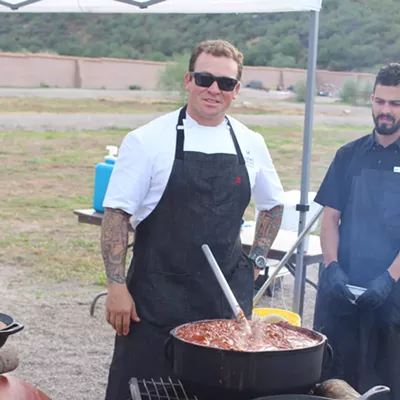
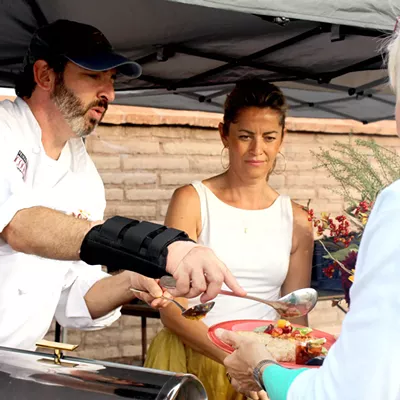
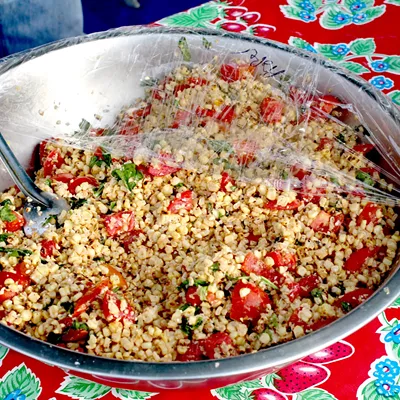
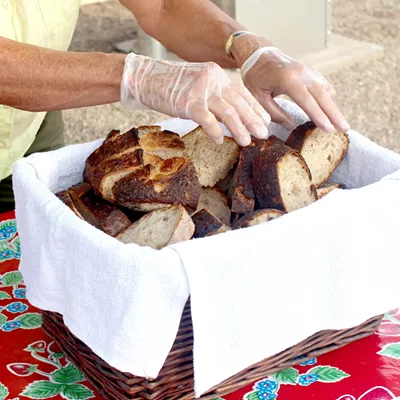
On Sunday, Oct. 18, the Mission Garden filled up with stands and long tables to serve up truly farm-to-table fare cooked up by some of Tucson's top chefs. While many food events focus on rich, decadent ingredients and loads of meat to win over attendees, almost all of the dishes at the gourmet picnic were vegetarian. The refreshing use of mostly veggies made for an event that was certainly easier to digest, but not lacking in flavor by any means. Instead, chefs like Doug Levy (Feast), Robbie Tutlewski (Pizzeria Bianco) and more simply enhanced the natural flavors of their freshly picked ingredients.
Here's what happened:



Of course, that's not the only way you can learn about and help out this outstanding native foods organization. Visit the Friends of Tucson's Birthplace website for more information.
Tags: mission garden , friends of tucson's birthplace , farm to table , gourmet , harvest , picnic , dinner , event , slideshow , native seeds search , Image , Slideshow