

Friday, November 13, 2015


The proposed expansion to Sabino High School was a contentious 3-2 vote in favor, however all the decisions are pending Department of Justice approval to make sure the district complies with the more than 40-year-old desegregation court case.
The Sabino proposal would allow seventh and eighth graders who would normally go to Magee Middle School to attend Sabino instead. The proposal was originally attached to the expansion of Fruchtendler and Collier elementary schools to include sixth graders, which normally feed into Sabino. Although the proposal was later fractured, the development of the two aforementioned elementary campuses passed unanimously during the governing board vote.
The protest of the expansion comes from both the plaintiffs and the desegregation expert appointed to oversee the ongoing court case, Special Master Willis Hawley. The worry is that Magee Middle School will drop in student population and begin to serve specifically lower income, minority students. This would be due to more higher income families choosing to go to Sabino as higher income families have more access to transportation to get their children to school everyday.
Attempts to alleviate these concerns in the proposal include express buses from ethnically concentrated areas to Sabino. It was noted at the meeting that express buses would be an extra expenditure and that efforts to promote express have been lackluster in the past.
Tags: TUSD , Sabino , magee , education , fruchtendler , grijalva , stegeman , collier , desegregation , special master , high school , Image

Anyone else super stressed out this week? We've got three paychecks until Christmas. It's time to make health insurance decisions. Some of us have to figure out what kind of gifts to give to our mothers as a wedding gift*. There's a lot going on.
So, how are we gonna deal with the pressure? We're going to paint ourselves orange, inhale popcorn and watch a movie about feelings. Obviously.
Here were the 10 most rented DVDs at Casa Video this week.
1. Inside Out
2. Jurassic World
3. San. Andreas
4. Vacation
5. Pixels
6. The Gift
7. Southpaw
8. Tomorrowland
9. The End of the Tour
10. Max
*Seriously, what's a good wedding present when you're the daughter of the bride?
The majority of the 9th Circuit panel contends that both the primary and the general are in fact one election process. There is a primary part to select the candidates, and a general part that selects councilmen. They object to changing the qualifying boundaries from primary election to the general election—from residing in a specific ward to residing in the city at large. Both sides agree that council members do, in fact, represent the city as a whole once in office. The majority asserts that that being the case the primary voter has a greater influence in the process than those living outside a given ward and cannot vote for that ward primary candidate, thereby violating the 14th amendment.
The dissent asserts that primary elections are treated differently in many jurisdictions, and that states and municipalities have traditionally been given wide latitude in running elections. They also argue that it is a stretch to apply the “one man one vote” principle of the 14th amendment to this case.
The politics of this issue are pretty straight forward. Democrats enjoy a registration advantage over Republicans of around 5-to-3. This means that with citywide elections they can elect Democrats to wards that are predominantly Republican. The recent election is an example. Of the three winning Democrat council candidates, only Regina Romero won in her ward. In a ward only election scenario, both Democrats Paul Cunningham and Shirley Scott would have lost to Republicans Kelly Lawton and Margaret Burkholder respectively. Obviously, Republicans would love a change to ward only elections.
Many fans of ward only elections are giddy over this most recent decision, but there is more than one fix to the constitutional problem as laid out by the 9th Circuit panel. Were the primary elections made citywide, the problem of voter advantage and changing of the geographic boundaries would also be fixed.
So, from the people’s perspective, which of the two fixes would be better? There is a lesson to be found in the political career of Harvey Milk. Milk was a businessman and member of the San Francisco Board of Supervisors—the equivalent of a Tucson City Council member. He and Mayor George Moscone were assassinated on Nov. 27, 1978, by former supervisor Dan White.
Tags: Tucson City Council , ward only elections , Harvey Milk , 9th Circuit Court of Appeals , Arizona Public Integrity Alliance , Regina Romero , Paul Cunningham , Shirley Scott , Margaret Burkholder , Kelly Lawton
Thanks to the American Civil Liberties Union of Arizona, there is now a cellphone app that lets you record video of law enforcement activity and right away submit it to the local ACLU for review—just in case someone's rights may have been violated.
Nearly 40 people have been killed by police so far this year in the state, according to the ACLU of Arizona. Also, the organization constantly gets reports of excessive use of force by police and Border Patrol agents, so this app is "intended to serve as a check on abusive behavior by police officers, sheriff’s deputies, and Border Patrol agents by allowing ordinary citizens to record and document any interaction with law enforcement," says a statement to the media by Will Gaona, policy director of the ACLU of Arizona.
With Mobile Justice AZ, you can record and report interactions with law enforcement. It also has educational information on individual rights. The videos captured can be sent to the ACLU of Arizona and are preserved even if the user's phone is later seized or destroyed, the press release says.
The functions of the app include:
Record allows individuals to capture exchanges with police officers and other law enforcement officials in a file that is automatically sent to the ACLU of Arizona.Mobile Justice AZ is available for use on Android and iOS phones and can be downloaded free through Apple’s App Store or Google Play," the ACLU of Arizona press release says.
Witness sends out an alert to anyone with the app, giving the location of a police encounter that is being documented by another app user.Report allows the user to complete a written incident report and send it directly to the ACLU of Arizona for review.
Know Your Rights provides an overview of what rights protect you when you are stopped by law enforcement officers.
While Mobile Justice AZ is intended for use by bystanders, the ACLU of Arizona recognizes that some users may want to use it while they are involved in a police encounter.
Anyone interacting with law enforcement should announce that they are reaching for a phone, and that they are attempting to access the app to record the exchange. Users’ safety depends on their ability to clearly communicate any actions they take and remain calm.
The same app is also launching in Minnesota, Georgia, Maryland, New Jersey, New Mexico, Oklahoma, Pennsylvania, Virginia and Washington, D.C. And the app is already in use in Michigan, Mississippi, Nebraska, California, Colorado, Missouri, North Carolina and Oregon. New York has the ACLU’s original app to record police, known as the Stop and Frisk app, the press release says.
Download it for iPhone (iOS) here.
Download it for Android here.
Tags: american civil liberties union of arizona , aclu , law enforcement , police , border patrol , mobile justice az
Thursday, November 12, 2015
Every year since the passing of Nowhere Man and A Whiskey Girl's Derrick and Amy Ross, we've written about the people they've left behind and the work they've done to make sure the husband-wife music duo are not forgotten through a benefit show for the Southern Arizona Lupus Foundation. This week, in a mini music feature, we gave you notice of Saturday's show at The Flycatcher. We're giving you notice the next couple of days, because we're certain with Jimmy Eat World returning to Tucson for this special night, it will sell out.
But we also want to make sure it's understood how special this event is. Yes, as a fundraiser you will hear a lot about lupus—complications from this disease took Amy away from the Tucson and Bisbee communities. But you will hear the music of NMWG from local music—many dear friends of the couple—who do want to make sure the music is heard, loved and celebrated.
On Saturday, Nov. 14, the Third Benefit to Fight Lupus takes place at the Flycatcher (340 E. Sixth St.).
So cheers to Bryan Sanders, Jimi Giannatti and Keli Carpenter for continuing this benefit and not forgetting their friends. We're lucky to have these dear people call Tucson home, just as we were lucky to have Amy and Derrick give us their music. Go. Remember. And yes, celebrate.
Filmmaker Charlie Minn—partially based in El Paso, Texas and the other half in New York—is screening his latest documentary, "43," which breaks down (as much as possible) what went down more than one year ago near the city of Iguala, Guerrero, after 43 students from Ayotzinapa were "arrested" by local policemen and never seen again.
Minn spent six months working in Mexico and the U.S., interviewing many of the students' family members, political experts and watching the heavy protests that took place shortly after the mass kidnapping—all demanding the government to investigate and reveal what happened the night of Sept. 26, 2014.
"It is pretty well known that the Mexican government is not trusted by the citizens," he says in a phone call with the Weekly. "During these protests, they have been called murderers."
He says that out of all the crimes he's explored in Mexico, this one is probably the most sickening—even more so than the alleged government involvement in the July prison escape of Sinaloa drug cartel king Joaquín "El Chapo" Guzmán. (Last year, Minn released another film where he questioned whether the real Chapo had gotten arrested, or if it was a pantomime by the Enrique Peña Nieto administration. Bottom line, he doesn't trust Mexican officials and political figures much.)
On that September day, the 43 Ayotzinapa Rural Normal School students were trying to gather buses to travel to Mexico City for the annual protest on Oct. 2, marking the anniversary of the 1968 massacre of unarmed students in Tlateloco.
(According to The Guardian, the Ayotzinapa school "is part of an ambitious educational project set up in the 1920s, after the Mexican revolution, which sought to provide young men of marginalized rural backgrounds with specialized education. The idea was to combine academic subjects with practical knowledge on how to take care of the land, and to encourage social activism."
In short, people in the southern state of Guerrero—which is Spanish for "warrior"—have always had the reputation of not taking shit from the oppressive Mexican government. And speaking up, especially if it comes from the poorer, more marginalized citizens of the country, is seen as highly inconvenient by the latter.
That night, roughly 100 students left a bus station in Iguala with five buses. On their way back to Ayotzinapa, municipal policemen ambushed four of the buses, three were pulled over together. After the first attack, a group of students was detained and put in police cars. The other group of students was arrested after they arrived at the scene to try to help their other colleagues. At some point, the policemen start shooting the students. Then the other buses are attacked; more students are detained. It's reported that six students were killed at the scene, according to VICE.
In the days and months that followed, nearly two dozen municipal policemen were arrested, as well as former mayor of Iguala José Luis Abarca and his wife, who allegedly ordered the massacre and mass kidnapping. (Checkout this VICE timeline and Amnesty International write up to learn more.)
Only one of the students' remains has been found and identified. One of the stories that made it out is that the local drug cartel, local officials and law enforcement collaborated in the disappearance—that the kidnapped students were handed off to a drug gang to be killed and burnt in the nearby town of Cocula. A lot has been said, but there still hasn't been any solid evidence.
"I am afraid Mexico has to go through a revolution to get themselves out of this. The Mexican government has done a terrible job revealing to the country what exactly happened," Minn says. "The parents of the missing sons and daughters are adamant about getting answers. I can't express my sympathy enough."
One of the major reasons he dug into the tragedy is so that more people around the world, and especially in the United States, educate themselves on what is happening in Mexico—the drug violence and corruption, he says have been highly influenced by U.S. intervention and its citizens heavy illegal drug use. "Too many innocent people die," he adds. "You can't solve a problem if you are not aware. My films are about Mexican people who have been murdered, someone has to speak for these people, give them a much-needed voice."
"43" is screening starting Friday and for at least one week at Harkins Tucson Spectrum 18, 5455 S. Calle Santa Cruz (I-19 and Irvington). For showtimes, call 889-5588, or visit the Harkins website.
Tags: 43 , ayotzinapa , normalistas , iguala , guerrero , escuela normal rural de ayotzinapa , enrique peña nieto , charlie minn , mexico , harkins , tucson , Video
Celebrate the bounty of the Sonoran desert, get a good breakfast and help support sustainability practices all in one go by heading to the Edible Shade Mesquite Pancake Breakfast. The event, which benefits the initiatives of the Watershed Management Group, will offer insight into what the organization seeks to accomplish over your desired amount of mesquite pancakes.
While the mesquite tree is, indeed, a great source of shade in the desert, it can also be milled for flour, converted to syrups and more. The unique flavor of mesquite—and I don't just mean using the wood for grilling—shows the rare flavors our area is capable of producing. Plus, it's pancakes. The event will also celebrate other shady desert-adapted and edible trees like pomegranate, olive and more.
The breakfast fundraiser will feature mesquite-sweetened cold brew coffee from Exo Roast Co., as well as vegan and gluten free options for the pancakes. Peddler on the Path will be on-site serving hot espresso drinks.
The Edible Shade Mesquite Pancake Breakfast kicks off on Sunday, Nov. 22 from 9 a.m. to noon at WMG's Living Lab (1137 N. Dodge Blvd.). Pancakes run at $2 per or $3 for five. You also have the option of skipping the ticket line for this year's event and buying your breakfast online in advance via the Watershed Management Group website. As far as entertainment goes, the event will feature live music from the Brambleberry Duo, educational presentations from Carolyn Niethammer and Scott Calhoun and an artisan market.
Tags: mesquite , pancake , breakfast , edible shade , watershed management group , tucson , event , dining , fundraiser , desert ecosystems , living lad
There’s something intoxicating about a movie that excels being something you did not expect. A Taiwanese film set 1,000 years ago and called “The Assassin” brings to mind a lot of high-flying action, and while there is some here and there, this is a moody, deliberate, and fascinating picture. Hou Hsiao-Hsien is a director you probably haven’t heard much about, but he just won best director at Cannes this summer, and it’s tough to find a great counterargument. The assassin is portrayed by Shu Qi, who you might recall from the first “Transporter” movie. While she does not show emotion on the job, the film does a great job weaving in her emotions through allegory and flashbacks. This is really good stuff, one of those period martial arts films like “Crouching Tiger, Hidden Dragon” that transcend the boundaries of genre and into must-see territory.
Wednesday, November 11, 2015
However, unlike his technicolor former gig, Kashtelyan's first solo show will feature all black and white sketches using India ink. The dozen or so pieces are all relatively small, between 8 and 12 inches, and will primarily be "portraits of friends and such."
"There's really no conceptual basis. It's just things I like to draw," Kashtelyan says, adding, "Mostly triangles and girls."
In the past, Kashtelyan has penned posters for local bands, including Hank Topless, Ohioan, Young Hunter and two of the bands playing the opening night event: Mastodonna and Ghostal. Dadsdad will also be playing the event as their first show. Kashtelyan says his "main drive" now is to sustain himself as an artist through his band poster work.
The art showing and concert will kick off at 6 p.m. on Saturday. The admission price is to be announced. For more information on this and other events at Tiny Town Gallery, visit the venue's Facebook page.
Tags: alexsey kashtelyan , art , tucson , gallery , tiny town , exhibit , ghostal , mastodonna , dadsdad , live music , event
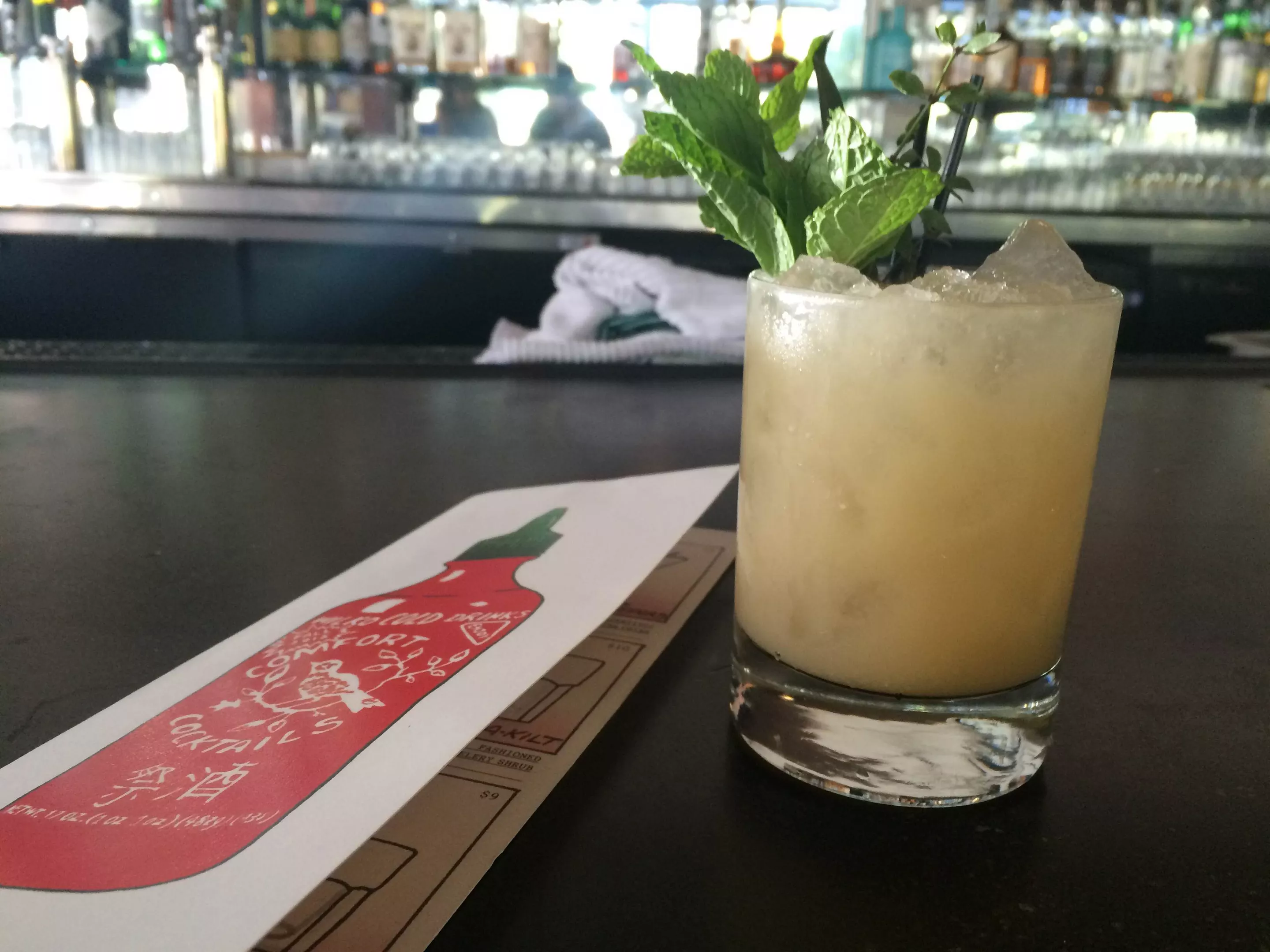
Although I mentioned previously that bartender Sara Roche would be taking over the helm as head bartender at Wilko (943 E. University Blvd.) in a recent cover story, it seems that's not all that's changing over at the upscale UA-area restaurant these days. Wilko has hired a new head chef after the departure of Ian Sugarman and is offering a new menu for both food and drink.
Before Sugarman left, he put the finishing touches on a menu, which is now available at the restaurant. However, with the recent acquisition of Jesse Curtin in the kitchen, the new chef, who came to Tucson from the Bay area, plans to revamp the menu yet again over the next few months to put his touch on it.
Until then, he's offering specials to show exactly what he can do. Judging from a recent dish Curtin was offering at Wilko, which paired a seemingly incongruous mix of components like seared scallops, beet, tea-soaked lentils and fried turmeric, Old Pueblo diners are in for a treat.
However, I couldn't very well finish up this blog without showing off Roche's new cocktail menu, which she also designed:
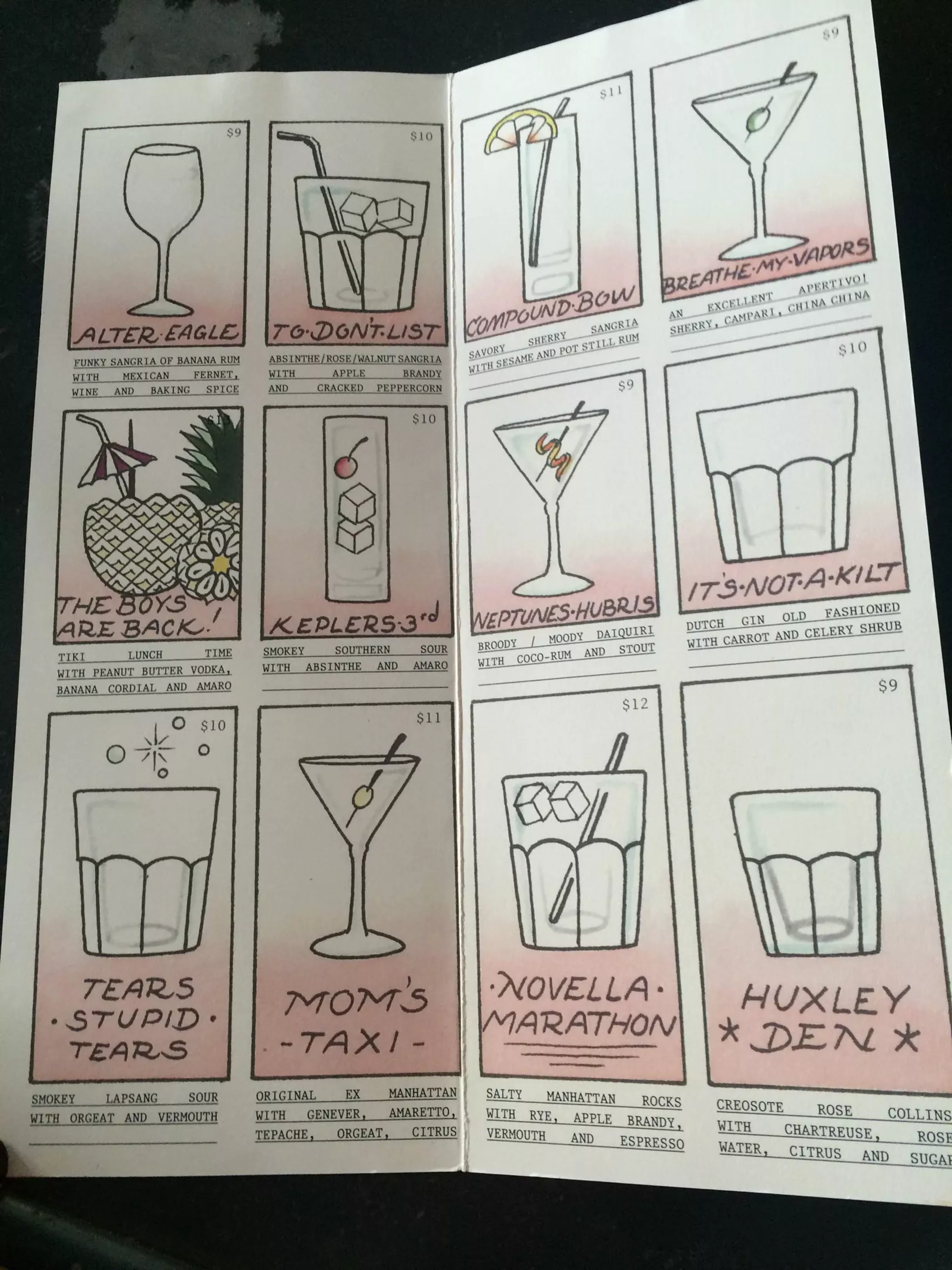
The 12-drink menu serves up several drinks that utilize savory, herby and floral components that offer a unique experience that's pretty much a balanced (in flavor, you guys) meal in a cup. From the cover's reimagined Sriracha bottle to the inside drink illustrations, the whole thing is pretty much ripe to be tattooed on many a Tucsonan's bodies. Plus, those illustrations are nice to coupe-averse cocktail drinkers because you know you're glassware before you order.
You can check out Roche's new menu, as well as a special from chef Curtin, now at Wilko. The restaurant is open Monday through Saturday from 8 a.m. until 10 p.m. and Sunday from 8 a.m. until 9 p.m.
Tags: wilko , tucson , restaurant , new chef , new menu , jesse curtin , sara roche , ian sugarman , cocktails , dining , Image

