

Wednesday, November 11, 2015
Rosa Robles Loreto says the first thing she is going to do after leaving sanctuary is walk around her house and cook dinner for her husband and two boys.
This morning, Robles Loreto celebrated a huge win: days after her attorney Margo Cowan worked out a confidential agreement with Immigration and Customs Enforcement officials, Robles Loreto walked out of Tucson's Southside Presbyterian Church—the place she called home for more than 15 months to avoid deportation.
"I have been crying all of these days. My children, when they heard the news, their faces just changed," Robles Loreto told the Weekly after a quick prayer and ceremony inside the church's worship room. "I thought my (youngest) son was going to jump with happiness, but no, he just cried and hugged me."
Robles Loreto's oldest son, Gerardo Jr., 12, says he can't wait for his mom to once again cheer for him from the sidelines at his baseball games. He, and younger brother José Emiliano, 9, spent the summer vacation at the church with mom, leaving her side only for baseball practice. When the Weekly spoke with Gerardo Jr. a few months ago, he said sometimes he would forget his mom wasn't around. He'd come back home from school screaming for her to talk about his day. Then, he'd remember she wasn't there.
"I am really happy because I wasn't expecting it, I am very grateful...I am happy that she is safe," Gerardo Jr. says. "(I want to) spend time with her and go to my baseball games, and go to the park."
On Aug. 7, 2014, Robles Loreto walked through the doors of the church with only a small bag—with belongings enough for no more than 10 days—after Immigration and Customs Enforcement told her to turn herself in to be deported. The removal order came to be at the hype of SB 1070—Arizona's so-called "show me your papers" law. Robles Loreto was apprehended over a minor traffic infraction in 2010.
She and her family never anticipated she'd be in the church for as long as she was. After all, on paper, she was not a priority for removal in ICE's book, according to a 2014 memo by the agency. She doesn't have a criminal record and has called the U.S. home for roughly 20 years.
Today, after 11 a.m., Harrington read a prayer in English and Spanish to send off Robles Loreto back to her life. The close to 100 people who showed up to support Robles Loreto sang while she, her husband, Gerardo, and her kids walked through a tunnel of spectators and out to the patio—all surroundings that she's been so familiar with, except merely a few days ago she couldn't leave.
"There are no words to express the gratitude in this moment," Harrington told the Weekly. "She came in a mom and a wonderful community member, she is leaving as a community leader, someone who knows that when she lifts up her voice, she lifts it up for many."
The community support for Robles Loreto has been overwhelming. Close to 10,000 homes and businesses have placed signs that read, "We Stand with Rosa;" and both the Tucson City Council and the Pima County Board of Supervisors passed resolutions pleading Department of Homeland Security and the Obama administration to help close Robles Loreto's case.
The fight isn't over, though. Robles Loreto says she won't stop speaking up until there is comprehensive immigration reform for the millions of undocumented people living in the U.S.—especially parents. No family deserves to be torn apart, she says.
"This has been a huge spiritual learning experience, even though it has been so hard. It gave me a lesson in how much people can love one another. I came in here with a family of four," she says. "Today, I know I have an even bigger family. I will keep going, because I thought there were no opportunities for me. Today I have the opportunity to leave," and she wants others in similar circumstances to have the same chance.
Two other people who sought sanctuary in Tucson—Daniel Neyoy Ruiz was the first case at Southside in May 13, 2014, and Francisco Perez Cordova took sanctuary at St. Francis United Methodist Church on Sept. 25, 2014—left after way shorter stays than Robles Loreto. Neyoy Ruiz moved out of Southside in June 2014, after DHS granted him a one-year stay (which was renewed earlier this year). Perez Cordova went home in December 2014, following a little more than 90 days at St. Francis, after his case was closed. Both of them—now very close friends with Robles Loreto—were at the ceremony today.
Tags: rosa robles loreto , sanctuary , alison harrington , margo cowan , southside presbyterian church , tucson
Tuesday, November 10, 2015
Congressman Raúl Grijalva says the 5th Circuit Court of Appeals 2-1 decision to continue blocking President Obama's 2014 immigration actions is the "politicization of justice, pure and simple."
On Monday evening, the federal court in New Orleans said it supported a lower court's decision to issue a temporary injunction back in February against both programs: an extension of 2012's Deferred Action for Childhood Arrivals and Deferred Action for Parental Accountability, or DAPA.
Grijalva said in a statement to the media that the decision is "prolonging the agony of countless families suffering in our broken immigration system. Each additional day means more families torn apart, more kids turned away from the only country they've ever called home, and more missed opportunities for our society as we reject talented and hardworking people for no good reason at all."
The matter is headed to the U.S. Supreme Court, as the Obama administration announced today it plans to appeal the 5th Circuit Court ruling from last night. "And I urge the justices to act swiftly and justly to protect the men, women and children that are counting on them," Grijalva's statement says.
Both of the reliefs were issued by Obama on Nov. 20, 2014, and could affect roughly 5 million undocumented people in the country.
DAPA would grant parents of U.S. citizen or legal resident children (and who have no criminal record) a renewable three-year work permit and temporary deportation relief.
DACA II is an extension of Obama's 2012 DACA, which allows for undocumented immigrants brought here as children to apply for a two-year work permit and remain in the country. Extended DACA got rid of the age restrictions (with DACA I, the person has to be under the age of 31 on June 15, 2012 and have arrived to the U.S. before turning 16) and extended the renewable work permission to three years.
Tags: raul grijalva , deferred action for parental accountability , deferred action for childhood arrivals , dapa , daca , obama , immigration
Now in its seventh iteration, MOCA is recognizing a diverse collection of thinkers in town who offer up some very different sets of skills.
Brad Lancaster, co-founder of Desert Harvesters, is being recognized for his visionary work in rainwater harvesting. Mort Rosenblum is a renowned journalist who currently teaches international reporting at UA and is known for his integrity in the field. Doctor Andrew Weil's work in integrative medicine focuses on both natural and preventative approaches to wellness. And last, but certainly not least, Tucson's former poet laureate Ofelia Zepeda will be honored for her commitment to teaching the Tohono O'odham language and promoting literacy in the indigenous language.
With such a varied group of recipients, you'll want to be sure to catch the events and lectures associated with the 2016 MOCA Local Genius Awards. While the final gala—which will be catered by another Local Genius, chef Janos Wilder—won't take place until April 16, 2016, events celebrating these luminaries will take place all throughout the spring. For more information on upcoming events at MOCA, visit the museum's website.
Tags: moca , tucson , local genius awards , brad lancaster , desert harvesters , mort rosenblum , ofelia zepeda , andrew weil
Although this plan is mostly platformed around ridding Arizona of Common Core standards and raising teacher salaries, there is a section about revitalizing career and technical education, which was one of the areas hit hardest by state education budget cuts last year.
“The 2016-17 budget cuts of $29 million to career tech education across the state will effectively kill these programs across the state,” said Alan Storm, Pima County Joint Technical Education District Superintendent/CEO. Joint Technical Education Districts provide the network for students to be able to receive career education that they want. The plan set forth by Douglas to improve CTE is paved with good intention, but is mostly just a symbolic gesture, Storm said.
“In the past [Douglas] has not shown that she was a great supporter of career and technical education,” said Kathy Prather, Director of CTE in Sunnyside Unified School District. “I find it a little suspect and I’m not sure I trust her intentions.”
Without the extra funding proposed in “AZ Kids Can’t Afford to Wait,” JTED’s will be almost non-existent in Arizona, officials say. According to the plan itself, projected funding for CTE is set at $41 million statewide. In the 2010-2011 educational year, funding was $94 million. Funding cuts to JTED's have been widely viewed a bad move by Tucson City Council and other education officials.
“We’re good for next year, but we will run into a financial crisis the year after,” said Jill Ranucci, CTE Director for Catalina Foothills Unified School District. The individual schools are already trying to streamline programs so that they might be able to offer some programs in the following years, according to Ranucci.
“Currently we’re barely able to keep the programs afloat,” Prather said. “We are going to do our best with whatever funding we receive, but it’s going to be difficult to take a 50 to 60 percent hit and keep everything and deliver the quality programs that we are barely able to deliver right now.”
Now that the clearance Halloween candy is finally gone from the grocery stores, it's time to start thinking about winter celebrations.
The kind folks over at Ballet Tucson have given us a hefty number of tickets to some of their upcoming shows—including some tickets to their upcoming performances of the Nutcracker.
We've got passes that can be used at performances Dec. 11-13. Enter here and don't forget to tell us if you're looking for two tickets or four:
5th Circuit Court of Appeals Continues to Block Obama's 2014 Immigration Actions DAPA, Extended DACA
The 5th Circuit Court of Appeals decided on Monday evening to continue blocking President Obama's 2014 immigration executive actions—Deferred Action for Parental Accountability, known as DAPA, and an extension to 2012's Deferred Action for Childhood Arrivals, or DACA. Both reliefs have been on hold since February, after a court in Texas issued a temporary injunction, while 26 states—including Arizona—continue a legal battle challenging the constitutionality of the programs.
According to The Huffington Post, "The appeals court accepted Texas’ argument that an expansion of immigration relief to include a wider class of undocumented immigrants would cause the state to 'incur significant costs in issuing driver’s licenses to DAPA beneficiaries'—a basic 'harm' requirement for any litigant seeking standing to sue."
U.S. Circuit Judge Jerry Smith said that, if DAPA goes into effect, it would allow for half a million undocumented immigrants in Texas to "satisfy that requirement with proof of lawful presence or employment authorization. Texas subsidizes its licenses and would lose a minimum of $130.89 on each one it issued to a DAPA beneficiary. Even a modest estimate would put the loss at several million dollars," The Huffington Post reports.
Immigration rights advocates were, of course, not happy with the decision.
Tom Jawetz, vice president of Immigration Policy at the Center for American Progress, released this statement:
We are disappointed in today’s flawed decision by the 5th Circuit Court of Appeals, which leaves millions of American families in limbo and in continuing danger of being torn apart. The court’s decision to intervene in this politically motivated case ignores strong legal and historical precedent for the actions taken by the administration last November, including a direct command by Congress that the secretary of homeland security set national immigration enforcement policies and priorities. Further delaying the implementation of these programs only harms the country by forgoing a cumulative $230 billion added to our gross domestic product over a decade, the creation of tens of thousands of jobs each year, and a significant increase in the wages of all workers. Enough slowing down sound legal action; the Supreme Court should take up this case as soon as possible so that the country can reap all of the benefits that would come from these crucial initiatives.DAPA would grant parents of U.S. citizen or legal resident children (and who have no criminal record) a renewable three-year work permit and temporary deportation relief.
DACA II is an extension of Obama's 2012 DACA, which allows for undocumented immigrants brought here as children to apply for a two-year work permit and remain in the country. Extended DACA got rid of the age restrictions (with DACA I, the person has to be under the age of 31 on June 15, 2012 and have arrived to the U.S. before turning 16. Also, you have to be over 15 years old to apply for the 2012 DACA, according to U.S. Citizenship and Immigration Services) and extended the renewable work permission to three years.
For obvious reasons, USCIS is not accepting applications for either DAPA or DACA II. The first DACA remains untouched.
Tags: deferred action for parental accountability , deferred action for childhood arrivals , dapa , daca , 5th circuit court of appeals , center for american progress , immigration , obama
Monday, November 9, 2015
Hi I'm Roger! Do you like my harness, it helps me feel safe plus it matches my pretty yellow eyes!
I'm looking for my forever home but I'm a very sensitive boy and have grown really attached to my friend Bell, we're both only 7 months old. HSSA is offering a two for one adoption for the both of us!
Stop by PAWSH located at La Encantada to meet Bell and I, they have a room in the back where we can meet and play!
See ya soon,
Roger, 808808
This week, the supervisors are set to consider an agenda item on the use of county cars for themselves and other county employees at the Tuesday, Nov. 10, board meeting.
Pima County Administrator Chuck Huckelberry sent out a memo on Oct. 13 for the board to consider before tomorrow’s vote—and one of the key points he makes is that it appears that Miller failed to properly account for her own personal use of her county-issued car before she turned it in and, in the process, may have cheated on her federal taxes.
Huckelberry notes early in the memo that Miller’s motivation in the push to be rid of county-issued vehicles “was designed as political theater” but adds that it’s a legitimate topic for conversation.
Huckelberry argues that allowing some county employees—including the elected supervisors—to take their vehicles home makes sense. Since supervisors have to travel in order to find out what’s happening in their districts (or, in other words, do their jobs), they’d be eligible for mileage reimbursement if they weren’t driving county cars. And in the case of larger districts like Democrat Sharon Bronson’s District 3 or Republican Ray Carroll’s District 4, the number of miles driven would soon exceed the cost of providing a county car, so, as Huckelberry puts it, “Obviously, the savings are not significant.”
But the other point Huckelberry makes in the memo revolves around Miller’s curious claim that she only drove 100 personal miles with her county-issued car in the nine months she used one.
Miller, like the other supervisors, was required to report her personal miles to the county because that’s considered a taxable benefit that must be reported to the IRS.
The report notes that Miller lives about 15 miles from the county’s downtown headquarters but she claimed she only drove 100 personal miles over the nine months she had a county-issued car.
As Huckelberry puts it in the memo: “The amount of personal miles for the 12 months ending Oct. 31, 2014, varies widely by supervisor with the least reported by Supervisor Miller at 100 miles per year and the most reported by Supervisor Richard Elias at 3,500 miles per year. This is an extreme variance.”
Huckelberry was more blunt in a comment to the Weekly: “Based on her reporting, Supervisor Miller either only traveled to/from work 3 times in one year or did not accurately report her personal mileage as required by the IRS.”
Miller did not respond to a request through her chief of staff, Jeannie Davis, to comment on the suggestion that she was not accurately reporting her mileage.
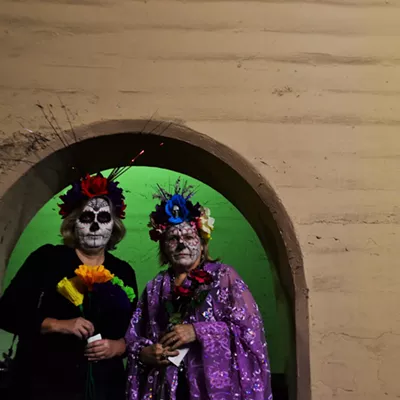
Here are a few images from last night:






Tags: all souls procession , tucson , Slideshow
Pueblo Magnet High School and Robison Elementary School are at risk of losing magnet status if Tucson Unified School District doesn't comply with a new to-do list filed by the parties involved in the decades-long desegregation lawsuit. They are the two latest schools added to a list of six others facing the same problem.
In September, Willis Hawley—the special master appointed by the federal court to oversee the district's progress— said elementary schools Bonillas and Ochoa; Safford K-8; Utterback Middle School and Cholla High School could lose their status because they were not integrated. The court order says that Hispanics, or any ethnicity, cannot make up more than 70 percent of the student body. At first, Pueblo was left out of that list, even though 90 percent of students are Hispanic (70 percent are enrolled in magnet programs, so according to Hawley, the school met the criteria). Holladay Elementary School was later added to the list, for a grand total of eight schools that could lose their magnet status.
According to Sylvia Campoy—who's been involved in the deseg lawsuit since the beginning and is the representative for the Mendoza plaintiffs (Fisher & Mendoza v. Tucson Unified School District)—the district has had since 2013 to fix the issues pointed out by the court. (That year they had to draft a new magnet plan.) Most recently, the court issued another order: Magnet schools had eight months to develop plans to meet the goals required by the court. On the 40th school day, Hawley was supposed to review the schools, which were ordered to be integrated by 2016 and have met academic criteria demands by the 2016-2017 school year. According to Campoy, some magnet school administrators reached out saying they didn't even have a copy of the court order.
"The situation cannot be a surprise to anyone paying attention, the court order handed down eight months ago was unambiguous, throughout the development of the magnet plans this spring, most, if not all of these schools were identified as being vulnerable to losing their magnet status," Hawley wrote in his September report.
While TUSD board members, and a group of parents and students, argue the district was not given enough time to implement its magnet plan, Campoy and other critics say the district has neglected its magnet schools for years, so the ultimatum should have been expected.
She says the district is in the situation that it's in because it's ignored feedback from the plaintiffs and the special master, and it has financially "starved" its magnet schools, she says. What's unfortunate, according to Campoy, is that TUSD's leadership is providing families with inaccurate information and portraying Hawley as a boogie man—with the purpose to defund schools and watch them burn, when that's not the case. It is on the district's shoulders, she told the Weekly last month.
"You have got some magnet schools that have been sitting there neglected for 15 years, they are racially concentrated, what else could you expect?" Campoy says.
Tags: tucson unified school district , desegregation , magnet , Fisher & Mendoza v. Tucson Unified School District , tusd , Bonillas elementary school , Ochoa elementary school; Safford K-8; Utterback Middle School , Cholla High School , sylvia campoy , willis hawley , betts putnam hidalgo

