

Friday, August 5, 2016
Well, let me correct that. Everything is still accessible to me; however, everything is not accessible to my daughter who uses a wheelchair as her main source of transportation. Therefore my statement stands true—not so much. It never dawned on me how much Tucson excludes those who use mobility aids until I took my daughter to the Tucson Children's Museum.
We tried to interact with some of the exhibits they had, specifically, the one where you spin a wheel mounted to the exhibit and made electricity. A typical and perfect example of cause and effect, right? Wrong. My daughter's wheelchair couldn't get close enough to grab the handle and spin the wheel because of the box it was mounted on. Only a slight problem, but not unfixable. I took her out of her wheelchair, propped her up on my knee, and we tried again. However, because my daughter's cerebral palsy greatly affects her motor skills she couldn't maintain a grip on the handle and therefore couldn't spin the wheel that created the electricity.
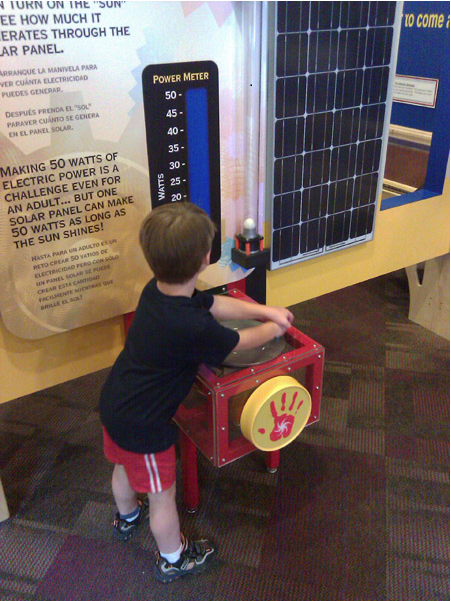
Womp woooommmmppp. Game over. NO ELECTRICITY FOR YOU!
Now, there is an easy fix here, but it requires thinking outside the box. The easy fix might be having something she could stand on (with my assistance) that would simulate the transfer of energy (weight) from her body to the exhibit, and that would stimulate electricity. When I put her back in her chair, the electricity goes out. Same concept of cause and effect, and the transfer of energy to create electricity. Bada Bing Bada Boom and the kid is happy.
Sadly, that is not an offered alternative. Now, some of you might say, well she could have put her hand on the giant "hand" picture, and interacted that way. To you, I say, perhaps. Perhaps she could have, but that would mean moving her far enough from the exhibit so that she could bend over in her wheelchair and maneuver her body in such a way that she could get her hand on it, and not fall out of her chair. And still breathe.
Sounds like a lot for a small child? It is. And it shouldn't have to be. I mean, it is the Children's Museum, which leads one to believe it's open to ALL children, not just able-bodied children, right? Now, before you give me the most wicked side eye in all of side eye history for pointing out a disparity at our beloved Children's Museum, I'm not saying they are the devil.
To our benefit, there are some exhibits that she can interact with, and always has fun with. She always has a blast chasing bugs in Techtopia, picking the giant nose in Bodyology and grocery shopping, where she gets all the things. Literally: She tries to put everything in her little shopping cart. So while this doesn't necessarily make up for the lack of adaptive scissors and art utensil aids in the Imaginarium (art is her favorite thing EVER), it does still allow her to have some fun.
I am simply saying they need to think more often about the kids who interact with the world around them a little differently.
Tags: special needs , tucson , handicapped , accessibility , wheelchair. disability , disabled residents , children , city codes , Image
The AZ Republic has a good article on the subject. Here's what I learned.
Ducey is still pushing his No New Taxes mantra—no surprise there—and is also saying, No New Funds. According to the article, Ducey's next step is a push for "outcomes, not funding." Watch for news from Ducey's Classrooms First Initiatives Council, which will recommend ways to redistribute our current education funding. Spoiler alert. Expect charters to do very well in the proposals, along with schools in high rent districts. Since this is a zero sum game, expect school districts with poor and minority children to be the losers.
The heavy hitters in the business community, like the Arizona Chamber of Commerce and Industry, agree with Ducey. Prop 123 relieved the pressure for funding increases, which is just fine by them. Their advice to the man in the governor's chair is, "Keep those yearly tax cuts coming, Doug!"
Tags: Prop 123 , Doug Ducey , Classrooms First Initiatives Council , Arizona Chamber of Commerce , Arizona Education Association , Education funding
Kurt Vile is riding a bit of a high. After a rigorous year of touring behind 2015’s b’lieve i’m goin down…, the Philadelphia-based musician and his band, The Violators, had been feeling a bit of the tour blues—that zombie-esque state where “you hit a wall and things just sound the same,” as he puts it. A big push into musical festivals, the bread-and-butter of indie rock acts during the summer months, was tempered by a much smaller and simple show that revitalized Vile the night before we spoke.
“We came back to a club, and played Norfolk, Virginia—NorVa, of all places, [where] years ago I opened for Flaming Lips there—and everything was perfect. Everything clicked with the stage sound or whatever.”
There’s a brightness to his description that touring musicians can appreciate, as those moments when it all comes together, much less comes flooding back, is a rare and pleasant thing. Vile is a musician’s musician as well, having bridged that divide between those who can really play and those who can really write. Even after being asked about that sunburst-finished Fender Jaguar in the “Pretty Pimpin” video, Vile can expound on its genesis and his reasoning behind that instrument (influenced by a combination of Violators guitarist Rob Laakso, indie rock band Swirlies, Spacemen 3’s The Perfect Prescription and a love of pre-CBS Fender guitars) at will. It’s hard to imagine the removal of Kurt Vile, the guitarist, from Kurt Vile, the songwriter, but he jokes about each medium growing in kind with the experience he’s gained.
“These days, I can really play guitar from all this touring, so I can pretty much shred the guitar—I’m officially a really good guitar player,” he jokes. “I’m also proud of all the songs I’ve written and I feel like my songwriting is always getting better all the time and that’s always a quest of its own. It’s fun because there’s no rules really, but I’m always influenced by classic things and I’m always trying to stand out. You’ve got to find your little nook to do it in, a little different than anyone else.”
Tags: Kurt Vile and the Violators , b’lieve i’m goin down… , Video

Tucson, we don't have too many slow weekends left this summer. School is starting up, the weather will soon take it down a notch (or 30) and our weekly list of events is going to explode. Until then, let's take it easy. Maybe catch a movie.
Here is your weekly look at the Top 10 most rented movies at Casa Video.
- Batman v Superman: Dawn of Justice
Tags: movie rentals , casa video top 10 , no dames , Image , Video
Thursday, August 4, 2016
Food & Booze
Bakasana And Beer: It's Yoga hour at the Dragoon Taproom on select Saturdays hosted by Exude Yoga LLC. First come, first served. The event will run 10:30 to 11:45 a.m. on S Aug. 6. $5. Looking for something more intense? Head back the next day for Brewery Bootcamp because beer should always come after a workout. Dragoon is offering a full body regimen followed by post-exercise brews. All fitness levels can participate, bring your own mat, water, and sweat towel. (21+) 11 a.m. to noon. Aug. 7. $10 per person, includes one beer. Dragoon Brewing Co., 1859 W. Grant Road #111. First Friday Summer Sale: The Food Conspiracy Co-op is offering 10 percent off all day Friday, August 5th with tunes and food included. Naim Amor will be playing from 6 to 8 p.m. The sale runs from 7 a.m. to 10 p.m. Aug. 5. Food Conspiracy Co-op, 412 N. 4th Ave.
Twilight Farmer's Market: The first Friday of every month head over to Sycamore Park to buy produce, food, arts and crafts and enjoy music. 5 to 8 p.m. Aug. 5 Sycamore Park, E. Sycamore Park Blvd.
Music
Next + Direct: MOCA is hosting some spacey beats this weekend. Cobra Family Picnic, Jim Colby, RND1 and Wet Marble will all be performing at Next + Direct, a celebration of rhythm and sonic power. 7 p.m. Aug. 6. MOCA, 265 S. Church Avenue. Free for MOCA members, $5 for non-members.The Key Ingredients of African Soul: Get excited for the latest Key Ingredients of African Soul show, featuring songs written by Mike "Doc Twang" Olson and covers from Afro-pop legends such as Thomas Mapfumo, Tshala Muana and Cardinal Jim "Rex" Lawson. 7 p.m. Aug. 6. Monterey Court, 505 W. Miracle Mile. $5.
Cornelius Performs Fantasma: Japanese pop-noise savant Cornelius will be performing 1997 album Fantasma at the Rialto next Monday. The show will undoubtably give you some serious '90s nostalgia so consider picking up the vinyl reissue of the album to help ease your pain once the show is over. 8 p.m. Monday, Aug, 8. Rialto Theatre, 318 E. Congress St. $26-$29.
Surfapalooza: Club Congress is gathering Arizona's finest surf bands (Grave Digger, Shrimp Chaperone, Big Galoot and The Surfboards) for an evening of fish tacos, cold beer and great music. It's gearing up to be a true blue surf party. Well, minus the beach. 21+. 6 p.m. Saturday, Aug. 6. Club Congress, 311 E. Congress St. Free.
Power Up Against Cancer is meant to be a show of strength for all the kids who are battling an illness and fighting for their life.
Hosted at the Fox Tucson Theatre, 17 W. Congress St., the show will be on Saturday, Aug. 6 from 10 a.m. to 4 p.m.
The fundraiser will feature everything from Arizona's top arm wrestlers and nationally ranked body builders posing, to bench and deadlift exhibition and olympic fitness competitors.
In addition to lifting by Unbreakable Gear's athletes there will also be a silent auction, crowd activities and more.
Bring the whole family out to simultaneously enjoy the strength show and put a smile on kids faces. Admission is $10 for adults, but children 15 and under are in free.
Can't make the show, but want to show some support? Donate to event's GoFundMe here.
Be a part of UGNation and help make this an incredible event for the UNBREAKABLE kids.For more information visit the Facebook event page or Unbreakable Gear's website.
Tags: Unbreakable Gear , Power Up Against Cancer , HopeKids , fundraising show , Fox Theatre
The resolution includes a number of concerns about charters. It states that charters increase segregation; some low-quality charters in low-income areas "mirror predatory lending practices;" the schools' boards are generally appointed, not elected; many use harsh disciplinary measures; and government oversight of charters is too weak.
The document states:
THEREFORE, BE IT RESOLVED, that the NAACP reaffirms its 2014 Resolution, "School Privatization Threat to Public Education," in which the NAACP opposes the privatization of public schools and/or public subsidizing or funding of for-profit or charter schools.Later language, however, talks about making sure charters currently in operation are better managed and overseen, meaning it isn't calling for the elimination of charters. It states, "the NAACP hereby supports a moratorium on the proliferation of privately managed charter schools."
The resolution is stronger than language in the Democratic Party platform, which has similar concerns yet praises "high quality public charter schools [which] provide options for parents," but there's not a lot of daylight between the two documents. As would be expected, Democrats for Education Reform, which represents the "education reform"/privatization wing of the Democratic party, is very critical of the NAACP resolution, as it is of the education planks of the Democratic platform related to charter schools.
Tags: NAACP , Charter Schools , NAACP National Convention , Democratic Party platform
Wednesday, August 3, 2016
The first round is Saturday, Aug. 6 from 9 to 10:15pm at Tucson Improv Movement, 329 E. 7th St.
For just $5 you can attend and be a member of the audience who will vote and decide who advances onto the next round.
Eight unique teams will compete over the next month and you can determine the champion, just make sure to attend each live game every Saturday for the next four weeks.
Fighting for the title of 3V3 Improv Comedy Champion, enjoy Tucson's best and most hilarious comedians duke it out.
Tags: Tucson Improv Movement , Improv Comedy Tournament , hilarious , 3v3 , audience votes
In the mood for a little nostalgia—and vodka? Plan to go to the '90s Bar Crawl this Saturday, Aug. 6.
The crawl will stop in at a plethora of downtown bars (Elliott's on Congress, Batch Cafe & Bar, Highwire Lounge, R Bar, Playground, O'Malley's, Borderlands Brewing Co., the Surly Wench, Maloney's, Che's Lounge, Mr. Heads, Sky Bar and the Hut), all of which will be blasting '90s tunes and giving out "goodies."
Registration starts at the Hut (305 N. 4th Avenue) at 6 p.m. The Bar Crawl itself will run fro 8 p.m. to midnight, followed by an afterparty at the Hut from midnight to 2 a.m.
Your $20 registration fee gets you food and drink specials, into the afterparty and goes (in part) to support Pima Paws for Life.
So work on your outfit (there's a costume contest) and dance moves (and a running man contest). Tickets are available online.
Look out a green envelope in your mail! Members of the Permanent Early Voting List should start seeing their ballots for Arizona's Aug. 30 election tomorrow.
Don't know what or who is going to be on the ballot? Read up on the candidates. Wish you had signed up for an early ballot ages ago? Request one before Aug. 19. Haven't even registered to vote? Outrageous! Make sure you get that taken care of before Oct. 10 to vote in November's general election.
Tags: arizona primary , local elections , 2016 elections

