

Tuesday, February 27, 2018

That's why a case currently in front of the U.S. Supreme Court, Janus vs. Afscme, is such a big deal, and why conservatives have been funding the cause behind the case for years.
Janus vs. Afscme would take away the ability of public employee unions to make non-union members pay a "fair share" fee. Twenty-two states currently have that requirement, which makes their public employee unions strong as a bargaining force for state employees and a political force during election time. The rest, like Arizona, don't have "fair share," making the unions weaker on both fronts. I don't plan to discuss the merits of the case, though like most people whose politics lean left, I very much hope the Supreme Court rules against Janus. The discussion here is about money in politics, specifically the money of one Richard Uihlein.
I had never heard of Uihlein until I read an article a few days ago saying he was one of the largest donors behind the current effort to get rid of the "fair share" fee. So I did a google search on the guy. One article I found calls him "The Koch of conservative politics in Illinois." Another wants you to "Meet the Illinoisan Trying to Buy a Wisconsin Senate Seat." Another article lists "10 super-rich people [who] dominate giving to super PACs active in midterm elections for Congress." For the 2018 elections, Uihlein is at the top of the list with $19.5 million so far, and we're at the beginning of the funding cycle.
Tags: Richard Uihlein , Labor unions , Janus vs. Afscme , Image
Monday, February 26, 2018

I am a mellow 7-year-old girl who is ready to meet my fur-ever family! I am a very smart girl who knows sit, stay, and lay down. I walk well on a leash and am already house- and crate- trained. I get to eat special food because I have allergies but I don't need any medication.
Come fall in love with me at HSSA Main Campus at 3450 N. Kelvin Blvd. and please bring any dogs or kids that live in your home. For more information give an adoptions counselor a call at 520-327-6088, ext.173.
Lots of Love,
Chloe (852346)
Saturday, February 24, 2018
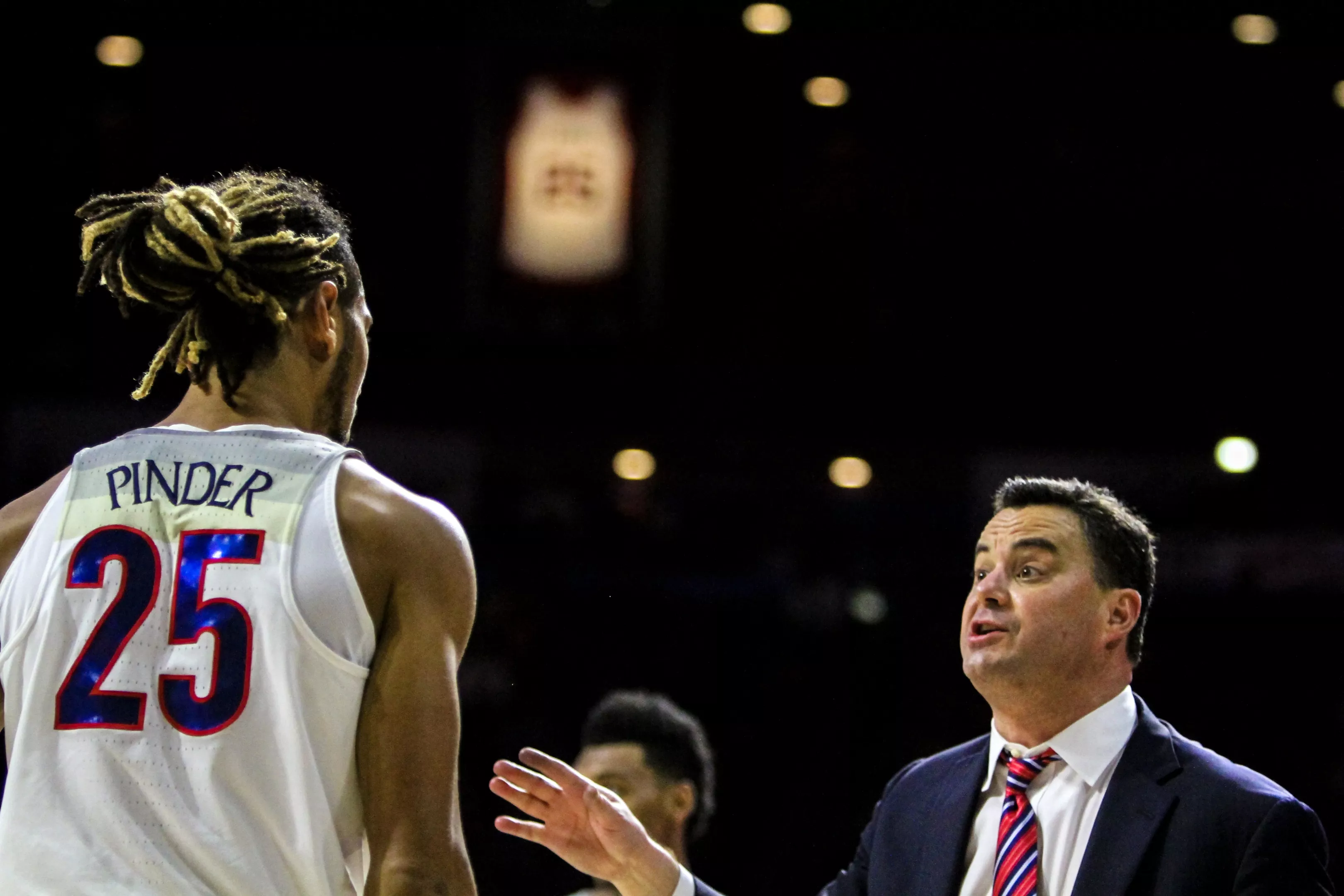
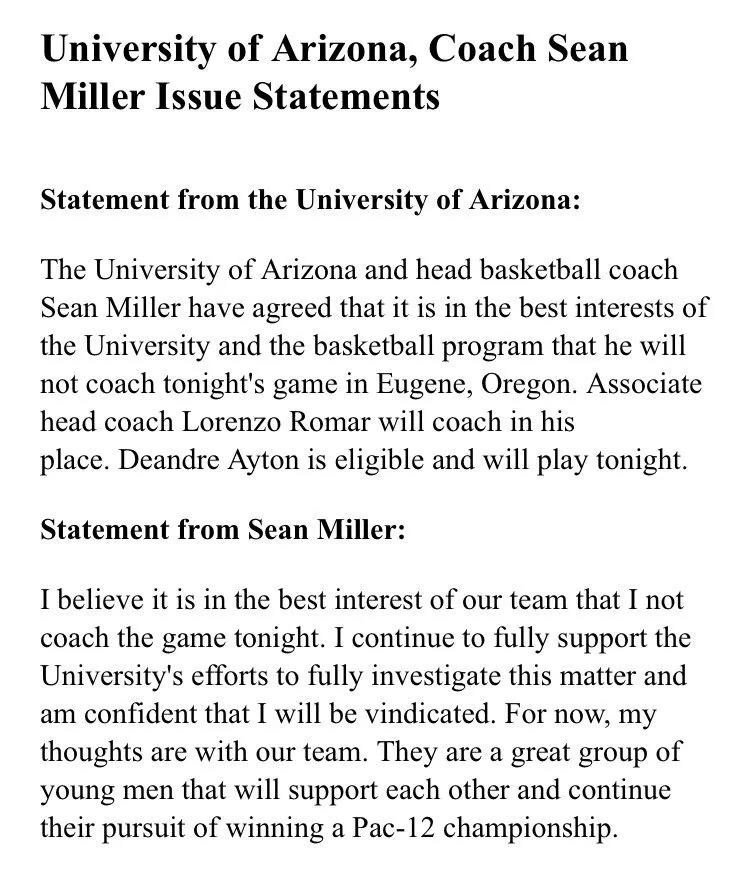
The ESPN report alleges that Coach Sean Miller discussed paying $100,000 to recruit seven-foot freshman Deandre Ayton.
The discussion, according to the report, was picked up by an FBI wiretap of former sports agent Christian Dawkins, a main source in the FBI’s investigation.
The FBI collected more than 3,000 hours of conversation between the former ASM agent and various subjects, according to the report, including Miller’s discussions.
Ayton, who’s averaging 19.6 points per game and 10.9 rebounds this season, was among the highest-rated prospects in the Class of 2017, highlighting Miller’s recruiting efforts.
The University, as of noon Saturday, has yet to say whether Miller or any players and assistants will be suspended or terminated.
The team is 22-6 this season, with a one-and-a-half game lead atop the Pac-12 conference standings. They play Oregon at 8:15 p.m. tonight.
According to ESPN, Miller’s contract has a buyout package that would cost $10.3 million to fire him for cause.
Oddly enough, Miller’s buyout would only be $5.15 million, should they fire him without cause, according to ESPN’s Darren Rovell.
Thursday, February 22, 2018

The answer is, never that I can recall. I can't remember old-manning teenagers about the good ol' days, ever.
Matter of fact, when a discussion in one of my high school English classes led to a moment when it looked like it was time for me to Tut-tut my students, I'd often say, "You know, right about now, I'm supposed to tell you what's wrong with your generation, how young people used to be polite and mind their parents and turn in their homework and join in marches for civil rights and protest the Vietnam war back in my day. But it's kind of hard for me to old-man you when my generation's slogan was 'Sex, Drugs and Rock 'n Roll.'"
Maybe as a teacher I wasn't supposed to say that. Setting a bad example and all. Except it's true. Children of the 60s have plenty to be red-faced about when we think about some of the things we said and did. And as for the 50s, well, we 60s college students were the ones who condemned our formative years for their lock-step conformity, racism and sexism. It would have been beyond hypocritical for me to praise the "Father Knows Best" era.
To my last day in the classroom, I maintained the students I had in the final years of my career were as good as, maybe even a little better than, my first students 30-plus years earlier.
The kids are all right. Always have been — acknowledging the obviously stupid, irrational, dangerous behavior which is part of growing up (also part of being a grown up, as this grown-up can attest). All the way back to the youth of ancient Athens running wild in the agora and, according to the leaders of the city-state, having their minds corrupted by that rabble rouser Socrates, the kids have been all right. When youth do truly awful, vicious, violent things, they're likely mirroring the society they live in.
Tags: Gun violence , Marjory Stoneman Douglas High School , Gun laws , NRA , Image
Theater

Black Pearl Sings! There are two things to know about Alberta “Pearl” Johnson. She’s in prison for life for murder, and the rare folk songs her ancestors have passed down to her are her lifeline to her family. Susannah, a collector of songs for the Library of Congress, wants to record Pearl singing the songs. To Pearl, Susannah could mean freedom. And to Susannah, Pearl could mean a huge advancement in her career. But the two find themselves tied together in ways deeper than they expected in this play that pass the Bechdel test with flying colors. 7:30 p.m. Thursday, Feb. 22 through Saturday, Feb. 24 and 3 p.m. on Saturday, Feb. 24 and Sunday, Feb. 25. Invisible Theatre, 1400 N. First Ave. $34 GA.
Let’s Get Literary
Panel: Poetry + Non-literary Influence. The Bagley Wright Lecture Series at the UA has given poets a platform to talk about the way they think about poetry since 2013. In this event, lecturers Dorothea Lasky, Joshua Beckman, Timothy Donnelly, Terrance Hayes, Rachel Zucker, Srikanth Reddy and program director Matthew Zapruder will all be reading from their lectures and talking about some of their greatest influences from outside the world of poetry. 3 to 4:30 p.m. Saturday, Feb. 24. UA Poetry Center, 1508 E. Helen St. Free.Tags: Lost in Yonkers , Arizona Rose Theatre , Black Pearl Sings! Invisible Theatre , Bagley Wright Lecture Series , Spent Saints , Brian Smith , B.S. Eliot , Cactus Flower Comedy Festival , women , women are funny , 2018 peace fair and music festival , Arizona Renaissance Festival , unreasonably large turkey legs , UA Discovery Days , free museum entry , Girls’ Day , Hinamatsuri , mini time machine museum , Babar the Elephant , Goat Playground Day , the goat , Chlidren’s Adventure Hour , Tucson Presidio , Remi Geniet , Verdi Requiem , The Ten Tenors , David Bowie , Leonard Cohen , Prince , John Lennon , Michael Jackson , Amy Winehouse , Summit Hut Swap Meet , M.O.V.E. , hiking , outdoors , Southwest American Indian Collector’s Expo , Tucson Roadrunners , San Antonio Rampage , San Antoni-foes , Tucson Rodeo , The White Buffalo , Marty Grimes , Motionless in White , Image
Wednesday, February 21, 2018

Of the 8.5 million people in Israel (the number doesn't include the 5 million Palestinians in the West Bank and Gaza), about 135,000 of them have gun licenses — more like 100,000 if you remove the security guards. Most of the licenses are for 9 mm pistols.
So why is our "Second Amendment above all else" crowd implying Israel is a model for rampant gun ownership in the U.S.?
Mike Huckabee and Wayne LaPierre have claimed in the past few days that the security guards Israel places in front of schools are the reason the country doesn't have the kind of shootings we do. People in Israel beg to differ. They say the guards are there to protect against the very real threat of terrorism. The country doesn't suffer from the kind of regular, random, out-of-nowhere shootings we have in this country, in schools or elsewhere. One reason is, they have far stricter gun laws.
An article in the New York Times describes Israel's gun laws. Anyone who scoffs and shouts "FAKE NEWS" because the article is in the Times is an idiot. Do your own research and see if the Times reporting bears out. I did, for a column I wrote in the Northwest Explorer in 2012 following the horrific Sandy Hook school shooting. The situation hasn't changed significantly since then.
Tags: Gun laws , Israel , Mike Huckabee , Wayne LaPierre , Sandy Hook , Image
In this televised edition of Zona Politics with Jim Nintzel: State Rep. Pamela Powers Hannley and state Sen. Andrea Dalessandro sit down for one-on-one interviews about what's going on at the Arizona Legislature this session.
When someone suffers a stroke, there is poor blood flow to the brain, and this results in the death of brain cells. Dead fragments of the brain don’t heal like normal muscle or body tissue — they liquify, and this liquid brain stays in the skull, right next to the healthy brain, for a long time.

Scientists at the UA’s College of Medicine found this liquefied brain tissue is toxic and can leak into the remaining healthy portion of the brain over time, potentially causing harm.
“Most people probably assume that the brain heals in the same way as other tissues,” said Kristian Doyle, PhD, assistant professor of Immunobiology at UA. “But it doesn’t; dead brain tissue doesn’t just heal and go away like other bodily injuries. Instead it liquefies and remains in this liquefactive state for a long time.”
These new findings may open the door for developing new treatments to fight dementia after a stroke. Roughly 10 million people survive a stroke annually. About one-third of which will develop dementia for unclear reasons. It is hypothesized that if the brain is injured near the hippocampus (the portion of the brain responsible for memory) this slow leak of toxic fluid can cause neuron loss in the brain and lead to memory problems.
“This work really challenges the old paradigms and breaks new ground critical for our understanding of stroke and its consequences,” said doctor Janko Nikolich-Zugich, chair of the UA Department of Immunobiology. “Thanks to this research, we now will be able to consider new and different stroke therapies.”
Tags: UA , College of Medicine , Stroke , Image
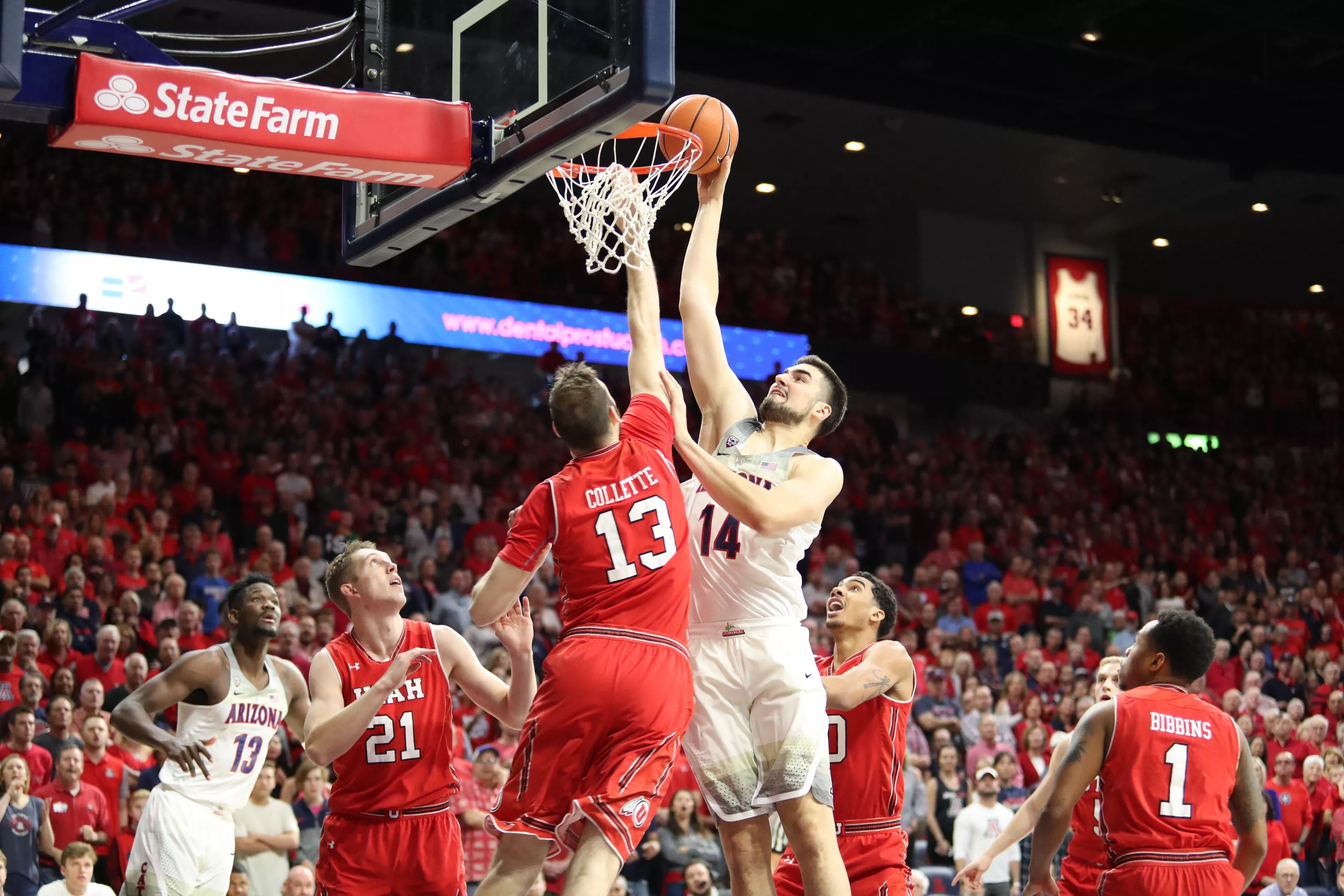
Sean Miller knows full well the horrors that await any team that sleepwalks into the cavernous confines of Gill Coliseum in Corvallis, Oregon.
That’s because Miller has been on the wrong side of the matchup in the Willamette three times since 2010, most recently in 2015, when the then-seventh ranked Wildcats met a Beaver buzz saw, falling 58-56, after former guard (and Philadelphia 76ers legend) T.J. McConnell missed a game-tying jump shot at the buzzer.
The Wildcats (21-6, 11-3) achieved some sort of redemption last year, trampling the semiaquatic rodent (and official state animal of Oregon) 71-54.
Fast-forward 385 days, and the two species will do battle at Gill once again, with the Wildcats looking for a third-consecutive victory.
A win on Thursday would also give Miller and company some breathing room atop the Pac-12 standings, with a current 1.5-game lead over UCLA and USC.
Miller knows that Thursday’s battle in Corvallis, which tips off at 7 p.m. Arizona time, will test the team’s resolve, in the first part of the team’s final road trip of the season.
“[Oregon State’s] a very physical team. They’re a team that takes a lot of pride in their defense, their half-court defense,” Miller said in his weekly press conference. “They do it by playing a lot of zone, not all zone, even when they’re man-to-man, they’re very physical.”
Miller highlighted the unenviable task of slowing down a pair of Beavers that have torched defenses this season: Forwards Tres Tinkle and Drew Eubanks, who average 18.1 and 12.9 points per game this season, respectively.
“I think Drew Eubanks is one of the most underappreciated, or underrated players in our conference,” Miller said. “He’s very good. He’s a great shot blocker. Part of Oregon State’s physicality really is him. He’s rugged, and he does it on defense and offense.”
Eubanks struggled in the team’s first meeting, scoring 8 points on 4-of-13 shooting, in a 62-53 slugfest that Arizona ultimately won at McKale.
Miller knows that his team will have to play significantly better against the Beavers, who enter Thursday’s game on a two-game slide, in order to pick up their 22nd win of the season.
“The first game, we did not generate enough good shots,” Miller said. “That had a lot to do with their defense, we had large segments of that game where we didn’t play exceptionally well. And I think that had a lot to do with it. And we’re going to have to be better this time around, for sure.”
Winning time
This week’s Beaver State road trip (yes, that’s actually the Oregon’s official state nickname), is of paramount importance to players and coaches alike, said senior center Dusan Ristic.The Serbian big man, who had eight points and eight rebounds against the Beavers in Tucson, expects a nightlong battle in Corvallis.
“Obviously, the Oregon schools are really good, even though their record isn’t that good, they have talented players,” Ristic said. “They play well. They have a few bad losses, but they’re good teams. Both of them.”
Ristic, who’s having a career year, in terms of points (11.9), rebounds (7.1) and field goal percentage (58.8 percent), is locked in to preparing for this week’s matchups against the Beavers and Ducks.
“Right now, our focus is on the Oregon trip,” Ristic said. “I think this is arguably one of the most important trips for the season for us. I think if we win both games, we’re going to put ourselves in a really good position to win the Pac-12 after these two games, so that’s our main focus.”
The 7-foot center from Novi Sad says his focus is on doing whatever it takes to get Arizona into the NCAA Tournament, and perhaps into the Final Four for the first time since 2001.
Doing so, he said, would put a cherry on top of what’s been a memorable four years in Tucson for the soft-spoken big man.
“We have a lot of goals to achieve,” Ristic said. “Even though we have four games left in the Pac-12, our goals are much bigger than only the Pac-12 itself. I think our goals for this year are just winning in March, going to the Final Four, and winning the National Championship. And if this team can do that then I will say that my goals will be 100 percent achieved here.”
How to Watch: Arizona plays Oregon State at 7 p.m. Arizona time, with Fox Sports 1 airing the game.
Tags: Sean Miller , Dusan Ristic , Pac-12 , Arizona Wildcats , Oregon State Beavers , Tres Tinkle , Devin Eubanks , Corvallis , Oregon , Arizona , Gill Coliseum , McKale Center , Oregon Ducks , Novi Sad , Serbia , Image
Tuesday, February 20, 2018

The Flycatcher nightclub may be demolished for seven-story apartments and retail space under contract with Education Realty Trust Inc., or EdR, a student-housing development company out of Memphis. The area that EdR has under contract stretches west from the corner of Fourth Avenue and Sixth Street to Fifth Avenue. The development is in the Infill Incentive District (IID) focused on creating more urban planning designs and offering development incentives and flexibility. With this development, EdR is reported to be avoiding the “group dwelling” designation for student housing and instead using the designation “multifamily dwelling” by renting units by room rather than bed and avoiding parking, loading, and landscaping standards.
Local First Arizona has many concerns about a development of this nature despite the supposed economic development benefits that will be touted. We have seen this story unfold before in the City of Tempe. What may seem like simply one new development different than the rest of Fourth Avenue can easily become a trend and the new norm. As Tempe invited more chains to their thriving downtown decades ago, the sales tax revenue dropped steadily for 27 months. Thus, the history and culture of localism on Fourth Avenue must continue to be supported and strengthened to prevent similar trends and norms here in Tucson. Tucsonans and visitors alike have embraced the avenue because of its makeup of unique local businesses, making it a top destination and driving a powerful local economy for decades.
Local ownership is critical to the prosperity of our local communities. By creating a structure of policies and processes for local businesses to be supported, more revenue will stay in Tucson. Local ownership is supported by models of economic development, including reducing economic leakage, avoiding ‘big-whale’ strategies, creating diverse and resilient economies by leveraging local talent, focusing on retention and expansion, tourism and events, and establishing a unique position in the market through these models combined.
What can the community do to address this development that is jeopardizing local ownership? Local First Arizona recommends advocating for the following action steps:

