

Thursday, August 13, 2020
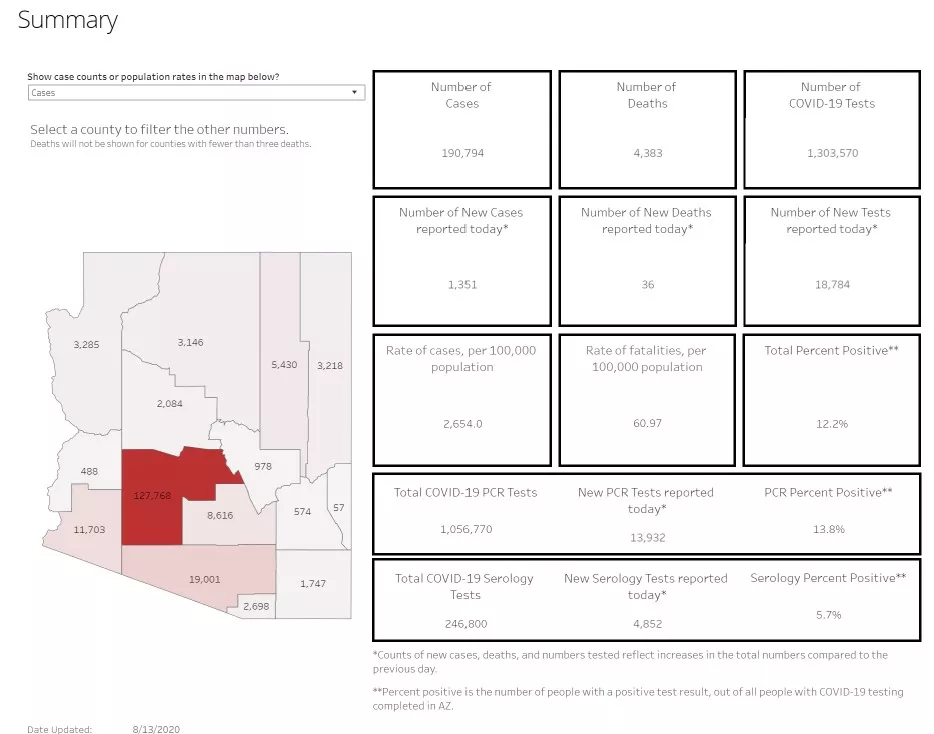
Pima County had seen 19,001 of the state’s 190,794 confirmed cases.
A total of 4,383 Arizonans had died after contracting COVID-19, according to the Aug. 13 report.
The number of hospitalized COVID cases continues to decline. ADHS reported that as of Aug. 12, 1,411 COVID patients were hospitalized in the state, down from a peak of 3,517 on July 13.
A total of 1,026 people visited ERs on Aug. 12 with COVID symptoms. That number peaked at 2,008 on July 7.
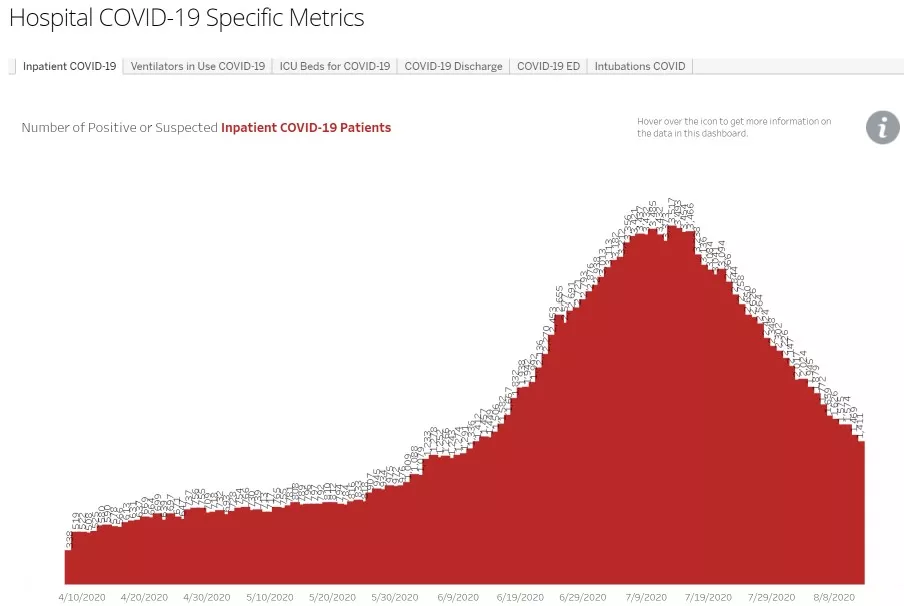
A total of 497 COVID-19 patients were in ICU beds on Aug. 10. The number in ICUs peaked at 970 on July 13.
Pima County sees downward trend in cases following mask mandate
Following the passage of an ordinance on June 19 requiring people to wear masks when out in public, Pima County has seen a dramatic drop in the number of new positive COVID-19 tests.
The number of cases dropped from a high of 2,368 new cases in the week ending July 4 to just 865 in the week ending Aug. 1, according to a Pima County Health Department report.
Fewer people are dying as well. Deaths related to COVID-19 peaked the week of July 4 with 51 people. The week ending Aug. 1, Pima County saw just 20 deaths.
Wednesday, August 12, 2020

The Arizona Department of Health Services has observed an increase in deaths due to suicide and drug overdose during the COVID-19 epidemic, according to Dr. Cara Christ, the department’s director.
“We are seeing an increase in drug overdose and in suicides, not just here in Arizona but nationally. Could some of that be associated to the isolation and loneliness? That was one of the things that we were worried about,” she said during a July 16 news conference.
Arizona health officials declined requests for further comment on the subject. While publicly available data reveals that in Arizona there had been 48,120 suspected opioid overdoses between June 15, 2017, and Aug. 7, 2020, the health department does not share data that isolates the number of suicides since the start of the pandemic.
Nationally, there had been a 17.59% increase in drug overdoses from March 19 to May 19, as reported by the Overdose Detection Mapping Application Program.
Health officials in other states, such as Illinois and Washington, are voicing similar concerns, as the number of incidents continues to grow.

Native communities throughout the country have cancelled the traditional gatherings indefinitely as a result. But Tiny Rosales, a member of the Ojibwe tribe, has found a way to “to keep the people dancing.”
In March, Rosales created a space on Facebook allowing families, schools and businesses to host virtual Native dance competitions from afar.
Four months later, “Quarantine Dance Specials 2020” has more than 71,000 members and hundreds of video submissions from Indigenous dancers in Canada and the United States.
“Some (Native) people are having a hard time right now” as the pandemic continues to spur cancellations and limit gatherings, Rosales said.
“These specials are not a powwow … but it does feel good to be able to get dressed and put our outfits on and dance.”

Almost 1.88 million people were covered by the Arizona Health Care Cost Containment System – the state’s Medicaid program – on March 1, the month coronavirus-related shutdowns started to take effect. By July 1, the number had topped 2 million and by Aug. 1 enrollment stood at 2,041,990, an increase of 8.7%.
The surge follows skyrocketing unemployment in the state, as COVID-19 shutdowns have shuttered industries. Arizona’s unemployment rate in June was estimated at 10% by the Bureau of Labor Statistics, down sharply from a high of 13.4% in April but still more than twice the 4.5% in February.
For many, like Tempe resident Cindy Andrews, the loss of a job has led to a loss of health insurance.
Andrews lost her job as a physical therapist in March and bought COBRA coverage, which lets workers continue on their health plan for a limited time at a hefty price. When she learned she had cancer, it helped pay for her surgery and radiation, but she dropped it soon thereafter because of the cost.
For Andrews, it has been a stressful experience.
Tuesday, August 11, 2020

Scott laid out the conference's decision in a press release on Tuesday afternoon, saying the communal spread of the COVID-19 coronavirus was still too rampant to risk players' health.
"We will continue to monitor the situation and when conditions change we will be ready to explore all options to play in the new calendar year," Scott's statement to the media read.
During the call, Scott discussed his desire for all fall athletes to maintain their current year of eligibility, while maintaining their scholarships as well. Scott addressed the realities of the virus, saying that holding events in a "bubble," where student-athletes are isolated from the rest of a given campus, was not realistic.
"This was an extremely difficult decision that we know will have impacts on our fans and student-athletes," Scott said.
University of Arizona Athletics Director Dave Heeke said he and his staff supported the decision.
This is an incredibly difficult outcome for the entire Wildcat Family of student-athletes, coaches, staff, alumni and supporters," Heeke said in a prepared statement. "I have a great deal of empathy for these student-athletes and the impact this will have on them personally. Representing our University, community and state in competition is the foundation of the mission of Arizona Athletics and the Wildcat Way. However, the endless hard work of our student-athletes, coaches and staff in preparation for Fall seasons is something we can all be proud of. The work of everyone who represents the Wildcat Way over the last five months has been an outstanding display of unity and resiliency."
Heeke said the Athletics Department would continue its reentry planning with other university departments.
University of Oregon President Michael Schill, who heads the Pac-12 CEO Group, which is made up of conference presidents and chancellors, said the ongoing uncertainty led to the cancelation.
"Our number one consideration all the way through was the health and safety of our student-athletes," Schill said. "Ever since this nightmare began about how we would approach this with intercollegiate athletics, we listened to all of the views and we determined that there’s just too many questions and uncertainty to feel comfortable beginning contact sports on-time."
Scott said the conference will continue to monitor the virus' spread, with an eye toward beginning competition whenever it's safe to do so. The conference's goal, according to Scott, is to push back the start of the winter sports season to early January, while playing football and other fall sports at an undetermined time in the spring.
"We feel a responsibility to try to give some of that responsibility and clarity. We want to give student-athletes time to plan," Scott said. "As soon as we feel comfortable and it feels safer and we feel more comfortable, we’re going to play."
That comfort level was not where it needed to be, especially given the travel and logistical demands of a given season, according to Dr. Doug Aukerman, who serves as the senior associate athletic director at Oregon State University.
"As we looked at traveling and making sure that we could stop the spread of coronavirus if a staff member or athlete got it, we felt that we had to shift to a mindset to not just stop spread, but to immediately remove anyone that has coronavirus right way," Aukerman said.
A local jerk has become Twitter famous after a video of his anti-mask tantrum in a Tucson Sprouts was posted on social media yesterday. When you get to the point where you have to be carried out of a store by your kid because you won't wear a mask, you've hit rock bottom.Anti-masker in Tucson, AZ throws a tantrum and has to be carried out by his own son pic.twitter.com/ggo4I968aL
— Fifty Shades of Whey (@davenewworld_2) August 11, 2020
Wednesday, August 5, 2020

Nearly half of all incarcerated people housed inside the Whetstone Unit of the Tucson state prison complex have tested positive for COVID-19, the Arizona Department of Corrections announced Tuesday evening.
The department indicated that 517 people out of the total 1,066 population have the virus. They are currently being housed together in a separate living area and are receiving “appropriate medical care.”
“They will not be allowed back into the general population until they have been medically cleared,” the department said in a press release. “In addition to measures that are already in place, all inmates at Whetstone will receive meals and all required medication and medical services in their housing units.”
Tags: COVID-19 , Coronavirus , Arizona Department of Corrections , Tucson , Whetstone Unit , Image
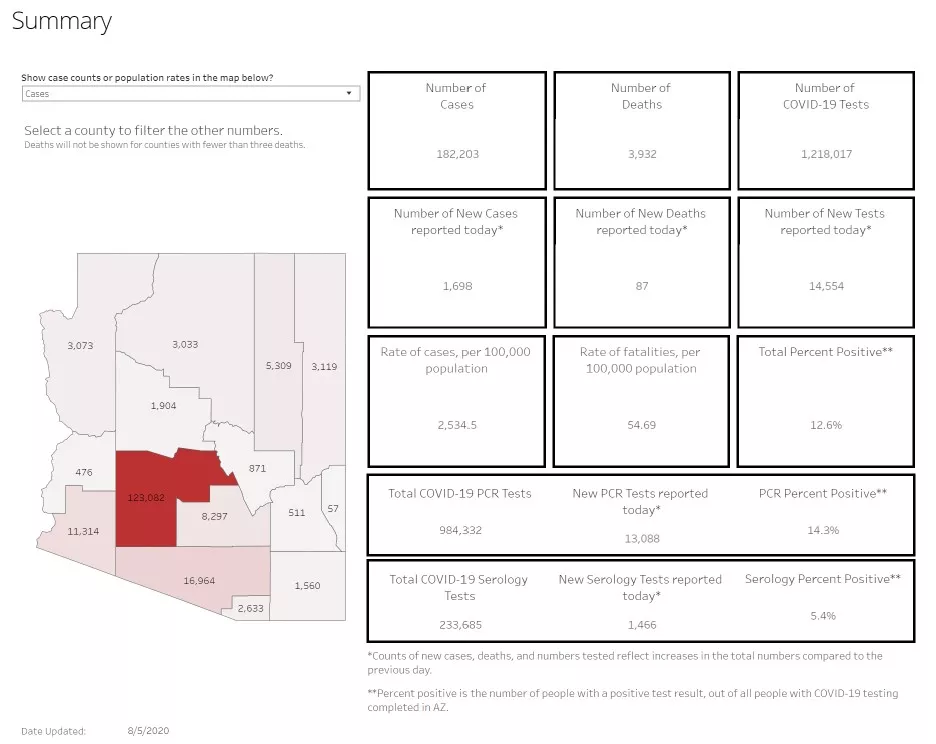
Pima County had seen 16,964 of the state’s 182,203 confirmed cases.
A total of 3,932 Arizonans had died after contracting COVID-19, according to the Aug. 5 report.
Arizona hospitals remain under pressure although the number of patients has declined from a peak last month. ADHS reported that as of Aug. 4, 1,945 COVID patients were hospitalized in the state, down from a peak of 3,517 on July 13.
A total of 1,171 people visited ERs on Aug. 4 with COVID symptoms. That number peaked at 2,008 on July 7.
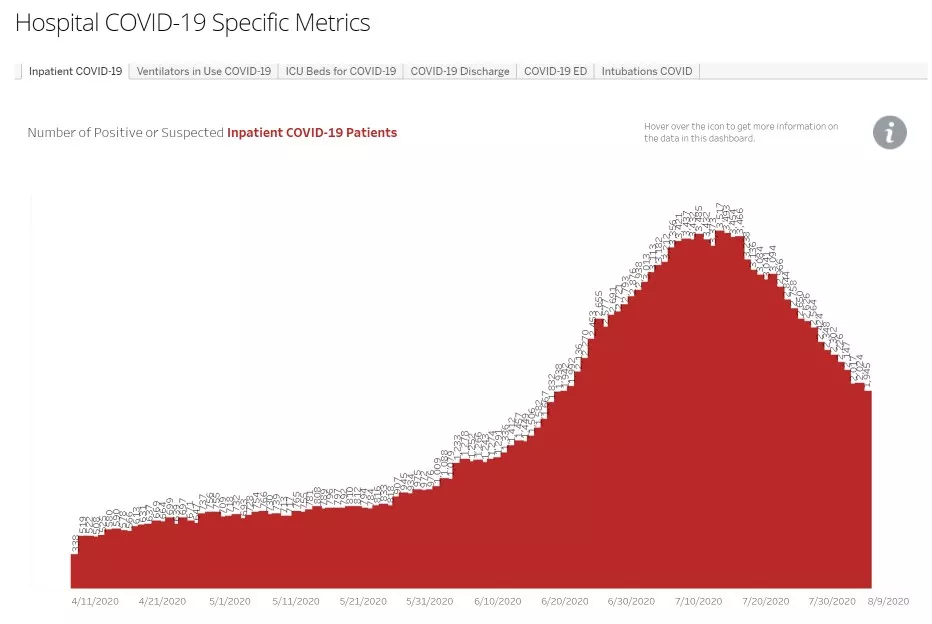
A total of 618 COVID-19 patients were in ICU beds on Aug. 4. The number in ICUs peaked at 970 on July 13.
July: Downward trend but a rough month
Pima County Administrator Chuck Huckelberry noted on Friday, July 30, there’s evidence that Pima County’s ordinance requiring masks or face coverings is lowering COVID-19’s spread in the region.
Huckleberry pointed to data showing that two key coronavirus trends measured by week began moving in a positive direction after the county passed the ordinance: The number of positive tests peaked at 2,351 the week after the mask ordinance was passed and dropped to 1,393 two weeks later, and the percentage of people visiting hospitals with symptoms of COVID or pneumonia had dropped from nearly 12 percent to less than 4 percent.

Despite those positive trends, Tucson City Councilman Steve Kozachik warned that the virus remains widespread. In his weekly newsletter, Kozachik pointed out that Pima County saw 7,747 confirmed cases of COVID in July. That’s nearly as many cases as the 7,780 cases the county saw in total over the previous four months of March, April, May, and June.
Monday, August 3, 2020
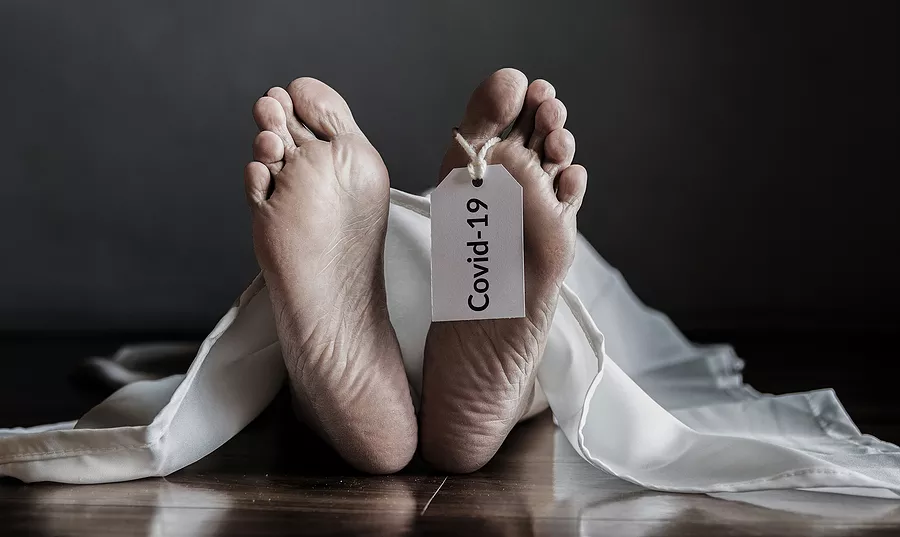
When police discovered the woman, she’d been dead at home for at least 12 hours, alone except for her 4-year-old daughter. The early reports said only that she was 42, a mammogram technician at a hospital southwest of Atlanta and almost certainly a victim of COVID-19. Had her identity been withheld to protect her family’s privacy? Her employer’s reputation? Anesthesiologist Claire Rezba, scrolling through the news on her phone, was dismayed. “I felt like her sacrifice was really great and her child’s sacrifice was really great, and she was just this anonymous woman, you know? It seemed very trivializing.” For days, Rezba would click through Google, searching for a name, until in late March, the news stories finally supplied one: Diedre Wilkes. And almost without realizing it, Rezba began to keep count.
The next name on her list was world-famous, at least in medical circles: James Goodrich, a pediatric neurosurgeon in New York City and a pioneer in the separation of twins conjoined at the head. One of his best-known successes happened in 2016, when he led a team of 40 people in a 27-hour procedure to divide the skulls and detach the brains of 13-month-old brothers. Rezba, who’d participated in two conjoined-twins cases during her residency, had been riveted by that saga. Goodrich’s death on March 30 was a gut-punch; “it just felt personal.” Clearly, the coronavirus was coming for health care professionals, from the legends like Goodrich to the ones like Wilkes who toiled out of the spotlight and, Rezba knew, would die there.
Friday, July 31, 2020

As of Friday, July 31, the Arizona Department of Health Services reported 3,694 deaths from COVID-19, which was first reported in the state on Jan. 26. That number has grown by 631 in the last week alone.
If COVID-19 deaths continue at the current pace, that would put the disease squarely between cancer, which killed 12,097 Arizonans in 2018, and accidents, which killed 4,211 people that year, the most recent for which state mortality numbers are available.
A health department official cautioned against reading too much into the numbers at this time, however, noting that the cause of death will not be official until analysts can review death certificates, something that is not likely to happen until late 2021.
“Final death certificate information can take weeks or months to collect, depending upon the complexity of each case and whether testing or autopsy is required through the medical examiner,” said Holly Poynter, the department spokesperson, adding that final counts “tend to be lower than the counts produced” by daily reporting.
But other health experts in the state said the disease could “easily” become one of the biggest killers in the state this year.

