
Wednesday, October 28, 2020
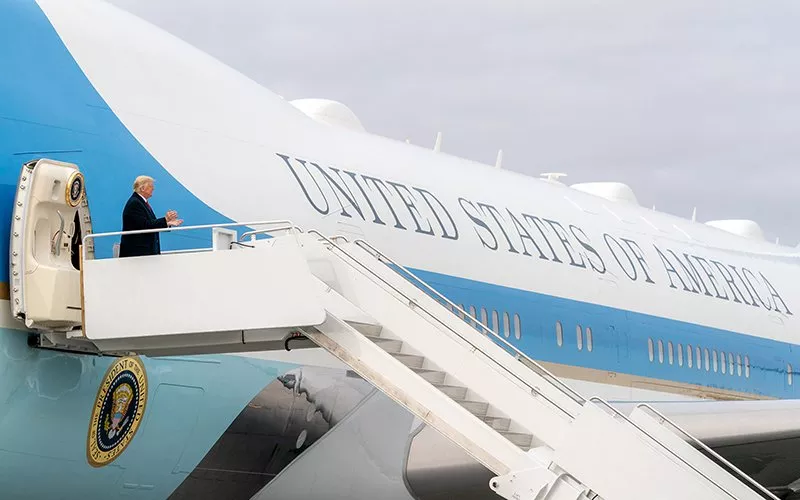
WASHINGTON – When Air Force One touches down in Arizona for President Donald Trump’s campaign visits to Bullhead City and Goodyear on Wednesday, it will be at least the 20th campaign stop for the jet in the past eight days.
Who pays for those trips? You do. Maybe. Or maybe the Trump campaign does. Or a little bit of both. Government watchdog groups say they have not been able to get a full accounting of the expenses related to the president’s use of Air Force One, despite years of trying.
“This is just a matter of good government transparency,” said Demian Brady, director of research for the National Taxpayers Union Foundation. “We should be able to have access to how our taxpayer dollars are being spent.”
The NTUF did learn Tuesday that the latest cost of operating the president’s plane has risen to $176,393 per hour, up from $142,380 per flight hour in 2017, the last time the Air Force reported the amount. An Air Force spokesperson confirmed the higher amount in an email Tuesday.
The NTUF is not the only group clamoring to get information on the costs of the president’s trips. The conservative group Judicial Watch took the administration of then-President Barack Obama to court to try to learn the costs associated with his travel, and it has continued that practice – with limited success – with the Trump administration.
Tags: trump , air force one , 2020 election , Image
Tuesday, October 27, 2020
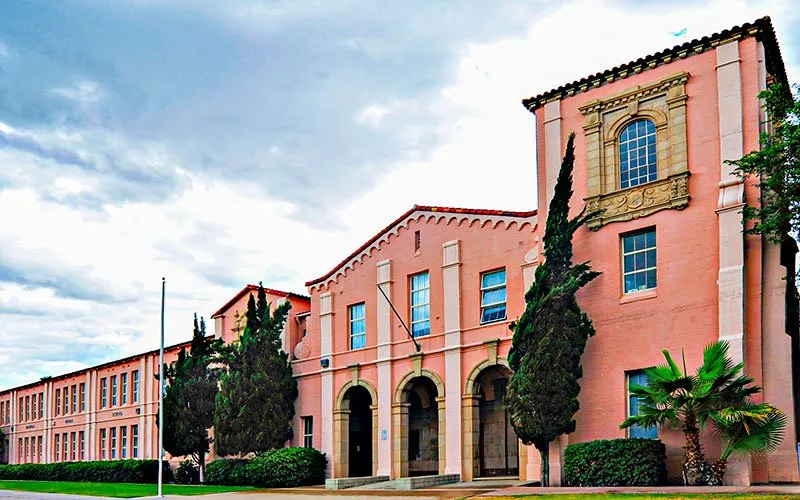
Tucson’s largest school district will allow students to return to in-person classes starting Nov. 12.
Tucson Unified School District’s governing board voted to return to school in a hybrid model in a 3-2 vote Tuesday night.
Board members Kristel Foster, Bruce Burke and Leila Counts voted to approve the reopening date, and members Adelita Grijalva and Rachael Sedgwick opposed.
The board voted to approve the hybrid learning model on Oct. 6 but delayed voting on when to implement it until Tuesday's special meeting.
Pima County Public Health Director Theresa Cullen discussed the county health department’s three specific guidelines for opening in a hybrid model: a two-week decline in COVID-19 cases, two weeks of percent positivity below 7 percent and hospital visits for COVID-19 illness below 10 percent. As of Oct. 22, Pima County had met all three benchmarks.
“We believe that as a county, it is okay for school districts to go to a hybrid learning model based on the current statistics,” Cullen said.
She noted the health department recommends the district take strict mitigation tactics including increased sanitation, social distancing and universal mask-wearing, as well as reporting COVID-19 cases to the health department and complying with isolation and quarantine guidelines.
The governing board unanimously approved a second motion to authorize “the Superintendent to initiate school closures…if such closures are recommended by the Pima County Health Department and deemed necessary to mitigate the spread of COVID-19 in Pima County.”
TUSD’s hybrid model
The TUSD board approved a new hybrid model for returning to school in-person that involves separating students into hybrid and online-only groups.
Four days a week, in-person students learn at their physical school sites for the first half of the day and work remotely from home the rest of the day. On Wednesdays, every student attends class remotely.
Remote students work asynchronously in the mornings and attend online teacher-led instruction in the afternoon. While teachers are instructing remote students the second half of the day, students in the hybrid system work asynchronously.
Asynchronous work involves working on class projects and assignments, social-emotional learning lessons with counselors, specialized services and working on digital platforms, according to a presentation from TUSD.
TUSD also came up with a contingency plan if the percentage of students who wish to attend classes in-person is at an unsafe level. This level, which the district refers to as a “threshold,” depends on each campus, but TUSD says most are between 45-60% of students on campus.
If a threshold becomes too high, the school will have the option of splitting their in-person students into two cohorts to attend classes on different days. Cohort A would attend on Mondays and Thursdays while cohort B would attend on Tuesdays and Fridays.
Tucson-based psych/cumbia rockers have released the second single from their upcoming sophomore album Genesis, set to release Feb. 19, 2021. The new track, "May They Call Us Home," features the band's familiar blend of borderlands guitar and trippy production, and ventures further into the esoteric themes teased by the first single "Genesis of Gaea."
The track comes with a new music video, stuffed with a blend of desert imagery, spiritual elements, and surreal editing a la Jodorowsky's El Topo. The video was written and directed by Charlie Stout, and features XIXA traveling through the Sonoran Desert, beckoned by a monk played by Tucson musician Howe Gelb (Giant Sand).
“The song infuses the tones and landscapes of our Sonoran homeland together with the rhythm and melody that we’ve found in chicha music,” said XIXA member Gabriel Sullivan in an interview with FLOOD Magazine. “It is us bringing Spanish and English lyrics together. It is us bringing mysticism and spiritual consciousness together with the earth.”
Got more Tucson music news? Email [email protected]
The Senate voted 52-48 to confirm Judge Amy Coney Barrett’s appointment to the Supreme Court on Monday, with Sen. Martha McSally casting a vote in favor of the judge receiving a lifetime appointment on the nation’s highest court, which will now hold a 6-3 conservative majority.
The Supreme Court will hear oral arguments in the Trump administration’s lawsuit to overturn the Affordable Care Act (ACA) on Nov. 10, one week after the general election. Protect Our Care, a healthcare advocacy organization, says overturning the Obama-era healthcare law could cause 223,000 Arizonans to lose their coverage.
Many have expressed concerns about Republican-nominated Coney Barrett, who could cast a vote to dismantle the ACA.
After the Supreme Court confirmation, Protect Our Care hosted a virtual press conference Tuesday to discuss the implications of McSally’s vote to approve the judge.
“With just a week left to election day, the confirmation of Amy Coney Barrett to the U.S. Supreme Court makes the situation even more dire. It has been literally shocking to watch the GOP, including Arizona’s Martha McSally, help rush through her nomination,” state Rep. Kelli Butler said at the conference. “With the entire Affordable Care Act set to be heard by the Supreme Court right after the election, we can expect her presence on the court is likely to be devastating to the ACA and for all its protections for your healthcare.”Today I had the honor of casting a historic vote to confirm Judge Amy Coney Barrett to the Supreme Court. She is a brilliant, fair jurist who will bring a stellar judicial temperament to the bench. I look forward to seeing her take her seat on our nation's highest court. pic.twitter.com/y3UKtpMhuv
— Martha McSally (@SenMcSallyAZ) October 27, 2020
Under the ACA, health insurance companies cannot deny coverage based on pre-existing conditions. Butler says if it were overturned, this would put nearly 2.8 million Arizonans with pre-existing conditions at risk, and that despite claims otherwise, there’s not a solid replacement plan to protect pre-existing conditions.
“Republicans like Martha McSally...have tried to basically fool you into thinking they want to protect people with pre-existing conditions,” Butler said. “It’s easy for them to say they want to protect people with pre-existing conditions, but their actions tell the real story, because there is only one set of laws that guarantees people with pre-existing conditions can get insurance coverage for the care they need, and that’s the Affordable Care Act.”
Alicia DeWitt, a Tucsonan survivor of the rare illness Cushing's Disease, shared how a lack of access to healthcare has been detrimental to her livelihood.
At 20 years old, she began developing “concerning medical symptoms,” but without health insurance, she couldn’t afford to see a specialist. Ten years later, doctors diagnosed DeWitt with a brain tumor and she had her pituitary and adrenal glands removed.
This week, doctors found a regrowth of her tumor tissue.
“I can’t help but think back on that if I had been a 20-year-old today and I had been on my parent’s insurance...I would’ve gotten an MRI, I would’ve been diagnosed with a brain tumor and I’d be living a happy and healthy life and I wouldn’t be permanently disabled from something that I shouldn’t be,” DeWitt said.

Today, the Tucson Gem & Mineral Society announced that the 2021 Tucson Gem and Mineral Show is canceled. While the overall Gem, Mineral & Fossil Showcase season that takes over Tucson from February to March is home to numerous showcases and exhibits, the Tucson Gem & Mineral Society's Gem and Mineral Show is the largest and the show that launched it all.
"COVID-19-related risks clearly make it impossible for TGMS to put on anything more than a shadow of our accustomed vibrant event," representatives of the Tucson Gem & Mineral Society announced in a prepared statement. "Restrictive COVID-19 travel policies mean many of our major domestic, and most of our international museum exhibitors and friends either won't or can't travel here. This effectively eliminates both our exhibits and educational programs."
However, the society has announced that they intend to use this time to plan for a "blockbuster" 2022 show.
"Most importantly, TGMS does not want to be responsible for a single COVID-19 fatality or serious illness. Our show is run by volunteers and many of us are in high-risk demographics...as are many of our participants and attendees," the statement continued. "Consulting closely with the Pima County Health Department, the Mayor and City Manager’s offices and the good folks who run the [Tucson Convention Center], it is clear that applying the mandated COVID-19 protocols to reduce risk would mean drastically restricted attendance and curtailment of many of our programs."
In 2018, the total Tucson Gem, Mineral & Fossil Showcase brought an estimated economic impact of $120 million to the City of Tucson.

PHOENIX – The pay gap is confoundingly stubborn: On average across the United States, women make 81 cents for every dollar a man makes, with the size of the gap varying based on a woman’s job, family status and race.
In Arizona, women fare slightly better than the national data, making 84 cents for every dollar a man is paid. That places the state at No. 11 for the smallest gender wage gap, according to a 2020 study by business.org. When the wage gap is broken down by race, many women are making even less.
Asian women overall are paid the most, matching the Arizona average of 84 cents. The gap grows for Black women, who make 65 cents on the dollar, and Hispanic women, who make 55 cents.
The National Committee on Pay Equity, which advocates for the elimination of the race and gender pay gaps, created a formula to determine how far into the following year different demographics of women would have to work to make the same as a man, on average, at the end of the year. They call each of these days “equal-pay day.”
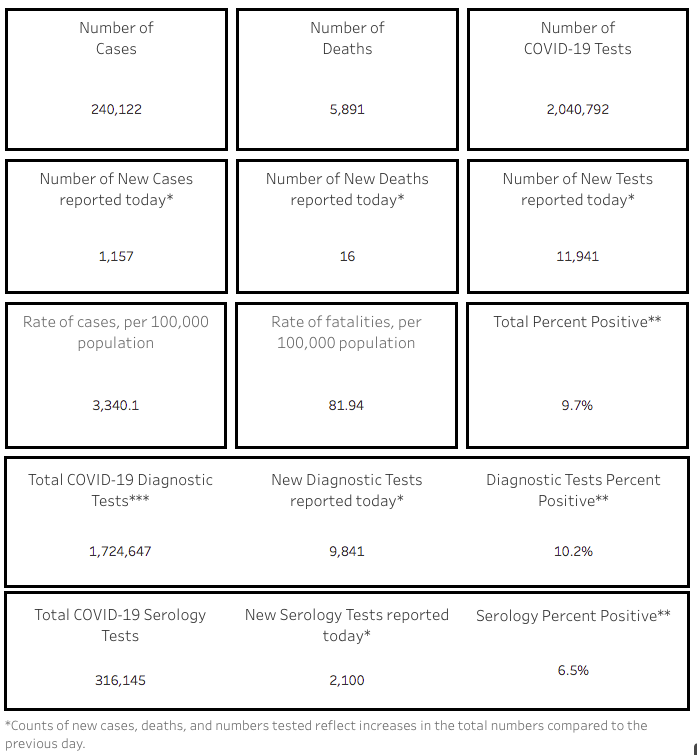
With 1,157 new cases reported today, the number of Arizona’s confirmed novel coronavirus cases topped 240,000 as of Tuesday, Oct. 27, according to the Arizona Department of Health Services.

Over the last week, the state has seen, on average, more than 1,000 new cases a day.
Pima County had seen 27,703 of the state’s 240,122 confirmed cases.
With 16 new deaths reported yesterday, a total of 5,891 Arizonans had died after contracting COVID-19, including 636 deaths in Pima County, according to the Oct. 27 report.
The number of hospitalized COVID cases has declined from July peaks but has ticked upward in recent weeks as the virus has begun to spread more rapidly. ADHS reported that as of Oct. 26, 861 COVID patients were hospitalized in the state. That number peaked with 3,517 hospitalized COVID patients on July 13.
A total of 784 people visited emergency rooms on Oct. 26 with COVID symptoms. That number peaked at 2,008 on July 7.
A total of 187 COVID-19 patients were in intensive care unit beds on Oct. 26. The number of COVID patients in ICUs peaked at 970 on July 13.
Although President Donald Trump said the “big spike” in Arizona cases was now “gone” during last week’s final presidential debate, Arizona Department of Health Director Cara Christ noted on her blog last week that cases in the state were on the increase.
Christ wrote that while Arizona has not seen as big a surge as other states, “we have recently seen a shift of COVID-19 spread in the wrong direction.”
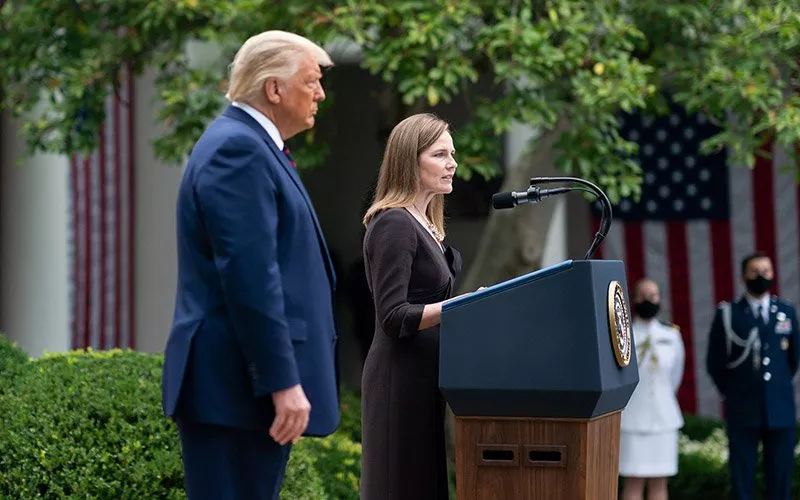
WASHINGTON – Arizona conservative groups hailed the confirmation of “capable, brilliant” Judge Amy Coney Barrett to the Supreme Court, after a rushed vote Monday that split the Senate along party lines.
Barrett’s confirmation comes less than six weeks after the death of Justice Ruth Bader Ginsburg and cements a conservative majority on the high court for years to come – what Senate Minority Leader Chuck Schumer called a “decades-long effort to tilt the judiciary to the far right.”
No Democrats voted for Barrett, who was sworn in Monday night at the White House by Supreme Court Justice Clarence Thomas within hours of the 52-48 Senate vote. Maine Sen. Susan Collins was the only Republican to vote no on the nomination.
Arizona’s senators also split on party lines, with Republican Sen. Martha McSally saying before the vote that she was eager to vote for “this highly qualified pioneering woman.” But Democratic Sen. Kyrsten Sinema, who voted no, expressed concerns over the weekend over what she called Barrett’s “inconsistent views on legal precedent.”