

Friday, October 23, 2020
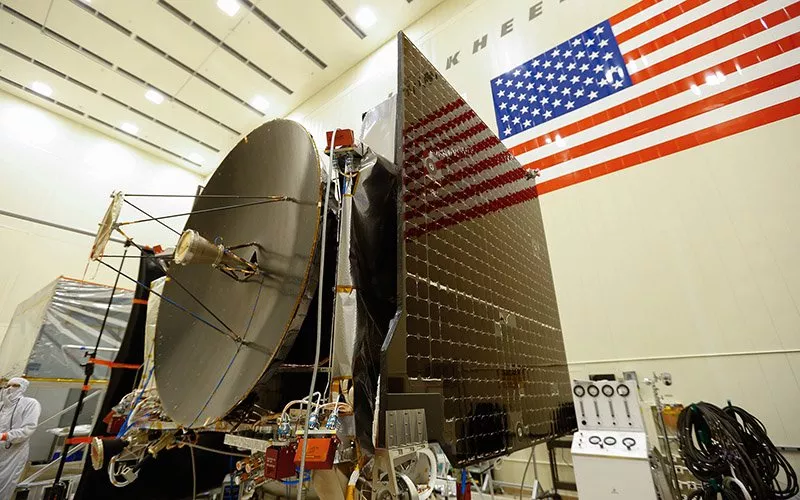
WASHINGTON – After more than a decade of work, $800 million and 200 million miles of space travel, it all came down to six seconds.
That’s how long OSIRIS-REx spent on the surface of near-Earth asteroid Bennu, collecting a small sample of soil before lifting off again for a return trip to Earth. But those six seconds were enough to get University of Arizona researcher Dante Lauretta’s head spinning.
“I must have watched it about 100 times last night before I finally got a little bit of shuteye,” Lauretta said of the video showing the spacecraft’s Touch-And-Go Sample Acquisition Mechanism pushing up a plume of debris from the asteroid’s surface. “And then I dreamed of a wonderworld of Bennu regolith particles floating all around me.”
Lauretta was not the only one hailing the apparent success of NASA’s Origins, Spectral Interpretation, Resource Identification, Security, Regolith Explorer – OSIRIS-REx – as it successfully touched down Tuesday night on Bennu, a maneuver one NASA official said “made humanity proud.”
Tags: osiris-rex , Image
WASHINGTON – Arizona’s unemployment rate bounced back up to 6.7% in September, but economists say there may actually be some positives behind what looks like negative numbers at first glance.
At least one of the reasons for the increased jobless rate is that more than 150,000 people returned to the labor force, which suggests that they are increasingly optimistic about their chances of finding a job.
“We did see an increase in the number of people unemployed, but that means they are actively looking for work and not just sitting on the sidelines out of the labor force more disheartened about their opportunities,” said Doug Walls, labor market information director with the Arizona Office of Economic Opportunity.
“They’re actively engaged and looking for work,” Walls said.
Bureau of Labor Statistics data shows that while the number of unemployed workers in the state rose by 35,287 people in September, to 237,774, the number of people with jobs grew by 116,440 in that time, to more than 3.3 million.
The increase in joblessness follows one of the steepest unemployment drops in years, when Arizona’s unemployment rate fell from 10.7% in July to 5.9% in August. But economists say the August drop, like this month’s rise, could be attributed largely to changes in the size of the workforce, with an estimated 150,000 people dropping out of the labor pool that month.
“Last month we saw the unemployment rate cut nearly in half,” Walls said. “That was one of the largest drops on record, but almost entirely due to that mass exodus from the labor force.”
At the time experts like Lee McPheters questioned how it was possible that that many people suddenly vanished from the labor force without explanation. He questioned the accuracy of the month-to-month data again after the September numbers came out.
“It is hard to conduct surveys in the pandemic and there is confusion about whether people who are laid off are truly unemployed and out of the labor force, or are they on furlough and still in the labor force and not counted as unemployed,” said McPheters, an economist at Arizona State University’s W.P. Carey School of Business.
Other experts said the fluctuating numbers point to the “underlying volatility in the data.”
David Wells, research director for the Grand Canyon Institute, said that he would set aside August’s report altogether and instead compare September’s rate to a more typical month.
“We have no history of having 150,000 people just flat out disappear like that from the labor force,” said Wells.
And they reappeared just as suddenly – BLS numbers show a difference of just 507 workers in the labor force from July to September, with the chasm of August in between.
Experts say people may go back to work for a variety of reasons, from feeling better about their prospects to coming back from a work hiatus. Wells pointed to one other factor that may have had an effect – the mid-September end of expanded unemployment benefits from the federal government.
“This was also around the time that the $300 supplement ended,” Wells said. “So this could also include people who are back in the labor force because they are increasingly desperate.”
Walls said the biggest employment gains in September came in state and local government jobs, education and “above average gains” in the leisure and hospitality industry, which was hit hardest by COVID-19 closures.
Despite the shifting numbers, McPheters said it will take a few months to see just how Arizona employment is actually faring in the pandemic.
“The economy is slowly adding jobs, but as people return to the labor force this tends to keep upward pressure on the unemployment rate,” said McPheters, “We do not expect rates to decline in the next few months.”
With 975 new cases reported today, the number of Arizona’s confirmed novel coronavirus cases closed in on 235,000 as of Friday, Oct. 23, according to the Arizona Department of Health Services.

In a worrisome trend, the number of cases statewide has climbed by nearly 4,000 in just the last four days.
Pima County had seen 27,297 of the state’s 235,882 confirmed cases.
With six new deaths reported yesterday, a total of 5,865 Arizonans had died after contracting COVID-19, including 635 deaths in Pima County, according to the Oct. 23 report.
The number of hospitalized COVID cases has declined from July peaks but has ticked upward in recent weeks. ADHS reported that as of Oct. 22, 815 COVID patients were hospitalized in the state. That number peaked with 3,517 hospitalized COVID patients on July 13.
A total of 815 people visited emergency rooms on Oct. 22 with COVID symptoms. That number peaked at 2,008 on July 7.
A total of 172 COVID-19 patients were in intensive care unit beds on Oct. 21. The number of COVID patients in ICUs peaked at 970 on July 13.
Arizona Department of Health Director Cara Christ noted on her blog yesterday that cases were on the increase.
Christ wrote that while Arizona has not seen as big a surge as other states, “we have recently seen a shift of COVID-19 spread in the wrong direction.”
Christ noted that the statewide positivity results from tests has climbed from 3.9 percent to 5.5 percent in recent weeks.
Christ urged Arizonans to wear masks but noted the numbers across the state still indicated “moderate” spread of the coronavirus and hospitals are not reporting a surge of patients.
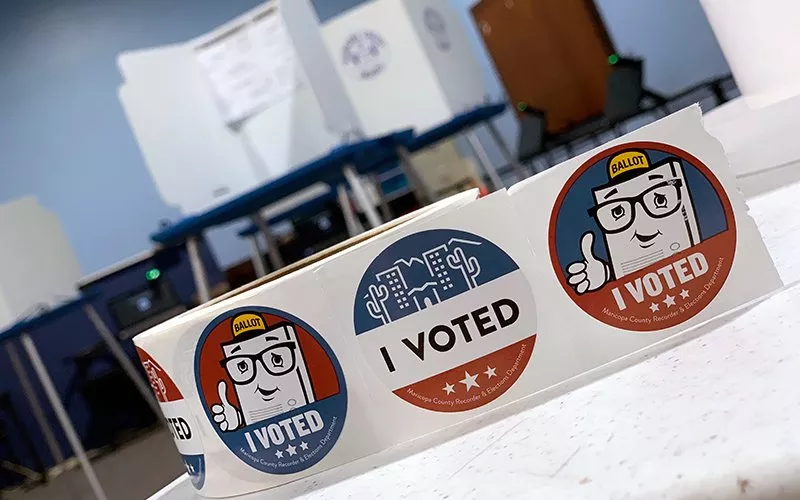
PHOENIX – Time is running out for voters to request mail ballots and for voters in nursing homes and hospitals to get help from a special elections team, state and county election officials said Thursday.
“There is still time to do so for this general election. But you must do it by tomorrow (Friday),” Secretary of State Katie Hobbs said at a news conference at the state Capitol.
The deadline to request a ballot by mail or a special election board from a county recorder is 5 p.m. Friday, she said. Special election boards help Arizonans in hospitals or a long term care facility, and anyone with a severe illness or disability, cast their ballots. Board members make in-person visits and conduct video conferences to ensure the right to vote is respected.
There’s still a chance to request the help of a special election board through Nov. 2 – the day before Election Day – if a voter can show that an emergency prevented them from asking earlier, Maricopa County Recorder Adrian Fontes said. But that help is not guaranteed after Friday, officials warned.
Representatives from AARP and the Arizona Center for Disability Law joined Hobbs and Fontes at the news conference to answer frequently asked questions about the rights of voters living in long term care facilities. The law center is operating a voter hotline through Election Day.
“We’ve moved forward early on as recorder to have a full-time coordinator for special election boards,” Fontes said. “These are authorized by federal law to assist voters with disabilities to make sure that they have their right to vote.”
Fontes described the board as “a two-person board of opposite political parties” that assists voters “who otherwise would not have access to the ballot.”
“For example, if you’re in a long term care facility and under quarantine, you can now have someone come and assist you to administer the ballot,” he said, adding that his office has received 144 such requests.
A Maricopa County Superior Court judge on Oct. 6 ruled that because of visitation restrictions at long term care facilities imposed to slow the spread of COVID-19, Arizonans in those facilities may be eligible to vote via video conference with help from a special election board.
The ruling by Judge Randall H. Warner came after Attorney General Mark Brnovich and Gov. Doug Ducey asked that the court deny plans to allow virtual voting.
At the time, Hobbs argued that voters in hospitals or assisted living arrangements should be allowed to cast their ballot via teleconference.“There are many communities where barriers continue to exist, and in fact the pandemic has exacerbated or highlighted those barriers even more,” she said.
Brnovich and Ducey argued that nothing in Arizona law allows voters to cast ballots via video conference or exempts special election boards from helping voters in person.
Brnovich also argued that the plan poses risk of voter fraud. Warner’s ruling says the chances of that are low because bipartisan special election boards act as a safeguard against voter fraud.
Although state law may not address such virtual voting, the judge wrote, the particular circumstances set forth by COVID-19 require additional procedures to ensure both voter safety and access to voting.
“It makes no difference whether, under Arizona’s COVID-19 guidelines, hospitals or care centers have to allow special election boards to enter,” the ruling says. “The issue is not the legal impediment to in-person contact, it is the health risk. Federal law does not allow Arizona to impose on a disabled voter the choice between voting and protecting their health.”
Fontes outlined key features of voting procedures for Arizonans who can’t physically mark a ballot. Members of the special election board team will go through the ballot with the voter and ask the voter’s selection for each candidate or issue.
They then will hold the ballot up to the camera and ask the voter for confirmation that the correct choice was marked.
After the voter’s confirmation the selections are correct, the special election board will place the ballot in an affidavit envelope, print the voter’s name and write, “Voter unable to sign due to COVID-19 rules” in the signature box.
More information on requesting special election boards, voting via teleconference and mail-in ballots can be found at arizona.vote.
Cronkite News reporter Alexander Gaul contributed to this report.
Thursday, October 22, 2020
As the drums ring out the Chinese New Year in a Singapore market, two young women wearing face masks watch the celebration. It's a scene characteristic of local artist Jacqueline Chanda’s work, which often allows the viewer to construct their own narrative of a scene.
“I like to catch these those kind of scenes where people can say ‘I wonder what they were thinking?’ or ‘I wonder where was this guy is going?’,” Chanda said. “Did he have intent or was he was he simply taking a stroll?”
Chanda’s painting, “Girl with a Turquoise Face Mask,” is based on a photograph she took while on vacation in February. The artwork is featured in the “Great American Paint In,” a new collection of works which shares artists’ experiences of living through the pandemic.
“The Great American Paint In,” now available online, documents the emotions felt by professional artists across the country, with 48 states represented in over 250 pieces, according to project founder, artist and engineer Bill Weinaug.

“I put a lot of effort into trying to make sure I did not lose my business at the end of the day, because I had no clue when the end of the day was coming,” Weinaug said. “And my daughter's telling me ‘Dad, you just can't shut down you need to stay relevant. This will be over with someday.’”
His daughter pitched him the idea of taking the “plein air” painting events he hosted at his eco-resort Wekiva Island in Longwood, Florida, and moving them online. Arists gather for plein air painting events and simultaneously paint their outdoor environment.
“In our case they go out into the wilderness and they paint for a week,” Weinaug said. “So they come with blank canvases, every day they add art and we build a temporary art gallery.”
Thus, “The Great American Paint In” was created. Artists paint their response to the pandemic and the emotions of quarantine, and submit the work to a jury who decides if it merits inclusion in the project.
The concept was a natural fit for artists nationwide with ample time to practice their craft but without access to galleries or events. The project’s website allows the artists to be able to sell their work and promote themselves.
Weinaug said he used his training as an engineer to investigate previous pandemics and said he didn’t see much art being created at the time of the outbreaks.
“We wanted to document what was going on in America during this pandemic so that future generations could look back and see it through the artist's eyes,” he said
Through the eyes of Chanda’s since returning to the United States somethings that haven’t changed is she goes into her studio to paint but finds herself accumulating more of her work.
“It's really been that sense of isolation, not being able to be connected with my friends, my daughter lives with me and my mother is not too far from here ... So I see her often enough, but it's been a different sense of isolation, it's an unwanted isolation,” she said.
Weinaug’s vision for the project is for it to serve as a textbook example of how to paint emotion. He intends to publish the collection as a book and is in the process of selecting a publisher but noted: “We're still in the middle of the pandemic and the story is still being written.”
To view the collection and Chanda’s submission, visit: thegreatpaint-in.com
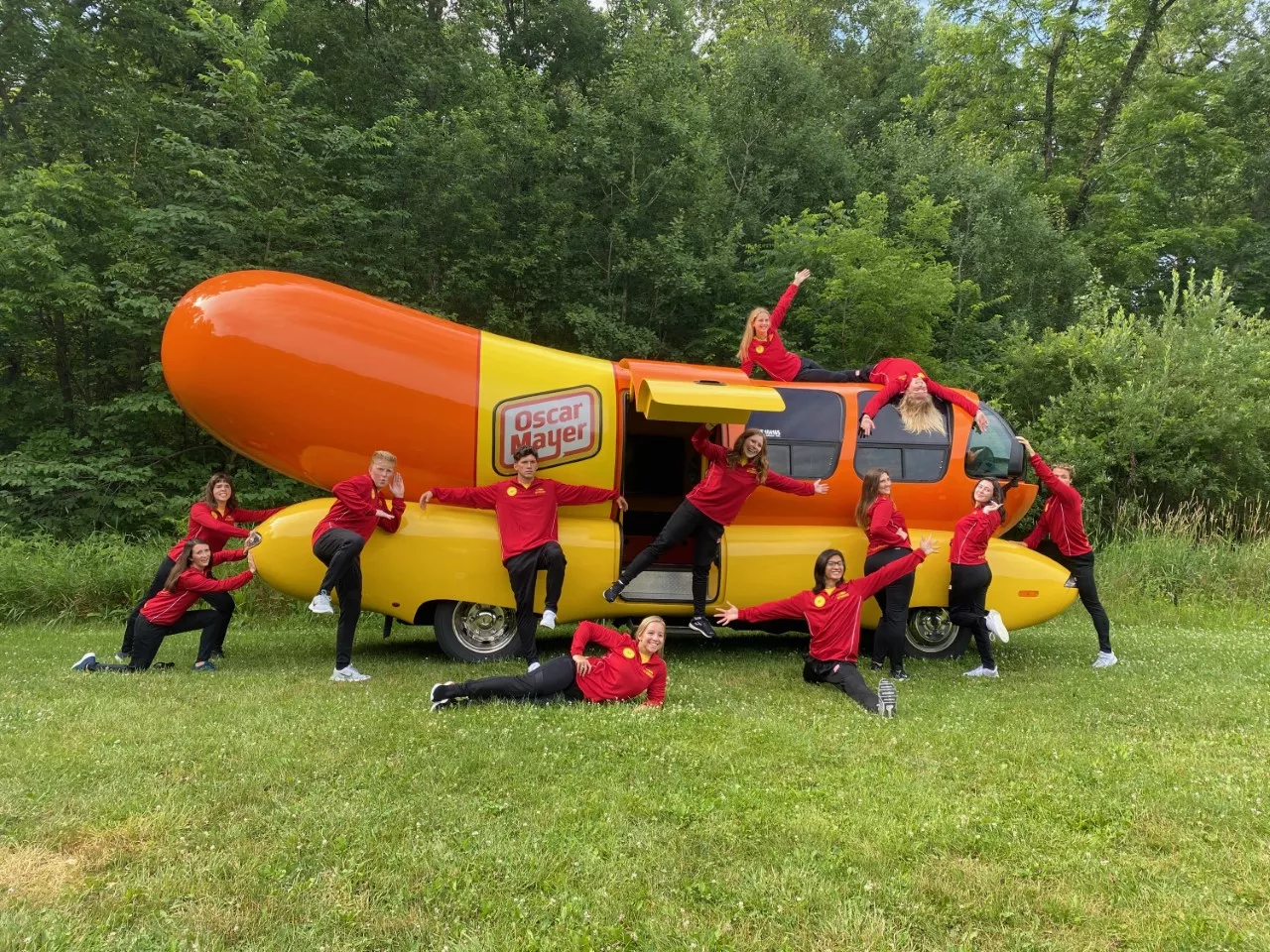
“Oh, I wish I were an Oscar Mayer wee-ner”
The world-famous Wienermobile is rolling through Pima County this weekend, giving residents an experience to relish—a chance to “meat” those bun-tastic hot doggers who are on a coast to coast weenie roast.
Oscar Mayer Hotdoggers Mayochup Molly and Saucy Spence will be handing out wiener whistles and taking pictures with you, their sausage subjects. If you’re nice to them, they may even give you your own honorary hot dogger name. If you’re really nice, you’ll even get a chance to win their special Halloween wiener whistle.
The Wienermobile will be making stops at:
- Marana Pumpkin Patch — 1 to 7 p.m., today, 14901 N. Wentz Road
- Botanical Gardens — 9 to 11:30 a.m., Oct. 23, 2150 N. Alvernon Way
- St. Philip's Plaza Market — 9 a.m. to 1 p.m., Oct. 24, 4280 N. Campbell Ave.
- Petting Zoo and Funny Foot Farm — 3 to 6 p.m., Oct. 24, 2405 W. Wetmore Road
- San Xavier del Bac Mission — noon to 1:30 p.m, Oct. 25, 1950 W. San Xavier Road
Want the Wienermobile to come visit your work or private event while in town?
Send them a request at https://khcmobiletour.com/wienermobile/request. They can't honor all requests during their limited time in the Old Pueblo, but they'll doggone try!
Oscar Mayer began employing the Wienermobile during the Great Depression after the owner’s nephew, Karl Mayer, came up with the idea that driving around a giant wiener could sell hot dogs. The original 1936 Wienermobile was only 13 feet and cost about $5,000. Soon after hitting the highways of the U.S.A, the public went crazy high octane hot dog cut the mustard and it became an icon almost overnight.
Two petitions are currently circulating on change.org, seeking to ban no-knock warrants in Arizona: one aimed at city lawmakers in Phoenix, and one aimed at state lawmakers. Together, the petitions have garnered more than 5,000 signatures.
“If our home is invaded, how are we to differentiate between a home invader and the police if they don’t announce their presence?” said Kenneth Cochran, a Tucson smoke shop owner who started the statewide petition. “With a huge percentage of Arizonans legally carrying firearms, this will almost always lead to tragedy."
These calls for reform are not limited to citizens. In July 2020, Pima County Sheriff Mark Napier issued a document calling for law enforcement reform under the initials ACT: Accountability - Community Engagement - Transparency. Among Napier's calls for reform is a ban on no-knock warrants, unless approved by the Sheriff, which would "only occur under the extreme circumstances."
Click below to read the specifics of the petitions:
Ban No-Knock Warrants In Phoenix
Ban No-Knock Warrants in Arizona
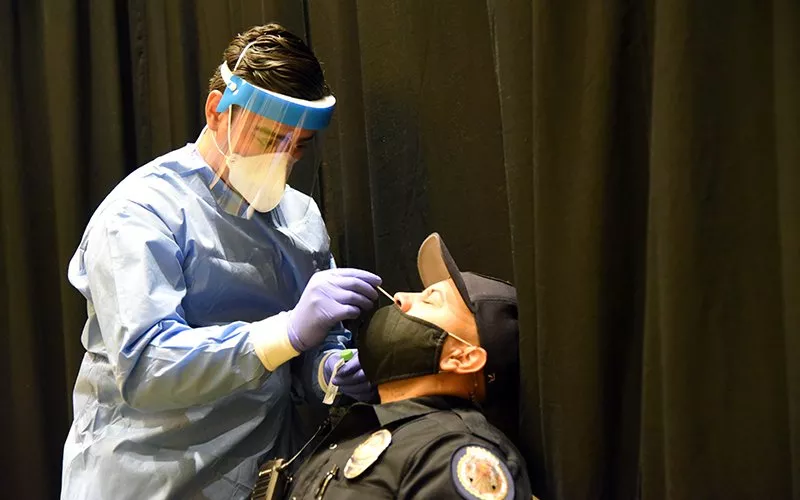
PHOENIX – Arizona is experiencing a COVID-19 surge similar to the one it saw in mid-June, and a vaccine that will get the population closer to herd immunity is in the distant future, the director of ASU’s Biodesign Institute said Wednesday.
“We are very close for a seven-day trailing average to crossing the 1,000 new cases a day mark,” Joshua LaBaer, institute executive director and professor at Arizona State University, said at an online news conference.
LaBaer said distributing a vaccine, once it’s developed and approved, will take some time. He urged Arizona residents, even though they are weary of the pandemic and its economic toll, to continue to wear masks, social distance and get tested every week until a reliable vaccine is ready.
The Arizona Department of Health Services has drafted a COVID-19 vaccination plan that allows county health departments and tribal health partners to decide who gets the vaccine in their communities.
With 994 new cases reported today, the number of Arizona’s confirmed novel coronavirus cases closed in on 235,000 as of Thursday, Oct. 22, according to the Arizona Department of Health Services.
In a worrisome trend, the number of cases statewide has climbed by nearly 3,000 in just three days.
Pima County had seen 27,208 of the state’s 234,906 confirmed cases.
With five new deaths reported yesterday, a total of 5,859 Arizonans had died after contracting COVID-19, including 635 deaths in Pima County, according to the Oct. 22 report.

