

Thursday, October 22, 2020

WASHINGTON – Arizona Sen. Martha McSally left little doubt how she plans to vote on Supreme Court Judge Amy Coney Barrett’s nomination, calling Barrett “a gift to America” during a brief meeting Wednesday.
The meeting, one of a series between senators and Barrett, came on the eve of a Senate Judiciary Committee vote on the nomination, which is expected to be before the full Senate for a final vote as early as Monday.
“I am so inspired to meet you,” McSally said to Barrett. “Really looking forward to voting to put you on the Supreme Court.”
Democrats do not appear to have the votes to block the confirmation, but continued to criticize the rushed process, which could put Barrett on the court less than six weeks after the death of Justice Ruth Bader Ginsburg and just days before Election Day.
Tags: mcsally , Amy Coney Barrett , Image

Wednesday, October 21, 2020
On Tuesday, Oct. 20, the OSIRIS-REx spacecraft touched down on the asteroid Bennu for 4.7 seconds, a maneuver that was more than a decade in the making. Scientists at the University of Arizona nervously watched the data from the autonomous process — because the asteroid is more than 200 million miles away, messages from the spacecraft take some 20 minutes to reach Earth, meaning the entire maneuver had to be programmed ahead of time. Preliminary data shows the “touch-and-go” process was a success, putting OSIRIS-REx one step closer to being the first American space mission to bring a sample of an asteroid back to Earth.
“It’s amazing just how fast it happened,” said Sara Knutson, science operations team lead engineer for the mission. “It was like a marathon that turned into a sprint.”
See the video from yesterday’s TAG event — NASA’s first asteroid sample collection attempt! Tune in TODAY at 5 pm EDT here: https://t.co/Sja14xcQ3o pic.twitter.com/iqP6I3Kzw0
— NASA's OSIRIS-REx (@OSIRISREx) October 21, 2020
However, researchers won’t know for another few weeks whether the amount of dust and rocks collected from Bennu’s surface is sufficient. The spacecraft will measure this by a series of maneuvers to determine the sample’s weight — should there be less than 2 oz. (roughly 60 grams) of captured space material, the spacecraft will attempt a second “touch-and-go” process no later than January 2021.
The OSIRIS-REx spacecraft left Earth in September 2016 with the goal of capturing carbon-rich material from Bennu’s surface, which may help scientists better understand the formation of our early solar system, and even the origins of life on our planet.
The sample process took more than four hours, with the spacecraft slowly descending 2,500 feet from orbit toward the asteroid. While the spacecraft came in contact with the asteroid, it didn’t land. Instead, it extended a robotic arm and fired a jet of pressurized nitrogen to kick up dust from the asteroid’s surface. Some of the agitated material was captured in OSIRIS-REx’s collector head, and the spacecraft then used thrusters to move away from the asteroid. Scientists believe the spacecraft touched the surface only three feet from where they originally planned.
“We spent all these years planning for today, and it happened so quick I almost missed it,” said Carl Hergenrother, staff scientist for OSIRIS-REx, who described the mission as a kind of relay race, with multiple teams working on different parts at different times.
According to Betsy Cantwell, UA’s senior vice president for research and innovation, this type of mission has the potential to affect science for decades to come.
“These kinds of events change the way we view the world around us,” Cantwell said. “I expect an immediate scientific explosion of interest [when the samples return].”
Because the collected samples will be finite, Cantwell says a major decision will be figuring out who gets to work with them. Cantwell expects a portion of the material will be investigated at UA, and some will even be stored for posterity to be examined when even more advanced scientific sensors are available in the future. Researchers expect to find “a large number of biological precursors” in the sample.
OSIRIS-REx is expected to return to Earth in 2023.

The Town of Marana’s mayor and council chose Police Chief Terry Rozema to replace Jamsheed Mehta as town manager in a 6-1 vote during a special council meeting on Tuesday, Oct. 20.
Rozema will begin his new job today.
Council Member Roxanne Ziegler cast the lone dissenting vote.
“I think this was something managed about a week and a half ago by some folks on this council,” Ziegler said during last night’s meeting.
The council member expressed her concern over her colleague’s decision to hire Rozema due to his lack of experience in the position. She preferred the chief serve as interim town manager—as Mehta did when former town manager Gilbert Davidson moved to be chief operating officer for the State of Arizona in 2017—while the council conducts a nationwide search for candidates with five to 10 years of municipality management experience. Rapid development within the town’s limits in recent years and how it will continue to be handled in the future is a driving force behind Zigler’s discontent with the decision.
“What we need is experience. This town is 52,000 plus citizens now. I think you could’ve gotten away with this when we were 35,000, 40,000 people and put someone who has absolutely no town manager experience,” Ziegler said. “I think the town of Marana and the employees of this town deserve something better than that.”
While town officials were tight-lipped as to why they wanted Mehta to go, Ziegler gave a glimpse as to a reason why the former town manager was abruptly dismissed, saying “this was a done deal” before the meeting took place.
“We also need somebody that isn’t handpicked and that’s what’s happened here,” Ziegler said, referring to why the council chose Rozema. “We need somebody with new eyes, a new face and a new perspective and insight to come into our town and take a very open-minded look at what we’ve got on our plates.”
Ziegler later added, “What I am tired of is 16 to 17 years being on this council and I know a few things and here we go again. Handpicking somebody in advance because, I think, mayor and vice mayor, you want somebody you can control. That’s not right. I’ve just about had it with that.”
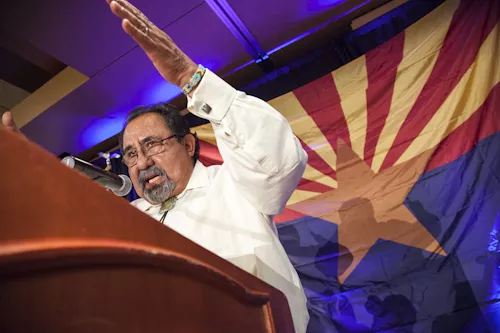
Lawyers were unable to track down the parents of 545 children removed from their families through the Trump administration’s family separation policy, according to a news release from Rep. Raúl Grijalva’s office.
When former Attorney General Jeff Session announced the administration’s “zero-tolerance policy” in April 2018, migrant children were separated from their parents instead of held with them in detention centers.
When the American Civil Liberties Union (ACLU) filed a class-action lawsuit against the Trump administration, a federal court order halted the separate detention of children and their parents in June 2018 and ordered the government to reunite children with their families.
According to Grijalva’s news release, lawyers from the ACLU and other pro-bono law firms haven’t been able to find parents separated from 545 children at the border.
“They were ripped from their parents’ arms, off-handedly placed in shelters, and left to wonder when, if ever, they would see their parents again. Due to the cruelty of Donald Trump and the xenophobia of Stephen Miller, we know that some of them may never see their parents again,” Grijalva said in the release.
“The Trump Administration must undertake every effort to reunite the families they so willingly destroyed, and every official complicit in this tragedy must face consequences for their actions. Human rights abuses should never be the foundations of government policy.”
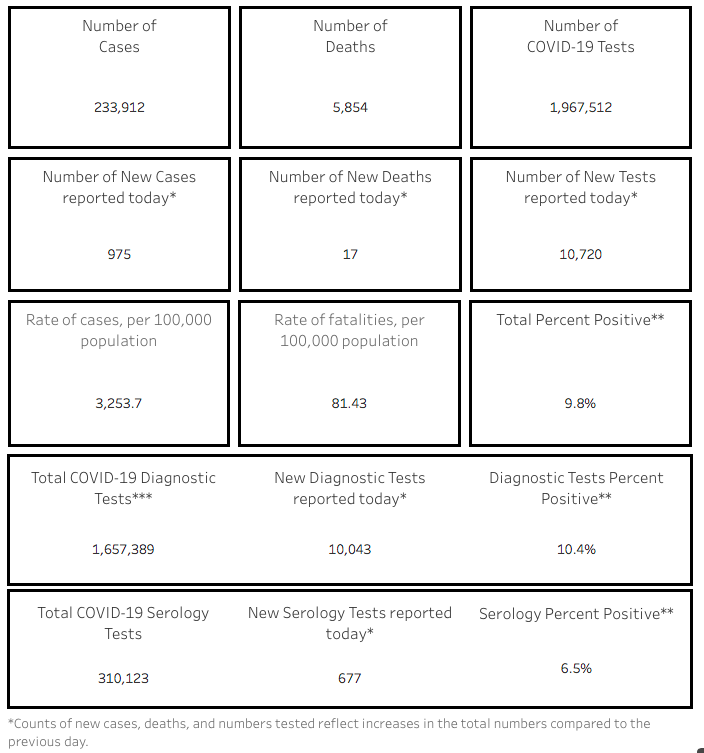
With 975 new cases reported today, the number of Arizona’s confirmed novel coronavirus cases closed in on 234,000 as of Wednesday, Oct. 21, according to the Arizona Department of Health Services.

Pima County had seen 27,128 of the state’s 233,912 confirmed cases.
With 17 new deaths yesterday, a total of 5,854 Arizonans had died after contracting COVID-19, including 635 deaths in Pima County, according to the Oct. 21 report.
The number of hospitalized COVID cases has declined from July peaks but has ticked upward in recent weeks. ADHS reported that as of Oct. 20, 832 COVID patients were hospitalized in the state, the highest that number has been since Aug. 26, when 895 people were hospitalized. That number peaked with 3,517 hospitalized COVID patients on July 13.
A total of 853 people visited emergency rooms on Oct. 20 with COVID symptoms, the highest that number has been since Sept. 21, when 867 people visited ERs with signs of the coronavirus. That number peaked at 2,008 on July 7.
A total of 171 COVID-19 patients were in intensive care unit beds on Oct. 20. The number of COVID patients in ICUs peaked at 970 on July 13.
On a week-by-week basis in Pima County, the number of positive COVID tests peaked the week ending July 4 with 2,453 cases, according to an Oct. 16 report from the Pima County Health Department.
After a bump following the return of UA students, cases on a week-to-week basis are on the decline. For the week ending Sept. 19, 1,225 cases were reported; for the week ending Sept. 26, 596 cases were reported; for the week ending Oct. 3, 523 cases were reported; for the week ending Oct. 10, 466 cases were reported.
Deaths in Pima County are down from a peak of 54 in the week ending July 4 to 10 in the week ending Sept. 5, one in the week ending Sept. 12, three in the week ending Sept. 19, four in the week ending Sept. 26 and three in the week ending Oct. 3.
Hospitalization peaked the week ending July 18 with 221 COVID patients admitted to Pima County hospitals, but it has been on the rise in recent weeks. In the week ending Sept. 12, 24 patients were admitted; in the week ending Sept. 19, 17 patients were admitted; in the week ending Sept. 26, 13 people were admitted; in the week ending Oct. 3, 20 patients were admitted; and in the week ending Oct. 10, 24 people were admitted. (Recent weeks are subject to revision.)
Amphi reports four coronavirus cases in its schools
In its second week of reopening, the Amphitheater Unified School District has reported four positive coronavirus cases resulting in 31 students and staff members quarantining, Communications Director Michelle Valenzuela said in an email Tuesday.
Amphitheater reopened for in-person classes in a hybrid model on Oct. 12, and its latest positive COVID-19 case was reported today, Oct. 20.
Today, one student at La Cima Middle School reported a positive coronavirus test. Although no close contacts to the person were discovered inside the school, three La Clima students who were with the student over the weekend are quarantining for 14 days.
One student at Canyon del Oro High School reported a positive test Monday, causing 13 students who may have been in contact with the person to self-quarantine.
Last week, 13 students and one staff member at Ironwood Ridge High School had to quarantine after a student reported a positive test on Oct. 16.
At Mesa Verde Elementary, one staff member reported a positive case on Oct. 14, but no other employees or students were identified as close contacts to require quarantining.
The 10,100 Amphitheater students who opted for hybrid classes attend two days a week and spend the other three learning remotely. About 1,400 students chose to continue attending school completely online.
UA increases number of in-person classes as campus-area cases remain low
The University of Arizona will allow more students to return to campus this week as metrics tracking the spread of coronavirus remain low, UA President Robert C. Robbins said in a news conference Monday, Oct. 19.
Continuing phase two of its reopening plan, the university will allow classes of 50 or fewer to return the week of Oct. 26, raising last week’s maximum of 30 students.
From Oct. 8-17, UA found 44 positive coronavirus cases after administering 6,867 tests for a positivity rate of 0.6%, the same rate the university reported last week.
“We have five weeks before the break. I’m very proud of the way the university has risen to the challenge so far, but we cannot become complacent,” Robbins said.
With fall break approaching Nov. 26, UA is taking proactive measures to minimize the potential spread of COVID-19 as students travel outside the area.
On Nov. 6, the university will begin a “testing blitz” by appointment only. Students who plan to travel over break and have not received a positive coronavirus test over the past 90 days are “strongly encouraged” to get tested.
All main campus students are required to take a coronavirus antigen test and complete a survey with their fall break traveling plans. Those who travel outside the Tucson area over break are encouraged to complete the semester remotely, according to Robbins.
However, UA students won’t get a similar week off in the spring. Instead of spring break, the university will have five separate “reading days” with no classes held.
“It’s a traumatic step to say we’re not going to have spring break next year, but it’s a really important step,” UA Provost Liesl Folks said. “The CDC is unambiguous about the fact that travel is one of the core ways that we spread the virus around the country.”
Get tested: Pima County opens new downtown testing center, UA offering antibody testing
The Pima County Health Department opened a new COVID-19 testing site downtown last Friday, Oct. 16, at 88 E. Broadway Blvd., on the southwest corner of Broadway and Sixth Ave. Testing will run from 10 a.m. to 2 p.m. every Monday, Wednesday and Friday. Testing is available without an appointment, or by appointment at pima.gov/covid19testing.
With workday testing available around lunch time, the county health department hopes this new site will serve as a resource for downtown employees. As with other county testing locations, the tests will be conducted by Paradigm Laboratories, and results will be available online in 72 hours or less.
“Quick and accessible testing is a key factor in helping businesses protect their employees and patrons as the pandemic continues,” said PCHD director Dr. Theresa Cullen in a press release. “We want to do all that we can to support businesses as they get back on their feet.”
The county has three other free testing centers with easy-to-schedule appointments—often with same-day availability—with results in 24 to 72 hours.
You’ll have a nasal swab test at the Kino Event Center, 2805 E. Ajo Way, and the Udall Center, 7200 E. Tanque Verde Road. The center at the northside Ellie Towne Flowing Wells Community Center, 1660 W. Ruthrauff Road, involves a saliva test designed by ASU.
Schedule an appointment at pima.gov/covid19testing.
The centers are also tied into Pima County’s developing contact tracing operation, which aims to be able to identify potential clusters and warn people if they have been in contact with someone who is COVID-positive.
The University of Arizona’s antibody testing has been opened to all Arizonans as the state attempts to get a handle on how many people have been exposed to COVID-19 but were asymptomatic or otherwise did not get a test while they were ill.
To sign up for testing, visit https://covid19antibodytesting.arizona.edu/home.
—with additional reporting from Nicole Ludden, Austin Counts, Jeff Gardner and Mike Truelsen
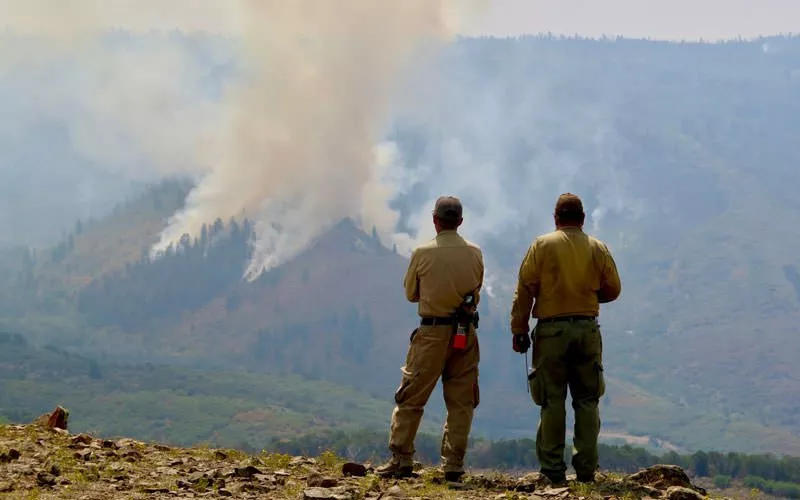
Major wildfires have burned through the Western U.S. in 2020, breaking records for their scale and damage. As firefighters tamp down their immediate effects, those who live nearby are coming to grips with the lingering danger of wildfires. Even long after the flames are gone, residents face a serious increase in the threat of flooding.
For Sue Lavin, who lives in No Name, Colorado, that threat is top of mind, more than a month after the Grizzly Creek Fire burned in the upper reaches of the No Name Creek, which runs through her backyard. She lives alone and says the running water normally makes for great company.
“The sounds you hear in the background accompany me all day every day and put me to sleep at night,” she said from her back patio. “Corny as it sounds, I consider the creek my friend.”
Lavin’s home and her couple dozen neighbors are tucked between Interstate 70 and the Colorado River in a narrow section of Glenwood Canyon.
In the waning days of summer, the sound of that creek is just a gentle babble as water slowly meanders into the nearby Colorado River. But Lavin has seen it get much higher during peak runoff. When water is surging down past her house, you can’t escape the noise.

Tuesday, October 20, 2020

In its second week of reopening, the Amphitheater Unified School District has reported four positive coronavirus cases resulting in 32 students and staff members quarantining, Communications Director Michelle Valenzuela said in an email Tuesday.
Amphitheater reopened for in-person classes in a hybrid model on Oct. 12, and its latest positive COVID-19 case was reported today, Oct. 20.
Today, one student at La Cima Middle School reported a positive coronavirus test. Although no close contacts to the person were discovered inside the school, three La Clima students who were with the student over the weekend are quarantining for 14 days.
One student at Canyon del Oro High School reported a positive test Monday, causing 13 students who may have been in contact with the person to self-quarantine.
Last week, 13 students and one staff member at Ironwood Ridge High School had to quarantine after a student reported a positive test on Oct. 16.
At Mesa Verde Elementary, one staff member reported a positive case on Oct. 14, but no other employees or students were identified as close contacts to require quarantining.
The 10,100 Amphitheater students who opted for hybrid classes attend two days a week and spend the other three learning remotely. About 1,400 students chose to continue attending school completely online.
This post has been updated to reflect a fourth positive case reported today.
WASHINGTON – The Supreme Court said Monday it will consider whether the Trump administration can use an emergency declaration to divert $2.5 billion on Defense Department funds to construct the southern border wall.
Two lower courts have rejected the administration’s argument, agreeing with opponents who argue that the emergency declaration was meant to bypass Congress and is unconstitutional, rulings the administration is challenging.
Both sides welcomed Monday’s announcement that the high court would hear the case.
“This gives us a chance to go to the highest court of the land and tell them why transferring this money was unlawful, as the other courts have said, but also to talk about the reasons why a border wall is so harmful for our communities,” said Vicki Gaubeca, director of the Southern Border Communities Coalition, one of two groups that sued to block the wall funding
But Rep. Paul Gosar, R-Prescott, defended the funding shift, saying in a statement Monday that “protecting the border and our national sovereignty is a core and fundamental purpose of the military.”
“The allocation of Defense money to defend the national borders is 100% constitutional and consistent with congressional intent,” Gosar said. “The American people need and deserve a secure border. They’re getting one from this administration.
No date has been set for a hearing on the case, but the court’s calendar is already full through the end of this year. But it will not be the first time the high court has considered the issue: The Supreme Court previously blocked the lower courts’ orders, allowing wall construction to proceed while the case worked its way through the courts.
The dispute over border wall funding began in late 2018 when Congress refused to give Trump billions for border wall construction and he refused to sign the budget, a standoff that led to a 45-day partial government shutdown.
The shutdown ended in February 2019, when Congress agreed to allocate $1.375 billion for limited border wall projects. But immediately after signing that budget, Trump declared a national emergency at the border that he said authorized the transfer of up to $8.1 billion from other government sources to fund border wall projects.
The Southern Border Communities Coalition and the Sierra Club quickly filed suit, claiming Trump’s use of emergency powers was an unconstitutional attempt to bypass Congress.
A federal district court agreed and in June 2020 a divided panel of the 9th U.S. Circuit Court of Appeals upheld the lower court’s ruling that transferring $2.5 billion in Defense Department funds originally budgeted for military pay and pensions was unlawful.
“We all learned in our basic civics education that Congress has the power of the purse, and that is definitely something that the administration has not acknowledged,” said Sandy Bahr, director of the Sierra Club Grand Canyon Chapter.
Even though Congress set a specific limit on wall funding, the administration said, “‘OK, well, we’ll just take this money and do it anyway,'” Bahr said. “That is contrary to the separation of powers outlined in the U.S. Constitution.”
But Ira Mehlman, media director for the Federation for American Immigration Reform, said the money is being used properly, as the Pentagon funds would be used for border protection.
“It’s not like they’re pulling this out of the Education Department or the Commerce Department’s budget,” Mehlman said. “This is legitimately going to be used for . . . the security of the country, because when you have borders that are open, it’s not just people who are coming here to work illegally, but potentially people who are coming here to do harm to this country.”
While conservation groups have criticized the wall’s environmental impact, saying it will disrupt threatened ecosystems and that construction will harm endangered species, Mehlman argues the opposite. He said that migrants crossing the border have a greater impact on the environment than construction crews do or a wall would.
Bahr calls that argument a “distraction from the real harm that is being done” by the wall: “Harm to the Constitution, the harm to the lands, to our waters, to communities, to people to wildlife to sacred areas, important for cultural values.”
The Supreme Court also said Monday that it will hear the Trump administration’s defense of its Migrant Protection Protocols, a policy that requires asylum-seekers at the southern border to wait in Mexico while their cases are pending. The 9th Circuit had blocked the “remain in Mexico” policy.
Gaubeca said she hopes the two cases start a conversation on what borders should look like.
“There is a need to rethink borders to create a new, more welcoming border,” she said. “We’re hopeful that both of these cases will start speaking to that new border governance model that we have been aspiring to for a while now.”

