

Monday, October 19, 2020

WASHINGTON – Local officials pushed back this week against a new report that showed three Arizona cities slipping in a national ranking on clean-energy policies, saying the report does not appear to reflect their clean- and renewable-energy efforts.
The 2020 City Clean Energy Scorecard, released last week by the American Council for an Energy-Efficient Economy, scores the 100 largest cities in the country in five categories ranging from local government to energy and water utilities.
Phoenix finished 19th in the ranking, while Tucson was 68th and Mesa was 76th – all three slightly lower rankings than the cities got on 2019’s scorecard.
That surprised Caryn Potter, a utility program manager with the Southwest Energy Efficiency Project, who considers Arizona “an energy efficiency success story.”
“While our cities are making important commitments towards reducing air pollution, conserving water, and making their cities more walkable and livable, I was surprised to see the drop in Phoenix, Mesa, and Tucson’s overall scores,” she said in an email.
Tags: solar power , wind power , clean energy , Image
The University of Arizona will allow more students to return to campus this week as metrics tracking the spread of coronavirus remain low, UA President Robert C. Robbins said in a news conference Monday, Oct. 19.
Continuing phase two of its reopening plan, the university will allow classes of 50 or fewer to return the week of Oct. 26, raising last week’s maximum of 30 students.
From Oct. 8-17, UA found 44 positive coronavirus cases after administering 6,867 tests for a positivity rate of 0.6%, the same rate the university reported last week.
“We have five weeks before the break. I’m very proud of the way the university has risen to the challenge so far, but we cannot become complacent,” Robbins said.
With fall break approaching Nov. 26, UA is taking proactive measures to minimize the potential spread of COVID-19 as students travel outside the area.
On Nov. 6, the university will begin a “testing blitz” by appointment only. Students who plan to travel over break and have not received a positive coronavirus test over the past 90 days are “strongly encouraged” to get tested.
All main campus students are required to take a coronavirus antigen test and complete a survey with their fall break traveling plans. Those who travel outside the Tucson area over break are encouraged to complete the semester remotely, according to Robbins.
However, UA students won’t get a similar week off in the spring. Instead of spring break, the university will have five separate “reading days” with no classes held.
“It’s a traumatic step to say we’re not going to have spring break next year, but it’s a really important step,” UA Provost Liesl Folks said. “The CDC is unambiguous about the fact that travel is one of the core ways that we spread the virus around the country.”
Reentry Task Force Director Dr. Richard Carmona highlighted the university’s 4.7% coronavirus positivity rating for their total testing window since the beginning of August. He said although the “desired number” is below 5%, the university shouldn’t get too comfortable.
During the past week, the university’s CART team, a collaboration with the UA and Tucson police departments that looks for noncompliance to COVID-19 precautions, responded to 15 incidents.
“We are happy that the intense public health practices we are inspiring others to adopt in our campus, in our community, are actually doing the job, but we got to push even harder now,” Carmona said.
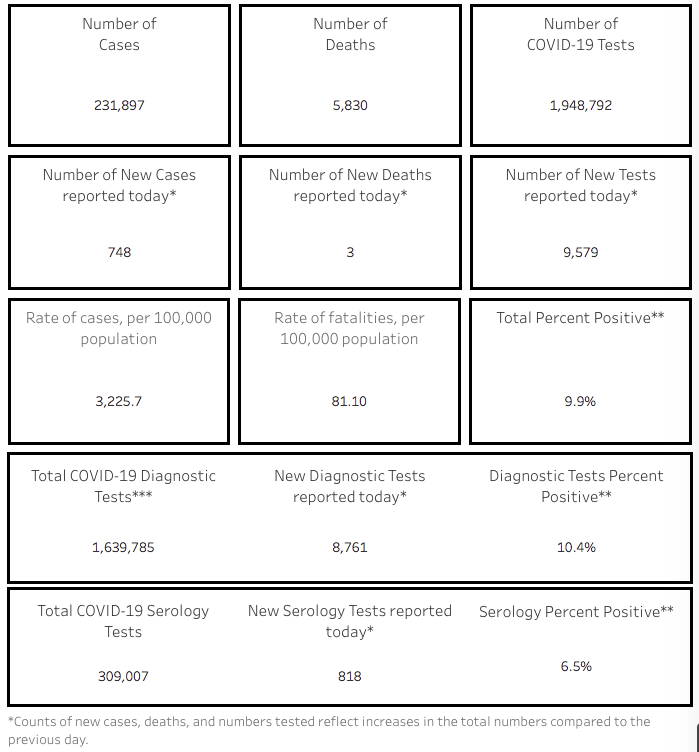
With 748 new cases reported today, the number of Arizona’s confirmed novel coronavirus cases closed in on 232,000 as of Monday, Oct. 19, according to the Arizona Department of Health Services.

Pima County had seen 26,955 of the state’s 231,897 confirmed cases.
With three new deaths yesterday, a total of 5,830 Arizonans had died after contracting COVID-19, including 634 deaths in Pima County, according to the Oct. 19 report.
The number of hospitalized COVID cases has declined from July peaks but has ticked upward this week. ADHS reported that as of Oct. 18, 721 COVID patients were hospitalized in the state. That number peaked with 3,517 hospitalized COVID patients on July 13.
A total of 717 people visited emergency rooms on Oct. 18 with COVID symptoms. That number, which peaked at 2,008 on July 7, hadn’t climbed above 800 since Sept. 21.
A total of 177 COVID-19 patients were in intensive care unit beds on Oct. 18. The number of COVID patients in ICUs peaked at 970 on July 13.
On a week-by-week basis in Pima County, the number of positive COVID tests peaked the week ending July 4 with 2,453 cases, according to an Oct. 7 report from the Pima County Health Department. For the week ending Sept. 5, a total of 863 cases were reported; for the week ending Sept. 12, 1,105 cases were reported; for the week ending Sept. 19, 1,219 cases were reported; for the week ending Sept. 26, 582 cases were reported; for the week ending Oct. 3, 472 cases were reported. (Recent weeks are subject to revision.)
Deaths in Pima County are down from a peak of 54 in the week ending July 4 to 10 in the week ending Sept. 5, one in the week ending Sept. 12, three in the week ending Sept. 19, two in the week ending Sept. 26 and one in the week ending Oct. 3. (Recent weeks are subject to revision.)
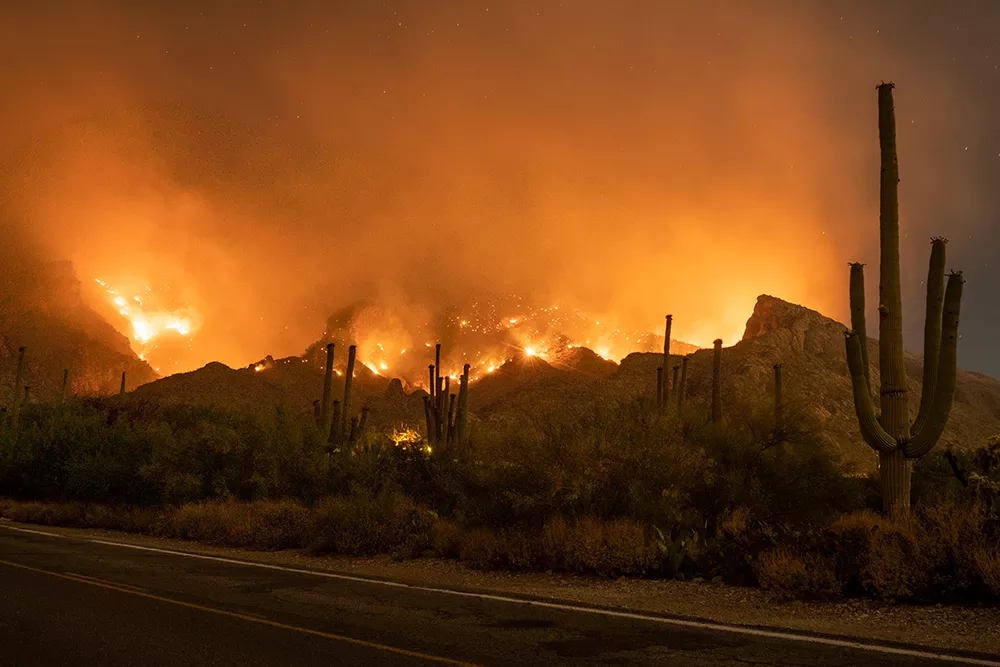
For many communities in the West, the water that flows out of kitchen faucets and bathroom showerheads starts high up in the mountains, as snowpack tucked under canopies of spruce and pine trees.
This summer’s record-breaking wildfires have reduced some of those headwater forests to burnt trees and heaps of ash. In high alpine ecosystems, climate change has tipped the scales toward drier forests, lessened snowpack, hotter summers and extended fire seasons.
Wildfires don’t just cause problems while they’re burning. For municipal drinking water systems, fires are felt for years after they’re snuffed out.
Few places in the West know that as well as Fort Collins, Colorado. Until eight years ago, one of the city’s of main water sources, the Poudre River, was nearly pristine. All year round, it tumbled out of the Rocky Mountains and into the city’s treatment plant for use by 135,000 people.
“We had been privileged and in some ways probably took for granted that these watersheds were providing us consistently clean, clear water, all the time,” said Jill Oropeza, the city’s water quality manager.
Tags: wildfire , climate change , water , Image

ANAHEIM, California – Guidelines for theme park reopening are coming “very shortly,” Gov. Gavin Newsom said in mid-September, but the Magic Kingdom remains closed and Disney fans, laid-off workers and city officials are pleading for tourism’s return to Orange County.
Newsom last week pointed to the severity of the COVID-19 pandemic and told reporters the state “is in no hurry” to reopen theme parks. California has the second-highest weekly rate of new infections in the country after Texas, according to the CDC, and Newsom chooses to err on the side of caution. Disneyland has been closed since March 14.
“We are going to be led by a health-first framework,” he said in an Oct. 7 news conference. “We’re going to be stubborn about it and that’s our commitment.”

Sunday, October 18, 2020
This week's streaming highlights:
TOTALLY UNDER CONTROL
A documentary on our pandemic that, not surprisingly, appears to paint our current douche President in a bad light. That's not a hard thing to do, making Trump look like a jackass. I mean, I have to commend the fucking asshole. He is actually terrific at making himself look like a jackass. His talent in this realm knows no bounds. Anyways, this is a movie about how he and his cronies have seriously fucked shit up old school. Yes...I'm cursing a lot...because I am fucking pissed...and you should be, too.
MARTIN EDEN
Adapted from a 1909 novel by Jack London yet set in a provocatively unspecified moment in Italy’s history, Martin Eden is a passionate and enthralling narrative fresco in the tradition of the great Italian classics.
WHITE RIOT
United Kingdom, 1976. The far-right National Front is gaining in popularity. Racist attacks are on the rise. In response, a group of activist and artists launch Rock Against Racism, a new movement to fight extremism and xenophobia.
HARRY CHAPIN: WHEN IN DOUBT, DO SOMETHING
Tells the incredible life story of the award-winning singer/songwriter, filmmaker and global activist who inspired and entertained music fans with such ‘70s hits as Cats in the Cradle and more.
I loved his songs when I was a kid. I lived in Long Island, N.Y. when he died in a car crash, and drove by his accident scene, crying in the backseat of my car. It's about time somebody made a movie about this great man.
SHE IS THE OCEAN
An award-winning, in-depth exploration into the lives of nine extraordinary women, scattered across the globe, who share one thing in common: a profound love for the sea.

For months now, we here in Arizona have said
that health care is on the ballot this November—and that is even more true
today than it was six months ago when this pandemic began.
The dual public health and economic crises
from the coronavirus have raised the stakes even higher when it comes to the
importance of having quality, affordable health care coverage, especially in our rural and border
communities.
As someone who has worked in public health for
35 years, I know how important it is for working families across Arizona to
have the peace of mind that comes with quality, affordable health care
coverage.
So when I see Donald Trump and the Republican
Party try to rush through a Supreme Court appointment just to overturn the
Affordable Care Act, especially in the middle of a pandemic, I am as confused
as I am horrified. Why fight to undermine something that has benefitted so many
people?
The Affordable Care Act helped more than 400,000 people in Arizona
gain coverage and led to a 42 percent reduction in the uninsured
rate.
But if Trump and Republicans have their way,
the Supreme Court will decide to rip away health care from 363,000 Arizonans
and strip away protections from 2.8 million people in Arizona with preexisting
conditions. To make matters worse, overturning the ACA would jeopardize
protections for people with pre-existing conditions at a time when
complications from COVID-19, like lung scarring and heart damage, could become
the next deniable pre-existing condition.
By continuing his crusade to dismantle the
ACA, Trump is gutting the protections that so many Arizonans families in our
rural, border, and foothills communities depend on. We have worked so hard over
the last several years to create a safety net infrastructure among our
communities in Arizona with critical access hospitals, rural health clinics,
and our community hospitals.
We can’t let Trump undo the progress we’ve
made. Arizonans deserve so much better. We need leaders who will fight to
protect our care and put working families first. That’s Joe Biden and Kamala
Harris.
Joe Biden and Kamala Harris will protect and
build on the Affordable Care Act to give Americans more choice, reduce health
care costs, and make our health care system less complex. This will greatly
benefit families in our border and rural communities who depend on the ACA to
keep themselves and their families safe and healthy.
Biden and Harris also have a plan
to help rural, border, and foothills communities like ours across Arizona meet
the pressing health challenges they are faced with. When elected, Joe and
Kamala will adequately fund our rural hospitals, double funding for community
health centers, and help build new clinics and deploy telehealth in rural
communities.
These common-sense solutions will help our
neighbors and families stay healthy, especially as we continue to battle
COVID-19.
We can’t afford four more years of attacks on
our health care. I’ve seen the faces, I’ve seen the devastation, I’ve seen the
work that my doctors do every day to save lives. Dismantling the Affordable Care
Act and ripping away health care coverage is not an option. We cannot let it
happen—and that starts with voting for Joe Biden and Kamala Harris this
November.
Former
Arizona State Senator Amanda Aguirre presently serves in the capacity of
President & CEO of the Regional Center for Border Health, Inc. since 1991
and its subsidiary San Luis Walk-In Clinic, Inc., a primary care rural health
medical center. Ms. Aguirre has been involved for more than 35 years in health
care and business administration.
Friday, October 16, 2020

The Tucson-based restaurant chain eegee's has announced their plans to expand to the Phoenix area in 2021, with five new locations slated throughout the Valley. The openings will begin in the second quarter of next year and take place in Phoenix, Mesa, Scottsdale and two locations in Gilbert.
While eegee's has expanded to two dozen locations throughout Tucson (and one in Casa Grande) since 1971, this marks the first time the restaurants will operate outside of Southern Arizona. Various locations throughout the Phoenix area already serve frozen eegee drinks, but none are a full restaurant.
The company was bought in 2018 by a partnership of 39 North Capital and restaurant investor Kitchen Fund.
In addition to expanding north, eegee's also plans to open seven more restaurants in the Tucson area in 2021, although the exact locations have not yet been announced.
For more information, visit eegees.com/locations

PHOENIX – In the first two weeks of the high school football season, the 6A conference has seen a high volume of blowouts. Twenty-five out of 34 matchups in the first two weeks in the 6A conference have been won by at least 17 points.
You can probably blame the pandemic.
Week two saw multiple head-scratching beatdowns, including Chandler’s 64-0 shutout of Pinnacle, Liberty’s 30-0 shutout of Red Mountain and Hamilton’s 64-22 smackdown of Perry. Pinnacle and Perry were 2019 state quarterfinalists in the Open Division and 6A conference, respectively, and Red Mountain came up six points short of the 2019 6A Conference state title.
Coach Rick Garretson credited the Chandler Wolves’ outscoring of their first two opponents 108-10 to his team’s length of preparation in the offseason. Many other schools have had less time to prepare.
Tags: high schools , high school football , sports , covid , Image

