

Friday, October 16, 2020
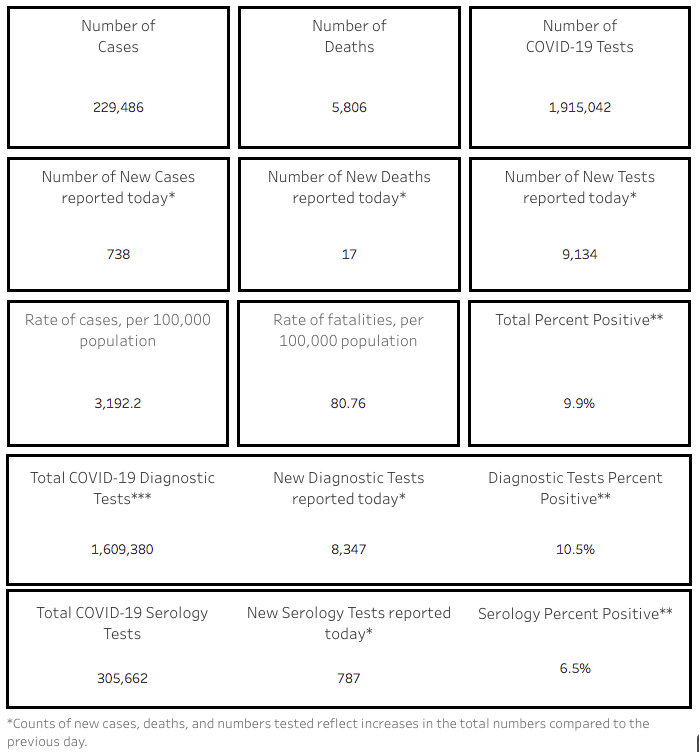
With 738 new cases reported today, the number of Arizona’s confirmed novel coronavirus cases topped 229,000 as of Friday, Oct. 16, according to the Arizona Department of Health Services.

Pima County had seen 26,769 of the state’s 229,486 confirmed cases.
With 17 new deaths yesterday, a total of 5,806 Arizonans had died after contracting COVID-19, including 633 deaths in Pima County, according to the Oct. 16 report.
The number of hospitalized COVID cases has declined from July peaks but has ticked upward this week. ADHS reported that as of Oct. 15, 747 COVID patients were hospitalized in the state. That number peaked with 3,517 hospitalized COVID patients on July 13.
A total of 801 people visited emergency rooms on Oct. 15 with COVID symptoms. That number, which peaked at 2,008 on July 7, hadn’t climbed above 800 since Sept. 21.
A total of 167 COVID-19 patients were in intensive care unit beds on Oct. 15. The number of COVID patients in ICUs peaked at 970 on July 13.
On a week-by-week basis in Pima County, the number of positive COVID tests peaked the week ending July 4 with 2,453 cases, according to an Oct. 7 report from the Pima County Health Department. For the week ending Sept. 5, a total of 863 cases were reported; for the week ending Sept. 12, 1,105 cases were reported; for the week ending Sept. 19, 1,219 cases were reported; for the week ending Sept. 26, 582 cases were reported; for the week ending Oct. 3, 472 cases were reported. (Recent weeks are subject to revision.)
Deaths in Pima County are down from a peak of 54 in the week ending July 4 to 10 in the week ending Sept. 5, one in the week ending Sept. 12, three in the week ending Sept. 19, two in the week ending Sept. 26 and one in the week ending Oct. 3. (Recent weeks are subject to revision.)
Hospitalization peaked the week ending July 18 with 221 COVID patients admitted to Pima County hospitals. In the week ending Aug. 29, 37 COVID patients were admitted to Pima County hospitals; in the week ending Sept. 5, 26 patients were admitted to Pima County hospitals; in the week ending Sept. 12, 23 patients were admitted; in the week ending Sept. 19, 14 patients were admitted; in the week ending Sept. 26, 11 people were admitted and in the week ending Oct. 3, 17 patients were admitted. (Recent weeks are subject to revision.)
Fourth Avenue Winter Street Fair canceled
The Fourth Avenue Merchants Association is canceling their annual winter street fair due to a new special event permit application which would leave little time to properly plan the event.
New guidelines released by the City of Tucson and Pima County last week state that all special events of 50 people or more held in unincorporated Pima County will need to apply with the Pima County Health Department. The special event application turnaround time is between 14 to 21 days, according to an Oct. 9 email sent by the county.
“We can’t do anything without proper permittaing,” said Monique Vallery of the Fourth Avenue Merchants Association. “We want to produce the safest COVID adherent event as possible and time just isn’t in our favor.”
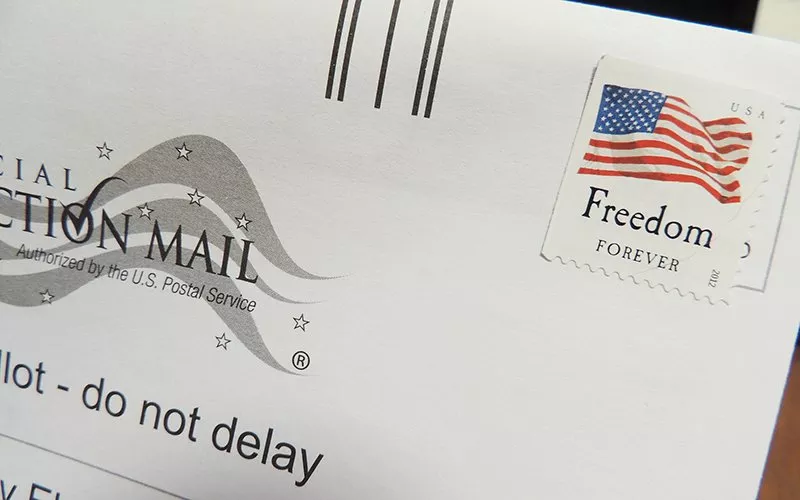
WASHINGTON – Native Americans may face barriers to voting in general, but that is not enough to require that ballots mailed from the Navajo Nation get 10 extra days to be counted, a federal appeals court said Thursday.
The ruling by a 9th U.S. Circuit Court of Appeals panel upheld a lower court that rejected the suit by six Navajo voters. The courts said the plaintiffs failed to show that their voting rights would be harmed by postal delays or helped by an extension – or even that they planned to vote by mail this election.
The ruling is the latest in a flurry of election challenges heard by the court in recent weeks. It was welcomed by election officials in northern Arizona who said an extension for Navajo ballots would be neither fair nor practical.
“I just don’t think it’s really feasible and we would want to do it for all voters, not just voters on the Navajo Nation,” said Coconino County Recorder Patty Hansen. “That to me would be not correct” because most of the county is rural, not just the part that is Navajo Nation land.
Tags: navajo , election , vote by mail , Image

WASHINGTON – Arizona schools have long struggled with teacher shortages but the problem was made worse this year by COVID-19, which has led to more teachers quitting or taking leave, school officials said.
Just over 28% of teaching slots were still vacant several weeks into the 2020-2021 school year, up from 21% last year, according to an annual survey by the Arizona School Personnel Administrators Association.
The association, which included a question on the coronavirus for the first time this year, found that 464 teachers who retired this year or who took a year off from teaching said their primary reason for doing so was COVID-19.
“We’ve had a couple of resignations and it’s not 100% related to the work – it’s definitely COVID related,” said Dawn Anderson, the human resources director for the Flagstaff Unified School District. And Flagstaff is in relatively good shape when it comes to teacher vacancies overall, she said.
The survey of 145 school districts and charter schools around the state found that of the 751 teachers who quit before or shortly after the start of the school year, 326 said they left because of the pandemic. Another 138 teachers took an unpaid one-year leave of absence, citing COVID-19, the report said.
Thursday, October 15, 2020

Owner Suzana Davila said after giving her "heart and soul" to Cafe Poca Cosa over the years, she is choosing to shut her restaurant down after experiencing "many months of great anxiety" because of the pandemic's impact on the cost of operating an eating establishment with limited occupancy.
“Clearly, this is not how I imagined my business would culminate. I always envisioned passing the business on to my hardworking children who have been actively involved in the business for many years”, said Davila. “The continued threat of Covid to the restaurant and hospitality industry is ever-present. With fixed costs of doing business and rising food costs, along with restrictive seating limits, we just do not see a profitable way of continuing."
Originally located in a small space at Scott Avenue And Congress Street, Cafe Poca Cosa earned a name for itself serving fantastic Mexican culinary wonders that became a destination for foodies from around the world. Davilla, with her sisters Marcela and Sandra, helped put Tucson on the culinary map long before UNESCO came calling.
"I feel incredibly privileged to have been part of our wonderful downtown for all these years," Davilla said. "I would like to thank the people of Tucson for all the goodwill and assistance they have provided over the years."
Cafe Poca Cosa's sister restaurant, The Little One, remains open as a grab-and-go market with limited outdoor seating.
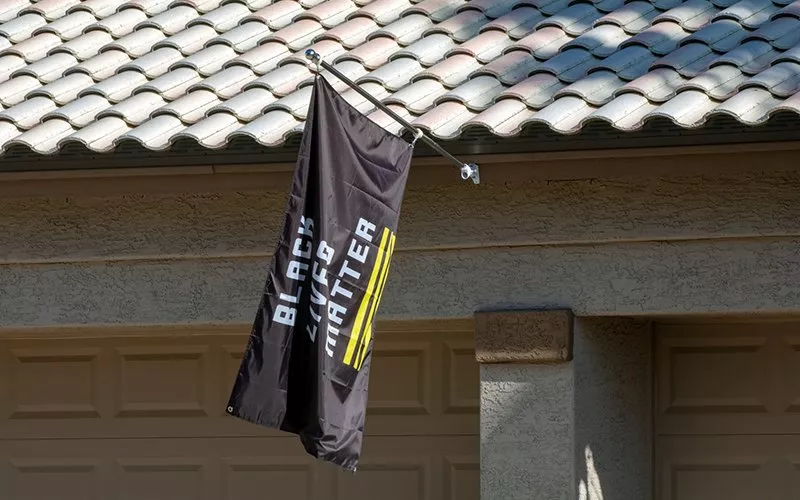
GLENDALE – Melanie Boyle hung a hand-painted Black Lives Matter sign on her home in July to show her support for the movement and its demands for justice.
“I wanted to do this little act of putting up a sign and open more conversation about it in my area,” she said.
Conversations with her neighbors went well, with some also expressing support for BLM and a supporter of President Donald Trump who acknowledged the rights of Boyle’s family to display their opinions.
Then, in September, she got a different response. Her homeowner’s association, or HOA, sent her a violation notice.
HOAs have the power to dictate which signs and flags can be displayed in homeowners’ yards and on their houses, a power backed up by federal, state and local laws.
Boyle wasn’t having it. One street down from hers, the 36-year-old physician said, are six houses displaying Trump 2020 flags. If those are allowed, she thought, so should her cardboard sign.
Email threads, political signs and a violation notice
Staples of election season, political signs and banners clutter the sides of busy streets and pop up in yards across metro Phoenix. Throughout the year, some neighbors use flags and signs to show their allegiance to sports team logos or to show “Congrats! You Graduated!” signs.A Phoenix attorney with expertise in HOAs said questions that arise in Boyle’s BLM sign case include First Amendment rights to use signs to speak your mind versus HOAs’ legal standing to regulate signs, and whether HOA policies are inconsistently applied.
A trail of emails shows Boyle’s attempts at clarification.
On Aug. 18, Boyle’s HOA in north Glendale, which is managed by Spectrum Association Management in Chandler, sent a mass email to residents with updates on the policy pertaining to home security system signs, real estate signs and political signs.
The company cited Glendale city code concerning political signs, set out the maximum number and size of signs allowed, and said they could not be displayed earlier than 71 days before an election. Noncompliant signs had to be removed within three days, it said.
That meant the earliest residents could display political signs was Aug. 24. Five days before that, Boyle sent an email asking whether the prohibitions included her family’s BLM sign.
“Black Lives Matters signs are not allowed, along with political flags,” Spectrum replied.
Violation notices start with a warning, then a $50 fine that increases based on the number of violations. Boyle removed her sign.
But she suspected Spectrum wasn’t applying the rules consistently. She emailed Spectrum again, this time about the six Trump 2020 flags on the next street. The company replied that flag restrictions would not be enforced if the flags are in good condition and removed after the Nov. 3 election.
Boyle responded that a Black Lives Matter flag should then be acceptable, and she put her sign back up on Sept. 4, intending to replace it with a BLM flag once it arrived in the mail.
Boyle received an official violation notice in the mail, dated Sept. 8, declaring she was in violation of the HOA’s sign policy.
“This is a property maintenance violation on your property. Please take steps to correct the problem. The sign on your property needs to be removed,” the notice warned.
Spectrum referred Cronkite News to its attorney, Beth Mulcahy, who did not return requests for comment by email and voicemail.
Political sign or property maintenance violation?
Opal Tometi, one of three women who co-founded Black Lives Matter in 2013, has written on her website that BLM is a human rights issue, a view that’s widely supported in some circles but controversial in others.
Jonathan Dessaules, an HOA attorney at Dessaules Law Group in Phoenix, is not representing Boyle but offered a legal perspective on her BLM sign.
It’s reasonable to argue that a BLM sign should be considered a political sign protected under Arizona law, he said, adding, “No one is going to believe that a Black Lives Matter sign is apolitical.”
Dessaules emphasized the importance of an HOA’s rules, known as declarations of covenants, conditions, and restrictions, or CC&Rs. Homeowners agree to abide by CC&Rs, which often prohibit any modification to the outside of a home, including a sign or flag, without approval.
According to the violation notice mailed to Boyle, her neighborhood’s CC&R says “No signs or advertisements of any kind may be placed, allowed or maintained without prior written approval and authorization of the Board.”
However, Dessaules said, if Spectrum is not regulating other kinds of signs and flags, such as congratulatory signs and those for sports teams, Boyle would have a solid argument that she is being discriminated against.
One key question needs to be answered, he said: “Is the association taking a position on speech that suggests that their actions are designed to prohibit only certain political speech, as opposed to all speech?”
Dessaules also questions Spectrum’s reference to the city code that defines political signs as those supporting a candidate or ballot measure.
“Enforcing city code is not the role of HOAs,” Dessaules said.
The power of signs, flags to connect people
Boyle said she needed to establish what she and her family stand for as they settled into homeownership.
“Given all the changes in our country right now and how the civil rights movement has reawakened itself, I felt it was the right time to get involved,” she said, and displaying the sign was one way to interact with neighbors.
Boyle said her family was in the front yard when an elderly couple walked by and said they supported BLM, too.
A neighbor who supports Trump said he respected Boyle’s right to publicly express her support for BLM.
Another neighbor discussed with her how he grew up in Mesa as a minority and understands what it is like to fight for equality.
Only some responses were negative.
On Sept. 5, a person driving by their house yelled at Boyle’s husband to take down the sign and shouted that all lives matter.
On Sept. 11, Boyle’s BLM sign was stolen.
On Sept. 23, she replaced the sign with a BLM flag, hanging from her home, above the driveway.
She has not received any additional violation notices.
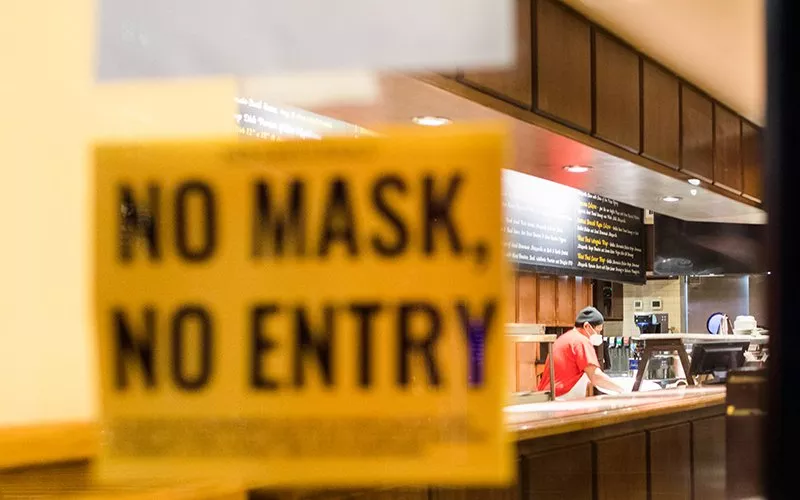
PHOENIX – A prominent health expert expressed worry Wednesday about rising COVID-19 numbers across Arizona, saying the trend is reminiscent of early summer conditions that preceded a spike in cases and rollback of measures to reopen businesses.
“This is a moment to sort of stop and take measure and think hard about: What can we do to prevent this?” said Joshua LaBaer, executive director of Arizona State University’s Biodesign Institute, which is tracking case trends across Arizona’s 15 counties, as well as in the state overall and the nation.
LaBaer said 902 new cases were reported Wednesday morning by the Arizona Department of Health Services, and “we haven’t seen that in a while.” One week ago, that daily number of new cases was 786.
Cases are rising in Maricopa, Yuma, Navajo and Coconino counties, among others, he said.
“In terms of numbers of new cases, we are on a path headed toward exponential growth,” LaBaer said. “The tricky thing about exponential growth is that it doesn’t look like it’s growing very fast at first. The numbers day over day don’t look like they’re big changes. But then all of a sudden, it really can take off. And so I am concerned.”

With 1,113 new cases reported today, the number of Arizona’s confirmed novel coronavirus cases topped 228,000 as of Thursday, Oct. 15, according to the Arizona Department of Health Services. Pima County had seen 26,727 of the state’s 228,748 confirmed cases.
With 17 new deaths yesterday, a total of 5,789 Arizonans had died after contracting COVID-19, including 633 deaths in Pima County, according to the Oct. 15 report.
The number of hospitalized COVID cases has declined from July peaks but has ticked upward this week. ADHS reported that as of Oct. 14, 726 COVID patients were hospitalized in the state. That number peaked with 3,517 hospitalized COVID patients on July 13.
A total of 753 people visited emergency rooms on Oct. 14 with COVID symptoms. That number peaked at 2,008 on July 7.
A total of 173 COVID-19 patients were in intensive care unit beds on Oct. 14. The number of COVID patients in ICUs peaked at 970 on July 13.
On a week-by-week basis in Pima County, the number of positive COVID tests peaked the week ending July 4 with 2,453 cases, according to an Oct. 7 report from the Pima County Health Department. For the week ending Sept. 5, a total of 863 cases were reported; for the week ending Sept. 12, 1,105 cases were reported; for the week ending Sept. 19, 1,219 cases were reported; for the week ending Sept. 26, 582 cases were reported; for the week ending Oct. 3, 472 cases were reported. (Recent weeks are subject to revision.)
Deaths in Pima County are down from a peak of 54 in the week ending July 4 to 10 in the week ending Sept. 5, one in the week ending Sept. 12, three in the week ending Sept. 19, two in the week ending Sept. 26 and one in the week ending Oct. 3. (Recent weeks are subject to revision.)
Hospitalization peaked the week ending July 18 with 221 COVID patients admitted to Pima County hospitals. In the week ending Aug. 29, 37 COVID patients were admitted to Pima County hospitals; in the week ending Sept. 5, 26 patients were admitted to Pima County hospitals; in the week ending Sept. 12, 23 patients were admitted; in the week ending Sept. 19, 14 patients were admitted; in the week ending Sept. 26, 11 people were admitted and in the week ending Oct. 3, 17 patients were admitted. (Recent weeks are subject to revision.)
Get tested: Pima County opening new downtown testing center, UA offering antibody testing
The Pima County Health Department will be opening a new COVID-19 testing site downtown this Friday, Oct. 16. The new Downtown Tucson Testing Center will be located at 88 E. Broadway Blvd., on the southwest corner of Broadway and Sixth Ave. Testing will run from 10 a.m. to 2 p.m. every Monday, Wednesday and Friday. Testing is available without an appointment, or by appointment at pima.gov/covid19testing.
With workday testing available around lunchtime, the county health department hopes this new site will serve as a resource for downtown employees. As with other county testing locations, the tests will be conducted by Paradigm Laboratories, and results will be available online in 72 hours or less.
“Quick and accessible testing is a key factor in helping businesses protect their employees and patrons as the pandemic continues,” said PCHD director Dr. Theresa Cullen in a press release. “We want to do all that we can to support businesses as they get back on their feet.”
The county has three other free testing centers with easy-to-schedule appointments—often with same-day availability—with results in 24 to 72 hours.
You’ll have a nasal swab test at the Kino Event Center, 2805 E. Ajo Way, and the Udall Center, 7200 E. Tanque Verde Road. The center at the northside Ellie Towne Flowing Wells Community Center, 1660 W. Ruthrauff Road, involves a saliva test designed by ASU.
Schedule an appointment at pima.gov/covid19testing.
The centers are also tied into Pima County’s developing contact tracing operation, which aims to be able to identify potential clusters and warn people if they have been in contact with someone who is COVID-positive.
The University of Arizona’s antibody testing has been opened to all Arizonans as the state attempts to get a handle on how many people have been exposed to COVID-19 but were asymptomatic or otherwise did not get a test while they were ill.
To sign up for testing, visit https://covid19antibodytesting.arizona.edu/home.
—with additional reporting from Nicole Ludden, Austin Counts, Jeff Gardner and Mike Truelsen
Tags: covid , coronavirus , Image


WASHINGTON – Voting rights groups who thought they had until Oct. 23 to register new voters were scrambling Wednesday after a federal court set a new registration deadline of 11:59 p.m. Thursday.
The ruling late Tuesday by the 9th U.S. Circuit Court of Appeals stays a lower court’s order that extended the deadline from the original Oct. 5, after advocates claimed that the COVID-19 shutdown earlier this year prevented them from registering thousands of potential voters.
The appeals court said the lower court had no business extending the deadline – but also delayed its stay until Thursday to ensure that the thousands who have registered since Oct. 5 would not have their registrations thrown out.
Advocates said they were disappointed with the ruling. But they also claimed that they have been able to register thousands of new voters during the registration window since Oct. 5, and that they continue doing so until Thursday.
“Mi Familia Vota along with our partner organizations are going to continue to work tirelessly to ensure that we can register as many eligible voters as possible so they can participate in this Election,” said Yara Marin, the organization’s political director.
Wednesday, October 14, 2020

PHOENIX – With a glance toward the southern sky this month, you’ll see Jupiter, the largest planet in our solar system. With a telescope or good binoculars, you may also see several of Jupiter’s 79 known moons.
Four of those moons, Europa, Callisto, Ganymede and Io, are heating up more than scientists thought they should considering Jupiter is the fifth planet from the sun – 483 million miles away.
A recent study found that a process known as tidal heating among these moons is the reason Europa, Ganymede and Callisto contain subsurface oceans and Io contains magma. The new discovery could help astronomers understand more about how Jupiter’s moons evolved.
Ultimately, Antony Trinh, a postdoctoral research associate studying planetary geophysics and theoretical astrophysics at the University of Arizona, said researchers hope to understand the source of the heat better to understand “its influence on the evolution and habitability of the many worlds across the solar system and beyond.”

