

Thursday, January 21, 2021
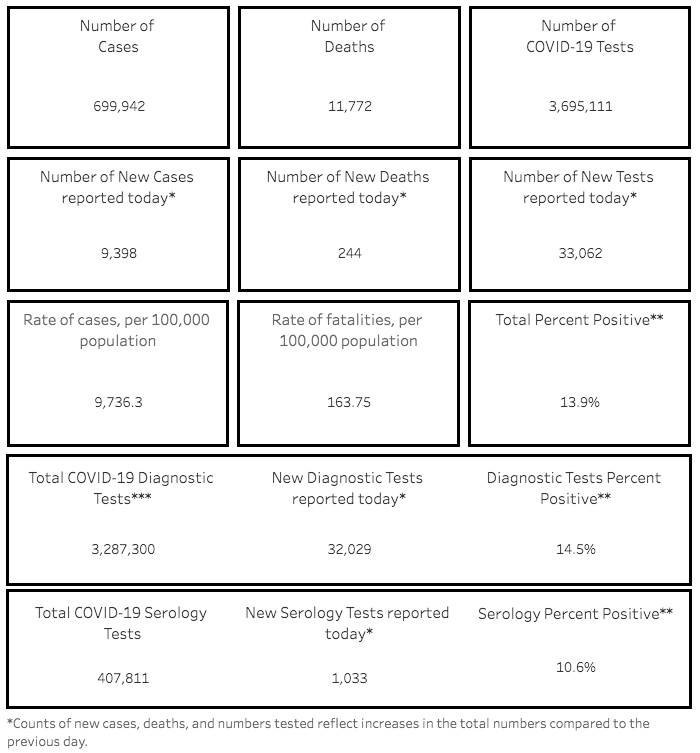
With more than 9,300 new cases reported today, the total number of Arizona’s confirmed novel coronavirus cases nearly hit 700,000 as of Thursday, Jan 21, according to the Arizona Department of Health Services.

Pima County, which reported 1,320 new cases today, has seen 93,839 of the state’s 699,942 confirmed cases.
A total of 11,772 Arizonans have died after contracting COVID-19, including 1,531 deaths in Pima County, according to the Jan. 21 report.
The number of hospitalized COVID cases statewide has dropped slightly in the last week but still remains far above the peak levels of the summer’s first wave. ADHS reported that as of Jan. 20, 4,580 COVID patients were hospitalized in the state. The summer peak of 3,517 hospitalized COVID patients was set on July 13; that number hit a subsequent low of 468 on Sept. 27, or about one-tenth of the current count.
A total of 2,046 people visited emergency rooms on Jan. 20 with COVID symptoms, down from the record high of 2,341 set on Tuesday, Dec. 29, 2020. That number had previously peaked at 2,008 on July 7; it hit a subsequent low of 653 on Sept. 28.
A total of 1,058 COVID-19 patients were in intensive care unit beds on Jan. 20. The summer’s record number of patients in ICU beds was 970, set on July 13. The subsequent low was 114 on Sept. 22.
Bars win round in court against Pima County curfew
Pima County’s mandatory 10 p.m. to 5 a.m. curfew has been temporarily halted after a group of Tucson bars were granted a preliminary injunction barring the county from enforcing the curfew.
Owners of Cobra Arcade Bar, HighWire Lounge and The Maverick filed a joint lawsuit on Jan. 5 contending the county overextended their legal authority to mandate a curfew.
WASHINGTON – President Joe Biden unveiled a sweeping immigration reform bill Wednesday that would create a pathway to citizenship for millions of undocumented immigrants, preserve DACA and end the ban on travel from Muslim-majority countries, among other changes.
The proposal, released on the first day of his presidency, is a sharp reversal from former President Donald Trump’s policies and was hailed by advocates for righting “the cruelty that was the cornerstone” of Trump’s immigration actions.
But other experts warned that while there are many good elements in the bill, it has little chance of passing the Senate without revisions.
“The big thing is the legalization of illegal immigrants, that’s a non-starter for a majority of Republicans,” said Alex Nowrasteh, director of immigration studies at the Cato Institute. In its current form, Nowrasteh, “has no chance of passing.”
Supporters would need to get 60 votes to overcome any likely filibuster attempts in the Senate, which is now evenly divided between Democrats and Republicans with Vice President Kamala Harris, a Democrat, holding the potential tie-breaking vote.

Wednesday, January 20, 2021
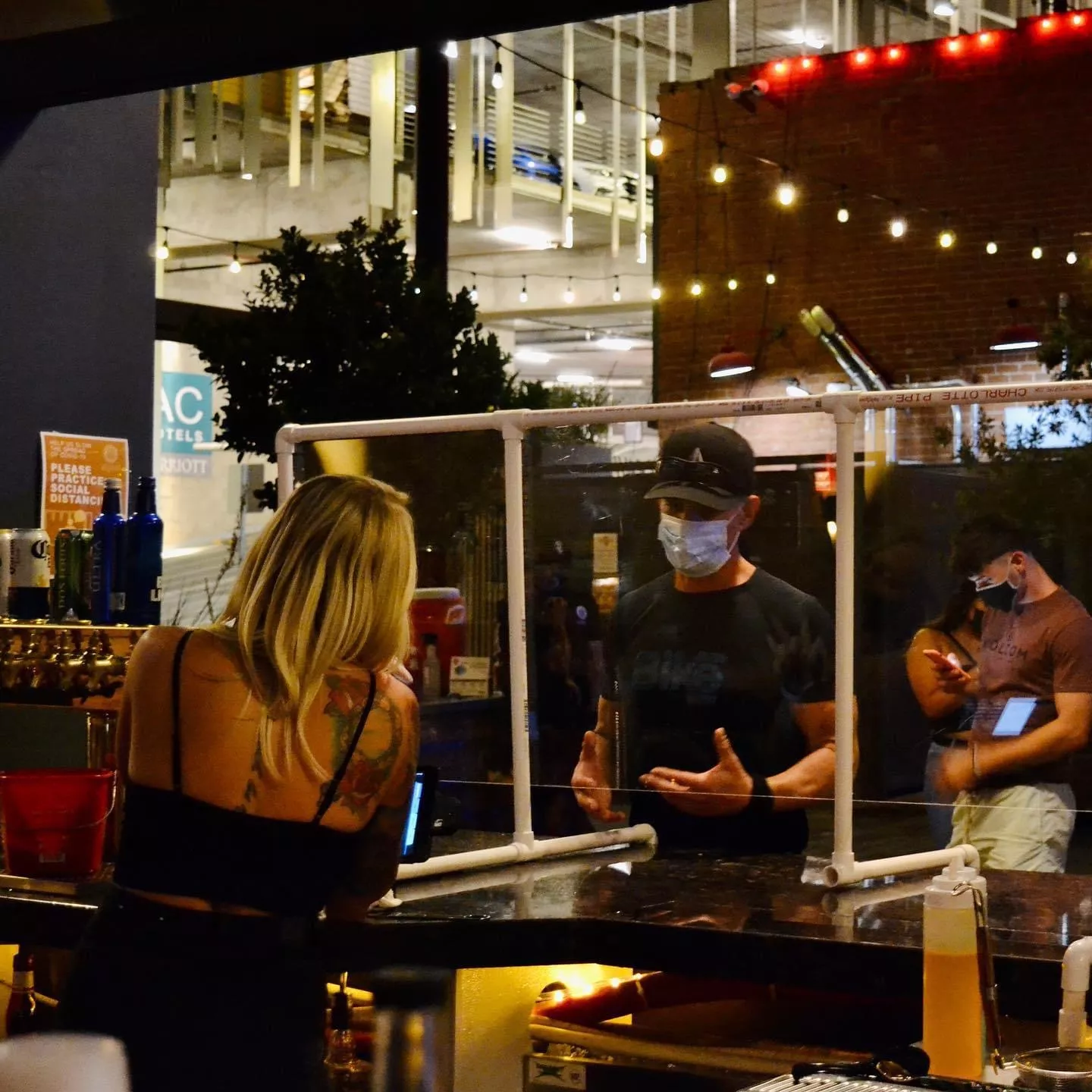
Pima County’s mandatory 10 p.m. to 5 a.m. curfew has been temporarily halted after a group of Tucson bars were granted a preliminary injunction barring the county from enforcing the curfew.
Owners of Cobra Arcade Bar, HighWire Lounge and The Maverick filed a joint lawsuit on Jan. 5 contending the county overextended their legal authority to mandate a curfew.
The owner of The Maverick, Grant Krueger, included other Tucson restaurants he owns in the lawsuit: Union Public House, Reforma Modern Mexican and Proof Artisanal Pizza & Pasta.
After considering the evidence at a Jan. 15 hearing, Pima County Superior Court Judge Kellie Johnson ordered Pima County to cease enforcing the curfew in a ruling filed Jan. 19.
“The Court finds the hardships imposed on the Plaintiffs by the curfew are severe. Additionally, the hardships are arguably unfair because the Court finds Plaintiffs can adhere to the ADHS required safety measures both before and after 10 p.m.,” Johnson wrote in the ruling, echoing the defendant’s arguments. “Moreover, the virus is spread just as easily late at night as it is during the day. Bar patrons can drink excessively during the day just as easily as they can at night.”
While the judge acknowledged the challenges Pima County has managing the COVID-19 pandemic, she held the parties’ legal arguments tipped in the restaurant owners’ favor.
“The County could not demonstrate in testimony or other evidence that more cases are contracted after 10 p.m. Nor has it demonstrated specifically that its current hardships are worsened by people and businesses engaging in conduct after 10 p.m.,” Johnson wrote of the county’s defense. “To the contrary, the burden the County faces in managing this pandemic will continue until the pandemic is under control. The County has simply failed to demonstrate how the curfew not being enforced would cause it additional hardship.”
Pima County County Chief Medical Officer Dr. Francisco Garcia said the 10 p.m. curfew was based on evidence gathered when the county sent 46 inspectors to observe nearly 400 establishments for compliance to the curfew and found 15% of them didn’t comply.
“We have to draw a line in the sand in terms of when you would ask a business like a bar or a restaurant to stop operating. That line in the sand needs to not be entirely arbitrary,” Garcia said. “We know that, based on the surveillance that our county inspection team did, that bars that were operating after 10 o'clock, that there was a substantial amount of non-compliance with the kinds of measures that we've recommended all along. So yes, 10 may seem like a rather odd and very specific time to select, but this is based on actually our observations of what people are doing in those kinds of establishments.”
Grant Krueger, a plaintiff in the case, said he plans to keep both The Maverick and Union Public House open until 2 a.m. beginning tonight.
“We feel that we've been doing it safely since before 10 p.m. and we can do it safely as well after 10 p.m.,” Krueger said. “We've made a lot of really, really good people really happy today by calling back all kinds of staff members who have had to have their hours reduced, limited or even completely eliminated.”
Chuckie Duff, a plaintiff and owner of Cobra Arcade Bar, said he plans on keeping the bar open until midnight tonight and returning to normal business hours of 4 p.m. to 2 a.m. this weekend.
“We're very happy with the ruling and we're glad that we can go back to our normal business hours and continue to follow the rules as we were before and keep everybody safe,” Duff said. “If we have more hours we can be open, it's definitely more hours for our existing employees and hopefully more employees that we'll be bringing back.”
Judge Johnson wrote she’s granting the injunction on the grounds that the curfew is not “statutorily authorized,” the plaintiffs demonstrated the harm it causes them and it violates Gov. Doug Ducey’s executive order.
The governor’s May 12 executive order states: “...no county, city or town may make or issue any order, rule or regulation that conflicts with or is in addition to the policy, directives or intent of this Executive Order, including but not limited to any order restricting persons from leaving their home due to the COVID-19 public health emergency.”

The Pima County Board of Supervisors authorized the county attorney to appeal the ruling, according to a press release.
“It is the County’s firm belief that state law empowers the Health Department to take specific actions such as the curfew to mitigate and halt the spread of infectious diseases,” the release said. “In the meantime, Pima County Chief Medical Officer Dr. Francisco Garcia urges all businesses to continue to voluntarily adhere to the curfew and limit gatherings.”
The curfew was originally set to end when the county reached a rate of 100 COVID-19 cases per 100,000 people. Its current rate is 8,856 cases per 100,000, according to state data.
The curfew will be halted until the resolution of the case. A trial date has yet to be set.
This post has been updated to include comments from bar owners and county officials.
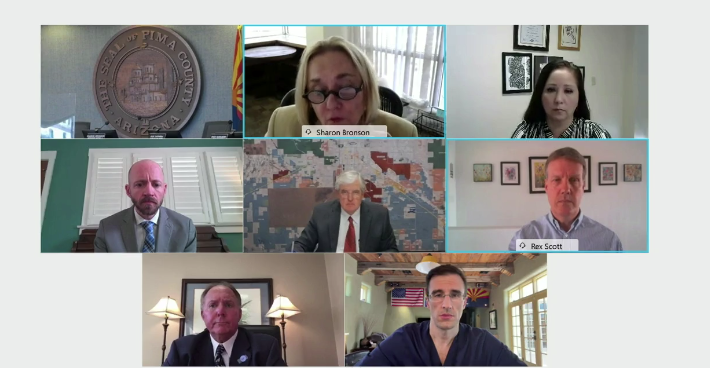
The Pima County Board of Supervisors voted 4-1 yesterday to renew County Administrator Chuck Huckelberry’s contract for another four years and reduce his salary.
With only District 4 Supervisor Steve Christy opposing, the board voted along party lines to extend Huckelberry’s contract to Jan. 7, 2025, and cut his yearly pay to $292,000.
The discussion of the new contract’s renewal was held in an hours-long executive session out of public view.
The county’s top administrator originally asked for a $13,000 raise to $315,000 per year, but the board instead cut his pay by $10,000.
Serving as county administrator since 1993, Huckelberry oversees more than 7,300 county employees and operates under the direction of the Pima County Board of Supervisors.
While the contract Huckelberry originally proposed held that any salary raises would be based on “adjustments that may be accorded Pima County employees generally,” any pay increases will now be based on an evaluation process to be determined by the board.
If the county administrator is terminated without cause, severance pay will now be three months salary instead of six months.

With more than 4,800 new cases reported today, the number of Arizona’s confirmed novel coronavirus cases topped 690,000 as of Wednesday, Jan 20, according to the Arizona Department of Health Services.
Pima County, which reported 779 new cases today, has seen 92,519 of the state’s 690,544 confirmed cases.
A total of 11,528 Arizonans have died after contracting COVID-19, including 1,495 deaths in Pima County, according to the Jan. 20 report.
The number of hospitalized COVID cases statewide has dropped slightly in the last week but still remains far above the peak levels of the summer’s first wave. ADHS reported that as of Jan. 19, 4,663 COVID patients were hospitalized in the state. The summer peak of 3,517 hospitalized COVID patients was set on July 13; that number hit a subsequent low of 468 on Sept. 27, or about one-tenth of the current count.
A total of 2,006 people visited emergency rooms on Jan. 19 with COVID symptoms, down from the record high of 2,341 set on Tuesday, Dec. 29, 2020. That number had previously peaked at 2,008 on July 7; it hit a subsequent low of 653 on Sept. 28.
A total of 1,050 COVID-19 patients were in intensive care unit beds on Jan. 19. The summer’s record number of patients in ICU beds was 970, set on July 13. The subsequent low was 114 on Sept. 22.
Vaccines now available at UA for teachers
The University of Arizona—one of six designated points of COVID-19 vaccine distribution in Pima County—began administering vaccines to qualifying individuals Tuesday, according to UA President Dr. Robert Robbins.
“[Pima County] asked us to be a point of delivery to vaccinate not just our 15,000 family members that are on the faculty and staff at the UofA, but also all childcare providers, all K-12 educators and staff and all Pima Community College faculty and staff,” Robbins said. “For the whole county of Pima, we’re the education POD.”
This week, 1,000 Phase 1B.1 educators will receive vaccines at the campus, according to a press release from the university.
UA will work with the county health department this week to “continue to refine” its delivery process, Robbins said, and it expects to deliver 396 vaccines to K-12 education workers Tuesday through Thursday.
WASHINGTON – In any other year, Ak-Chin Chairman Robert Miguel would have headed to Washington to be part of the inauguration of President-elect Joe Biden and Vice President-elect Kamala Harris.
But Miguel will instead be watching the swearing-in from home, one of the thousands who would normally have flooded Washington this week but were told to stay home because of COVID-19 and the security concerns following the deadly Jan. 6 storming of the Capitol.
“I wish I could have been there, I got invited, definitely,” Miguel said Tuesday. “But again, through the travel restrictions and the COVID at a high, especially here in Arizona, we felt the best way for me to participate was through virtual video and what not.”
After a year filled with virtual conventions, virtual schooling and even virtual legislating, Arizonans like Miguel are taking the largely virtual inauguration ceremonies in stride. They are planning watch parties and contributing video for the days of online events and concerts that celebrate the inauguration.
Miguel recorded a statement the campaign used for its day of service Monday to mark Martin Luther King Jr. Day, while singers from the Fort Yuma-Quechan tribe took part in a welcome video on Saturday.

Tuesday, January 19, 2021

Though not explicitly about Tucson, Doxy Lamine’s new EP features many of the elements that make our town distinct. Doxy Lamine is a side project of local rock band Infinite Beauties, led by guitarist and singer Adam Lopez. At under 25 minutes, the new EP is clean, energetic and to-the-point — and it certainly has some points to make.
Lopez was writing and rehearsing new material while recording his last album, 2020’s Precarious Time, with Jim Waters at Waterworks here in town. While the band was ready to record the new tracks right away, the pandemic kicked everything to the side.
“It was frustrating in many ways because we couldn't even rehearse, albeit it also gave me time for making demos and preparing the details for the return to the studio — I mean every detail!” Lopez said.
Ultimately, the band was able to record the well-polished tracks from July to October 2020. Though the sessions produced eight songs, only six made the cut. “The original idea was to have an eponymous CD, but we instinctively called it ‘Small, Small Town’ based on the opening tune and the artwork done by my son Sol,” Lopez said. “The song is not so much about Tucson, but more about dating in a small town.”
Themes aside, the EP itself works as a kind of small town, with each song serving a unique role and sound: the title track kicks things off in a bluesy fashion, with Lopez lamenting personal vices over a surprisingly upbeat rhythm and some wonderful violin lines by Mariah McCammond. "You Did It," has more of an alternative rock flair with call-and-response singing between Lopez and Marta DeLeon from the Weekend Lovers, gradually forming into a close harmony; "Crisis Or Opportunity" features a classic borderlands rock sound, based around a dusty guitar line and Lopez's low and smooth vocals.
Though the EP begins with standard rock affair, it grows more political and spiritual through its runtime, with some blunt and even existential lines on the second half like “Make peace with God before you’re dead … If it happened to you, maybe you’ll know how it feels.”
This all concludes with the multi-layered, progressive final track “Spirituality Song,” which begins with a spoken word recital by Joseph Graves. The jaunty closer channels some darker themes, but never loses sight of the driving central melodies. At points, the groove even sounds like another great Tucson band, The Mission Creeps, with its chilly keyboards and vast sound.
It’s a quick, easily digestible collection of tracks that reminds you to try to get your life together, and if you can’t, you might as well dance.
The University of Arizona—one of six designated points of COVID-19 vaccine distribution in Pima County—began administering vaccines to qualifying individuals Tuesday, according to UA President Dr. Robert Robbins.
“[Pima County] asked us to be a point of delivery to vaccinate not just our 15,000 family members that are on the faculty and staff at the UofA, but also all childcare providers, all K-12 educators and staff and all Pima Community College faculty and staff,” Robbins said. “For the whole county of Pima, we’re the education POD.”
This week, 1,000 Phase 1B.1 educators will receive vaccines at the campus, according to a press release from the university.
UA will work with the county health department this week to “continue to refine” its delivery process, Robbins said, and it expects to deliver 396 vaccines to K-12 education workers Tuesday through Thursday.
UA will administer 84 doses to university employees Wednesday and Thursday, Robbins said. On Friday, the university expects to be “up and running” under the county’s regular scheduling process for those who register through the county.
On Friday, 500 childcare workers and K-12 teachers will receive vaccines at UA, he said.
Pima County prioritizes who receives the vaccine, and eligible recipients must register through the county to make an appointment.
Qualified 1B educators can register online at: https://webcms.pima.gov/cms/One.aspx?portalId=169&pageId=690372#School.
Qualifying individuals can register Monday through Friday, 8 a.m. to 5 p.m., by calling: 520-222-0119.
The University of Arizona’s POD dates and times this week:
- Tuesday, 11 a.m.-3 p.m. (132 K-12 teachers)
- Wednesday, 11 a.m.-3 p.m. (132 K-12 teachers, 42 UA educators)
- Thursday, 11 a.m.-3 p.m. (132 K-12 teachers, 42 UA educators)
- Friday, 11 a.m.-4 p.m. (last scheduled appointment 2:45 p.m.) (500 Phase 1B.1 K-12 teachers and educators in Pima County)
By April 1, Robbins hopes the university will have vaccinated 60,000 childcare providers, K-12 educators, Pima County Community College employees and UA’s staff of 15,000.
“If we could get to 1,000 a day, we could get 60,000 individuals vaccinated over the next two months,” Robbins said.
UA requiring on-campus students get tested twice a week
About 3,800 UA students returned to in-person classes Wednesday during Stage 1 of the university's reentry plan.
Robbins said Stage 1 will continue through the week of Jan. 25, but it’s possible the phase of limited in-person classes could run throughout the entire semester.
“We’ve gotta see the numbers come down before we can move to Stage 2, which would be up to 50 students in a classroom.”
In attempts to control the spread of COVID-19, on-campus dorm students will take COVID-19 tests twice a week with at least 48 hours between tests.
Students will take the new PCR saline gargle test developed by Michael Worobey, the head of UA’s department of ecology and evolutionary biology.
Those receiving the test have to swish and gargle 5 milliliters of saltwater three times, and spit the solution into a tube to be tested. At a press conference in December, Worobey said the test detects present coronavirus material and amplifies it to a traceable amount.
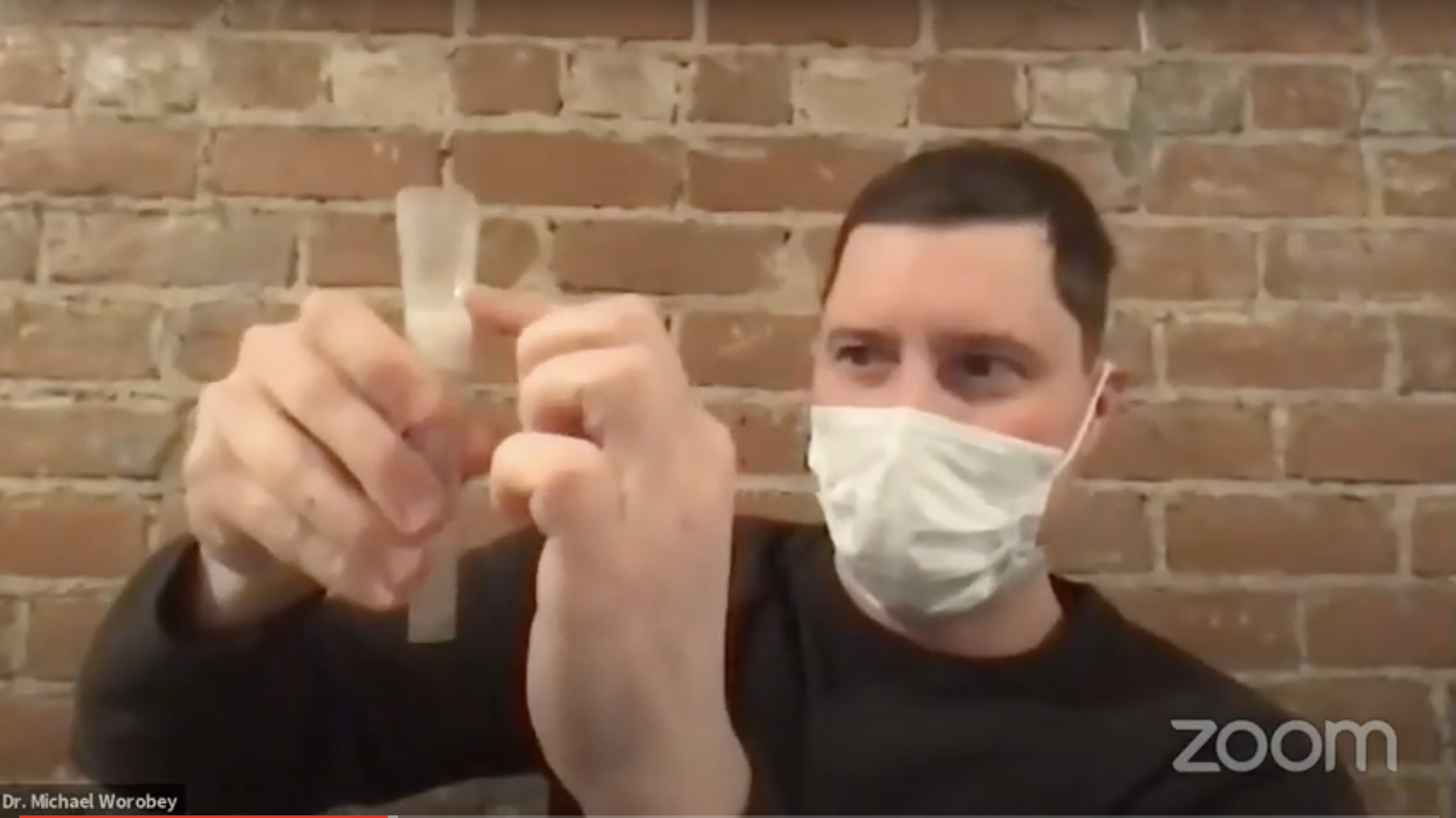
Worobey said he assessed the test's effectiveness by giving potentially infected persons both saline and nasal swab tests. He found the gargle swish test pulled coronavirus material out of about 30-35% more people than the nasal swab.
“I think this is going to become the new gold standard for how to test for this virus,” Worobey said.
Robbins said the swish gargle test will allow the university to conduct 3,000 COVID-19 tests a week. With the nasal swab, they could only conduct 1,000 tests a week.
COVID-19 on campus
From Jan. 9 through 18, UA administered 11,713 COVID-19 tests and found 194 positive cases for a positivity rating of 1.7%.
As of Jan. 15, 28 students were in isolation dorm beds with 568 beds still available, according to Robbins.
Although positive tests have dropped since last semester, Reentry Task Force Director Richard Carmona called the numbers “still unacceptably high.”
While some statewide COVID-19 statistics have appeared to improve recently, Carmona warned not to become complacent.
Carmona went over data showing the 14-day change of coronavirus cases, deaths and hospitalizations in Arizona. Cases declined 10%, deaths increased 119% and hospitalizations increased 8%.
“There’s a lot of data still coming in, and often, the data that we see on a daily basis isn’t reflective of what’s actually happening because it takes a while to get that data tabulated and put into the system,” Carmona said. “Although it looks like we’re doing a little bit better, we have more testing, we got some control, we’ve managed to get the university open relatively safely, our students are doing well—but we’re far from where we need to be. It’s still a long journey ahead of us.

