Thursday, May 13, 2021
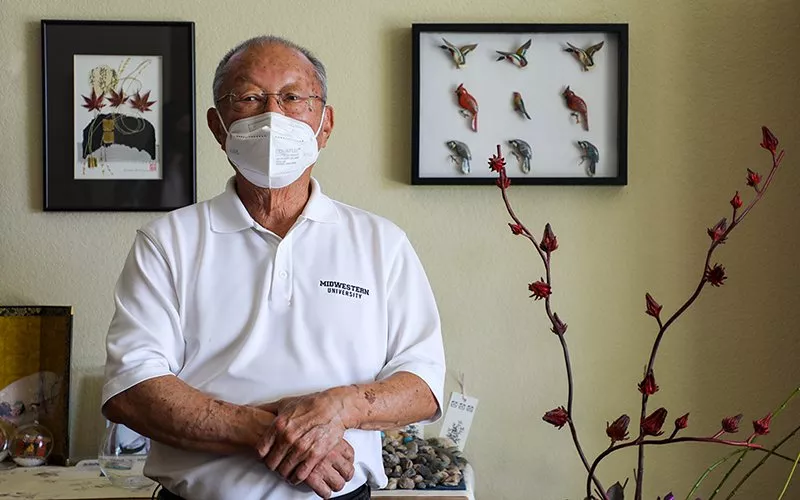
PHOENIX – Thirty miles southeast of Phoenix, on sacred land belonging to the Gila River Indian Community, lie the remnants of an internment camp that once housed more than 13,000 people, mostly Japanese Americans, during World War II.
Concrete foundations and cisterns remain, but gone are the fences, barracks and gun tower that revealed the purpose of the place was incarceration rather than internment, at a time when Japanese Americans were suspected of being spies and saboteurs.
“These internment camps were less like camps and more like prisons,” said Koji Lau-Ozawa, an archeology doctoral student at Stanford University whose grandparents were incarcerated there. “There’s a complicated history, but it’s important to note that.”
Gone, too, are the bases, bleachers and foul lines made of flour that represented a form of escapism for those inside the wire: baseball.
Two months after Japan bombed Pearl Harbor on Dec. 7, 1941, the U.S. government issued Executive Order 9066 authorizing the incarceration of an estimated 120,000 Japanese Americans on the West Coast. They often were given just 48 hours to sell their homes, businesses and possessions before assignment to one of 10 locations.

Pima County and the Federal Emergency Management Agency have launched mobile vaccination units to reach vulnerable communities with high risks of COVID-19 exposure and infection.
The operation includes two mobile vaccination units that are able to administer 250 vaccines per day each, according to a county press release.
The units will run through June 26, operating at two concurrent locations for three days, with one day to tear down and move to the next location. The locations were selected based on census tract data and the Social Vulnerability Index of the area to identify highly vulnerable communities.
The sites will offer walk-up vaccinations of both the Moderna and Johnson & Johnson vaccine for those 18 and older on a first-come, first-served basis. Patients will return to the same mobile site 28 days after their first visit to receive their second dose, following CDC guidance. Help will be available to all who need assistance with mobility, language or other accommodations.
Thursday, May 13
- Greyhound Park, 2601 S. 3rd Ave., 10 a.m. – 8 p.m.
- Wheeler Taft Library, 7800 N. Schisler Drive, 10 a.m. – 8 p.m.,
- Rillito Race Track, 4502 N. 1st Ave., 10 a.m. – 8 p.m.
- CDO High School, 25 W. Calle Concordia, Oro Valley, 4 - 7 p.m.
- Antigone Books, 411 N. 4th Ave., 5 - 9 p.m.
Friday, May 14
- Fox Tucson Theater, 17 W. Congress St., 4 – 8 p.m.
Saturday, May 15
- Our Lady of Fatima Parish, 1950 Irvington Place, 11 a.m. - 3 p.m.
- Dunbar Pavilion, 325 W. 2nd St., 11 a.m. - 3 p.m.
- Robles Ranch Community Center, 16150 W. Ajo Way, Robles Junction, 5:30 - 8:30 p.m.
Saturday, May 15 - Monday, May 17
- Curtis Park, 2110 W. Curtis Road, 10 a.m. – 8 p.m.
- Rillito Race Track, 4502 N. 1st Ave., 10 a.m. – 8 p.m.
Sunday, May 16
- Sacred Heart Church, 601 E. Fort Lowell Road, 8 a.m. - 2 p.m.
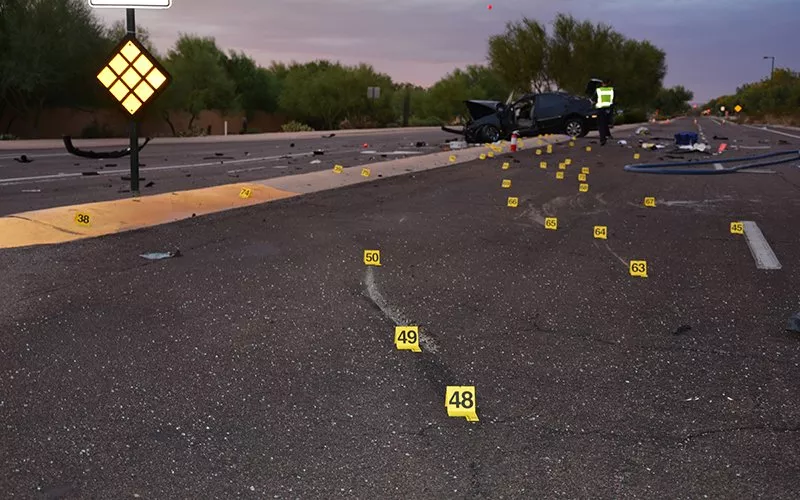
PHOENIX – Ramon Angel Carrasco and his girlfriend were driving home from a Scottsdale bakery in a white BMW in August 2019 when Robert J. Foster pulled up next to them in a light blue Lamborghini.
According to a witness account provided to police, Carrasco and Foster revved their engines at a red light on Hayden Road before heading north, and within seconds they were traveling more than 100 mph.
Meanwhile, Cynthia Ann Fisher was driving south on the same stretch of Hayden. The 68-year-old hairdresser had just left the grocery store and was planning to make breakfast the next morning for a new roommate, said Leah Stenzel, her friend and boss.
Fisher was turning left onto Williams Drive when Carrasco’s BMW struck the passenger side of her black Camry, propelling her car 160 feet from the impact, according to police records. Fisher, who was a minute from her home, was declared dead at the scene.
Carrasco and his girlfriend, Jaymi Lynn Chagolla, suffered minor injuries. Carrasco told police he had nothing to do with the Lamborghini and refused to speak further without an attorney present, but Chagolla confirmed what multiple witnesses who called police had reported.
“Yes, we did a pull against a Lamborghini,” she said when police asked whether the cars were racing.
Wednesday, May 12, 2021
After the Food and Drug Administration’s emergency use authorization of Pfizer for children 12 to 15 on Monday, the Advisory Committee on Immunization Practices and CDC are expected to approve and recommend the use of Pfizer to vaccinate those 12 and older on Wednesday.

The Pfizer vaccine is currently available for those ages 16 and older. The Moderna and Johnson & Johnson vaccines are authorized for those 18 and older.
“The COVID-19 vaccines are safe, effective and free ‒ and they’re our best shot to end this pandemic and return to the things we’ve missed. We’re moving quickly to empower parents and guardians to get this protection for their children,” said Gov. Doug Ducey. “Millions of Arizonans have already received the COVID-19 vaccine. Soon, kids ages 12 to 15 years old will now be eligible to get vaccinated and state vaccine sites are ready to serve them.”
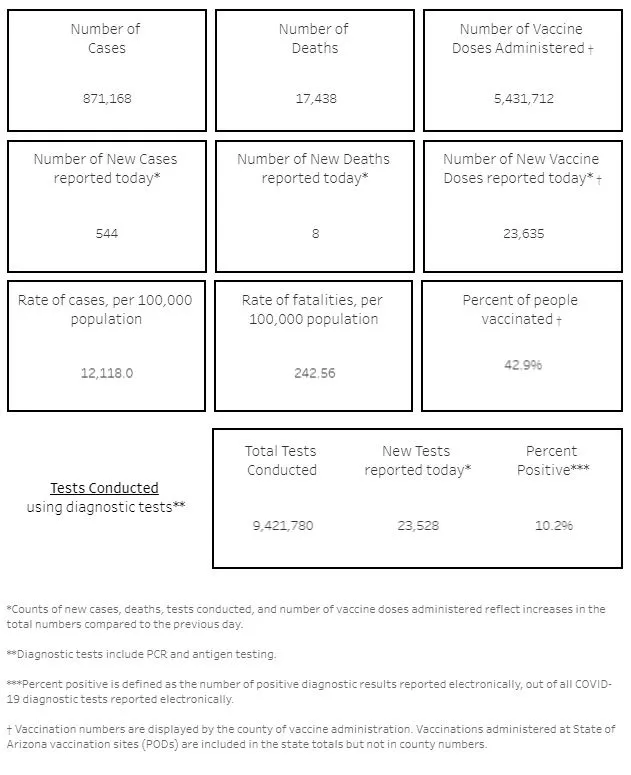
Arizona has nearly 400,000 youths ages 12 to 15, about 5 percent of Arizona's population. As of Tuesday, 5,383,508 vaccines have been administered in Arizona, with 35% of Arizonans fully vaccinated.
“We’re delighted to be able to welcome these young people to state-run mass-vaccination sites starting Thursday,” said ADHS Director Dr. Cara Christ. “These safe, highly effective, and free vaccines are our best shot at returning to normal, and having more vaccinated individuals gives COVID-19 less of a chance of spreading.”
The University of Arizona POD, as a state site, will vaccinate children 12 to 15 and although it will close on June 25, they had factored the drop in vaccination age into their decommission plan, said Vice President of Communications Holly Jensen.
“We will continue to monitor the numbers, and are ready to adjust if necessary,” said Jensen.
Once CDC makes the recommendation, parents and guardians may bring those ages 12 to 15 to state vaccination sites starting Thursday. They must accompany the child and sign a consent form in person, which states that the child is at least 12 years old. No identification is required for the child and place of permanent residence is not a factor.
Parents and guardians also will be able to register those ages 12 to 15 for vaccination starting at 8 a.m. Thursday by visiting podvaccine.azdhs.gov or calling 844-542-8201 to be connected with someone who can assist in English or Spanish. However, appointments are no longer required for state-run sites.

PHOENIX – Sports is a billion-dollar industry, with revenue streams ranging from television rights to ticket sales. Add cryptocurrency and NFTs to the mix, and this latest gold rush has leagues, teams and players taking advantage of opportunities in an unlikely territory.
Former Arizona Diamondbacks pitcher Taijaun Walker, now with the New York Mets, was the first known and active Major League Baseball player to create and sell a piece of digital art through a non-fungible token, otherwise known as an NFT, the New York Times reported. The piece of art sold for 2.35 Ether, a form of cryptocurrency, or roughly $4,275. Proceeds from the auction benefited the team’s charity, the Amazin’ Mets Foundation.
Walker’s NFT announcement opened eyes and raised eyebrows about this new way athletes could generate income.
What exactly is an NFT?
“(It is) a piece of digital asset, which can be video, file, photo, really anything that you like, to be managed by smart contracts,” said Dragan Boscovic, director of ASU’s Blockchain Research Lab.
Simply, think of it as something intangible – something you can’t hold in your hand – such as Walker’s digital art, or a unique video or Twitter CEO Jack Dorsey’s first tweet, which fetched a cool 1,630.58 Ether, the equivalent to about $2.9 million.
Boscovic added that with a smart contract “you can basically control certain properties of that digital asset.” If it’s a photo, for example, you can control who has access to it and how many copies of it can be made.