

Wednesday, November 24, 2021

Tuesday, November 23, 2021
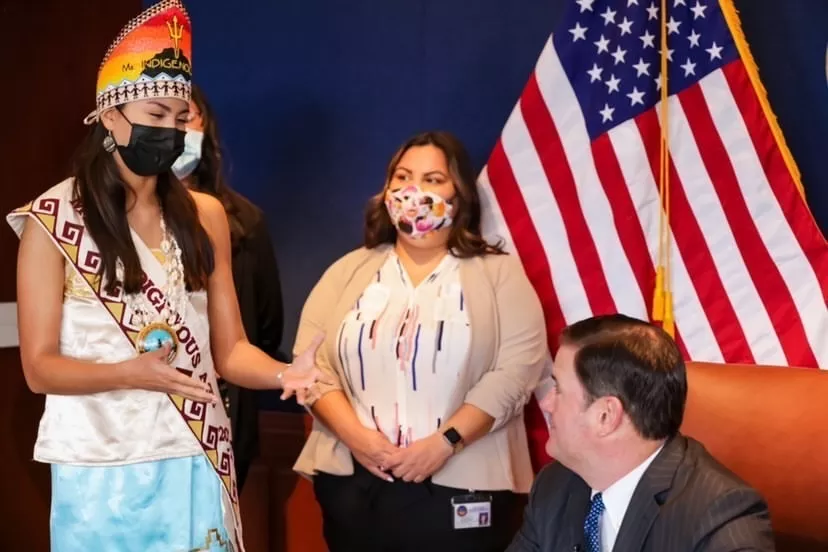
PHOENIX – Just minutes before her high school graduation in Gallup, New Mexico, three years ago, Dakotah Harvey was told to remove the eagle feather from her mortarboard or she would be escorted out of the ceremony and her diploma would be withheld.
Her grandfather had tied the feather to the cap’s tassel earlier that day, Harvey told Cronkite News. He loaned it to her after performing a Navajo prayer in celebration of her achievement.
“I didn’t have the heart to tell him I couldn’t wear it,” Harvey said.
To Navajos and many other Indigenous peoples, the feather of an eagle is an important and sacred component of many ceremonies and blessings.
In April, Arizona Gov. Doug Ducey signed legislation that public schools can’t prohibit Indigenous students from “wearing traditional tribal regalia or objects of cultural significance at a graduation ceremony.” The bill specifically includes eagle feathers or eagle plumes.
Cultural regalia includes hair buns, rug dresses, woven sashes, moccasins, beadwork and turquoise jewelry, including bracelets, belts and necklaces.
New Mexico does not have a similar law.
Monday, November 22, 2021
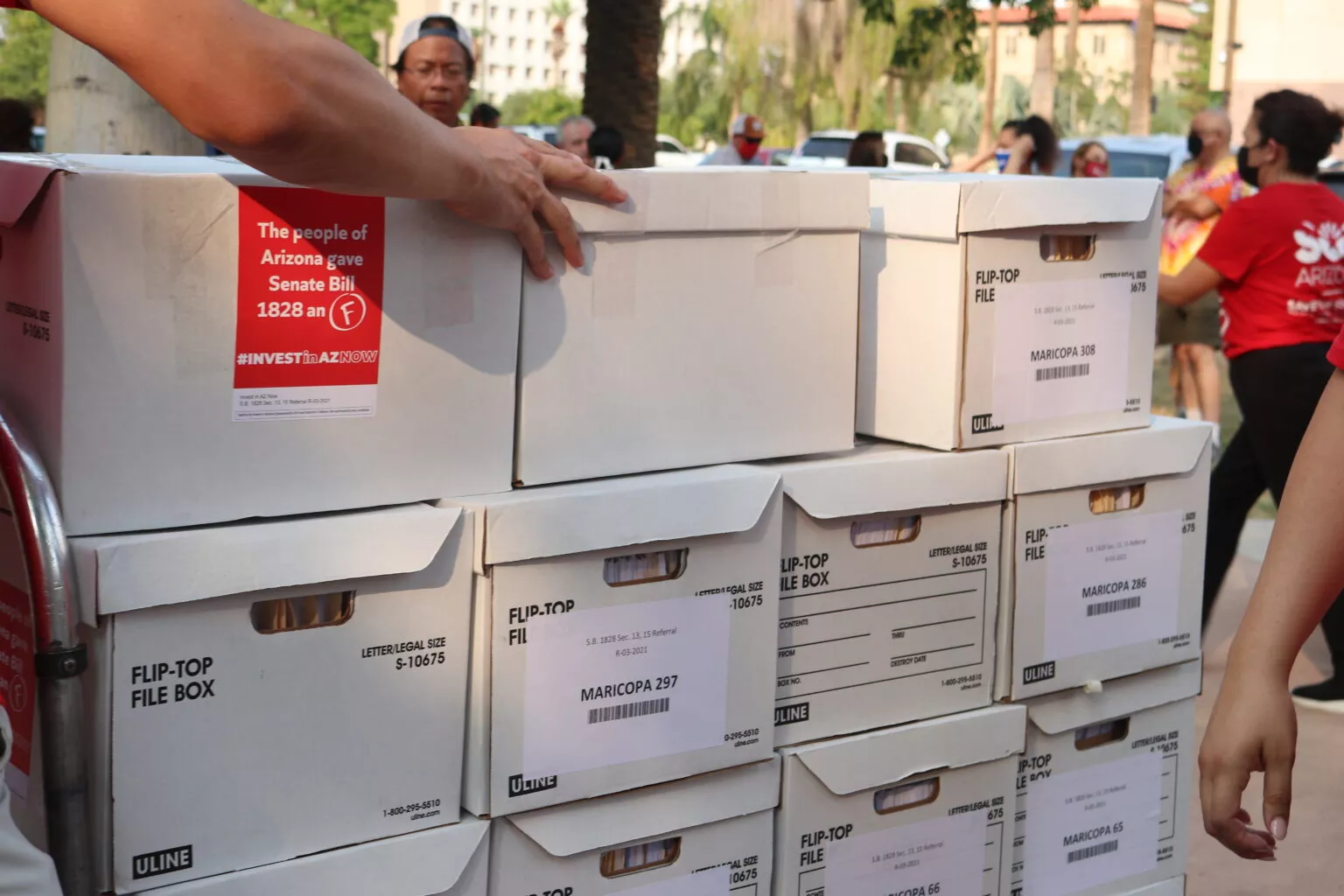
Arizona voters will get the final say on Gov. Doug Ducey’s legacy income tax cut package that was signed into law earlier this year, after a coalition of public education groups successfully forced a public vote in 2022.
The Secretary of State’s Office announced Friday that the referendum effort gathered more than the 118,823 signatures needed to block the tax cuts from going into effect unless voters approve them next year. It will be called Proposition 307, said Sophia Solis, spokesperson for the Secretary of State’s Office.
Ducey’s income tax cuts, which serve as his legacy policy achievement during his two terms as governor, dramatically reform Arizona’s tax system. Instead of a progressively graduated system with a maximum rate of 4.5%, Arizona will shift to two income tax rates: 2.55% for people who earn $27,272 annually and 2.98% for those who earn more than that. The tax law changes in Senate Bill 1828 also create a single 2.5% rate as soon as 2023 if state revenues hit certain triggers.
Legislative budget analysts concluded that it would cost the state about $1 billion annually. And while all taxpayers would see a reduction in income taxes, the wealthy receive the largest benefit: the poorest Arizonans would save $1 a year while the wealthiest would keep an average of nearly $350,000. The typical Arizona family would save about $42 a year, on average.
The tax cuts were designed to shield the wealthy Arizonans from the Invest in Education Act that voters approved in 2020. That voter-approved measure, also known as Proposition 208, imposes a 3.5% surcharge on income greater than $250,000 for individuals and $500,000 for couples, with the money directed to public schools to increase teacher pay and boost overall funding.
Prop. 208 will likely never go into effect. The Arizona Supreme Court ruled in August that it’s subject to the Arizona Constitution’s spending limits for K-12 education, setting the stage for a new trial court ruling that is expected to invalidate the measure.
Friday, November 19, 2021

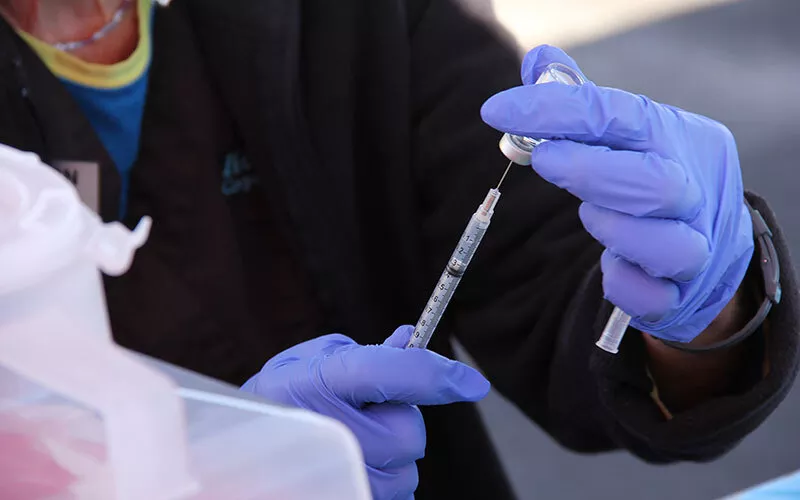
PHOENIX – As hospitalizations rise and the holidays approach, health officials concerned about a new wave of infections are urging Arizonans to take preventative measures to stop the spread of COVID-19 and seasonal influenza.
Maricopa County last week experienced the biggest spike in daily cases since August, peaking at 4,708 on Nov. 8. COVID 19 hospitalizations and ICU cases also are up at the state’s largest hospital systems, placing strain on a workforce already struggling with staff shortages.
“We still have some capacity, but we’re stretched thin,” Dr. Michael White, chief clinical officer at Valleywise Health, told a news conference Wednesday. “It’s not just available space to take care of folks, it’s the qualified health care professionals and the team we need to be able to care for patients at the ICU level of care.”
White said there were 40 COVID-positive patients hospitalized on Wednesday, twice the number of three weeks ago.
Banner Health, Arizona’s largest health care system, which treats 44% of all COVID 19 cases in the state, reports a significant increase in COVID 19 admissions in the last week. Banner on Tuesday reported the highest ICU census in the past eight months.
The largest spike in the pandemic so far in Arizona occurred in early January, just after last year’s holiday season.
In the face of this growing concern, White stressed the importance of getting vaccinated, and he advised against relying on recently developed antiviral pills, such as Molnupiravir.

Thursday, November 18, 2021

Pima County posed an update on Huckelberry's health via wife, Maureen Huckelberry, who said that Huckelberry, who turns 72 on Monday, Nov. 22, was on the road to recovery.
“Chuck is out of the hospital and is now receiving care and physical and other therapies at a new facility," Maureen Huckelberry said. "His physicians and care team are happy with his progress recovering from his injuries."
Huckelberry, who has been county administrator since 1993, had been in the hospital since he was struck by a car on Oct. 23 while cycling downtown. He suffered a severe head injury that including bleeding on the brain.
Maureen Huckelberry thanked the staff at Banner University.
"The care they provided Chuck and the kind and nurturing support they gave to me and my family was extraordinary," she said. "Again, I want to thank everyone for their continued concern for Chuck and his progress. It is deeply touching and meaningful to me, Chuck and our entire family."
She also encouraged Pima County residents to consider giving blood in honor of Huckelberry's upcoming birthday.
Pima County is expanding COVID booster eligibility rules to allow anyone over 18 to get the booster.
As Pima County hospitals fill up because of an increase in COVID cases, county officials are expanding eligibility ahead of the CDC’s recommendation.
Banner Health officials announced earlier this week that they have seen a significant increase in COVID ICU admissions and that COVID patients now account for more than a third of all ICU patients in Banner’s Arizona hospitals.
Dr. Joe Gerald, an epidemiologist with the UA Zuckerman School of Public Health who has been tracking COVID cases since the virus first arrived in Arizona, reported that as of Nov 10, 24% of Arizona’s general ward beds were used by COVID-19 patients—a 16% increase from a week before.
COVID hospitalizations align with the increasing trend of rising COVID-19 cases all over Arizona. As of Nov 7, Arizona’s COVID cases increased by 30% from the week prior, according to Gerald’s COVID report. From Nov 1 to Nov 9, Pima County cases increased by 38%, according to the Arizona Department of Health Services.
Pima County Health Department Director Dr. Theresa Cullen said at a Nov. 17 press conference that 25% of cases reported in October were of vaccinated people. The breakthrough infection rate has risen from 1% to 1.2%, indicating to health officials that vaccines have lower effectiveness over time.
“Vaccination is not sufficient to prevent transmission and clearly vaccination does not last forever, it doesn’t work that way for the flu either,” Pima County Chief Medical Officer and Deputy County Administrator Dr. Francisco Garcia said during the Pima County Board of Supervisors Nov. 16 meeting.
Health officials found that breakthrough cases tend to happen at about six months after full vaccination. As a result, Pima County health officials are urging all Pima County residents to get a booster shot if it’s been six months since their second dose of the Pfizer or Moderna vaccines, or two months since their single shot of Johnson & Johnson.

