

Wednesday, February 10, 2010

"J'tois Leather Dress" is among the pieces that will be available for purchase during "Pop Up Shop" on Saturday, Feb. 20 at Zoe Boutique, 735 N. Fourth Ave. "Pop Up Shop" will be from 10 a.m. to 10 p.m. with live models and a cocktail party from 5 to 10 p.m.
Tags: Paula Taylor , Pop Up Shop , Zoe Boutique
Tuesday, February 9, 2010
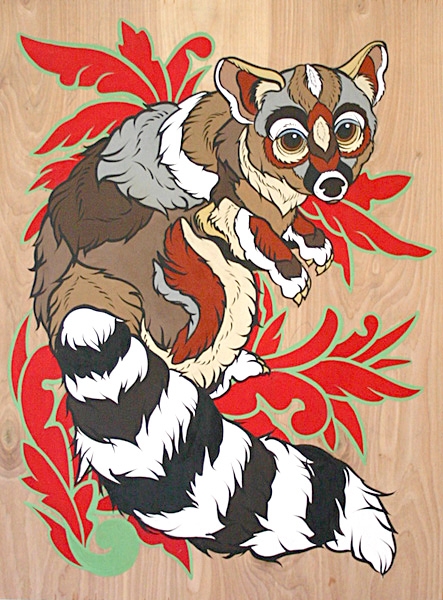
- Allyson Bennett
- Ringtail
"Ringtail," by Allyson Bennett, is among the works on display in Mysterious Strangers, continuing through the end of February at Epic Café , 745 N. Fourth Ave. The café is open from 6 a.m. to midnight, seven days a week.
Sunday, February 7, 2010

- Laura Moriarty
- How Mountains Are Made
"How Mountains Are Made," by Laura Moriarty, is one of the works in Geologic Time, continuing through Feb. 27 at the Conrad Wilde Gallery, 439 N. Sixth Ave., Suite 171. The gallery is open Tuesday through Saturday from 11 a.m. until 5 p.m.
Tags: Laura Moriarty , Conrad Wilde Gallery , Tucson artists
Friday, February 5, 2010

"Flirt," by Catherine Eyde, is among the works in Sweet Love, which continues through Wednesday, March 10, at Hotel Congress, 311 E. Congress St. Come to the artist's reception, featuring a performance by local cowpunk Al Perry, from 6 to 8 p.m. tonight.
Tuesday, February 2, 2010

"Bella Donna," by Juan Carlos Breceda, is among the works on display from Feb. 11 through Feb. 22 at the Tansey Gallery, 3001 E. Skyline Drive, Suite 109. The gallery is open Monday through Saturday from 10 a.m. to 6 p.m. and Sunday 11 a.m. to 5 p.m.
Opening reception is from 5 to 7:30 p.m., Thursday, Feb. 11. Breceda will visit the gallery to demonstrate his techniques from 1 to 3 p.m., Saturday, Feb. 13.
Tags: Juan Carlos Breceda , Tansey Gallery
Monday, February 1, 2010

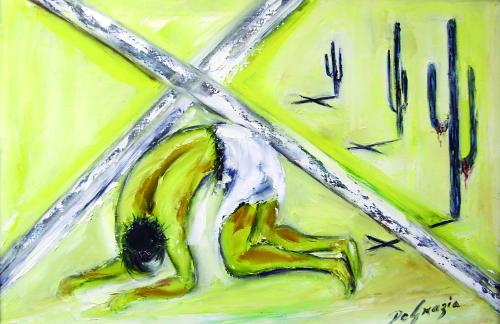
"Mountain Scene No. 3" (top) and "Station VII" (bottom) by Ted DeGrazia are among the works on display through April 30 at the DeGrazia Gallery in the Sun, 6300 N. Swan. The gallery is open from 10 a.m. to 4 p.m. daily.
Thursday, January 28, 2010
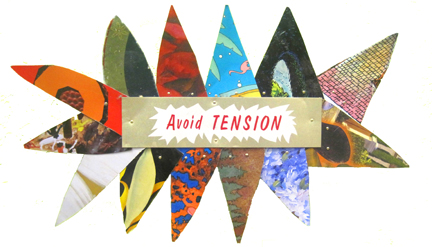
"Avoid Tension" by Rand Carlson, whose work is on display at Bohemia: An Artistans Emporium, 2920 E. Broadway.
Wednesday, January 27, 2010
In our Sept. 6, 2007, issue, Margaret Regan wrote a story on Maurice Grossman, who died last week at the age of 82.
Here it is in its entirety.
———————————————————————
Maurice Grossman, Tucson's Mr. Ceramics, never intended to be a potter.
The founder of the UA's ceramics program way back in 1955, Grossman started out as a painter, studying watercolor and commercial art at Detroit's Wayne State University in the 1940s.
"But I fell in love with clay," he said one day last week, surrounded by 30 of his favorite pieces. "Clay took over my life."
That may be an understatement.
Grossman last Saturday opened a mini-retrospective representing a half-century of his ceramic work. Officially called Maurice Grossman: Along the Way, the retired professor jokingly renamed it Maurice's Pieces, because it exhibits the art he's kept—and lived with—in his home and studio.
"It's great to dust them off and make a show," he said. "This is a 50-year Tucson journey in clay."
And more than that, the show is "a history of ceramics" in the second half of the 20th century, said Dinnerware executive director David Aguirre. A ceramic artist himself, Aguirre said that Grossman helped transform the medium in the 1950s and 1960s.
The exhibition is the first at Dinnerware Artspace, the new Congress Street digs of the nonprofit formerly known as Dinnerware Contemporary Arts. Now in its 28th season, the gallery is making yet another new beginning.
After getting kicked out of the Steinfeld Warehouse at the end of July, Dinnerware has reconstituted itself in a former office space recently vacated by an architectural firm. Aguirre said the new Artspace hopes to run lectures, operate phantom galleries in empty storefronts and generally be a good, arty neighbor in what he hopes will be a revitalized downtown. A small gallery two doors up will exhibit emerging artists (the current show is a mixed-media installation by Iris Hutegger).
"I saw a sign that called this the Congress Street District," he said. "I want Dinnerware to change that to the Arts District."
Timed to coincide with Grossman's 80th birthday this month, Along the Way is a good match for Dinnerware's latest venture. In fact, the theme of both gallery and show could be reinvention.
The exhibition chronicles Grossman's changing techniques, as he shifted from early functional pots made on the potter's wheel to free-form sculptures that just happen to use clay as a material. Grossman had fairly traditional training, getting an MFA at Ohio State and studying in the summers at Alfred University, famed for its industrial bent. Ohio State was more aesthetically oriented, he said, but the ceramic studio was in a factory, and many grads went on to careers in industrial ceramics.
The oldest piece in the show, "Acrobats," from 1956, was inspired by practical wares used everyday. A tall, functional vessel, complete with a lid, it was made on the traditional potter's wheel. Its aesthetics, though, owe more to Grossman's 1954 Fulbright year in Japan than they do to the robust industry of Ohio. Toned in an Asian earth palette of beige and brown, the piece is etched with stylized dancers in dark brown cavorting around the pot's curves.
The most recent work, "The House Within," from 2004, is worlds away, in form, color and intention. No wheel was used: Grossman shaped slabs and coils of clay with his hands and created a shape that has nothing to do with a traditional pot. A small solid house, deeply colored in blue, is set inside a clay latticework that traces out a larger house. With its allusions to home and psyche, "The House Within" has metaphorical ambitions far beyond the ken of the simple functional pot.
Groundbreaking Los Angeles clay artist Peter Voulkos helped incite Grossman's clay revolution.
"He was a great inspiration," Grossman said. "He was breaking down the rules about pottery as a craft, and going into sculpture. He was an eye-opener. I started going into constructed pieces, using slabs of clay, and getting away from the wheel."
But Grossman felt free to mix his techniques, too. In between "Acrobats" and "House Within" are all manner of pieces, some of them solidly in the wheel or free-form camp, others hybrids treading the boundary between the two extremes. Quite a few are the result of a mixture of techniques, pairing wheel-thrown shapes with slabs of clay or forms created in molds.
"Owl," from the early '60s, is a whimsical abstraction of the nocturnal bird, in the quiet browns and beiges of earthenware pottery. But the owl's body was made in a mold, and the pedestal was thrown on the wheel.
With "Pagoda," made a few years later in the mid- to late-'60s, Grossman was still mixing techniques—this time wheel-throwing and slab—but he was ratcheting up his colors. The multi-layered architectural piece, with roof edges evoking a Japanese temple, abandons earth tones and veers into yellow.
By "Moon Shot," an early '70s work commemorating the 1969 moon landing, Grossman was reveling in a painterly palette of blue-purple and silver, tracing out glittery, wavy lines across the face of his moon. And the surface of the work was no longer sedate. Little bumps erupt all over.
Ceramic traditions from around the world also turn up in Grossman's art. He's traveled widely, to India, Mexico, Greece and Bali; everywhere, he finds himself "sucking up the energy and taking it home." He became a Buddhist during his time in Japan, and his works have had a spiritual dimension ever since. African textiles turn up in "Shaman Box," a tall, solemn work etched with geometric designs in ochre, brown and red.
The "overwhelming" stone shrines of Bali made their way into a series of upright pieces that radiate a quiet spiritual strength. He had a need for such clay shrines in the late '70s. His wife, Marilyn, died young of a stroke in 1979, leaving him with two children to raise. Her death also led him on a quest to create a vessel where he could put her ashes to rest.
Enamored with raku, a firing technique that leaves the clay burned and blackened, he made his late wife a modified sphere, scorched by fire and torn on the sides. A subsequent urn series allows space for the living to store ashes as well as letters to their dead. But even some of these demonstrate Grossman's famous playful side.
"Winged Box," a funerary pot in two sections, is "for people who don't want to be together," he said. And "Moon Dog," from the 1990s, represents a happy memory from Grossman's time as a single dad. At left is a crescent moon in profile, and at right is small dog talking to it. It came, he said, "out of stories I made up for my kids."
At almost 80, Grossman is still beloved by legions of former students, and he's a reliable supporter of artists in town, invariably turning up at openings and contributing his works to galleries big and small. And he's still working, lassoing ideas from all over the universe.
"Whenever I'm short of ideas," he said, "I go steal from the Tang dynasty."
Tuesday, January 26, 2010
After the jump is a wonderful Arizona Public Media interview that ran last night about artist and LGBT activist Maurice Grossman, who died last week at age 82. The Tucson Weekly looks back at Grossman's life in our quarterly Pride issue this Thursday.
After speaking to a few people who knew Maurice well, I'm left wishing I had had a chance to count him as a friend or even an acquaintance. I first met him when I went to cover a Stonewall Democrats meeting. I saw him in action at a Pima County Nucleus Club debate. He let them have it.
The last time I saw him was last fall when he officiated a friend's wedding up in the hills near Vail. He had me in tears. It was one of the most beautiful weddings I ever attended. At the end, my son and I went up to him and introduced ourselves. We were up on one hill over looking the Empire Valley and Davidson Canyon. At the end of the ceremony we needed to walk down a rocky path and go up another hill for the reception. He asked if we could help him out a bit and figure out where we were all going.
My son took one elbow, and I took Maurice's other, and we talked a little. The conversation wasn't life-changing; it was just a little moment. But now, as I look back at that wedding, the people we met that night, and remembering Maurice's ceremony and blessing on my friends, I'm glad I had a chance to meander with him from one hill to the next.
Thursday, January 14, 2010
The Drawing Studio, this year's Best of Tucson(R) winner for Best Art Classes, will hold an open house this Friday from 5 p.m. to 7 p.m. when TDS's new and returning "teaching artists" (including yours truly) will display their work and answer any questions you may have about their upcoming classes.
From its humble beginnings in 1992, The Drawing Studio has become an important part of the art scene in Tucson by bringing the power of observation and the craft of drawing to the community at large. From TDS's website: "We view the practice of art as a life-long exploration that includes continuous learning from each other."
The informal gathering is free and open to the public. So, stop by The Drawing Studio at 33 S. Sixth Ave. this Friday, Jan. 15, 5-7 p.m., and see what's going on!

- David Kish, "Baxter Building," graphite on paper

