

Monday, July 20, 2020
ProPublica is a nonprofit newsroom that investigates abuses of power. Click here to read their biggest stories as soon as they’re published.
The economic and health crisis brought on by the pandemic has struck Black Americans especially hard: from their prevalence among workers in essential high-risk fields, to their disproportionate share of deaths, to extensive job losses. But the racial disparities didn’t begin with the virus. National unemployment numbers that now seem unprecedented for workers as a whole have been a daily reality for many Black communities for decades. See how different groups have experienced unemployment in the graphics below. (For the full interactive graphic, click here.)
The economic and health crisis brought on by the pandemic has struck Black Americans especially hard: from their prevalence among workers in essential high-risk fields, to their disproportionate share of deaths, to extensive job losses. But the racial disparities didn’t begin with the virus. National unemployment numbers that now seem unprecedented for workers as a whole have been a daily reality for many Black communities for decades. See how different groups have experienced unemployment in the graphics below. (For the full interactive graphic, click here.)
PHOENIX – Arizona is one of 18 states in the coronavirus “red zone” that should take stricter action to curb the rapid spread of COVID-19, according to an internal White House report unveiled Thursday.
The document, first reported by the Washington-based nonprofit Center for Public Integrity, categorizes states as being in the red zone if they exceeded 100 new cases per 100,000 residents last week and had more than 10% positive tests for the virus. Arizona topped both categories, with 349 new cases per 100,000 residents and a 20% positive test rate, according to the document.
The report came the same day Gov. Doug Ducey said the state’s COVID-19 numbers were headed in the right direction, even as he warned state residents that the virus is here to stay and urged people to wear masks, socially distance and take other measures to curb its spread.
The report also came one day before Arizona recorded 91 new deaths, to top 2,500 for the first time, and added 3,910 new cases.
Calls seeking comment from Ducey’s office and the Arizona Department of Health Services seeking comment on the White House report were not immediately returned Friday.
But the executive director of the Arizona Public Health Association said it is important that people see the numbers in the report. Will Humble said that the percentage of positive tests, in particular, gives a clearer picture of the situation.
The document, first reported by the Washington-based nonprofit Center for Public Integrity, categorizes states as being in the red zone if they exceeded 100 new cases per 100,000 residents last week and had more than 10% positive tests for the virus. Arizona topped both categories, with 349 new cases per 100,000 residents and a 20% positive test rate, according to the document.
The report came the same day Gov. Doug Ducey said the state’s COVID-19 numbers were headed in the right direction, even as he warned state residents that the virus is here to stay and urged people to wear masks, socially distance and take other measures to curb its spread.
The report also came one day before Arizona recorded 91 new deaths, to top 2,500 for the first time, and added 3,910 new cases.
Calls seeking comment from Ducey’s office and the Arizona Department of Health Services seeking comment on the White House report were not immediately returned Friday.
But the executive director of the Arizona Public Health Association said it is important that people see the numbers in the report. Will Humble said that the percentage of positive tests, in particular, gives a clearer picture of the situation.
PHOENIX — Melissa Calles used to walk her dog to the park every day, and she was part of a dance group. Life changed for the 26-year-old Phoenix resident on May 15 when she fell ill. After tests, her doctor informed her she had COVID-19.
“I lost my sense of smell, that was the first symptom in my experience, and I had a mild fever and headache,” she said. “But the most prominent symptom was shortness of breath.”
According to Maricopa County’s website, 50% of COVID-19 cases and 40% of hospitalizations in the county involve Hispanics, including Calles.
“I felt like I was running a marathon,” she said of her fatigue. “Even going to the bathroom left me agitated and lightheaded, and I have to take a break from that.”
Calles is among the estimated 24% of Arizona’s eligible voters who are Latino. A Jan. 30 report by the Pew Research Center indicates that Arizona is among the top states for Latino eligible voters in the 2020 election, with 1.2 million.
Members of Mi Familia Vota, a national nonprofit working to unite the Latino community through voter participation, said they are watching the high numbers of COVID-19 cases in Maricopa County. They are informing the Hispanic community about taking health precautions while voting.
“You don’t have to line up, you don’t have to be in big groups because of the pandemic we’re living in,” said Cristian Avila, the group’s national coordinator for civic engagement.
“I lost my sense of smell, that was the first symptom in my experience, and I had a mild fever and headache,” she said. “But the most prominent symptom was shortness of breath.”
According to Maricopa County’s website, 50% of COVID-19 cases and 40% of hospitalizations in the county involve Hispanics, including Calles.
“I felt like I was running a marathon,” she said of her fatigue. “Even going to the bathroom left me agitated and lightheaded, and I have to take a break from that.”
Calles is among the estimated 24% of Arizona’s eligible voters who are Latino. A Jan. 30 report by the Pew Research Center indicates that Arizona is among the top states for Latino eligible voters in the 2020 election, with 1.2 million.
Members of Mi Familia Vota, a national nonprofit working to unite the Latino community through voter participation, said they are watching the high numbers of COVID-19 cases in Maricopa County. They are informing the Hispanic community about taking health precautions while voting.
“You don’t have to line up, you don’t have to be in big groups because of the pandemic we’re living in,” said Cristian Avila, the group’s national coordinator for civic engagement.
Friday, July 17, 2020
ICYMI, here are the stories we covered today:

- The total number of confirmed coronavirus cases in Arizona climbed past 138K as of Friday, July 17, after the state reported 3,910 new cases this morning, according to the Arizona Department of Health Services.
- In yet another sign that Arizona is in play in this year's presidential race (as in the U.S. Senate race between appointed Republican Sen. Martha McSally and Democrat Mark Kelly), the Democratic National Committee is launching a new ad on Tucson airwaves.
- The Outpost—based on a real-life battle that took place at an American base poorly placed in the middle of a mountainous Afghanistan—is a harrowing and frustrating experience.
- As COVID-19 began to spread across the Southwest in March, lawyers representing incarcerated Arizonans reported “unsanitary conditions,” “inadequate medical staffing and treatment” and a “failure to take strong and sensible precautionary measures” in state prisons.
- Strewn across parking lots, in rivers and washing up on beaches, disposable face masks, gloves and other personal protection equipment are turning up everywhere except where they should be – in the landfill.
- As hospitals across the United States brace for a difficult six months — with the first wave of the coronavirus pandemic still raging and concerns about a second wave in the fall — some are acutely short-staffed because of an ill-timed change to immigration policy and its inconsistent implementation.
- Gov. Doug Ducey extended the state’s eviction moratorium and announced an additional $5 million for renters and measures to prevent foreclosure as the state continues to grapple with unemployment and housing problems caused by COVID-19.
- Hospitalizations for COVID-19 have been seen as a key metric of both the coronavirus’s toll and the health care system’s ability to deal with it. Recent federal actions may strike a blow to the public’s ability to track them.
- Arizona’s U.S. senators are pushing legislation to renew a federal program that fights diabetes in Indian Country – an initiative tribal leaders say is vital amid the COVID-19 pandemic.
PHOENIX — Arizona’s U.S. senators are pushing legislation to renew a federal program that fights diabetes in Indian Country – an initiative tribal leaders say is vital amid the COVID-19 pandemic.
“The Special Diabetes Program for Indians is critical in our fight against diabetes and viruses such as COVID-19,” Navajo President Jonathan Nez said in a statement. “If we want our people to be stronger and able to prevent and fight off viruses, then we need our people to eat healthy foods and build their immune system.”
The reauthorization bill – introduced by Sen. Martha McSally, Republican, and co-sponsored by Sen. Kyrsten Sinema, Democrat – seeks to reauthorize the program for five more years and increase funding to $200 million a year from $150 million. The measure is pending in the Senate Indian Affairs Committee.
COVID-19, which is more dangerous and deadly for people with diabetes and other underlying health conditions, has devastated parts of Indian Country. As of Wednesday, the Navajo Nation had 8,370 cases and 405 fatalities.
Native American adults have the highest rates of diabetes in the U.S. and are twice as likely as white adults to have the chronic disease, according to the Centers for Disease Control and Prevention.
Congress in 1997 established the Special Diabetes Program for Indians to provide funding for diabetes prevention and treatment programs. The initiative has received $150 million a year since 2004.
“The Special Diabetes Program for Indians is critical in our fight against diabetes and viruses such as COVID-19,” Navajo President Jonathan Nez said in a statement. “If we want our people to be stronger and able to prevent and fight off viruses, then we need our people to eat healthy foods and build their immune system.”
The reauthorization bill – introduced by Sen. Martha McSally, Republican, and co-sponsored by Sen. Kyrsten Sinema, Democrat – seeks to reauthorize the program for five more years and increase funding to $200 million a year from $150 million. The measure is pending in the Senate Indian Affairs Committee.
COVID-19, which is more dangerous and deadly for people with diabetes and other underlying health conditions, has devastated parts of Indian Country. As of Wednesday, the Navajo Nation had 8,370 cases and 405 fatalities.
Native American adults have the highest rates of diabetes in the U.S. and are twice as likely as white adults to have the chronic disease, according to the Centers for Disease Control and Prevention.
Congress in 1997 established the Special Diabetes Program for Indians to provide funding for diabetes prevention and treatment programs. The initiative has received $150 million a year since 2004.
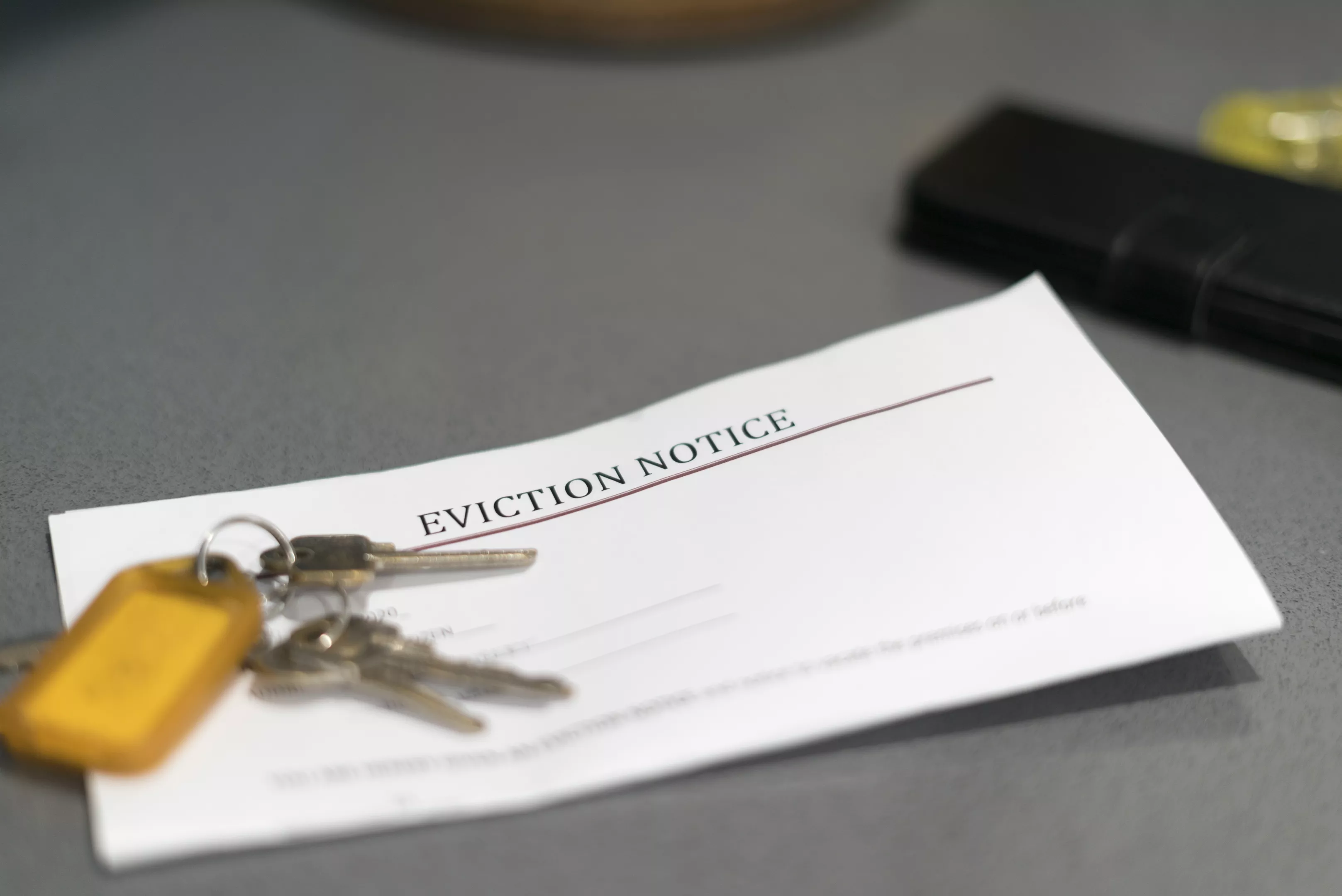
PHOENIX – Gov. Doug Ducey extended the state’s eviction moratorium and announced an additional $5 million for renters and measures to prevent foreclosure as the state continues to grapple with unemployment and housing problems caused by COVID-19.
“Today’s plan protects families and individuals impacted by COVID-19 while empowering them to keep making rent payments,” Ducey told a news conference Thursday. “We’ll continue working with our partners at the county and local levels to make resources and assistance available for all those impacted by COVID-19.”
Housing advocates this week had raised the alarm that with the moratorium slated to end July 25, many Arizonans were in danger of losing housing or facing hardship, the Arizona Daily Star reported.
The second-term Republican governor voiced optimism about the latest numbers in Arizona, stating that the percentage of positive tests is trending downward.
“Much of this gives us reason to be very cautious, but to have some hope and optimism about what is possible in the very near future in the state of Arizona,” he said.
“Today’s plan protects families and individuals impacted by COVID-19 while empowering them to keep making rent payments,” Ducey told a news conference Thursday. “We’ll continue working with our partners at the county and local levels to make resources and assistance available for all those impacted by COVID-19.”
Housing advocates this week had raised the alarm that with the moratorium slated to end July 25, many Arizonans were in danger of losing housing or facing hardship, the Arizona Daily Star reported.
The second-term Republican governor voiced optimism about the latest numbers in Arizona, stating that the percentage of positive tests is trending downward.
“Much of this gives us reason to be very cautious, but to have some hope and optimism about what is possible in the very near future in the state of Arizona,” he said.
The total number of confirmed coronavirus cases in Arizona climbed past 138K as of Friday, July 17, after the state reported 3,910 new cases this morning, according to the Arizona Department of Health Services.
Pima County had seen 13,058 of the state's 138,523 confirmed cases.
A total of 2,583 people have died after contracting the virus.
Maricopa County has 91,863 of the state's cases.
Hospitals remain under pressure. The report shows that 3,466 COVID patients were hospitalized yesterday in the state.
A total of 1,574 people visited ERs yesterday.
A total of 944 COVID-19 patients were in ICU beds yesterday.
Gov. Doug Ducey said yesterday that mask-wearing and steps to reduce the interaction of people in large groups had resulted in some positive signs regarding the spread of the virus. He cited a slight drop in the percentage of people visiting emergency rooms exhibiting COVID-like illness in the last week, as well as a drop in the total number of cases on a week-to-week basis (although all test results may not be in yet for tests in recent days).
Ducey also said Arizona R-naught number—or the number of people with the virus who are infecting other people—dropped to .98 as of yesterday, meaning the infection rate has slowed. An R-naught of less than 1 means the virus is in decline.
But Ducey warned the state still had a long road ahead in the fight against the deadly virus.
"I want people to get their heads around this," Ducey said. "There's no end in sight today."
Figures from Pima County show that on a week-by-week basis, cases here may have also peaked in the week ending June 27, with new cases reaching 2,300. Pima County Administrator Chuck Huckelberry noted that the two subsequent weeks could still be adjusted upwards, but during the week ending July 4, 2,092 cases were reported. But Huckelberry noted that the week ending July 4, the county saw a peak of 37 deaths so the county is far from out of the woods.
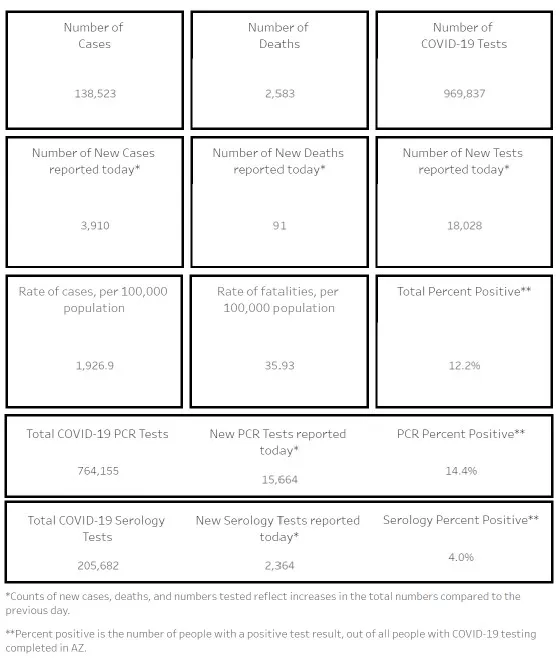
Pima County had seen 13,058 of the state's 138,523 confirmed cases.
A total of 2,583 people have died after contracting the virus.
Maricopa County has 91,863 of the state's cases.
Hospitals remain under pressure. The report shows that 3,466 COVID patients were hospitalized yesterday in the state.
A total of 1,574 people visited ERs yesterday.
A total of 944 COVID-19 patients were in ICU beds yesterday.
Gov. Doug Ducey said yesterday that mask-wearing and steps to reduce the interaction of people in large groups had resulted in some positive signs regarding the spread of the virus. He cited a slight drop in the percentage of people visiting emergency rooms exhibiting COVID-like illness in the last week, as well as a drop in the total number of cases on a week-to-week basis (although all test results may not be in yet for tests in recent days).
AZ Dept of Health Services
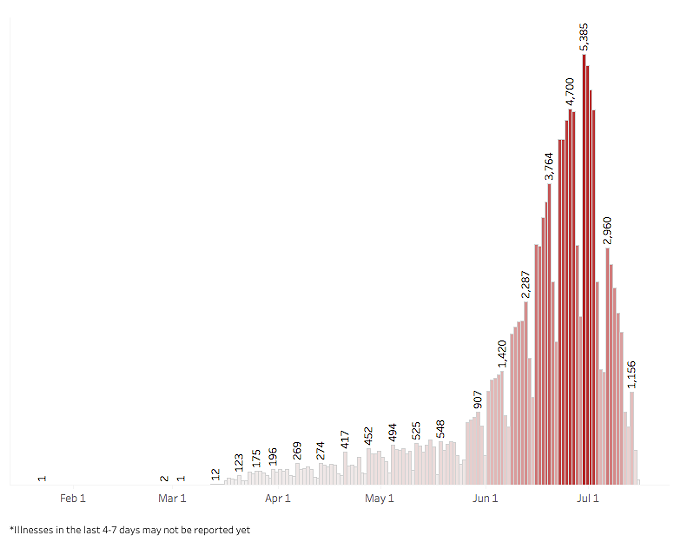
Arizona's epic-curve is seeing a decline in the number of cases reported by day, although all data from recent days is not yet available.
Ducey also said Arizona R-naught number—or the number of people with the virus who are infecting other people—dropped to .98 as of yesterday, meaning the infection rate has slowed. An R-naught of less than 1 means the virus is in decline.
But Ducey warned the state still had a long road ahead in the fight against the deadly virus.
"I want people to get their heads around this," Ducey said. "There's no end in sight today."
Figures from Pima County show that on a week-by-week basis, cases here may have also peaked in the week ending June 27, with new cases reaching 2,300. Pima County Administrator Chuck Huckelberry noted that the two subsequent weeks could still be adjusted upwards, but during the week ending July 4, 2,092 cases were reported. But Huckelberry noted that the week ending July 4, the county saw a peak of 37 deaths so the county is far from out of the woods.
Thursday, July 16, 2020
WASHINGTON – Arizona’s interstate highways are in generally good shape, but they experienced the highest rate of fatalities in the nation in 2018, according to a national report released Tuesday.
The report by The Road Information Program said that Arizona recorded 1.09 highway deaths per 100 million vehicle miles traveled on the state’s interstate highways in 2018, almost twice the national average of 0.58 deaths that year.
Authors of the TRIP report – titled “Restoring the Interstate Highway System” – used it as a call for more funding to rebuild and modernize the nation’s 64-year-old interstate system, claiming that deteriorating roads pose a threat to commerce and to safety.
“Deteriorating conditions and fatality rate are because of poor funding,” said Carolyn Bonifas Kelly, director of communications and research at TRIP.
But public and private officials in Arizona said it’s not the roads that are the issue, it’s driver behaviors.

The report by The Road Information Program said that Arizona recorded 1.09 highway deaths per 100 million vehicle miles traveled on the state’s interstate highways in 2018, almost twice the national average of 0.58 deaths that year.
Authors of the TRIP report – titled “Restoring the Interstate Highway System” – used it as a call for more funding to rebuild and modernize the nation’s 64-year-old interstate system, claiming that deteriorating roads pose a threat to commerce and to safety.
“Deteriorating conditions and fatality rate are because of poor funding,” said Carolyn Bonifas Kelly, director of communications and research at TRIP.
But public and private officials in Arizona said it’s not the roads that are the issue, it’s driver behaviors.
The total number of confirmed coronavirus cases in Arizona climbed past 134K as of Thursday, July 16, after the state reported 3,259 new cases this morning, according to the Arizona Department of Health Services.
Pima County had seen 12,697 of the state's 134,613 confirmed cases.
A total of 2,492 people have died after contracting the virus.
Maricopa County has 88,954 of the state's cases.
Hospitals remain under pressure. The report shows that 3,454 COVID patients were hospitalized yesterday in the state.
A total of 1,695 people visited ERs yesterday.
A total of 918 COVID-19 patients were in ICU beds yesterday.
With cases on the rise, concern continues to mount about opening schools next month. Will Humble, executive director of the Arizona Public Health Association, said last week that while states that have taken more aggressive steps earlier to slow the spread of the virus will be able to reopen schools, he can’t see the same thing happening in Arizona.
“We just have too much community spread,” Humble said.
Humble, who headed up the Arizona Department of Health Services in the administration of former Gov. Jan Brewer, said there are two main factors to consider when opening schools in the fall: mitigation measures alongside the level of community spread within a school district.
“School districts have some really creative folks and I think they could put some effective mitigation measures in place that would make it safe to open schools if we didn’t have so much community spread,” Humble said. “Because we have the level of community spread that we have, I just don’t see that mitigation measures, which help but don’t eliminate transmission, are going to be adequate to make it a safe environment for teachers and schools and families.”
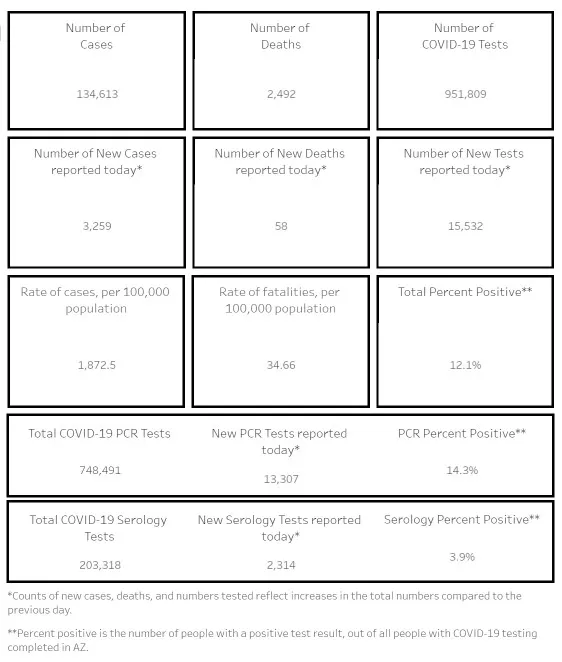
Pima County had seen 12,697 of the state's 134,613 confirmed cases.
A total of 2,492 people have died after contracting the virus.
Maricopa County has 88,954 of the state's cases.
Hospitals remain under pressure. The report shows that 3,454 COVID patients were hospitalized yesterday in the state.
A total of 1,695 people visited ERs yesterday.
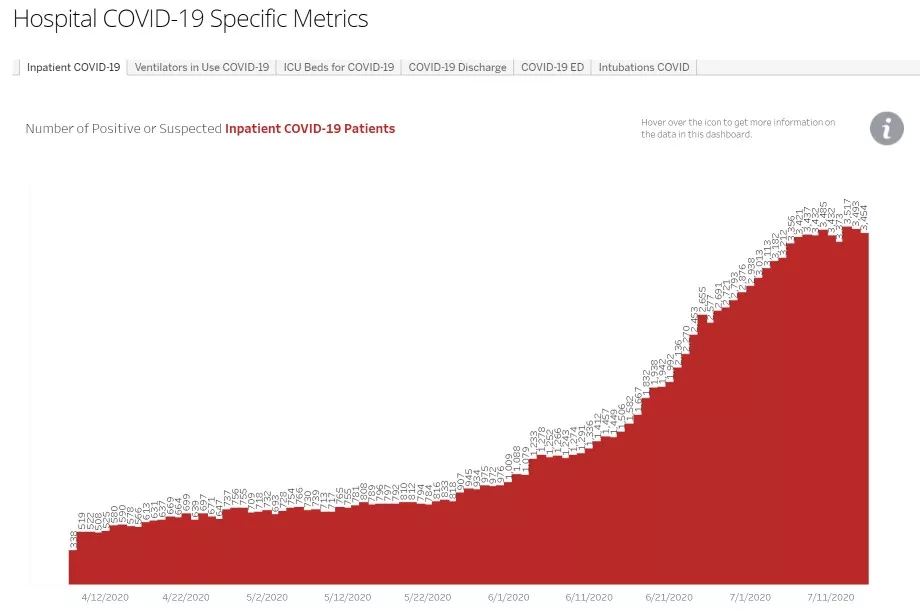
A total of 918 COVID-19 patients were in ICU beds yesterday.
With cases on the rise, concern continues to mount about opening schools next month. Will Humble, executive director of the Arizona Public Health Association, said last week that while states that have taken more aggressive steps earlier to slow the spread of the virus will be able to reopen schools, he can’t see the same thing happening in Arizona.
“We just have too much community spread,” Humble said.

Humble, who headed up the Arizona Department of Health Services in the administration of former Gov. Jan Brewer, said there are two main factors to consider when opening schools in the fall: mitigation measures alongside the level of community spread within a school district.
“School districts have some really creative folks and I think they could put some effective mitigation measures in place that would make it safe to open schools if we didn’t have so much community spread,” Humble said. “Because we have the level of community spread that we have, I just don’t see that mitigation measures, which help but don’t eliminate transmission, are going to be adequate to make it a safe environment for teachers and schools and families.”
Wednesday, July 15, 2020
Just ICYMI, here are the stories we covered today:

- The total number of confirmed coronavirus cases in Arizona climbed past 131K as of Wednesday, July 15, after the state reported 3,257 new cases this morning, according to the Arizona Department of Health Services.
- The Tucson Museum of Art and Historic Block announced that it will reopen its doors on Thursday, July 30.
- As the August 17 school start date grows closer, TUSD has created a unique reopening plan with a completely virtual learning model.
- As fire crews work to snuff out the last hotspots of the Bighorn Fire, a lengthy cleanup process begins.
- The Bar Exam has long been seen as the moment of reckoning for hopeful law students, but with Arizona COVID cases skyrocketing, the test pressure is higher than ever before.
- The July 4th holiday saw examples of what you have correctly called ‘bad actors’ ignoring both mask wearing and social distancing protocols. We will very soon see the impacts of that behavior in increased COVID-19 infection rates.

