

Friday, May 1, 2020

Logan Burtch-Buus / Tucson Local Media
Canyon del Oro High School science teacher Jordan Castle prepares a yard sign for a CDO senior.
Emblazoned with the mascot of each school, the signs remind the students that they are the “Pride of Amphi.”
The signs were the result of a brainstorming session between Amphi Superintendent Todd Jaeger and Director of 21st Century Education Tassi Call. The latter was inspired after overhearing her daughter, a junior at Canyon del Oro High School, on the phone with some of her senior friends lamenting over lost traditions like prom and Project Graduation.
Call knew the district had to do something.
“The Amphitheater school district loves and cares about all of our students,” she said. “Especially our seniors in the class of 2020.”
With a concept in mind, Amphi turned to its staff to make it all a reality—and they were more than ready to spread some love.
Wednesday, April 29, 2020
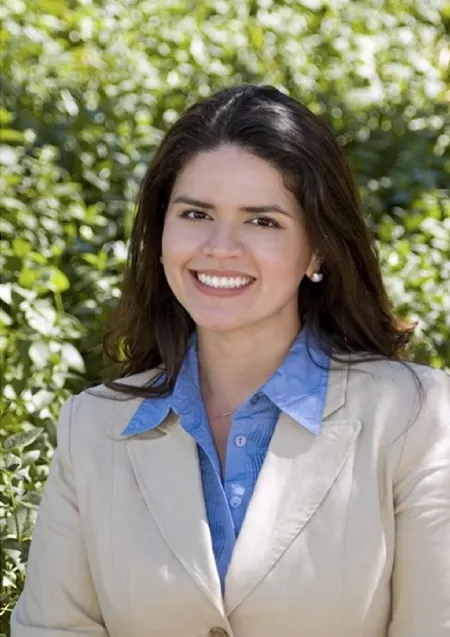
Tucson Mayor Regina Romero was joined by Phoenix Mayor Kate Gallego and Flagstaff Mayor Coral Evans in asking Gov. Doug Ducey Wednesday afternoon to follow the Centers for Disease Control guidelines when considering when to re-open.
The joint statement was issued less than an hour before Ducey is scheduled to speak at a press conference with other state officials regarding his stay-home order, which is set to expire at the end of the day tomorrow.
The three mayors said they have received no guidance from Ducey’s office with just over one day left on the order—and urged the governor to adhere to the guidelines established by the CDC and the federal government.
“The state must be able to provide clear data showing that we have achieved a 14-day decline in COVID cases before the economy begins to reopen,” the statement reads.
The federal government’s “Opening Up America Again” program includes a list of criteria states need to meet before beginning to reopen, including a downward trajectory of influenza-like and COVID-19 cases for two weeks, having “robust testing” in place and a sufficient supply of PPE.
The joint statement also gives credit to Ducey for expanding testing to greater segments of the population, as that data will be “critical in determining our ability to safely reopen the economy without unnecessary imperiling the lives of our residents.”
“We are all eager to reopen the economy as soon as it is safe to do so,” the statement reads. “We again ask the governor to work closely with cities on COVID resiliency efforts. Our cities’ first responders are tasked with carrying out any statewide executive orders and the more time they have to prepare the better chance we have to keep our police, fire, and residents safe and healthy.”
Gov. Ducey is expected to deliver remarks alongside the Arizona Department of Health Services Director Dr. Cara Christ and Arizona Department of Emergency and Military Affairs Director Major General Michael T. McGuire at 3 p.m. and provide an update on the state’s actions in response to COVID-19.
The joint statement was issued less than an hour before Ducey is scheduled to speak at a press conference with other state officials regarding his stay-home order, which is set to expire at the end of the day tomorrow.
The three mayors said they have received no guidance from Ducey’s office with just over one day left on the order—and urged the governor to adhere to the guidelines established by the CDC and the federal government.
“The state must be able to provide clear data showing that we have achieved a 14-day decline in COVID cases before the economy begins to reopen,” the statement reads.
The federal government’s “Opening Up America Again” program includes a list of criteria states need to meet before beginning to reopen, including a downward trajectory of influenza-like and COVID-19 cases for two weeks, having “robust testing” in place and a sufficient supply of PPE.
The joint statement also gives credit to Ducey for expanding testing to greater segments of the population, as that data will be “critical in determining our ability to safely reopen the economy without unnecessary imperiling the lives of our residents.”
“We are all eager to reopen the economy as soon as it is safe to do so,” the statement reads. “We again ask the governor to work closely with cities on COVID resiliency efforts. Our cities’ first responders are tasked with carrying out any statewide executive orders and the more time they have to prepare the better chance we have to keep our police, fire, and residents safe and healthy.”
Gov. Ducey is expected to deliver remarks alongside the Arizona Department of Health Services Director Dr. Cara Christ and Arizona Department of Emergency and Military Affairs Director Major General Michael T. McGuire at 3 p.m. and provide an update on the state’s actions in response to COVID-19.
ProPublica is a nonprofit newsroom that investigates abuses of power. Click here to read their biggest stories as soon as they’re published.
In the past two weeks, researchers across America have begun announcing results from studies showing that there have been many more coronavirus infections in their communities than were previously recorded.
Findings have come in from Santa Clara County, California, as well as Los Angeles, New York, Chelsea, Massachusetts, and Miami-Dade County, Florida. The debates began immediately. What did the study results actually mean? If more people were infected than previously known, did that mean the death rate is actually lower than previously thought? Is the coronavirus actually more like the flu, after all? And are we close to “herd immunity,” meaning enough people are infected that the virus won’t spread easily anymore?
These studies all were based on antibody tests, which are diagnostics that can look in a person’s blood and see if there is evidence of prior infection. In the past month, as these tests have reached the market, researchers have launched large-scale studies, known as sero-surveys (sero is short for serology, the study of blood serum). By running these surveys, scientists are finally able to start estimating how many people have been infected, which can give us information about how deadly the disease is and where the disease was most concentrated geographically.

In the past two weeks, researchers across America have begun announcing results from studies showing that there have been many more coronavirus infections in their communities than were previously recorded.
Findings have come in from Santa Clara County, California, as well as Los Angeles, New York, Chelsea, Massachusetts, and Miami-Dade County, Florida. The debates began immediately. What did the study results actually mean? If more people were infected than previously known, did that mean the death rate is actually lower than previously thought? Is the coronavirus actually more like the flu, after all? And are we close to “herd immunity,” meaning enough people are infected that the virus won’t spread easily anymore?
These studies all were based on antibody tests, which are diagnostics that can look in a person’s blood and see if there is evidence of prior infection. In the past month, as these tests have reached the market, researchers have launched large-scale studies, known as sero-surveys (sero is short for serology, the study of blood serum). By running these surveys, scientists are finally able to start estimating how many people have been infected, which can give us information about how deadly the disease is and where the disease was most concentrated geographically.
ProPublica is a nonprofit newsroom that investigates abuses of power. Click here to read their biggest stories as soon as they’re published.
Darcel Richardson knows she’s fortunate in one sense: She still has her job as a vocational counselor in Baltimore. But despite that, she won’t be able to make her rent payment this month because she’s not getting her full salary for a while. More than $400 per biweekly paycheck — about a quarter of her after-tax income — has been siphoned off by Johns Hopkins University for unpaid medical bills at one of its hospitals.
Richardson, 60, got word of the garnishment from her employer just as the coronavirus pandemic was arriving in full force last month. “My job was going to take the money out. They don’t want to get in trouble,” she said. “I spoke with our payroll accountant, and the bottom line was, even though the crisis had begun, they still had to pay my money to them.”
In a moment when hospitals nationwide are being heralded for their role at the front lines of fighting the pandemic, some Americans continue to experience a less favorable side of hospital operations: aggressive collection for unpaid medical bills, even at a time when many of the debtors are seeing their income plunge. Debt collection is occurring on other fronts as well, over unpaid college and bank loans among others, prompting debates over protecting people’s economic stimulus checks from collection agencies or suspending garnishments outright. But collection by the very hospitals that are treating coronavirus patients brings the health and economic exigencies of the moment into especially stark relief.
In a few cases, hospitals have brought new cases against former patients in recent weeks, such as in Wisconsin, where Froedtert Hospital in Milwaukee filed 46 small-claims lawsuits even after the governor declared a state of emergency on March 12, and other hospital systems in the state filed dozens more, according to a report by Wisconsin Public Radio and Wisconsin Watch. Steve Schoof, Froedtert’s director of external communications, told ProPublica in a statement that the hospital stopped filing small claims suits on March 18. “Moving forward,” the statement continued, “Froedtert Health will no longer be filing small claims suits for medical debt collection. Unfortunately, there was a miscommunication that resulted in small claims filings after March 18. We immediately rectified this miscommunication and dismissed these small claims cases that were filed after March 18.”

Darcel Richardson knows she’s fortunate in one sense: She still has her job as a vocational counselor in Baltimore. But despite that, she won’t be able to make her rent payment this month because she’s not getting her full salary for a while. More than $400 per biweekly paycheck — about a quarter of her after-tax income — has been siphoned off by Johns Hopkins University for unpaid medical bills at one of its hospitals.
Richardson, 60, got word of the garnishment from her employer just as the coronavirus pandemic was arriving in full force last month. “My job was going to take the money out. They don’t want to get in trouble,” she said. “I spoke with our payroll accountant, and the bottom line was, even though the crisis had begun, they still had to pay my money to them.”
In a moment when hospitals nationwide are being heralded for their role at the front lines of fighting the pandemic, some Americans continue to experience a less favorable side of hospital operations: aggressive collection for unpaid medical bills, even at a time when many of the debtors are seeing their income plunge. Debt collection is occurring on other fronts as well, over unpaid college and bank loans among others, prompting debates over protecting people’s economic stimulus checks from collection agencies or suspending garnishments outright. But collection by the very hospitals that are treating coronavirus patients brings the health and economic exigencies of the moment into especially stark relief.
In a few cases, hospitals have brought new cases against former patients in recent weeks, such as in Wisconsin, where Froedtert Hospital in Milwaukee filed 46 small-claims lawsuits even after the governor declared a state of emergency on March 12, and other hospital systems in the state filed dozens more, according to a report by Wisconsin Public Radio and Wisconsin Watch. Steve Schoof, Froedtert’s director of external communications, told ProPublica in a statement that the hospital stopped filing small claims suits on March 18. “Moving forward,” the statement continued, “Froedtert Health will no longer be filing small claims suits for medical debt collection. Unfortunately, there was a miscommunication that resulted in small claims filings after March 18. We immediately rectified this miscommunication and dismissed these small claims cases that were filed after March 18.”
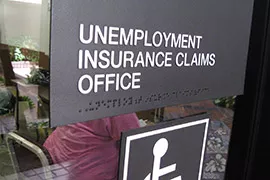
Photo by Bytemarks/Creative Commons
More than 470,000 Arizonans have filed for unemployment in the last six weeks. New expanded jobless benefits begin in May, but advocates worry it won’t be enough to offset the massive damage from the coronavirus.
But economists and advocates say that while the change is welcome – it’s probably too little, and too late.
The changes, which take effect May 12, are part of the Pandemic Unemployment Assistance program that all states are rolling out under the Coronavirus Aid, Relief and Economic Security (CARES) Act, the $2 trillion federal relief package approved last month.
Under the new rules, benefits will be available to the self-employed, to people seeking part-time work and people who lack sufficient work history. It also includes federal funds that extend benefits to 39 weeks for some workers and can add $600 a week to unemployment checks.
The Department of Economic Security said last week that it had contracted with a private firm to help speed the delivery of benefits under the expanded program.
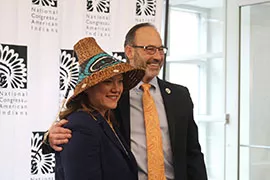
Photo by McKenzie Sadeghi/Cronkite News
National Congress of American Indians President Fawn Sharp and CEO Kevin Allis pose at the group’s annual State of Indian Nations address in Washington in February. Sharp moderated a town hall Tuesday on the federal response to COVID-19 in Indian Country.
The National Congress of American Indians town hall on the congressional response to COVID-19 in Indian Country came one day after a federal court blocked the Treasury Department from giving relief funds to Alaska corporations that other tribes said were not legitimate tribal governments.
Lawmakers on the call said that is just one of the problems faced by tribes, which have had to fight for access to funding while having underlying health care and economic problems ignored.
“This is a very trying time in Indian Country, and it’s always been, you know, difficult I think dealing with the federal government and Indian Country,” said Rep. Ruben Gallego, D-Phoenix, one of the lawmakers in the town hall. “But particularly during this pandemic we’ve seen a lot of the underlying problems that have consistently been around.”
Sen. Tina Smith, D-Minn., said tribes face barriers that include health, education, jobs and housing, all of which have “really exacerbated now with what is happening with the coronavirus pandemic.”

Phoenix Mayor Kate Gallego has requested that Ducey allow mayors to be a part of the decision process on whether to extend or keep the stay-at-home order, which is set to expire at the end of Thursday. The governor last week said he would base his decision on the latest data on the spread of COVID-19 in the state, which has claimed 293 lives so far.
“Governor Doug Ducey put in an executive order and has made it clear that he is the decision maker on these issues,” Gallego said. “Governor Ducey’s staff used to have phone calls daily with the mayors at the beginning of the virus, but they have canceled that.”
The mayors of Casa Grande and Tolleson reported that more essential businesses in their cities stayed open during Ducey’s order than in Phoenix and Mesa, which might help them in the long run.
“A lot of our industry is essential so it continues to work, we have about 27 manfucturing facilities. The biggest issue is going to be the bars and restaurants,” said Casa Grande Mayor Craig McFarland, adding that the city’s 2020-21 budget is expected to fall just 0.6%.
Several mayors said that whenever Ducey allows businesses to reopen, it will have to be done gradually, with social distancing and crowd-size limits still in place.
“It’ll be interesting to see how we transition out of the stay-at-home order to what extent we incorporate social distancing into our daily lives so we can engage in economic activity as soon as possible,” Mesa Mayor John Giles said. The roundtable was hosted by the Greater Phoenix Economic Council.
Tuesday, April 28, 2020
ProPublica is a nonprofit newsroom that investigates abuses of power. Click here to read their biggest stories as soon as they’re published.
As some governors prepare to relax social distancing restrictions in their states, ProPublica hosted a digital event on Thursday answering your questions on how to safely leave home, reopen businesses and return to work. Based on a recent ProPublica article that pulled together seven key lessons learned by scientists, doctors and researchers in other countries that have battled the virus, the digital event assembled Editor-in-Chief Stephen Engelberg; health care reporter Caroline Chen; and Andy Slavitt, former head of the Centers for Medicare and Medicaid Services, to take questions and share what they’ve learned that can help all Americans for the days, weeks and months ahead.
“I think the big takeaway is there’s no such thing as returning to normal,” Chen said of what she learned after interviewing front-line officials from Italy, Germany, Spain, Singapore, Taiwan and South Korea. “And the goal should not be ‘normal.’”
She found that the experts she consulted consistently recommended that governors should plan to track where the virus is spreading by coordinating a large army of contract tracers and have a well-thought-out plan for isolating infected people. Across the board, they expressed the idea of never letting one’s guard down. “You cannot relax,” she said. “Because the second you relax, there’s going to be a second wave.”

As some governors prepare to relax social distancing restrictions in their states, ProPublica hosted a digital event on Thursday answering your questions on how to safely leave home, reopen businesses and return to work. Based on a recent ProPublica article that pulled together seven key lessons learned by scientists, doctors and researchers in other countries that have battled the virus, the digital event assembled Editor-in-Chief Stephen Engelberg; health care reporter Caroline Chen; and Andy Slavitt, former head of the Centers for Medicare and Medicaid Services, to take questions and share what they’ve learned that can help all Americans for the days, weeks and months ahead.
“I think the big takeaway is there’s no such thing as returning to normal,” Chen said of what she learned after interviewing front-line officials from Italy, Germany, Spain, Singapore, Taiwan and South Korea. “And the goal should not be ‘normal.’”
She found that the experts she consulted consistently recommended that governors should plan to track where the virus is spreading by coordinating a large army of contract tracers and have a well-thought-out plan for isolating infected people. Across the board, they expressed the idea of never letting one’s guard down. “You cannot relax,” she said. “Because the second you relax, there’s going to be a second wave.”
TEMPE – The coronavirus had already made 2020 an unusual election year when campaign finance reports added another twist, showing challengers in some congressional races raising far more than the incumbents they hope to unseat.
Democratic hopeful Mark Kelly continued to lead all Senate candidates, bringing in $11 million in the first quarter of 2020 to bring his campaign total to $31.3 million, according to his latest Federal Election Commission filing.
The senator he’s targeting, Sen. Martha McSally, R-Arizona, brought in $6.3 million in the quarter, raising her total to $19 million – good enough for fifth-highest among all Senate candidates, but still well below Kelly’s funds.
In the House, Rep. David Schweikert, R-Fountain Hills, raised $221,000 in the first quarter for a total of $1.1 million this campaign. But that trails Hiral Tipirneni, one of his Democratic rivals, who raised $507,000 this year for a total of $1.7 million. She had $1.2 million on hand as of March 31 compared to Schweikert’s $226,000 in the bank.
By contrast, four other House incumbents had fundraising advantages of at least $1 million each over their challengers. Two other incumbents with less than $1 million in contributions still had 10 times as much campaign cash as their challengers.
Political analysts have a range of theories on why some challengers have raced ahead of the incumbents, from the effect of coronavirus on fundraising, to the president’s unpopularity to factors specific to each race.
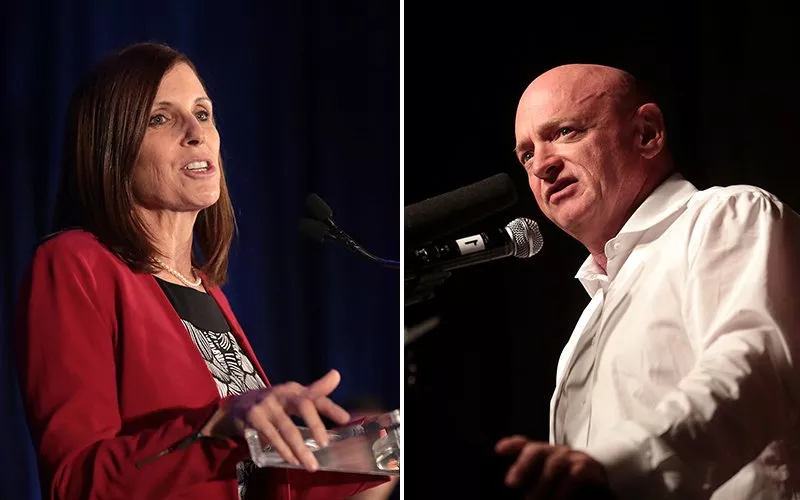
Democratic hopeful Mark Kelly continued to lead all Senate candidates, bringing in $11 million in the first quarter of 2020 to bring his campaign total to $31.3 million, according to his latest Federal Election Commission filing.
The senator he’s targeting, Sen. Martha McSally, R-Arizona, brought in $6.3 million in the quarter, raising her total to $19 million – good enough for fifth-highest among all Senate candidates, but still well below Kelly’s funds.
In the House, Rep. David Schweikert, R-Fountain Hills, raised $221,000 in the first quarter for a total of $1.1 million this campaign. But that trails Hiral Tipirneni, one of his Democratic rivals, who raised $507,000 this year for a total of $1.7 million. She had $1.2 million on hand as of March 31 compared to Schweikert’s $226,000 in the bank.
By contrast, four other House incumbents had fundraising advantages of at least $1 million each over their challengers. Two other incumbents with less than $1 million in contributions still had 10 times as much campaign cash as their challengers.
Political analysts have a range of theories on why some challengers have raced ahead of the incumbents, from the effect of coronavirus on fundraising, to the president’s unpopularity to factors specific to each race.
Tags: kelly , mcsally , election , race , funding , politics , Image
With Arizona schools closed indefinitely, children have plenty of time on their hands – and parents are looking for teachable moments. One subject that’s not taught in most schools is money and how to earn it, spend it, share it and save it.
Gregg Murset of Scottsdale, a certified financial planner and father of six, also is chief executive and co-founder of BusyKid, a money-management app based on chores. The online tool, for children 5 to 15, is among several apps that teach children about finances, including Chore Check, Homey, Rooster Money and Greenlight.
Murset said BusyKid was launched in 2011 with input from psychologists, psychiatrists and data on parent’s interactions with their children and money. The app, he said, has 125,000 families signed up with a company goal by the third quarter of 2021 of having 1 million families.
Cronkite News recently spoke with Murset, Gilbert mom Milissa Chanice and her children Vincent, 10, and Vanessa, 7, who have used the BusyKid app for three years, to discuss how money management tools are valuable – especially for families with younger children who are sheltering at home.
Here are eight takeaways for parents and children. (Interviews were edited for clarity and length.)

Gregg Murset of Scottsdale, a certified financial planner and father of six, also is chief executive and co-founder of BusyKid, a money-management app based on chores. The online tool, for children 5 to 15, is among several apps that teach children about finances, including Chore Check, Homey, Rooster Money and Greenlight.
Murset said BusyKid was launched in 2011 with input from psychologists, psychiatrists and data on parent’s interactions with their children and money. The app, he said, has 125,000 families signed up with a company goal by the third quarter of 2021 of having 1 million families.
Cronkite News recently spoke with Murset, Gilbert mom Milissa Chanice and her children Vincent, 10, and Vanessa, 7, who have used the BusyKid app for three years, to discuss how money management tools are valuable – especially for families with younger children who are sheltering at home.
Here are eight takeaways for parents and children. (Interviews were edited for clarity and length.)

