

Friday, April 2, 2021

Assistance League of Tucson, a volunteer organization whose mission is “Volunteers working in the Tucson community to help those in need,” faced some grim moments at the outset of the pandemic last year.
The nonprofit saw a dramatic drop in the number of volunteers who are vital to the organization’s operations.
But the organization reacted quickly to the changing conditions brought about by the pandemic.
“We're coming up on our 61st anniversary of helping people, those in need here in Tucson,” said Kim Sterling, Assistance League of Tucson president. “You look ahead and you go, did we do well during the pandemic? Are we going to survive another 60 years and still be here to help out?”
At the start of the pandemic, Sterling said they closed down their thrift shop, which provides about 60 percent of their revenue, with donations and grants providing the rest.
As soon as they closed they began to look at their expenses. In 1959, their founders built up a reserve fund totaling one year’s operating expenses, which they didn’t want to dip into since they could not see the end of the pandemic and worried about the possibility of another disaster, Sterling said.
“We did three things, but we had one goal in mind, keep serving those most in need in the Tucson community,” said Sterling. “So we pivoted our program, we cut costs, and we created new revenue streams.”
Sterling said all five of their programs continued with $190,000 in cuts with the proviso that if revenue increased, funding would return to the programs. They looked to maintain the number of people they served, but reduce the amount provided. Their Starting Over Supplies program required a shift in the way the program operated.
Through the program, the organization works with social workers to provide basic housekeeping supplies and other provisions tailored to individuals who may be experiencing homelessness for the first time or coming out of foster care, said Sterling. So when social service agencies shut down and they could not deliver a kit because they were no longer meeting in person, Sterling said they panicked.
Tuesday, February 23, 2021
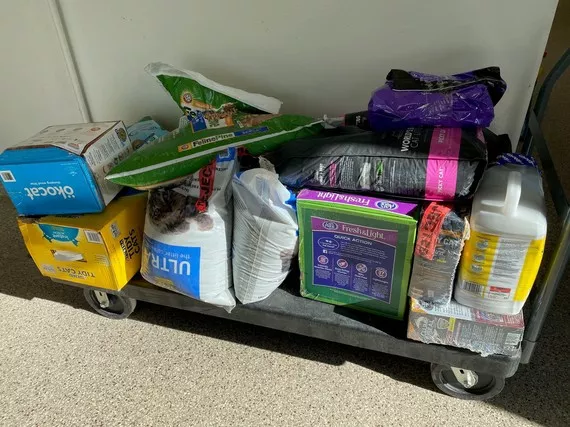
Items available will include collars, food, leashes, bowls, treats, toys, pet stairs and cat litter. There will also be some human-related items too, such as laundry detergent, blankets and hygiene products. Pet owners won’t need to have a pet with them in order to pick up supplies.
“Since the beginning of the pandemic, people have been asking us for help so that they can keep their pet,” said PACC Director of Human Animal Support Services Michele Figueroa. “If we are able to keep a pet in a loving home all for the cost of some food or leashes, we absolutely want to make that happen.”
This outreach is part of PACC's Human Animal Support Services program, which has distributed 1.3 million meals and 36,180 pounds of supplies to vulnerable pet owners. This program is funded through the Friends of PACC and food is provided by local donors, as well as Amazon and Greater Good.
For more information, visit PACC's website.
Wednesday, February 17, 2021
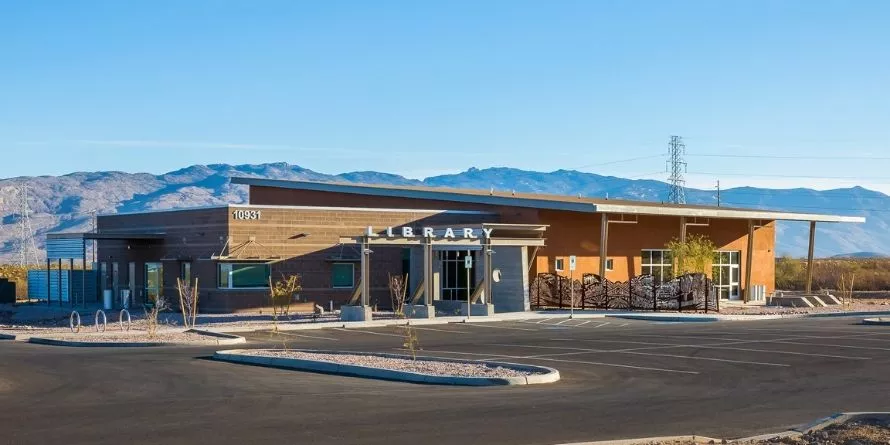
On Tuesday, Feb. 16, the Pima County Public Library officially opened the W. Anne Gibson-Esmond Station Library on the far southeast side of Tucson at 10931 E. Mary Ann Cleveland Way. Due to COVID, there is no public entry at this time, but the library is offering curbside pickup. Books can be reserved online or via Infoline at (520) 791-4010.
The W. Anne Gibson-Esmond Station Library is the 27th library in the PCPL system, and is intended to primarily serve those living in the greater Vail area, such as Corona de Tucson and Rita Ranch.
The 8,000 square-foot library was designed by BWS Architects and was named after Anne Gibson, who served on the Vail School District Governing Board from 1999 to 2010 and has long advocated bringing a library to the greater Vail area. Construction on the library began in late January 2020.
"Southeast residents have been waiting a long time for a library," said Mary McKinney, library manager. "I am happy and excited that the community can finally begin to use their new library. I feel fortunate that I will be there when it happens.”
Curbside pickup at the W. Anne Gibson-Esmond Station Library is available Monday through Friday from 10 a.m. to 5 p.m. For more information about PCPL's curbside pickup program, click here.
Tuesday, January 26, 2021
After last week’s inauguration of the first female vice president, the University of Arizona is hosting a virtual discussion about voting history and voting rights on Thursday, Jan. 28.
The discussion includes a panel of local women in the industry: Pima County Recorder Gabriella Cázares-Kelly; assistant professor of government and public policy Lisa M. Sanchez; and Heidi Osselaer, author of "Winning Their Place: Arizona Women in Politics.”
The panel discussion is presented by UA’s Special Collections in partnership with Patricia MacCorquodale, professor emerita in the Department of Gender and Women's Studies. The event is part of UA’s online exhibit "Founding Mothers: From the Ballot Box to the University.”
According to UA, the panelists will discuss how the 100th anniversary of the right to vote and 2020's historic election outcomes have impacted women. They will also talk about how people and institutions can remove barriers that prevent people from participating in democracy, and how to encourage participation among women and people of color.
The discussion takes place at 6 p.m. Thursday, Jan. 28. The event is open to the community, but registration is required. Register for the online event at the University Libraries website.
Thursday, January 21, 2021

As Arizona health officials scramble to speed up rollout of the life-saving COVID-19 vaccine, the deadly virus is still spreading rapidly. Over 12,500 Arizonans have died, and we are seeing more than 9,000 new infections daily. The outbreak in Arizona is the worst in the nation, with one in every 147 residents being infected as of 1/21/2021. The clock is ticking and the time for action is now.
Even under the best circumstances, it will take a year or more for a vaccine to be fully effective. In the meantime, we can save lives with aggressive public health measures. No arena is more important than Arizona workplaces, a dangerous source of COVID hotspots which then spread to our neighborhoods and communities.
We need enforceable emergency workplace standards and worker safety committees to monitor and implement worksite COVID protection plans. Workplaces can play a significant role in turning the economy around to create a safe environment for everyone. Unfortunately, many workplaces remain unsafe, endangering frontline workers and the public they serve.
Our government offices have been impacted by this disease: A top county health official, unemployment staffers and county employees have contracted COVID-19 in their workplaces. Healthcare workers and their support staff are stretched thin and exhausted, grocery, retail and postal workers are exposed to risk of infection on a daily basis. All of us rely on these workers, who don’t have the option to stay at home, and we all need to be involved in demanding that employers and the government do more to keep them safe.
If we want to flatten the curve of new virus cases, employers must take every step possible to implement safety controls to reduce contact with the public and co-workers. Companies like Amazon, with a deplorable record of putting workers in unsafe environments, must involve workers in safety plans, instead of fighting worker efforts to have a voice in the workplace. Every job can be protected, if management develops a plan with input from workers, who know their own jobs and can come up with solutions to reduce exposure.
Innovative approaches to reducing contact between workers and the public include remote working whenever possible, barriers for cashiers, staggering service hours, and reducing the number of shoppers to allow for social distancing. In-person work requires detailed planning and implementation of COVID protection programs. These controls have been adopted in some workplaces, frequently only because workers took the initiative to protest unsafe conditions.
Gov. Ducey recently chose to protect himself from the risk of infection by delivering his state of the state address from inside his own office, instead of in front of the legislature. But instead of protecting frontline workers who can’t work in isolation, his backwards response has focused on protecting business at the expense of workers and community health. This will not preserve jobs and actually makes it more difficult to rebound to a healthy business climate.
Fourteen states and local communities around the country have enacted new protections to assist both workers and employers in implementing COVID protection programs. The Arizona Department of Occupational Safety and Health [ADOSH] has the legal authority to enforce compliance if there is a new standard. We can’t wait any longer to take positive steps to make workplaces safe for everyone. Workers have been the engine driving our efforts to control the virus and deserve to be protected. Protecting them helps protect our communities.
Mr. Valencia is chair of Tucson Jobs with Justice. Mr. Dooley, a certified industrial hygienist (CIH), is safety and health senior project coordinator for the National Council of Occupational Safety and Health (National COSH). Shannon Foley is with IATSE Local Union 415
Arizona COSH is a new worker safety advocacy organization to promote safe jobs for all workers in Arizona. Visit nationalcosh.org for more information or contact [email protected]
Thursday, January 7, 2021
WASHINGTON – Arizona has 304,180 infants and toddlers who need child care but only 234,270 slots to accommodate them, with poor and rural families most likely to be left out, a recent study said.
Arizona child care advocates said they were not surprised by the numbers in the Bipartisan Policy Center study, which they said has inspired them to push harder for accessible care.
“Some people can afford to put their children in high-quality care and their children will get that and we don’t have to worry about those kids, fortunately,” said Marilee Dal Pra, CEO of First Things First, a Phoenix-based children’s advocacy group.
“Unfortunately, in a state like Arizona that has such a high poverty level, especially for the zero to 5 (year old) population, these families don’t have those resources,” Dal Pra said.
The October report by the Bipartisan Policy Center’s early childhood initiative looked at 25 states – an initial plan to get data from all 50 states was derailed by the COVID-19 pandemic – to analyze gaps in child care across the country.
While Arizona fell short, its nearly 70,000-slot deficit was not the worst in the nation. Arizona fell about in the middle of the 25 states, both in terms of whole numbers and percentage shortfall.
North Carolina had just under 200,000 slots for the more than 459,000 children in need of care there, according to the report, which said California had about 1 million slots to accommodate demand from about 1.7 million children. Only Texas had a supply of child care slots that slightly exceeded its need, according to the report.
Thursday, December 31, 2020
The Pima County Department of Environmental Quality hand-delivered an abatement order to a northwest-side apartment complex owner for causing a public health nuisance to the complex’s tenants by shutting off the water supply.
The county ordered GR Partners Casas Adobes to restore potable water service within 24 hours of receiving the notice or PDEQ will do it for them and send the property owner the bill.
Residents of the 204-unit Casas Adobes Apartment Homes, located at 6200 N. Oracle Road, have been without running water and “unable to bathe, flush toilets or maintain hand hygiene since” Saturday, Dec. 26, according to the order.
Friday, December 18, 2020

The FBI’s Phoenix field office is warning buyers of common scams during the holiday shopping season.
In 2019, 7,795 Arizona consumers claimed a total loss of more than $47 million, according to a press release from the FBI.
The three main scams the FBI warns shoppers of include online shopping, gift card and charity scams.
Some online stores offer reduced brand-name merchandise that is compromised or doesn’t exist. Scammers often use phishing tactics in emails and advertisements, which involve fraudulent links or attachments that if clicked on, can reveal personal information.
The same thing can happen when clicking on fake social media posts that appear to be vouchers or gift cards but rather reveal personal information, according to the release.
Shoppers should also be wary of buying gift cards from outside sources requesting their purchase.
“In these scams, the victims receive either a spoofed email, a spoofed phone call, or a spoofed text from a person in authority requesting the victim purchase multiple gift cards for either personal or business reasons,” the FBI release said. “The gift cards are then used to facilitate the purchase of goods and services which may or may not be legitimate.”
They also caution against websites that only take payment through gift cards or wire transfers, which can give scammers access to “receive illicit funds.”
Thursday, December 17, 2020
PHOENIX – Even as courses throughout Arizona stayed open, COVID-19 robbed local golfers of some of the smaller delights of a day at the links.
For example, pulling the flagstick is a sign that a player is about to accomplish the challenging feat of completing a hole. However, many courses have placed a circular piece of foam in the cup to discourage this satisfying tradition to help limit exposure to the coronavirus.
The foam barriers placed in golf holes are one of many changes Arizona courses had to make to keep players and staff safe amid the pandemic.
When the virus forced lockdowns in March, Arizona Gov. Doug Ducey kept golf courses open by declaring them as essential businesses. As part of his executive order, clubs had to close many indoor areas and facilities, but the courses themselves remained open for business.
For the most part, courses in the state did more than just stay open. Many saw their businesses thrive and even expand in some cases. Several courses have reported an increase in the number of rounds played since the onset of the virus earlier this year.
Golf is big business in the state. According to a 2016 study from the University of Arizona, golf contributes $3.9 billion to the state’s economy every year. And that number has likely increased, said Bob Sykora, the general manager of Mesa Country Club.
“We were already trending to grow in golf,” he said. “We are in a position to grow. We were in a position where we were looking to have accelerated growth in golf. … While the pandemic didn’t hurt us necessarily, we were already on that trajectory.”
According to the UA report, golf tourism, in which people come from out of state to either play or watch golf, is responsible for $1.1 billion of that nearly $3.9 billion output. In a year where people are traveling less and less, courses have had to rely on the business of locals for much of this year.
Wednesday, December 16, 2020
PHOENIX – Attorney Ehsan Zaffar is leading an initiative to establish a civil rights center at Arizona State University to target inequality in the U.S. To do so, Zaffar envisions a range of products, services and programs – perhaps including Yelp-like reviews of how Arizona companies address social justice issues.
“Inequality is the greatest social, political, economic problem facing this country today,” said Zaffar, a civil rights and civil liberties official with the Department of Homeland Security who will join ASU in January. “I think our country is headed back to a time when institutions were powerless to fix the problems in the country. There’s a lack of trust.”
He hopes the center’s work will help strengthen institutions by encouraging them to be more responsive to the public and to produce more factual information about social justice issues.
Zaffar said his work at the center, which will include fundraising, also could examine how news and social media cover certain communities in ways that affect lawmakers, analyze emergency response times in communities of color and explore the gender pay gap in U.S. companies.

