

Monday, March 30, 2020
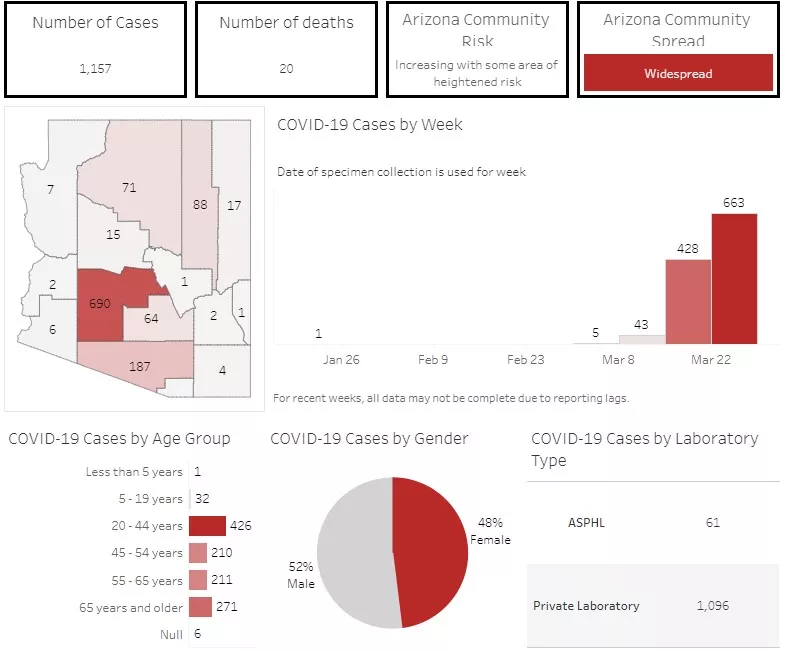
A total of 1,157 cases of COVID-19 have been confirmed in Arizona. There are now 187 confirmed cases in Pima County.
The latest death in Pima County was described by health officials as a man between 41 and 65 who had underlying health conditions.
In Maricopa County, the number of confirmed COVID-19 cases has risen to 690.
Meanwhile, Gov. Doug Ducey and State Superintendent of Public Instruction Kathy Hoffman announced this morning that school closures would continue through the end of the school year. Schools are transitioning to online learning and districts across the region are delivering lunch and breakfast meals to kids via school buses or setting up central locations.
Tags: covid19 , coronavirus , stats , updates , Image
Friday, March 27, 2020

- A total of 665 cases of COVID-19 have been confirmed in Arizona on Friday, March 27, according to the morning report from the Arizona Department of Health Services.
- With the Arizona Department of Health Services announcing the state’s COVID-19 transmission level to be “widespread,” sectors from private businesses to the state government are implementing new plans to combat the steadily growing pandemic.
- Internal Emails from the CDC show how chaos slowed the early response to coronavirus.
- The #SceneFromASocialDistance for today came from early morning grocery shopping experience, or more specifically, the line to get in.
- In an interview with ProPublica, Dr. Fineberg talks about how our goal should be to flatten the curve.
- As with many businesses, dispensaries continue to adapt to daily societal change in the face of the COVID-19 virus. While non-essential businesses remain closed for the foreseeable future, dispensaries continue to maintain recommended measures to keep patients and staff safe.
- As basic necessities and rest-stop options become limited across the nation during the coronavirus pandemic, the Triple T Truckstop is stepping up to make sure truck drivers on Interstate 10 have what they need and a safe, clean place to lay their head.
- As the question of whether Arizona’s public schools will reopen before the scheduled date of summer break hangs in the air, administrators now know they will not have to extend the academic year.
- A group of researchers from the University of Arizona's College of Engineering and College of Medicine are 3D printing medical masks for health care workers at Banner Medical Center.
- As the coronavirus pandemic spreads, so have confrontations between detainees and guards at Immigration and Customs Enforcement detention facilities across the country.
- We continue to update our list of restaurants still serving Tucsonans.
Tags: covid19 , coronavirus , roundup , information , Image

Mayor Joe Winfield issued his original proclamation on March 17, but at the time did not require establishments to close. In his original message, Winfield delivered a “strong advisory” that restaurants and similar businesses enact measures to implement social distancing and rely on the use of delivery and take-out service.
Two days later, Winfield amended his proclamation by including stricter guidelines for businesses. That change included a restriction for restaurants and an order to close businesses and gathering places.
In addition to extending that mandate, Winfield’s latest amendment also suspended regulation on temporary signs to aid businesses, closed playgrounds, basketball courts, fenced dog parks and other amenities in the town and strongly urged personal hygiene businesses to close.
“The Town Council understands that this unprecedented situation is significantly impacting many of our local businesses,” said Winfield, in a statement. “Suspending enforcement of the temporary sign code in our commercial corridors is one meaningful way we can try to help businesses that have modified operations to let our residents know they are open for business. I hope the community will continue to patronize these places, as appropriate, during this emergency.”
Oro Valley’s decision comes one day after the Pima County Board of Supervisors voted 3-2 to extend its own emergency. Democratic Supervisors Richard Elías, Sharon Bronson and Ramón Valadez voted in favor, while Republican Supervisors Ally Miller and Steve Christy voted against the measure.
The Town of Marana’s proclamation is already in effect through April 10.
On Friday, March 20, Arizona Gov. Doug Ducey and Superintendent of Public Instruction Kathy Hoffman also announced a two-week extension on public school closures, to last until April 10.
In the face of the spreading virus, Ducey also halted to evictions for 120 days; ordered bars, gyms and theaters to be closed in any county with confirmed COVID-19 cases; halted all elective surgery to keep hospital beds available for COVID-19 patients; loosened regulations to make telemedicine more available and increase eligibility for AHCCCS, the state's Medicaid program; and activated the National Guard to assist in grocery stores as Arizonans clear the shelves.
A total of 665 cases of COVID-19 have been confirmed in Arizona as of Friday, March 27, according to the morning report from the Arizona Department of Health Services. That's a jump of 157 from the previous day’s 508. There are now 102 confirmed cases in Pima County.
The virus has killed 13 people in Arizona, including four in Pima County— two being a woman in her 50s and a man in his 70s who both had underlying health conditions.
In Maricopa County, the number of confirmed COVID-19 cases has risen to 399, with 100 more cases being reported than yesterday.
Health and government officials have urged the public to avoid unnecessary trips and gatherings of more than 10 people. They warn that the extremely contagious virus is rapidly spreading in the community. Symptoms can take up to 14 days to appear, so people can pass COVID-19 without realizing they have been infected with it. Some people remain entirely asymptotic but are carriers.
Tags: oro valley , covid19 , coronavirus , shutdown , closures , parks and rec , restrictions , Image

The project involves multiple scientific fields; researchers in materials science and engineering will print the masks, then a chemical engineering researcher and a medical professor will test the masks to make sure they meet standards set by the National Institute for Occupational Safety and Health.
The materials science researchers are currently testing multiple mask designs on their available 3D printers, but have ordered 10 new 3D printers and hope to increase production to 200 masks and 2,000 disposable filters per week. Some of the current mask designs were created by UA's engineering students, and the researchers hope to finalize a mask design soon.
This increase in medical masks is aimed at helping health care workers in need of medical equipment to combat the COVID-19 pandemic.
Earlier this week, Pima County Health Director Bob England stated that the county could not keep up the demand from local hospitals for medical equipment. While Pima County received a shipment of the state's portion of the federal National Strategic Stockpile, it's not enough.
England said when the County tried to respond to the requests of local hospitals, they could only deliver 9 percent of the surgical masks, 3 percent of the goggles and face shields, and 2 percent of the gloves that were requested.
Tags: 3D printing , masks , health , covid19 , coronavirus , hospitals , ua , uarizona , Image

Gov. Doug Ducey signed legislation Friday that ensures school will not have to make up for days lost due to statewide closures caused by the COVID-19 pandemic.
“During this unprecedented time, parents and educators need certainty so they can plan and make decisions—and this bill provides it,” said Ducey in a statement. “It protects our teachers and prioritizes our students, ensuring kids continue to receive instruction even with schools closed.”
House Bill 2910, introduced by State Rep. Michelle Udall (R-Mesa), also requires public schools to begin offering education via “alternative formats” while the schools are closed. Ducey has ordered them shuttered at least through April 10.
If the closure lasts through the end of the academic year, the new law requires schools to provide instruction until summer break is scheduled to begin. If the closure ends before that time, schools have the option to either resume physical operations or stick with technology-based distance learning.
The bill also moves the testing window for statewide assessments back to May 31.
School transportation fleets, including school buses, may be used to perform school operations “that are deemed to support students and their families during the statewide closure as determined by the public school.”
Teachers are expected to continue providing education during the closure, with both salaried and hourly employees now guaranteed their pay.
HB 2910 also allows for schools to reassign employees whose work cannot be done remotely, and eases statutory requirements for the delivery of special education as long as a school can ensure “to the greatest extent possible” that students covered under Section 504 of the Rehabilitation Act receive special education services and access to alternative modes of teaching.
“This is what coming together to support our kids and families looks like, and Arizona is again leading the way,” Ducey said.
Tags: ducey , hb2910 , sign , schools , education , remote , telework , azmerit , covid19 , Image

This article is co-published with The Texas Tribune, as part of an investigative partnership.
As the coronavirus pandemic spreads, so have confrontations between detainees and guards at Immigration and Customs Enforcement detention facilities across the country, the latest in Louisiana and Texas.
The battles come as four people — two correctional officers and two detainees — tested positive for COVID-19 at New Jersey detention facilities.
On Monday, migrants clashed with guards over a lack of safe conditions and demanded to be released from the South Texas Processing Center in Pearsall, attorneys and family members said. The melee led to a standoff and the guards shot pepper spray at the detainees, which ended with nine of the migrants now held for disciplinary charges. The migrants had raised concerns about the lack of screening measures for new arrivals to the complex, operated by the Florida-based GEO Group under a contract with ICE.
Tags: ice , covid19 , detention , coronavirus , spread , clash , Image

Recently the grocery store changed their hours to open for seniors at 6 A.M. Monday through Thursday, and then to the general public at 7 A.M. On Fridays, however, the store opens to everyone at 7 A.M. Young and old line up about a shopping cart's distance to wait the hour before the doors open to see which items have been restocked.
70-year-old Don Reister said this is his second time coming the grocery store this week. He came to Fry's early yesterday morning and waited, but they were out of what he needed once. He hopes today they'll have cheese, yogurt and blueberries in stock.
"I'm a little annoyed because I think people are getting out of hand with this," Reister said while waiting in the bitterly crisp morning air. "I just went yesterday and they didn't have anything."
At the front of the line is an employee of the store named Kevin (declined to give his last name). He is here on his day off to buy groceries for the week - and find out if he can pick up a few more shifts. Kevin has a hunch that out of stock items like toilet paper, bleach and paper towels were restocked the night before and will be on the shelves this morning.
"On these days, I'm just like any other customer," Kevin said waiting for his fellow employees to unlock the doors. "I like to start on (the toilet paper) aisle and work my way across. I hope a shipment came because I don't have much toilet paper at home."
Even though Kevin works at the store, he said he still has trouble getting his necessities like frozen dinners, cat litter, toothpaste and basic groceries. He believes the shortages are directly related to people hoarding during the coronavirus pandemic.
"People are hoarding and over-buying stuff," Kevin said. "You don't know how long this is going to last before the virus is curtailed. People are just being crazy."
Tags: grocery , line , waiting , food , hoarding , store , covid19 , panic buying , shortage , Image

These plans all focus on preventing an eventual hospital overload with more patients than beds, as has happened in other countries where the pandemic has quickly spread.
Dr. Cara Christ, ADHS director, said in a press briefing yesterday that Arizona’s COVID-19 outbreak could peak in April, with the greatest pressure on hospitals in May. But given the lack of data (the state lab has only run a few hundred tests; private labs have run more, but the number is unknown) means it’s impossible to say how many Arizonans are already infected with the virus.
COVID Act Now, a team of data scientists, engineers, and epidemiologists working to estimate the growth of infections across the country, projected that a potential overload could happen in Arizona as soon as late April if the state took little action to limit the spread of the virus. By contrast, three months of social distancing could still lead to an overload in mid-May.
Tags: covid19 , coronavirus , hospital , strategies , local , health , Image

In January 1976, flu broke out among Army recruits training at Fort Dix, New Jersey. Most of the flu, tests revealed, was of a common strain, A-Victoria, but four cases (one of them fatal) proved to be swine flu, similar to the strain that caused the 1918 pandemic that killed half a million people in this country and 50 million worldwide. Swine flu had, in 1976, not been seen in humans for more than a half century, so immunity was almost nonexistent. Further testing at Fort Dix turned up some alarming results — an additional nine cases with as many as 500 recruits who had been exposed to the virus but were asymptomatic. While a vaccine had been developed for A-Victoria and many other flu strains, none existed for swine flu. Public health authorities, led by the Centers for Disease Control, quickly became alarmed.
The CDC recommended in March that a swine flu vaccine be developed on a crash basis and that every American be vaccinated by fall. President Gerald Ford concurred, and implementation of the plan moved into high gear, with Congress appropriating money for the vaccine and later effectively indemnifying vaccine manufacturers.
The swine flu epidemic never materialized, which was fortunate because the vaccination rollout was slower than planned and riddled with problems. About one quarter of all adults were vaccinated before the program ended in December 1976. Compounding the rollout problems, about 450 people developed Guillain-Barre syndrome, a serious muscle disorder, as a side effect of the vaccine. The federal involvement in the entire episode was widely labeled a fiasco.

Tags: covid19 , coronavirus , curve , economy , Image

On Feb. 13, the U.S. Centers for Disease Control and Prevention sent out an email with what the author described as an “URGENT” call for help.
The agency was struggling with one of its most important duties: keeping track of Americans suspected of having the novel coronavirus. It had “an ongoing issue” with organizing — and sometimes flat-out losing — forms sent by local agencies about people thought to be infected. The email listed job postings for people who could track or retrieve this paperwork.
“Help needed urgently,” the CDC wrote.

