

Tuesday, July 13, 2021

WASHINGTON – Federal officials have awarded $45.3 million in COVID-19 relief funds to 68 Arizona concert venues, a vast improvement over the single grant awarded a month ago but still far short of the need, advocates say.
The Arizona funding was part of the $3.2 billion awarded as of Tuesday by the Small Business Administration under the $16 billion Shuttered Venue Operators Grant.
The disastrous June rollout of the program – more than six months after funding was approved – led to a staff overhaul at SBA. While some venue owners and operators in Arizona said this week they were finally feeling some relief, others said they are still “anxiously waiting” months after applying for assistance.
Jenny Thomas, director of communications for the Association of Performing Arts Professionals, said she is “extremely appreciative of this essential support that has the potential to save the live performing arts industry.” But the grants need to be processed much faster, she said.
“According to the SBA’s latest report, only 28% of applications have resulted in an award, and only about 18% of awards, or just over $2 billion, have been disbursed, more than six months after the law was enacted,” Thomas said.
For organizations like Arizona Arts Live in Tucson, every day of delay hurts.
“We’re hoping the SVOG money comes through soon,” said Chad Herzog, executive director of the group that used to be known as UA Presents. While they wait for word on funding, he said, all their efforts to maintain business during the pandemic have come at “a tremendous loss.”
Of the total that had been awarded as of Tuesday, according to the most recent report from the SBA, just $2 billion has actually reached businesses. The remaining $1.2 billion that had been awarded was still pending disbursement.
It is not clear how many Arizona businesses are still waiting or have been denied: The SBA does not release those numbers by state. But nationally, the agency said it has received 14,884 applications and has awarded grants to 4,222 of the businesses, an approval rate of 28%. Just 364 have had their applications declined so far.
Friday, July 9, 2021

PHOENIX – Health experts are concerned that Arizona’s recently approved budget, which bans public schools and universities from enforcing mask mandates and COVID-19 testing for unvaccinated students, is endangering public health across the state.
In a virtual panel assembled by the Committee to Protect Health Care, a national advocacy organization that aims to “fight for quality, affordable health care that protects patients over profits,” experts weighed in on how the legislation, as well as Gov. Doug Ducey’s June 15 executive order banning masks at schools, could prolong the pandemic in Arizona.
“Students are being linked to community outbreaks, including in Arizona, and they accounted for 72% of all school-related cases in Maricopa (County) at one point in the past spring,” said Dr. Elizabeth Jacobs, a professor of epidemiology at the University of Arizona. “Banning schools from adopting a simple, cost-effective and scientifically proven safety measure like mask wearing while we are still in the midst of a pandemic makes absolutely no scientific or public health sense.”
Daily COVID-19 cases in Arizona have declined since March, according to the Arizona Department of Health Services, with only several hundred new cases per day now compared with the thousands of daily new cases earlier this year. However, in recent weeks, that number has ticked up slightly.
The state’s low vaccination rate also was a major concern for the experts on the panel.
“Only 23.5% of Arizona youth, aged between 12 and 17, have been vaccinated,” said Dr. Ricardo Correa, program director for endocrinology at the University of Arizona. “Policymakers and politicians must do better for Arizona and for children in our state, who deserve elected leaders who will use science and other resources to keep them safe during a pandemic.”
Thursday, July 8, 2021
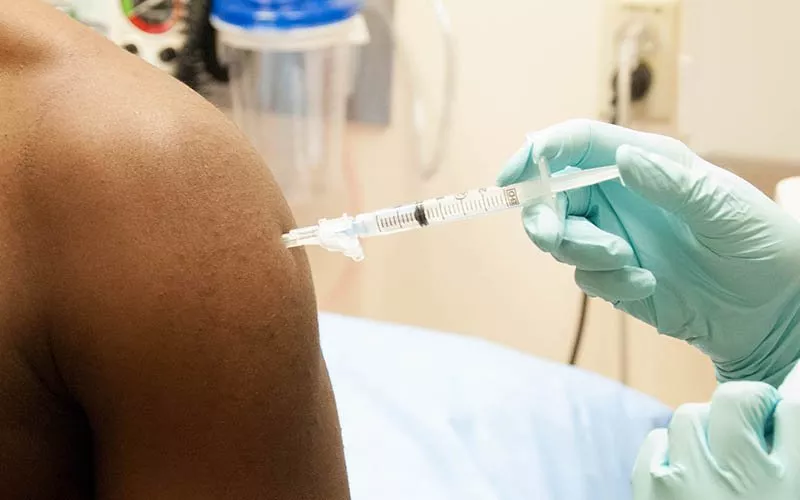
Pima County reached the goal of 70% vaccination for adults with at least one dose on Thursday.
President Joe Biden in June set a national goal of vaccinating at least 70% of all U.S. adults with at least one dose by July 4. Although Pima County fell short by just four days, it is now one of four counties in Arizona that have reached the goal, including Santa Cruz County, which has vaccinated almost 100% of adults with at least one dose.
As of Thursday, Arizona has vaccinated half of the total population with at least one dose.
According to data from the CDC, the county has fully vaccinated 61.7% of adults ages 18 and older. For those 12 and older, 67.5% have received at least one dose and 92.9% of adults 65 and older has had at least one dose.
"The science has become very clear – being vaccinated protects you from getting COVID," said Pima County Health Director Dr. Theresa Cullen. "COVID is a serious illness. People can end up with significant disease and even death. For those who are still unvaccinated, I want to reassure them that the vaccines are safe and we encourage them to seek vaccination."
The county has reported 401 breakthrough cases and 16 hospitalizations among the more than 535,000 fully vaccinated people in Pima County, about .07% of those fully vaccinated.
Pima County is continuing its mobile vaccination efforts in order to reach traditionally underserved areas and census tracts with lower vaccination rates. For more information, go to pima.gov/covid19vaccine.
County Rescinds COVID-19 Emergency Resolution
On Tuesday, the Pima County Board of Supervisors voted 3-2 to rescind a resolution that declared a state of emergency because of the COVID-19 pandemic.
Since March 19, 2020, the emergency declaration allowed the Board of Supervisors to take immediate and urgent actions that included regulating businesses, limiting gatherings and requiring mask wearing in public as cases began to rise.
Those restrictions had been lifted through state or local actions prior to the July 6 vote.
"We have had substantial and sustained improvement in Pima County," Pima County Chief Medical Officer Dr. Francisco Garcia said."I believe it would be safe to lift the emergency declaration. The cases that we're seeing are cases among unvaccinated individuals, and we continue to work on that population very vigorously and we will continue to move that further. I'm not saying the pandemic is over."
The state's highest single day of reported cases was at more than 12,000 on Jan. 4, but as more people have become vaccinated, the number of cases has declined. For the past two months, the state has fluctuated at around 50 cases of COVID-19 per 100,000 individuals.
County Administrator Chuck Huckelberry noted that the CDC reported last week that 99.5 percent of the COVID-19 deaths across the country in the past six months involved unvaccinated individuals.
"I think the message is, if you're not vaccinated, get vaccinated," Huckelberry told the board on July 6. "The rate of infection is in the hands of those who are unvaccinated."
Monday, June 28, 2021

PHOENIX – Experts describe “brain fog” as a cognitive dysfunction when your brain isn’t performing in top shape.
Although everyone is susceptible to occasional brain fog, experts say some of the worst cases have been identified in the group known as COVID-19 long-haulers – patients who had the disease and recovered but still can’t “get going” as they did before falling ill.
In February, the National Institutes of Health opened a multifaceted study into “long COVID” and its effects in the United States. Researchers hope to answer such questions as why symptoms are worse and last longer for some patients than others, and does the coronavirus that causes COVID-19 trigger other disorders of the brain and heart.
Two studies in England and Italy showed long-haulers did experience brain fog more commonly than non-COVID-19 patients during the pandemic. Long-haulers coping with brain fog improved over the course of the study.
Dr. Carmine Pariante, a professor of biological psychiatry at King’s College London, told The Guardian brain fog is the “cognitive equivalent of feeling emotionally distressed; it’s almost the way the brain expresses sadness, beyond the emotion” as a response to stress.
Although studies are in their initial stages, researchers don’t think brain fog stems from just one source. A predominant factor, though, is a lack of variety in our daily routine. CNBC reports that brain fog could be “a sign of something underlying, such as a health problem or the consequence of lifestyle choice.”
Doing a lot of the same things every day makes it hard for the brain to differentiate tasks, researchers say, so it essentially goes into an autopilot.
Friday, June 25, 2021
WASHINGTON – The Navajo Nation has yet to record a single case of the Delta variant of COVID-19, but now is not the time for tribe members to let down their guard, Navajo President Jonathan Nez said Wednesday.
Nez spent much of the time during a Washington Post program on public health talking about the Navajos’ success in fighting the pandemic, falling from a national COVID-19 hotspot at one point last year to negligible case numbers today.
But while the tribe has “been very cautious … I think we need to continue to be cautious,” Nez said, in part because of the arrival of the highly contagious Delta variant.
“We have heard updates that the city of Tucson has identified a Delta variant … so we are concerned,” Nez said.
An Arizona Department of Health official said Wednesday that the Delta variant has been found in northern, central and southern Arizona.
“The Alpha variant currently is the predominant strain in Arizona, but we anticipate that there will be an increase in the Delta variant since it appears to be more transmissible than the Alpha variant,” said Steve Elliott, a health department spokesperson.
Arizona Public Health Association Executive Director Will Humble said experts “expect that the Delta variant will be dominant by mid-to-late summer in Arizona.”
“It’s going to take over,” he said. “It’s just outcompeting the other strains. The question is how long it’s going to take.”
But Humble said that despite the high transmission rates health experts have seen for the Delta variant, it will likely not spread as fast as previous variants because of the availability now of COVID-19 vaccines.
Thursday, June 24, 2021
PHOENIX – If you’ve had COVID-19, chances are you lost your sense of smell, at least temporarily.
Losing the sense of smell and taste is one of the most common symptoms of COVID-19. A recent study of more than 2,500 COVID-19 patients published in the Journal of Internal Medicine found that 74% reported loss of smell.
For many, olfaction – the ability to smell – returns after a few days or weeks. In the study, 75% to 85% of the patients had recovered their sense of smell within two months. However, some people feel the lingering effects for much longer.
Dr. Janice Johnston with Redirect Health in metro Phoenix told ABC15 that sufferers are trying to find relief through smell therapy.
“The new term for it is smell therapy or physical therapy for your nose, which is a cute way to phrase that,” Johnston said. “What that means is, where you try to train the neurons that interpret those smells to learn again. And how do you do that? You can smell things that have a real distinct odor … say roses or eucalyptus or herbs or essential oils. As you are smelling them, try to envision what you’re smelling and try to teach your brain what that is.”
If smell therapy doesn’t work, she said, other treatments are being developed.
Dr. David Rosen, an otolaryngologist at Jefferson Health in Philadelphia, said alpha lipoic acid, vitamin A supplements and over-the-counter steroid nasal sprays also could help, according to the Health Nexus.
In this video, Cronkite News reporter Jordan Spurgeon explains smell therapy and how your brain has to retrain its sense of smell after losing it to COVID-19.
Cronkite News has partnered with ABC15 Arizona to expand the station’s Health Insider series, which provides expert advice and insights into health topics. Cronkite News is experimenting with storytelling tools and techniques to help explain the issues.
Tuesday, June 22, 2021
PHOENIX – After months of relaxed COVID-19 precautions, including lifting restrictions on face masks and social distancing, India has suffered a second surge that set records for new infections and deaths.
As the United States begins to ease into a new normal and relaxes its own pandemic restrictions, is there a chance of a similar outbreak here? Dr. Janice Johnston, chief medical director of Redirect Health, told ABC15 multiple factors, including emerging variants and vaccines, ultimately will determine the severity of the spread.
“This is what viruses will do,” Johnston said. “They will start to mutate and vary. And what we think right now is that the vaccines are being quite effective with these variants, but time will tell.”
From a global perspective, health officials are watching the variants closely. The Centers for Disease Control and Prevention says its working with partners around the world to detect, track and respond to new variants.
In this video, Cronkite News reporter Jamie Landers explains where the U.S. stands compared to other countries.
Cronkite News has partnered with ABC15 Arizona to expand the station’s Health Insider series, which provides expert advice and insights into health topics. Cronkite News is experimenting with storytelling tools and techniques to help explain the issues.
Monday, June 21, 2021
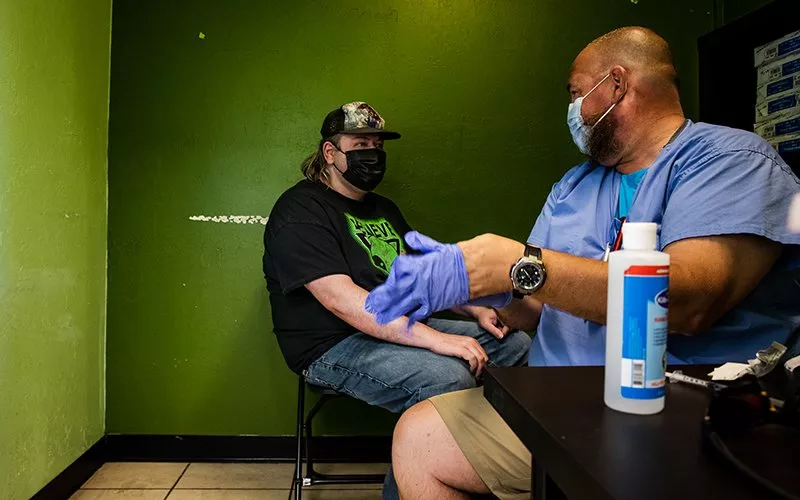
MESA – On a recent weekday morning, Paul Petersen of Florence was one of the first to arrive at Mint Dispensary to get something not usually offered at the cannabis shop: a free COVID-19 vaccine.
The 40-year-old had been holding off on getting vaccinated to see how others responded but was persuaded by an added perk: Mint’s Snax for Vaxx event. Mint gave away one free edible and a pre-rolled joint to anyone 21 or older receiving a Moderna vaccine.
Petersen said he took advantage of the opportunity to acquire “two things at once.”
“I’m comfortable with it now,” he said of the vaccination process, “but I didn’t trust the science before.”
With COVID-19 vaccination rates declining in Arizona and other states, public and private entities are using incentives to reverse the trend and get more shots into more arms.
From free doughnuts at Krispy Kreme shops to cold, hard cash from the state of California, individuals stepping up to get pricked can be rewarded in myriad ways.
In Arizona, Mint joined with Commerce Medical Group to provide vaccinations at pop-up clinics June 1 through 3 at its locations in Mesa, Tempe and Phoenix. Forty doses were brought to each location, and about two-thirds were distributed, said Kristy Jozwiak, a spokesperson for Mint.
Linzy Volm, a medical assistant for Commerce Medical Group who helped at the Mesa location, said more people turned up than she’d expected.
“I think it helps, giving a reward for (the shots),” she said. “But it kind of sucks that it has to come down to people being bribed to get vaccinated.”
Wednesday, June 16, 2021
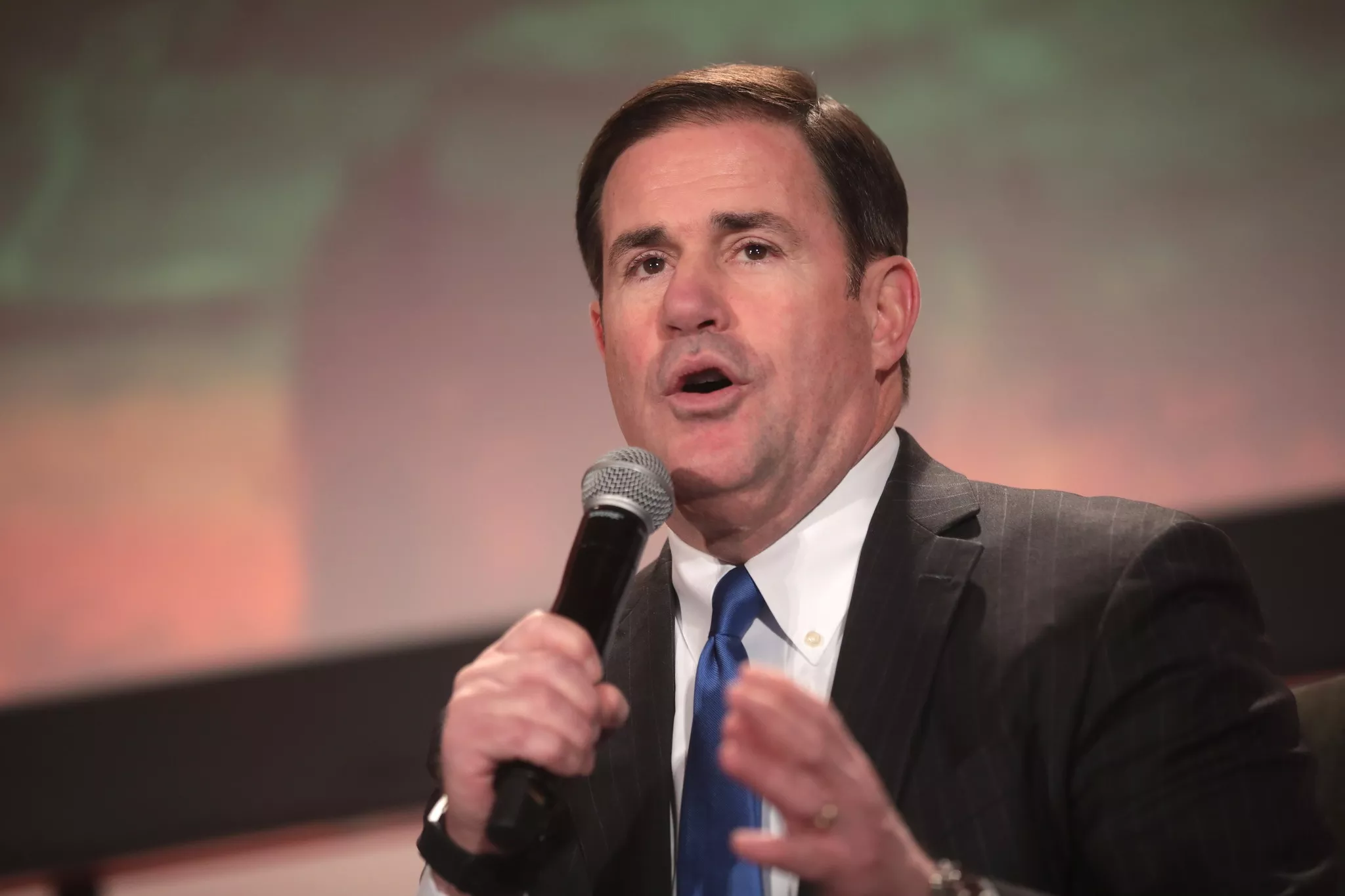
Gov. Doug Ducey issued an executive order on Tuesday preventing Arizona’s public universities and community colleges from mandating students to receive the COVID-19 vaccine or submit COVID-19 vaccination documents. In addition, higher education students cannot be mandated to be tested for the virus or wear masks in order to participate in learning.
“The vaccine works, and we encourage Arizonans to take it. But it is a choice and we need to keep it that way,” Ducey said in a news release. “Public education is a public right, and taxpayers are paying for it. We need to make our public universities available for students to return to learning. They have already missed out on too much learning.”
The executive order provides exemptions for students participating in medical or clinical training. It also does not prevent colleges from encouraging vaccinations, providing testing or having voluntary mask usage. According to the executive order, although COVID is highly contagious, it has not demonstrated transmission characteristics that would mandate vaccines in "narrow circumstances."
Arizona has administered more than 6 million vaccine doses to date, with more than 3 million Arizonans fully vaccinated.
Read the full executive order here.
PHOENIX – Phoenix Sky Harbor International Airport is filling up with more travelers this summer, with more than 4.8 million passengers boarding flights there in the past four months alone, according to a report published on the airport’s website.
Due to the low volume of travelers at the height of the pandemic, getting through security and the preboarding process was quick and easy. But today, the process is a bit more difficult, according to Patricia Mancha, a media Transportation Security Administration spokesperson.
“During the pandemic, if anyone traveled they saw no lines. It was a quick process. That’s not the case anymore,” Mancha said.
The COVID-19 pandemic hit American travelers hard in 2020 and early 2021. In addition to lockdowns and people’s health concerns over travel, government-issued bans on travel to countries such as Iran, China, the United Kingdom, Brazil, South Africa and most recently, India.
According to Sky Harbor officials, 2020 had a total of around 21 million travelers, compared to the more than 40 million who traveled through the airport in every other year in the decade.

