
Wednesday, April 29, 2020
With Gov. Doug Ducey announcing his plans for modifying Arizona's Stay-at-Home order at a 3 p.m. presser today, Tucson Mayor Regina Romero and Pima County Board of Supervisors Chairman Ramon Valadez say that it's not yet time to open Arizona. The joint statement:

Pima County and the City of Tucson are united in our concern on relaxing restrictions and opening up our economy at this time. We encourage Governor Ducey to give counties and local jurisdictions the flexibility to act at the regional level if he does not want to extend his 'Stay Home, Stay Healthy, Stay Connected' executive order statewide.
The CDC’s guidelines on 'Opening Up America Again' clearly state that Governors have the discretion to allow local jurisdictions to act at the regional level. The Pima County Health Department has issued guidelines based off CDC recommendations on when it is safe to begin a phased re-opening, including a decline of positive cases over 14 consecutive days, widespread testing, and sufficient PPE for first responders and healthcare workers. We urge great caution in any relaxation.
ProPublica is a nonprofit newsroom that investigates abuses of power. Click here to read their biggest stories as soon as they’re published.
In the past two weeks, researchers across America have begun announcing results from studies showing that there have been many more coronavirus infections in their communities than were previously recorded.
Findings have come in from Santa Clara County, California, as well as Los Angeles, New York, Chelsea, Massachusetts, and Miami-Dade County, Florida. The debates began immediately. What did the study results actually mean? If more people were infected than previously known, did that mean the death rate is actually lower than previously thought? Is the coronavirus actually more like the flu, after all? And are we close to “herd immunity,” meaning enough people are infected that the virus won’t spread easily anymore?
These studies all were based on antibody tests, which are diagnostics that can look in a person’s blood and see if there is evidence of prior infection. In the past month, as these tests have reached the market, researchers have launched large-scale studies, known as sero-surveys (sero is short for serology, the study of blood serum). By running these surveys, scientists are finally able to start estimating how many people have been infected, which can give us information about how deadly the disease is and where the disease was most concentrated geographically.

In the past two weeks, researchers across America have begun announcing results from studies showing that there have been many more coronavirus infections in their communities than were previously recorded.
Findings have come in from Santa Clara County, California, as well as Los Angeles, New York, Chelsea, Massachusetts, and Miami-Dade County, Florida. The debates began immediately. What did the study results actually mean? If more people were infected than previously known, did that mean the death rate is actually lower than previously thought? Is the coronavirus actually more like the flu, after all? And are we close to “herd immunity,” meaning enough people are infected that the virus won’t spread easily anymore?
These studies all were based on antibody tests, which are diagnostics that can look in a person’s blood and see if there is evidence of prior infection. In the past month, as these tests have reached the market, researchers have launched large-scale studies, known as sero-surveys (sero is short for serology, the study of blood serum). By running these surveys, scientists are finally able to start estimating how many people have been infected, which can give us information about how deadly the disease is and where the disease was most concentrated geographically.
ProPublica is a nonprofit newsroom that investigates abuses of power. Click here to read their biggest stories as soon as they’re published.
Executives at Cigna, the health insurance giant, have signaled to investors that the coronavirus pandemic isn’t hurting the company’s business and might actually be a boon.
But that hasn’t stopped the trade group that represents Cigna and other health insurers in Washington from asking lawmakers for aid.
Last month, as the coronavirus outbreak sent the stock market into freefall, executives conferred with equity analysts at major investment banks — a key way for companies to communicate with investors. In a four-hour virtual meeting with analysts at global investment bank UBS, Cigna’s CEO and other top executives explained that although they were seeing higher medical claims for treating coronavirus, those costs were being offset by hospitals’ canceling elective surgeries and other procedures.
As a result, the executives said, they did “not see COVID-19 having a material financial impact,” according to the UBS analysts’ report on the conversation. Cigna advised that it might even have the resources to take over rivals or buy back its own stock, according to the March 20 UBS report.

Executives at Cigna, the health insurance giant, have signaled to investors that the coronavirus pandemic isn’t hurting the company’s business and might actually be a boon.
But that hasn’t stopped the trade group that represents Cigna and other health insurers in Washington from asking lawmakers for aid.
Last month, as the coronavirus outbreak sent the stock market into freefall, executives conferred with equity analysts at major investment banks — a key way for companies to communicate with investors. In a four-hour virtual meeting with analysts at global investment bank UBS, Cigna’s CEO and other top executives explained that although they were seeing higher medical claims for treating coronavirus, those costs were being offset by hospitals’ canceling elective surgeries and other procedures.
As a result, the executives said, they did “not see COVID-19 having a material financial impact,” according to the UBS analysts’ report on the conversation. Cigna advised that it might even have the resources to take over rivals or buy back its own stock, according to the March 20 UBS report.
ProPublica is a nonprofit newsroom that investigates abuses of power. Click here to read their biggest stories as soon as they’re published.
Darcel Richardson knows she’s fortunate in one sense: She still has her job as a vocational counselor in Baltimore. But despite that, she won’t be able to make her rent payment this month because she’s not getting her full salary for a while. More than $400 per biweekly paycheck — about a quarter of her after-tax income — has been siphoned off by Johns Hopkins University for unpaid medical bills at one of its hospitals.
Richardson, 60, got word of the garnishment from her employer just as the coronavirus pandemic was arriving in full force last month. “My job was going to take the money out. They don’t want to get in trouble,” she said. “I spoke with our payroll accountant, and the bottom line was, even though the crisis had begun, they still had to pay my money to them.”
In a moment when hospitals nationwide are being heralded for their role at the front lines of fighting the pandemic, some Americans continue to experience a less favorable side of hospital operations: aggressive collection for unpaid medical bills, even at a time when many of the debtors are seeing their income plunge. Debt collection is occurring on other fronts as well, over unpaid college and bank loans among others, prompting debates over protecting people’s economic stimulus checks from collection agencies or suspending garnishments outright. But collection by the very hospitals that are treating coronavirus patients brings the health and economic exigencies of the moment into especially stark relief.
In a few cases, hospitals have brought new cases against former patients in recent weeks, such as in Wisconsin, where Froedtert Hospital in Milwaukee filed 46 small-claims lawsuits even after the governor declared a state of emergency on March 12, and other hospital systems in the state filed dozens more, according to a report by Wisconsin Public Radio and Wisconsin Watch. Steve Schoof, Froedtert’s director of external communications, told ProPublica in a statement that the hospital stopped filing small claims suits on March 18. “Moving forward,” the statement continued, “Froedtert Health will no longer be filing small claims suits for medical debt collection. Unfortunately, there was a miscommunication that resulted in small claims filings after March 18. We immediately rectified this miscommunication and dismissed these small claims cases that were filed after March 18.”

Darcel Richardson knows she’s fortunate in one sense: She still has her job as a vocational counselor in Baltimore. But despite that, she won’t be able to make her rent payment this month because she’s not getting her full salary for a while. More than $400 per biweekly paycheck — about a quarter of her after-tax income — has been siphoned off by Johns Hopkins University for unpaid medical bills at one of its hospitals.
Richardson, 60, got word of the garnishment from her employer just as the coronavirus pandemic was arriving in full force last month. “My job was going to take the money out. They don’t want to get in trouble,” she said. “I spoke with our payroll accountant, and the bottom line was, even though the crisis had begun, they still had to pay my money to them.”
In a moment when hospitals nationwide are being heralded for their role at the front lines of fighting the pandemic, some Americans continue to experience a less favorable side of hospital operations: aggressive collection for unpaid medical bills, even at a time when many of the debtors are seeing their income plunge. Debt collection is occurring on other fronts as well, over unpaid college and bank loans among others, prompting debates over protecting people’s economic stimulus checks from collection agencies or suspending garnishments outright. But collection by the very hospitals that are treating coronavirus patients brings the health and economic exigencies of the moment into especially stark relief.
In a few cases, hospitals have brought new cases against former patients in recent weeks, such as in Wisconsin, where Froedtert Hospital in Milwaukee filed 46 small-claims lawsuits even after the governor declared a state of emergency on March 12, and other hospital systems in the state filed dozens more, according to a report by Wisconsin Public Radio and Wisconsin Watch. Steve Schoof, Froedtert’s director of external communications, told ProPublica in a statement that the hospital stopped filing small claims suits on March 18. “Moving forward,” the statement continued, “Froedtert Health will no longer be filing small claims suits for medical debt collection. Unfortunately, there was a miscommunication that resulted in small claims filings after March 18. We immediately rectified this miscommunication and dismissed these small claims cases that were filed after March 18.”

Photo by Bytemarks/Creative Commons
More than 470,000 Arizonans have filed for unemployment in the last six weeks. New expanded jobless benefits begin in May, but advocates worry it won’t be enough to offset the massive damage from the coronavirus.
But economists and advocates say that while the change is welcome – it’s probably too little, and too late.
The changes, which take effect May 12, are part of the Pandemic Unemployment Assistance program that all states are rolling out under the Coronavirus Aid, Relief and Economic Security (CARES) Act, the $2 trillion federal relief package approved last month.
Under the new rules, benefits will be available to the self-employed, to people seeking part-time work and people who lack sufficient work history. It also includes federal funds that extend benefits to 39 weeks for some workers and can add $600 a week to unemployment checks.
The Department of Economic Security said last week that it had contracted with a private firm to help speed the delivery of benefits under the expanded program.
The UA can expect a $250 million drop in revenue along with a significant drop in new enrollment of both in-state and out-of-state students, according to UA President Robert C. Robbins.
Robbins delivered the grim news via an April 29 email to faculty and staff.
The UA is predicting:
• $250 million loss in revenue through June 2021;
• Auxiliary income loss of $58.2 million in revenue, including Intercollegiate Athletics;
• A decrease in philanthropic gifts and investment income from cash on hand, projected to result in a $54.8 million loss in revenue.
• A decrease of 11% in new in-state and 19% in new out-of-state undergraduate and graduate student enrollments, equivalent to an $18.7 million loss in revenue. Returning graduate student losses are projected to be 4% for in-state and out-of-state students, equivalent to a $1.6 million loss in tuition revenue.
• A decrease in research activity is projected to result in a $16 million hit to Facilities & Administrative Expense Recovery.
• Reduction in activities associated with departmental sales and service, summer programs, camps, and conferences is projected to result in a $14.1 million loss in revenue.
The UA has already seen an estimated $7.1 million in new expenses related to the COVID-19 outbreak and Robbins anticipates significant investments in fiscal year 2021 for testing, tracing, and isolation.

Robbins delivered the grim news via an April 29 email to faculty and staff.
The UA is predicting:
• $250 million loss in revenue through June 2021;
• Auxiliary income loss of $58.2 million in revenue, including Intercollegiate Athletics;
• A decrease in philanthropic gifts and investment income from cash on hand, projected to result in a $54.8 million loss in revenue.
• A decrease of 11% in new in-state and 19% in new out-of-state undergraduate and graduate student enrollments, equivalent to an $18.7 million loss in revenue. Returning graduate student losses are projected to be 4% for in-state and out-of-state students, equivalent to a $1.6 million loss in tuition revenue.
• A decrease in research activity is projected to result in a $16 million hit to Facilities & Administrative Expense Recovery.
• Reduction in activities associated with departmental sales and service, summer programs, camps, and conferences is projected to result in a $14.1 million loss in revenue.
The UA has already seen an estimated $7.1 million in new expenses related to the COVID-19 outbreak and Robbins anticipates significant investments in fiscal year 2021 for testing, tracing, and isolation.
"We are not alone in these challenges," Robbins wrote in his email. "Colleges and universities across the nation are facing similarly difficult circumstances, including large drops in tuition revenue, and many are taking major steps in response. Together, we can—and we will—overcome these challenges and flourish as a world-class institution of higher education and research. Together, our compassion, our adaptability and our determination will propel us forward."

Phoenix Mayor Kate Gallego has requested that Ducey allow mayors to be a part of the decision process on whether to extend or keep the stay-at-home order, which is set to expire at the end of Thursday. The governor last week said he would base his decision on the latest data on the spread of COVID-19 in the state, which has claimed 293 lives so far.
“Governor Doug Ducey put in an executive order and has made it clear that he is the decision maker on these issues,” Gallego said. “Governor Ducey’s staff used to have phone calls daily with the mayors at the beginning of the virus, but they have canceled that.”
The mayors of Casa Grande and Tolleson reported that more essential businesses in their cities stayed open during Ducey’s order than in Phoenix and Mesa, which might help them in the long run.
“A lot of our industry is essential so it continues to work, we have about 27 manfucturing facilities. The biggest issue is going to be the bars and restaurants,” said Casa Grande Mayor Craig McFarland, adding that the city’s 2020-21 budget is expected to fall just 0.6%.
Several mayors said that whenever Ducey allows businesses to reopen, it will have to be done gradually, with social distancing and crowd-size limits still in place.
“It’ll be interesting to see how we transition out of the stay-at-home order to what extent we incorporate social distancing into our daily lives so we can engage in economic activity as soon as possible,” Mesa Mayor John Giles said. The roundtable was hosted by the Greater Phoenix Economic Council.
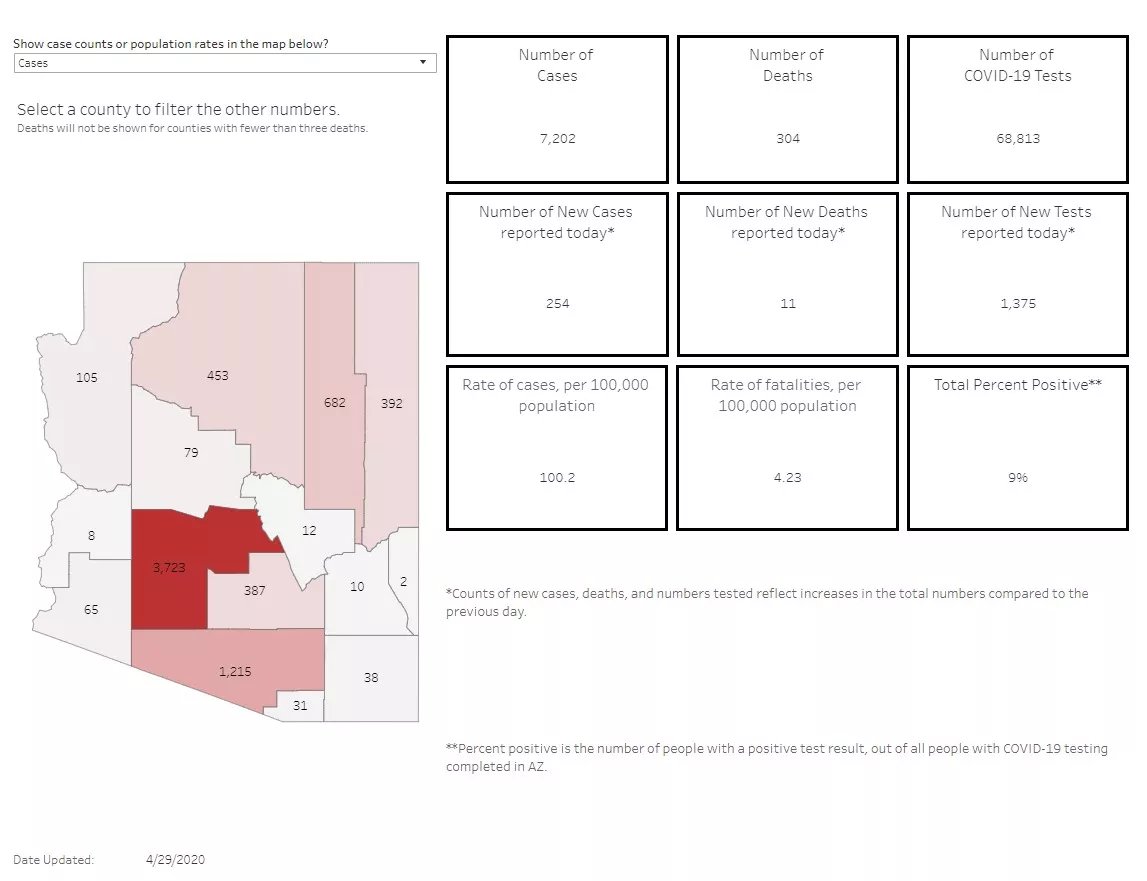
The number of confirmed coronavirus cases in Arizona topped 7,000 as of Wednesday, April 29, according to the morning report from the Arizona Department of Health Services.
Pima County had 1,215 of the state's 7,202 confirmed cases.
The coronavirus had killed 304 people statewide, including 80 in Pima County, according to the report.
In Maricopa County, the number of confirmed COVID-19 cases had risen to 3,723.
Because testing remains limited in Arizona and COVID-19 symptoms can take as long as two weeks to appear after exposure to the virus (while some people can remain entirely asymptomatic), health officials continue to urge the public to avoid unnecessary trips and gatherings of more than 10 people and have advised people to cover their faces with masks in public.
Gov. Doug Ducey’s stay-home-home order, which drew a two-day protest earlier this month at the state Capitol, expires tomorrow.
The order has closed a wide variety of “non-essential” businesses, including bars, barbershops, salons, theaters, gyms, swap meets, and many retail stores. Restaurants may remain open but only for takeout and delivery service. Public parks remain open but amenities such as playgrounds and restrooms are closed.
Ducey spokesman Patrick Ptak said that administration officials were still tracking data to determine the best course of action regarding whether the stay-at-home order would be extended into May.
Pima County had 1,215 of the state's 7,202 confirmed cases.

The coronavirus had killed 304 people statewide, including 80 in Pima County, according to the report.
In Maricopa County, the number of confirmed COVID-19 cases had risen to 3,723.
Because testing remains limited in Arizona and COVID-19 symptoms can take as long as two weeks to appear after exposure to the virus (while some people can remain entirely asymptomatic), health officials continue to urge the public to avoid unnecessary trips and gatherings of more than 10 people and have advised people to cover their faces with masks in public.
Gov. Doug Ducey’s stay-home-home order, which drew a two-day protest earlier this month at the state Capitol, expires tomorrow.
The order has closed a wide variety of “non-essential” businesses, including bars, barbershops, salons, theaters, gyms, swap meets, and many retail stores. Restaurants may remain open but only for takeout and delivery service. Public parks remain open but amenities such as playgrounds and restrooms are closed.
Ducey spokesman Patrick Ptak said that administration officials were still tracking data to determine the best course of action regarding whether the stay-at-home order would be extended into May.
Tuesday, April 28, 2020
Here's a roundup of all the news we've touched on today:

- The number of confirmed coronavirus cases in Arizona reached 6,948 as of Tuesday, April 28, according to the morning report from the Arizona Department of Health Services.
- The Pima County Health Department will be led by former Assistant U.S. Surgeon General Dr. Theresa Cullen.
- To increase statewide testing for COVID-19, Gov. Doug Ducey announced a plan Monday to test up to 60,000 Arizonans over the course of three weekends.
- Democratic hopeful Mark Kelly continued to lead all Senate candidates in campaign funding for the first quarter of 2020.
- As some governors prepare to relax social distancing restrictions in their states, ProPublica hosted a digital event on Thursday answering your questions.
- Offers from Comcast have been extended to June 30 to help students finish out their school year.
- With Arizona schools closed indefinitely, children have plenty of time on their hands – and parents are looking for teachable moments. One subject that’s not taught in most schools is money and how to earn it, spend it, share it, and save it.
In mid-March, Comcast responded to the COVID-19 pandemic by promising to not cut its Xfinity internet and mobile services for nonpayment and would begin waiving late fees if customers indicated that they could not pay their bills.
Comcast gave unlimited data to all customers, created public WiFi hotspots in business and outdoor locations across the country, and began offering 60 days of complimentary WiFi service to new customers.
These offers have been extended to June 30, so that students can finish out their school year while maintaining WiFi connections. School districts across the country quickly pivoted toward an online format when nationwide school closures were mandated in early March to stop the spread of COVID-19.

Comcast gave unlimited data to all customers, created public WiFi hotspots in business and outdoor locations across the country, and began offering 60 days of complimentary WiFi service to new customers.
These offers have been extended to June 30, so that students can finish out their school year while maintaining WiFi connections. School districts across the country quickly pivoted toward an online format when nationwide school closures were mandated in early March to stop the spread of COVID-19.
“These extended measures will continue to keep Americans safe and ensure that households are equipped for students to learn and stay informed at home as the nation copes with this unprecedented disruption to our daily lives,” said Comcast CEO Dave Watson in a press release. “Our services have never been more important, and we’re doing everything we can to keep people connected to the internet.”
For more information, visit www.comcastcorporation.com/COVID-19/.
Tags: Comcast , WiFi , Service , COVID-19 , Coronavirus , Internet , Students , School Closure , Image