
Wednesday, March 3, 2021

Gov. Doug Ducey issued an Executive Order on Wednesday requiring schools to return to in-person, teacher-led instruction by March 15, or after Spring Break. This comes as 12 of Arizona’s 15 counties, including Pima, are "in phases where all schools are safe to open." This includes district and charter schools. The majority of Arizona counties are still in the "substantial" category of COVID-19 spread.
“Arizona’s students need to be back in the classroom," Ducey said. "More than half of Arizona’s schools are open and offering in-person options. More schools need to follow their lead, and pave the way for equitable education options for every Arizona student."
However, an individual district may close if the local health department advises closure due to "a significant outbreak" of the COVID-19 virus that poses a risk to the students or staff, and is approved for closure by the Arizona Department of Health Services.
An exception is made for middle and high schools located in the counties with “high” transmission of COVID-19: Coconino, Yavapai and Pinal.
The Arizona Department of Health Services updated their COVID-19 School Benchmarks following the executive order on Wednesday.
Following CDC recommendations, schools should keep track of two metrics to track community transmission: cases per 100,000 and the percentage of positive nucleic acid amplification tests all in the last week. Both will determine whether a school has low, moderate, substantial, or high transmission. ADHS recommends elementary schools remain in hybrid learning if in the moderate to high range, while middle schools and high schools should offer virtual learning if high transmission, unless they are already offering in-person instruction and have few cases or have implemented mitigation strategies to keep cases down. Once schools reach moderate transmission, they recommend all K-12 schools open for full in-person instruction.
Several school districts in Pima County have already reopened schools or plan to reopen them before or after Spring Break. However, most districts offer several different methods of instruction, not a full-five days of in-person learning.
For example, as of March 1, Sunnyside Unified School District has almost half of their students attending school as part of their in-person hybrid program. These students are split into two groups, each attending school two days per week and one day remote. Other districts with varying hybrid programs are Amphitheater and Catalina Foothills.
School districts surveyed teachers, staff, parents and students in order to provide a method of instruction that would suit them. Parents with children attending Tucson Unified School District have until March 7 to decide the method of instruction for their child. According to a TUSD spokesperson, they are still reviewing Governor Ducey’s Executive Order.

PHOENIX – High school athletes will not be required to wear masks during spring sports competition and neither will winter sports athletes during playoffs, the Arizona Interscholastic Association Executive Board voted Tuesday
The decision comes after the Sports Medicine Advisory committee recommended removing the mask mandate for outdoor spring sports.
The only exception is for boys volleyball. It was recommended they should continue wearing masks for play.
The committee also recommended finishing the winter regular season with masks. The removal of the mask mandate only applies to those in the field of competition, including officials. All coaches, players on the bench and spectators will continue to be required to wear masks.
The AIA has had about 160 positive COVID cases out of roughly 10 to 12,000 athletes participating in winter sports, AIA Executive Director David Hines said.
“We also have information that the medical professionals get in regard to hospital capacity, hospital cases, hospital COVID cases, in ICU, in hospitals, etc.,” Hines said. “They absolutely admit the numbers are coming down, getting much better.”
With 1,284 new cases reported today, the total number of Arizona’s confirmed novel coronavirus cases closed in on 820,000 as of Wednesday, March 3, according to the Arizona Department of Health Services.

Pima County, which reported 257 new cases today, has seen 109,941 of the state’s 819,954 confirmed cases.
With 29 new deaths reported today, a total of 16,089 Arizonans have died after contracting COVID-19, including 2,233 deaths in Pima County, according to the March 3 report.
The number of hospitalized COVID cases statewide has continued to decline, with 1,165 coronavirus patients in the hospital as of March 2. That’s less than a fourth of the number hospitalized at the peak of the winter surge, which reached 5,082 on Jan. 11. The summer peak was 3,517, which was set on July 13, 2020. The subsequent lowest number of hospitalized COVID patients was 468, set on Sept. 27, 2020.
A total of 1,087 people visited emergency rooms on March 2 with COVID symptoms, representing about 46 percent of the record high of 2,341 set on Tuesday, Dec. 29, 2020. That number had peaked during the summer wave at 2,008 on July 7, 2020; it hit a subsequent low of 653 on Sept. 28, 2020.
Tuesday, March 2, 2021
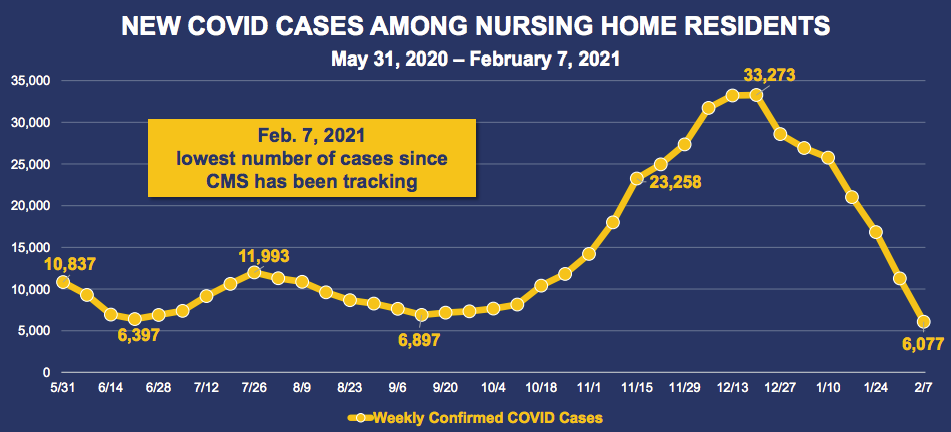
Nursing home COVID cases have declined since vaccines began to be administered in mid-December, according to a report released Tuesday by the American Health Care Association and National Center for Assisted Living. Nursing homes in the US have seen the lowest number of new COVID cases since the Centers for Medicare & Medicaid Services started tracking cases in May.
In the week of Dec. 20, 2020, U.S. nursing homes saw 33,000 new COVID cases. And in the week of Feb. 7, that number dropped to 6,000 cases. In the same period of time, AHCA/NCAL reports community cases in the general population dropped by 46%.
“We still have a long road ahead, but these numbers are incredibly encouraging and a major morale booster for frontline caregivers who have been working tirelessly every day for a year to protect our residents,” said AHCA/NCAL President Mark Parkinson in a press release. “This new data showcases just how important it is for nursing homes residents and staff, as well as the general public, to get the vaccine because it is clearly working.”
In addition to greatly reduced cases, nursing home COVID deaths have reduced by more than 60%. In the week of December 20, 2020, U.S. nursing homes saw 5,900 COVID-related deaths. Compare that to the week of Feb. 7, when U.S. nursing homes saw 2,200 COVID-related deaths.
“Though this report brings hope, we cannot let our guard down. We must continue to encourage folks to get vaccinated, especially caregivers and staff,” Parkinson said.
With 849 new cases reported today, the total number of Arizona’s confirmed novel coronavirus cases topped 818,000 as of Tuesday, March 2, according to the Arizona Department of Health Services.

Pima County, which reported 83 new cases today, has seen 109,684 of the state’s 818,670 confirmed cases.
With 81 new deaths reported today, a total of 16,060 Arizonans have died after contracting COVID-19, including 2,227 deaths in Pima County, according to the March 1 report.
The number of hospitalized COVID cases statewide has declined in recent weeks, with 1,202 coronavirus patients in the hospital as of March 1. That’s less than a fourth of the number hospitalized at the peak of the winter surge, which reached 5,082 on Jan. 11. The summer peak was 3,517, which was set on July 13, 2020. The subsequent lowest number of hospitalized COVID patients was 468, set on Sept. 27, 2020.
Monday, March 1, 2021
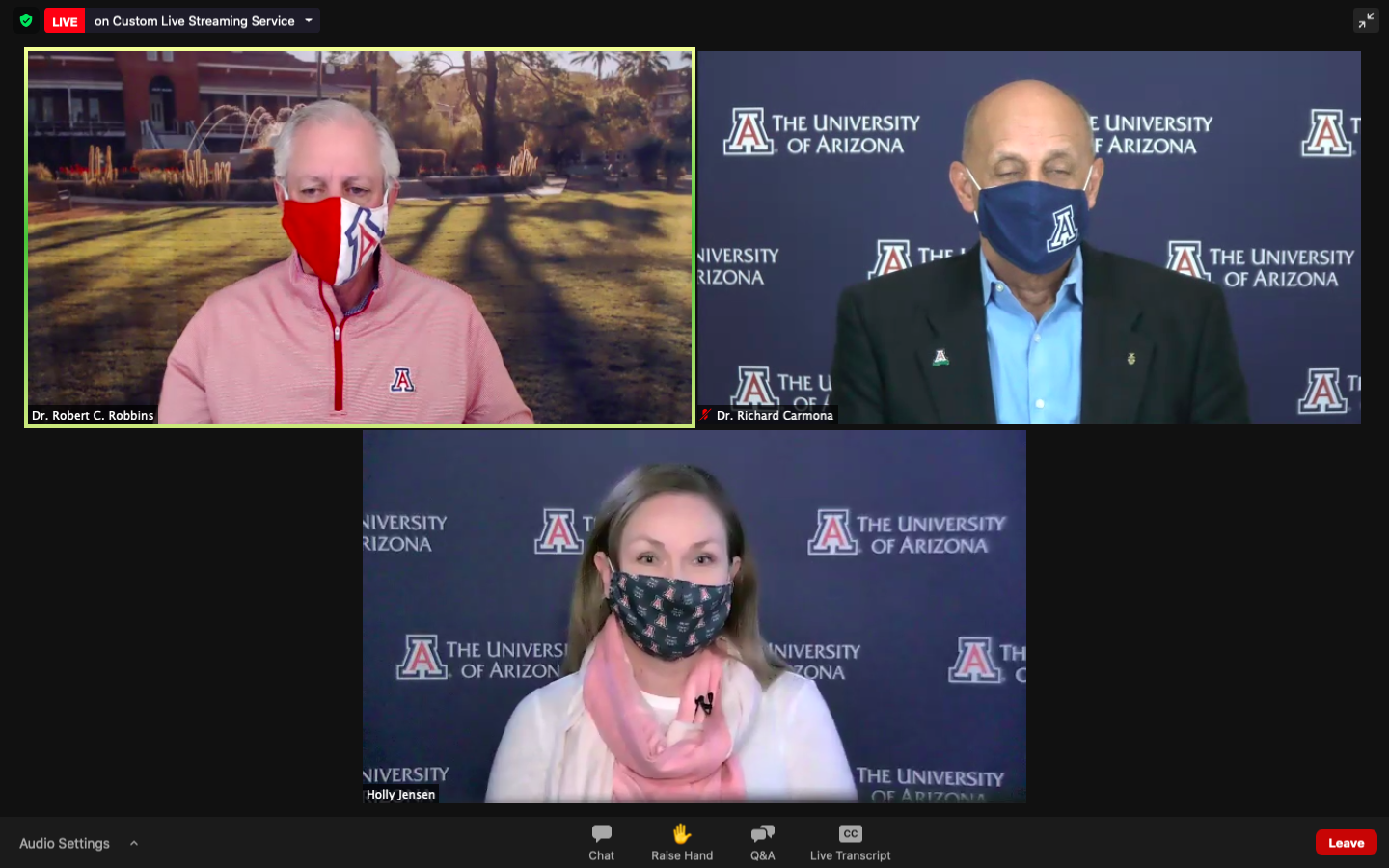
Additional vaccine appointments beginning Sunday for the University of Arizona POD will be made available soon, said UA President Dr. Robert C. Robbins at a press conference this morning.
Robbins asks the public to continue to check for appointments and reminded the public that the number of appointments available is directly proportional to the number of vaccine doses.
The university is scheduled to receive 16,380 doses this week and has distributed more than 35,000 doses, said Robbins.
The POD continues to run from 10 a.m. to 10 p.m. seven days a week, but with an increase in vaccines, the hours may be expanded to become a 24/7 POD by the end of March or the beginning of April, said Arizona Health Director Dr. Cara Christ during a news conference last week.
Robbins said the issue is a supply problem, as with the expanded hours, the vaccine distribution center could deliver 6,000 to 7,000 doses per day with 24-hour service.
"As soon as the state can give us the vaccine that we need, we'll gladly go 24/7, seven days a week, until we get as many people vaccinated as soon as possible," said Robbins.
As vaccines become available at pharmacies like CVS and Walgreens, Dr. Richard Carmona, UA's reentry task force director, hopes people will go to where they can get a vaccine as quickly as they can.
“The more places we have that allow vaccines to be given is clearly part of our value proposition to accelerate herd immunity,” said Carmona.
Tags: UA POD , tucson vaccine , where to get a vaccine in tucson , COVID Robbins , Carmona , Uarizona news , Tucson news , arizona news , Image
With 1,039 new cases reported today, the total number of Arizona’s confirmed novel coronavirus cases closed in on 818,000 as of Monday, March 1, according to the Arizona Department of Health Services.
Pima County, which reported 113 new cases today, has seen 109,601 of the state’s 817,821 confirmed cases.
A total of 15,971 Arizonans have died after contracting COVID-19, including 2,216 deaths in Pima County, according to the March 1 report.
The number of hospitalized COVID cases statewide has declined in recent weeks, with 1,241 coronavirus patients in the hospital as of Feb. 28. That’s less than a fourth of the number hospitalized at the peak of the winter surge, which reached 5,082 on Jan. 11. The summer peak was 3,517, which was set on July 13, 2020. The subsequent lowest number of hospitalized COVID patients was 468, set on Sept. 27, 2020.
A total of 952 people visited emergency rooms on Feb. 28 with COVID symptoms, a big drop from the record high of 2,341 set on Tuesday, Dec. 29, 2020. That number had peaked during the summer wave at 2,008 on July 7, 2020; it hit a subsequent low of 653 on Sept. 28, 2020.
A total of 382 COVID-19 patients were in intensive care unit beds on Feb. 25, less than a third of the record 1,183 set on Jan. 11. The summer’s record number of patients in ICU beds was 970, set on July 13, 2020. The subsequent low was 114 on Sept. 22, 2020.
How to get a vaccine
While supplies are limited, Pima County is providing vaccination shots to people 65 and older as well as educators, first responders and healthcare workers. Those who qualify in Pima County’s 1B priority group of eligible vaccine recipients can register for a vaccine at www.pima.gov/covid19vaccineregistration or by calling 520-222-0119.
A state-run vaccination site opening at the University of Arizona was not accepting first-dose appointments as of Monday, March 1. When accepting new appointments, the site follows the state’s current vaccine eligibility, which includes those 65 and older, educators, childcare workers and protective service workers.
As the state-run POD, or point of distribution, registrations will go through ADHS’s website. When online registration resumes, you can make an appointment at at pod vaccine.azdhs.gov, and those who need assistance can call 1-844-542-8201. More details here.
Eight CVS pharmacies throughout Arizona began offering COVID-19 vaccines starting last week.
Patients must register in advance at CVS.com or through the CVS Pharmacy app. People without online access can contact CVS Customer Service: (800) 746-7287. Walk-in vaccinations without an appointment will not be provided. Per the state of Arizona, eligible individuals for the Federal Retail Pharmacy Program are people age 65 and over, health care workers, protective services, teachers and childcare providers.
As more supply becomes available, the company will expand vaccine access through an increasing number of store locations and in more Arizona counties.
Click here register in advance for a vaccine at a CVS location.
Cases continue decline, health officials say relaxed restrictions on horizon
With the winter wave of coronavirus cases receding and more Pima County residents getting vaccinated, local officials say they may soon loosen COVID-related restrictions on crowd sizes and similar measures meant to slow the spread of the disease.
Dr. Theresa Cullen, head of the Pima County Public Health Department, said last week that as long as current trends continue, she expected that she’d release a new Public Health Advisory that would offer relaxed recommendations in the near future.
“If you go look at the Public Health Advisory, it still recommends that people stay in groups of 10, that would be a thing we would loosen up,” said Cullen. “We loosen up the concept of having spectators at external sporting events, which I know is near and dear to many people.”
However people should still expect the “three W's” (wear a mask, wash your hands, and wait) to remain in place as well as a physical distance of six feet, said Cullen.
Dr. Cara Christ, the head of the Arizona Department of Health, said that the state will also look at easing restrictions on large gatherings and other COVID-related regulations if the numbers continue a downward slide.
“We'd normally wait for all of the metrics to get down into the yellow for two weeks before we would start loosening some of those things,” said Christ.
Dr. Joe Gerald, an associate professor at the UA College of Public Health who puts out a weekly tracker of COVID trends, noted that for the week ending Feb. 21, at least 9,646 COVID cases were diagnosed in Arizona, which represented a 16% drop in the previous week’s numbers. That’s the lowest weekly number since Nov. 1 and marked six straight weeks of decline, but Arizona still had the 17th highest rate of transmission in the nation, according to the CDC.
In his weekly report released over the weekend, Gerald noted that the number of COVID patients in both general-ward and ICU beds dropped by 20 percent compared to the previous week. “While Arizona hospitals’ safety margins remain low, they are slowly improving,” Gerald wrote.
He urged people to continue wearing masks in public, avoid social gatherings, maintain physical distance from people not in your household and spend less than 15 minutes in indoor spaces, but said people could likely resume lower-risk activities once rates fall below 100 new diagnoses per 100,000 residents per week.
While the week ending Jan. 17 remained Arizona’s deadliest with 1,021 people dying after contracting COVID, Gerald estimated that the coronavirus death toll would be above 200 a week for another two to four weeks and falling below 200 a week by the end of March.
A total of 1,093 Pima County residents tested positive for COVID-19 in the week ending Feb. 21, which was a 34% drop from the 1,666 cases in the previous week. Pima County saw 104 new cases per 100,000 residents in the week ending Feb. 21, according to Gerald.
Vaccination progress
As of last Friday, Feb. 26, more than 1 million Arizonans have received at least the first dose of the vaccine with over 1.6 million doses administered, according to Dr. Cara Christ, head of the Arizona Department of Health Services.
With an expected increase in vaccine doses with the FDA’s approval of the Johnson & Johnson vaccine, Christ anticipates expanding the pool of people eligible to receive a vaccine at a state point of distribution sometime this month.
“If it's approved, we anticipate receiving the (Johnson & Johnson) vaccine in early March,” Christ said.
Christ said while the state was still working out the details, she expected to get between 50,000 and 60,000 Johnson & Johnson doses. Because people only need one shot of the Johnson & Johnson vaccine, it would be ideal for hard-to-track populations.
“This would be a great thing for doing mobile vaccination, especially out in rural communities,” said Christ. “You only have to go once and they are considered a completed dose, so they don't have to go back for that second dose.”
An estimated 15,000 to 20,000 Pima County residents in the 65+ group remained to be vaccinated as of last Friday, Feb. 26, said Dr. Theresa Cullen, head of the Pima County Health Department. Pima County had administered more than 250,000 vaccinations, with roughly 173,000 people receiving the first dose and roughly 80,000 people fully vaccinated.
However, expanding the pool of people eligible for the vaccine will depend on balancing second shots for those who have received their first one with scheduling first shots for 1B patients.
“We are in the process of working with both TCC and TMC which are our large efficient pods, as well as Banner to figure out how to appropriately get the first shots into the system,“ said Cullen
For the current week, the health department requested 40,000 doses independent of the UA POD, and received 24,000 Moderna doses, along with 17,550 Pfizer doses for Banner North and UMC for a total of 41,550 doses, said Cullen.
Get tested: Pima County has free COVID testing
After the state agreed to provide additional funding to keep testing centers open through at least March 2, Pima County is continuing to offer a number of testing centers around town.
You’ll have a nasal swab test at the Kino Event Center (2805 E. Ajo Way), the Udall Center (7200 E. Tanque Verde Road) and downtown (88 E. Broadway).
The center at the northside Ellie Towne Flowing Wells Community Center, 1660 W. Ruthrauff Road, involves a saliva test designed by ASU.
In addition, the Pima County Health Department, Pima Community College and Arizona State University have partnered to create new drive-thru COVID-19 testing sites at three Pima Community College locations. At the drive-thru sites, COVID-19 testing will be offered through spit samples instead of nasal canal swabs. Each site will conduct testing from 9 a.m. to noon, and registration is required in advance. Only patients 5 years or older can be tested.
Schedule an appointment at these or other pop-up sites at pima.gov/covid19testing.
The University of Arizona’s antibody testing has been opened to all Arizonans as the state attempts to get a handle on how many people have been exposed to COVID-19 but were asymptomatic or otherwise did not get a test while they were ill. To sign up for testing, visit https://covid19antibodytesting.arizona.edu/home.
—with additional reporting from Austin Counts, Christina Duran, Jeff Gardner and Mike Truelsen
Friday, February 26, 2021

PHOENIX – Reminders to stay connected and reach out to loved ones have been constant during the pandemic. However, as shutdowns and quarantines continued, the safety precautions worsened a long-term issue for LGBTQ seniors – loneliness.
It’s a feeling Lavina Tomer, executive director of Southern Arizona Senior Pride in Tucson, knows all too well.
“In terms of isolation and loneliness – that’s something that we’ve all lived with, with varying degrees at certain times,” she said.
Tomer was just 23 in the 1970s when she came out as a lesbian to her Lebanese-American family of six on the East Coast. The reaction from her religious family was mixed. Although a few were supportive, others were upset and chose to ignore her sexuality.
At church, coming out was traumatic and difficult for Tomer.
“It caused such a big issue that people began to treat me differently,” she recalled. “The minister was not willing to support me. So I chose to leave the church because I felt people were not ready to welcome me in my authenticity.”
With 1,621 new cases reported today, the number of Arizona’s confirmed novel coronavirus cases reached 814,528 as of Friday, Feb. 26, according to the Arizona Department of Health Services.
Pima County, which reported 185 new cases today, has 109,137 of the state’s cases.
With 83 new deaths reported today, a total of 15,897 Arizonans have died after contracting COVID-19, including 2,212 deaths in Pima County, according to the Feb. 26 report.
The number of hospitalized COVID cases statewide has declined in recent weeks, with 1,354 coronavirus patients in the hospital as of Feb. 25. That’s less than a third of the number hospitalized at the peak of the winter surge, which reached 5,082 on Jan. 11. The summer peak was 3,517, which was set on July 13, 2020. The subsequent lowest number of hospitalized COVID patients was 468, set on Sept. 27, 2020.
A total of 1,190 people visited emergency rooms on Feb. 25 with COVID symptoms, a big drop from the record high of 2,341 set on Tuesday, Dec. 29, 2020. That number had peaked during the summer wave at 2,008 on July 7, 2020; it hit a subsequent low of 653 on Sept. 28, 2020.
A total of 419 COVID-19 patients were in intensive care unit beds on Feb. 25, down from a peak of 1,183 set on Jan. 11. The summer’s record number of patients in ICU beds was 970, set on July 13, 2020. The subsequent low was 114 on Sept. 22, 2020.
How to get a vaccine
While supplies are limited, Pima County is providing vaccination shots to people 65 and older as well as educators, first responders and healthcare workers. Those who qualify in Pima County’s 1B priority group of eligible vaccine recipients can register for a vaccine at www.pima.gov/covid19vaccineregistration or by calling 520-222-0119.
A state-run vaccination site opening at the University of Arizona began appointments last week. The new site follows the state’s current vaccine eligibility, which includes those 65 and older, educators, childcare workers and protective service workers.
The POD is expanding its hours of operation from 10 a.m. to 10 p.m seven days a week.
As the state-run POD, or point of distribution, registrations will go through ADHS’s website. Online registration will be available at podvaccine.azdhs.gov, and those who need assistance can call 1-844-542-8201. More details here.
Eight CVS pharmacies throughout Arizona are set to begin offering COVID-19 vaccines starting today, but CVS is not yet announcing which locations. Company officials say this is to avoid “stores from being overwhelmed by those who may seek a vaccination without making an appointment," but they have confirmed vaccinations will be offered in Pima, Maricopa, Mohave, Pinal and Yuma counties. Rather than selecting a specific store, patients choose their city.
Patients must register in advance at CVS.com or through the CVS Pharmacy app. People without online access can contact CVS Customer Service: (800) 746-7287. Walk-in vaccinations without an appointment will not be provided. Per the state of Arizona, eligible individuals for the Federal Retail Pharmacy Program are people age 65 and over, health care workers, protective services, teachers and childcare providers.
As more supply becomes available, the company will expand vaccine access through an increasing number of store locations and in more Arizona counties.
Click here to register in advance for a vaccine at a CVS location.
Get tested: Pima County has free COVID testing
After the state agreed to provide additional funding to keep testing centers open through at least March 2, Pima County is continuing to offer a number of testing centers around town.
You’ll have a nasal swab test at the Kino Event Center (2805 E. Ajo Way), the Udall Center (7200 E. Tanque Verde Road) and downtown (88 E. Broadway).
The center at the northside Ellie Towne Flowing Wells Community Center, 1660 W. Ruthrauff Road, involves a saliva test designed by ASU.
In addition, the Pima County Health Department, Pima Community College and Arizona State University have partnered to create new drive-thru COVID-19 testing sites at three Pima Community College locations. At the drive-thru sites, COVID-19 testing will be offered through spit samples instead of nasal canal swabs. Each site will conduct testing from 9 a.m. to noon, and registration is required in advance. Only patients 5 years or older can be tested.
Schedule an appointment at these or other pop-up sites at pima.gov/covid19testing.
The University of Arizona’s antibody testing has been opened to all Arizonans as the state attempts to get a handle on how many people have been exposed to COVID-19 but were asymptomatic or otherwise did not get a test while they were ill. To sign up for testing, visit https://covid19antibodytesting.arizona.edu/home.
—with additional reporting from Austin Counts, Jeff Gardner, Nicole Ludden and Mike Truelsen
Thursday, February 25, 2021

This past year the pandemic has subjected our economy to massive, unprecedented challenges in nearly every sector. We’ve heard from countless constituents who struggled after losing their jobs due to the pandemic and the associated government restrictions on businesses. Hundreds of thousands of hard-working Arizonans have been affected, and nearly one-half million people have applied for unemployment since the COVID-19 pandemic began.
Unemployment assistance benefits exist for this singular reason: to provide a temporary safety net to bridge the gap and meet the needs of Arizona’s working families who find themselves without a source of income. We fully believe it is the duty of state legislators to help hard-working Arizonans across the state as they manage the impacts of this crisis.
Arizona’s unemployment insurance benefit is currently limited to $240 – the second-lowest in the nation – providing little help for a family when expenses average $1,120 per week for basic needs like housing, food, and health care. unfortunately, Current unemployment law also punishes people for accepting part-time work by reducing their benefit after earning just $30.
That’s why we introduced bipartisan legislation, HB 2805, to provide much-needed, additional unemployment assistance to Arizonans who have been put in this terrible situation. This legislation raises the weekly unemployment benefit cap to $300, giving the people of Arizona the equivalent of one more assistance payment per month. It also allows people to earn up to $160 per week from part-time hours while looking for a new job without a reduction in their weekly benefit.