

Friday, January 8, 2021

The Arizona Interscholastic Association's executive board voted 5-4 to cancel the upcoming high school winter sports season during a Jan. 7 special session.
The Sports Medicine Advisory Committee recommended the executive board cancel the winter season, citing hospital capacity concerns during a week when 93% of all ICU beds and 92% of all inpatient beds are in use. SMAC Committee Chair Dr. Kristina Wilson said their main concern is that injured students might be unable to receive proper care during this time.
“Unfortunately, it is expected that the state will see a continued rise in Covid-19 hospitalizations for some time,” Wilson said. “As medical professionals, we cannot in good conscience recommend that students engage in a winter season under the current conditions.”
While the board’s decision to once again cancel another high school season was not taken lightly, AIA Board President Toni Corona said at this point there isn’t enough time to have a winter season if delayed for a second time. The winter season was expected to start on Jan. 18 after originally scheduled to start in November.
“We do not see the situation improving very quickly,” Corona said. “Unfortunately, it does not appear that there will be adequate time before the start of the spring season for a winter season to occur.”
The Arizona high school spring sports season is still scheduled to start on March 1, but will depend on statewide COVID-19 metrics improving and continued evaluation by SMAC officials.
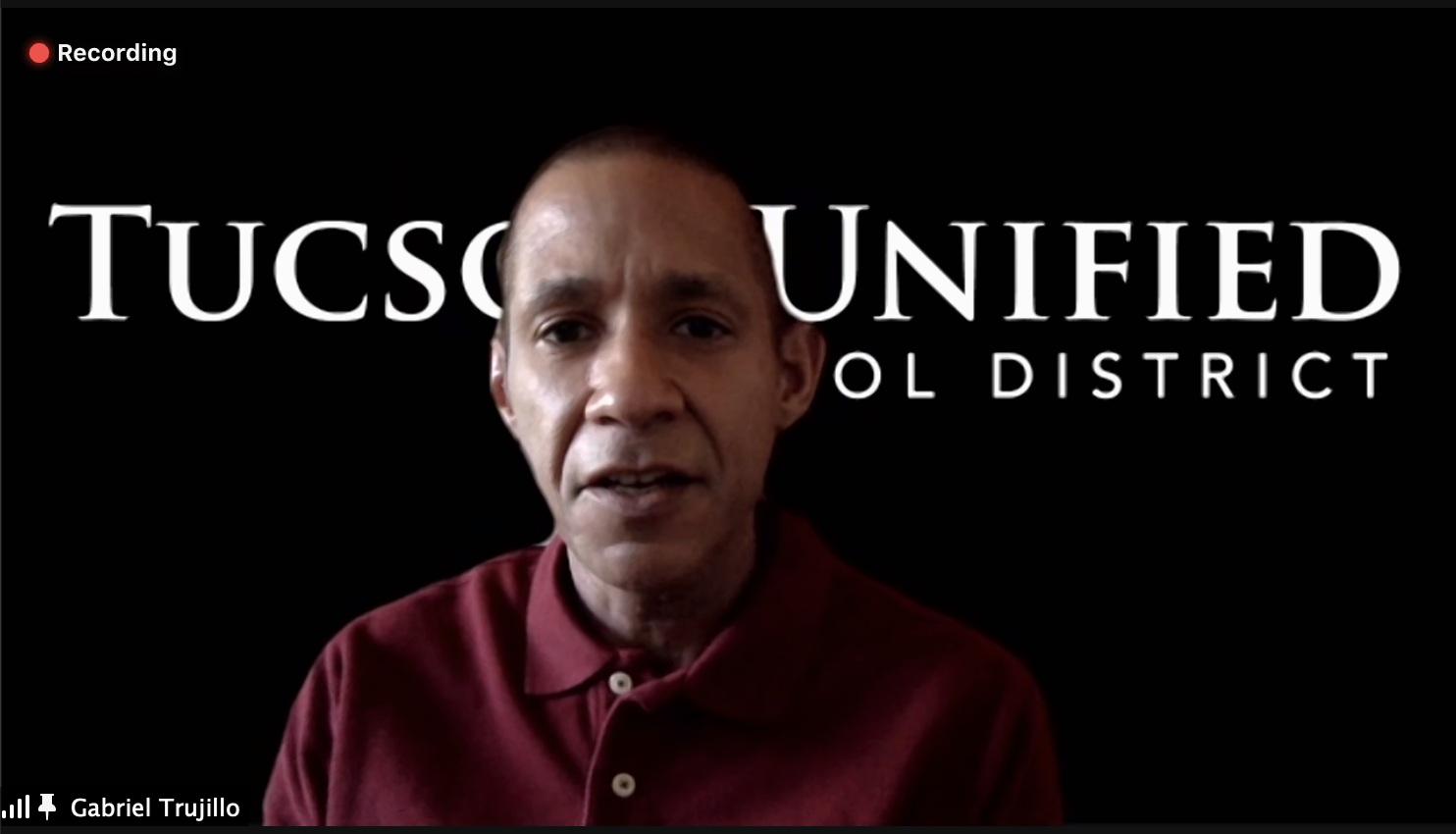
The superintendent of Tucson's largest school district announced it will not be returning to in-person instruction at least through January.
In the meantime, as Pima County is poised to begin administering vaccines to group 1B—which includes teachers—as early as next week, Tucson Unified School District is gearing up to help vaccinate its staff.
The county will set up a “supersite model” of six or seven vaccination centers where all district employees can receive the vaccine, said TUSD Superintendent Dr. Gabriel Trujillo.
On Friday, Jan. 15, a registration website will be set up for employees to make an appointment to receive a vaccination at one of the vaccine sites and schedule an appointment for a second dose 28 days later, he said. He made clear, however, that no employee will be mandated to receive the vaccine.
“We believe that it's our responsibility to create the conditions, create the opportunities for employees who want to go get the vaccine of their own free will and their own accord,” Trujillo said. “We will be creating conditions internally that will make it as easy as possible for an employee to choose to go get the vaccine.”
Some TUSD employees have already been vaccinated in their capacity as nurses, health assistants, athletic trainers, occupational therapists, speech therapists and language therapists that qualified under group 1A of vaccine recipients.
However, Trujillo noted, many who didn’t qualify also received the vaccine.

The Small Business Administration and the U.S. Department of the Treasury recently announced a second round of Paycheck Protection Program loans will begin for new and certain existing borrowers later this month.
The First Draw of PPP loans will be distributed to qualifying borrowers through community financial institutions on Monday, Jan. 11, with the Second Draw on Wednesday, Jan. 13. All participating lenders will have access to the PPP shortly after, according to a statement released by the SBA on Friday, Jan. 8.
“The historically successful Paycheck Protection Program served as an economic lifeline to millions of small businesses and their employees when they needed it most,” said SBA administrator Jovita Carranza. “Today’s guidance builds on the success of the program and adapts to the changing needs of small business owners by providing targeted relief and a simpler forgiveness process to ensure their path to recovery.”
The SBA also updated PPP guidance for potential borrowers as a part of the Economic Aid to Hard-Hit Small Businesses, Non-Profits and Venues Act.
Major updates include:
PPP borrowers can set their PPP loan’s covered period to be any length between eight and 24 weeks to best meet their business needs;
PPP loans will cover additional expenses, including operations expenditures, property damage costs, supplier costs and worker protection expenditures;
The Program’s eligibility is expanded to include 501(c)(6)s, housing cooperatives, direct marketing organizations and other types of organizations;
The PPP provides greater flexibility for seasonal employees;
Certain existing PPP borrowers can request to modify their First Draw PPP Loan amount;
Certain existing PPP borrowers are now eligible to apply for a Second Draw PPP Loan.
Borrowers could be eligible for a Second Draw PPP Loan if they:
Previously received a First Draw PPP Loan and will or have used the full amount only for authorized uses;
Have no more than 300 employees;
Can demonstrate at least a 25% reduction in gross receipts between comparable quarters in 2019 and 2020.
Businesses are encouraged to contact their financial lender or banking institution to see if they qualify.
For more information about the second round of PPP loans, visit sba.gov/ppp or treasury.gov/cares.
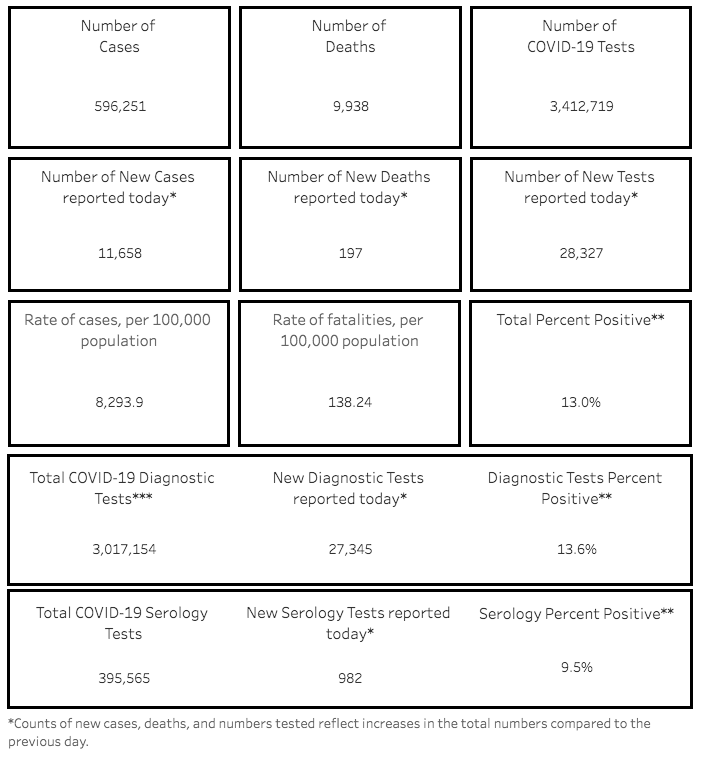
With more than 9,900 new cases reported today, the number of Arizona’s confirmed novel coronavirus cases topped 596,000 as of Friday, Jan 8, according to the Arizona Department of Health Services.

Pima County, which reported 1,336 new cases today, has seen 79,190 of the state’s 596,251 confirmed cases.
A total of 9,938 Arizonans have died after contracting COVID-19, including 1,216 deaths in Pima County, according to the Jan. 8 report.
The number of hospitalized COVID cases statewide continues to soar as the virus has begun to spread more rapidly, putting stress on Arizona’s hospitals and surpassing July peaks. ADHS reported that as of Jan. 7, 4,907 COVID patients were hospitalized in the state, a slight drop from yesterday’s record 4,920. The summer peak of 3,517 hospitalized COVID patients was set on July 13; that number hit a subsequent low of 468 on Sept. 27, or less than a tenth of the current count.
A total of 2,188 people visited emergency rooms on Jan. 7 with COVID symptoms, down from the record high of 2,341 set on Tuesday, Dec. 29. That number had previously peaked at 2,008 on July 7; it hit a subsequent low of 653 on Sept. 28.
A record number of 1,122 COVID-19 patients were in intensive care unit beds on Jan. 7. The summer’s record number of patients in ICU beds was 970, set on July 13. The subsequent low was 114 on Sept. 22.
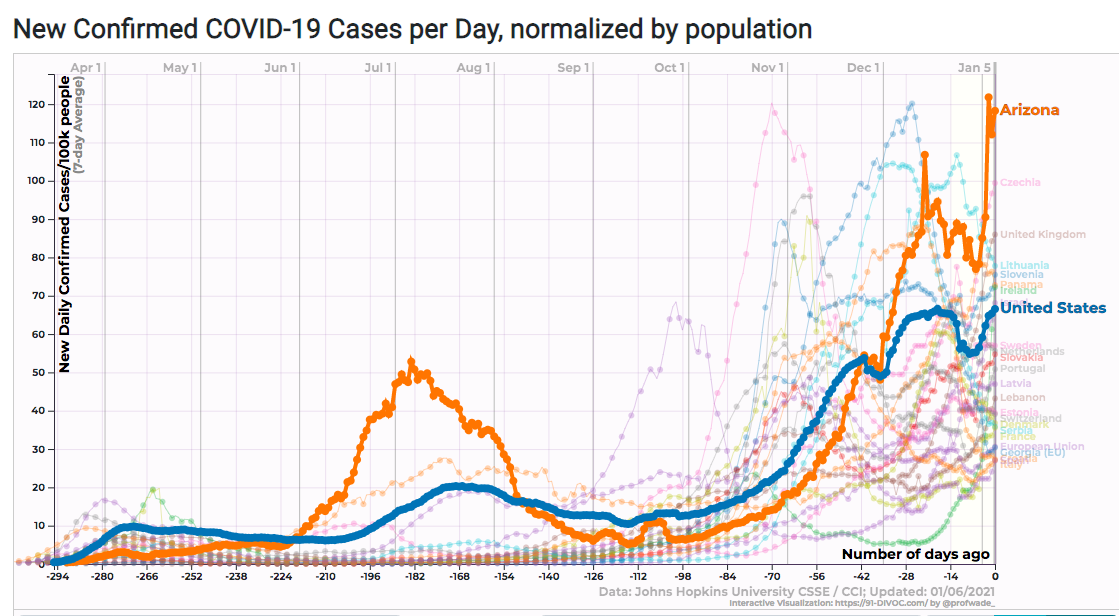
A website that tracks COVID infections across the globe reports that Arizona continues to have the highest rate of COVID infection in the world.
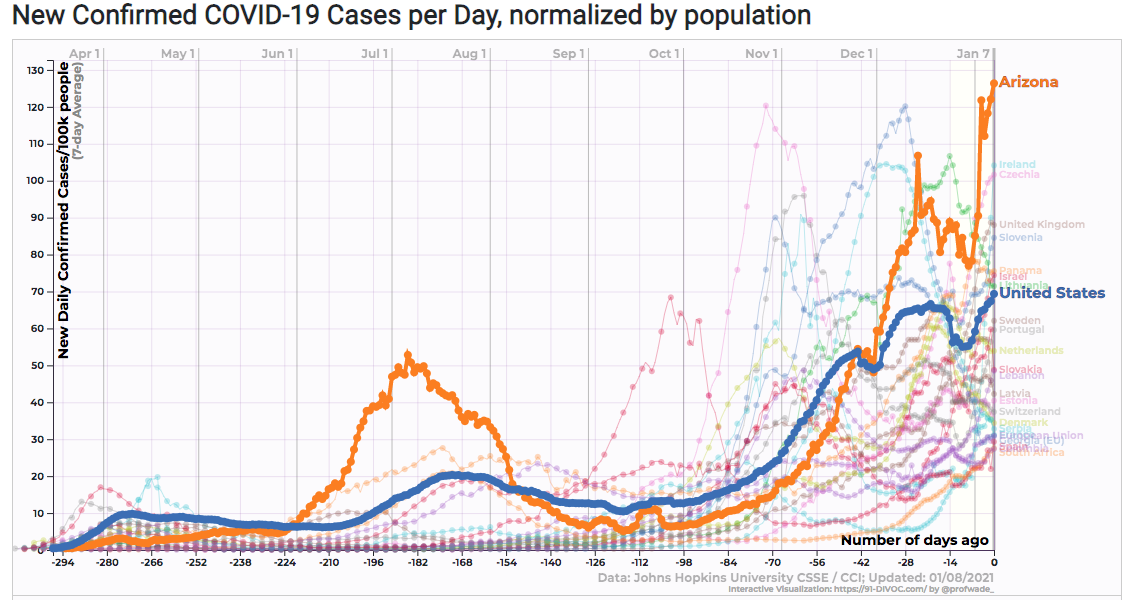
The website 91-divoc.com, which uses data from Johns Hopkins University, reports that Arizona is seeing a record 126.4 infections per 100,000 people on a seven-day average, compared to 69.3 infections per 100,000 for the United States as a whole.
Bars sue over Pima County curfew
Several Tucson-based bars and restaurants have filed litigation against Pima County in attempts to overturn its mandatory 10 p.m. to 5 a.m. curfew they say disproportionately affects the private sector of businesses that depend on revenue from operations during these hours.
Owners of Cobra Arcade Bar, HighWire Lounge and The Maverick have joined in a lawsuit against Pima County and several county representatives they say are responsible for the curfew passed Dec. 15, including County Administrator Chuck Huckelberry and the board of supervisors who voted 3-2 to instate it.
Huckelberry proposed the curfew as the coronavirus pandemic continued to set records for both infections and deaths, which have been far surpassed since the beginning of December.
Thursday, January 7, 2021
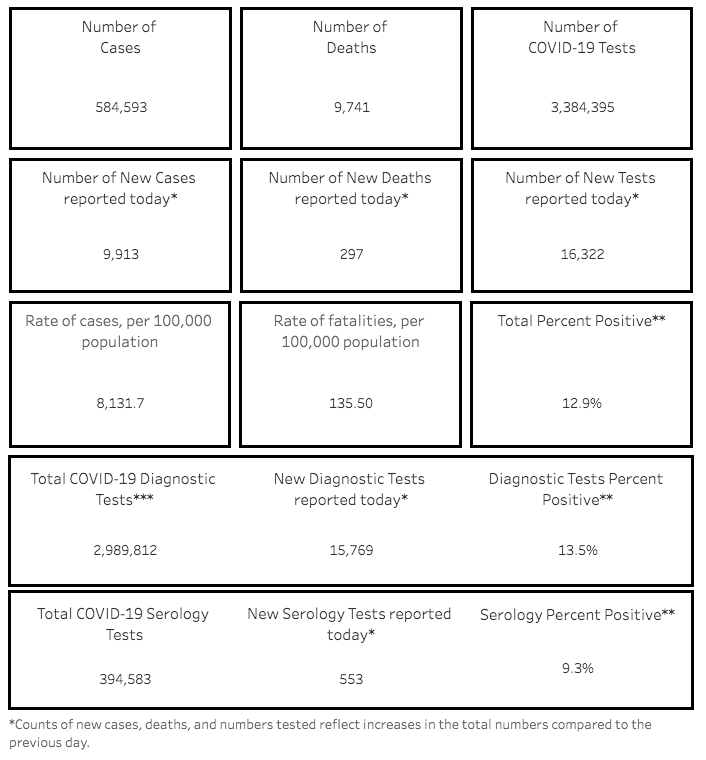
With more than 9,900 new cases reported today, the number of Arizona’s confirmed novel coronavirus cases topped 584,000 as of Thursday, Jan 7, according to the Arizona Department of Health Services.

Pima County, which reported 1,611 new cases today, has seen 77,854 of the state’s 584,593 confirmed cases.
A total of 9,741 Arizonans have died after contracting COVID-19, including 1,189 deaths in Pima County, according to the Jan. 7 report.
The number of hospitalized COVID cases statewide continues to soar as the virus has begun to spread more rapidly, putting stress on Arizona’s hospitals and surpassing July peaks. ADHS reported that as of Jan. 6, a record 4,920 COVID patients were hospitalized in the state. The summer peak of 3,517 hospitalized COVID patients was set on July 13; that number hit a subsequent low of 468 on Sept. 27, or less than a tenth of the current count.
A total of 2,280 people visited emergency rooms on Jan. 6 with COVID symptoms, down from the record high of 2,341 set on Tuesday, Dec. 29. That number had previously peaked at 2,008 on July 7; it hit a subsequent low of 653 on Sept. 28.
A total of 1,001 COVID-19 patients were in intensive care unit beds on Jan. 6. The summer’s record number of patients in ICU beds was 970, set on July 13. The subsequent low was 114 on Sept. 22.
A website that tracks COVID infections across the globe reports that Arizona continues to have the highest rate of COVID infection in the world.
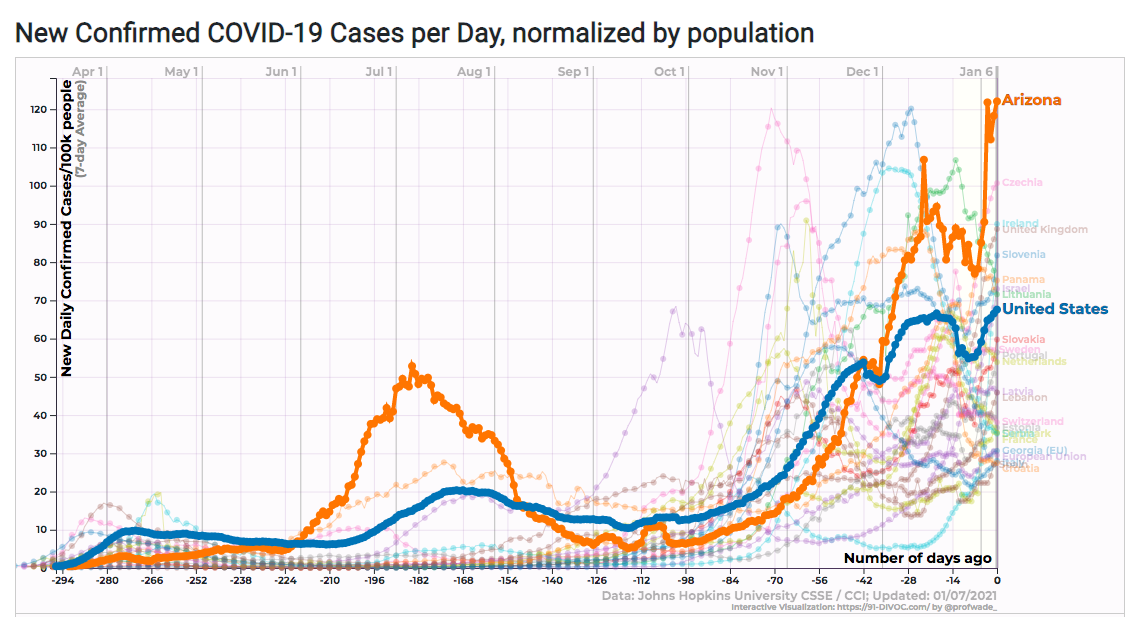
The website 91-divoc.com, which uses data from Johns Hopkins University, reports that Arizona is seeing 122.1 infections per 100,000 people on a seven-day average, compared to 67.6 infections per 100,000 for the United States as a whole.
Progress on vaccine distribution in Pima County
As early as next week, the groups of essential workers and those older than 75 included in the next phase of Pima County’s vaccine distribution plan may have access to the COVID-19 vaccine, the Pima County Health Department announced at a press conference this week.
Wednesday, January 6, 2021
For Arizona’s students, 2020’s winter break is over, but the alarming spread of COVID-19 remains. As a result, students are returning to school this January predominantly in remote online models.
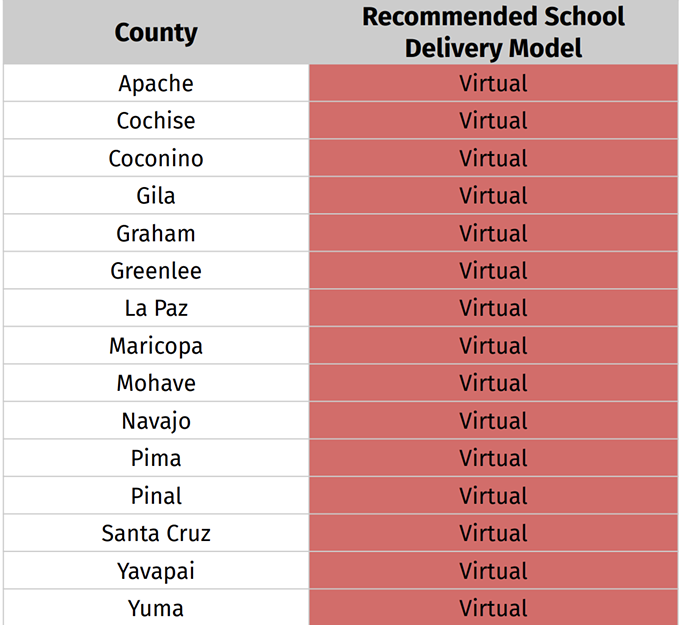
The Arizona Department of Health Services is recommending all counties in the state commit to virtual learning for students to attend classes online with some onsite support services available.
ADHS makes its recommendation based on three key benchmarks: cases per 100,000 individuals, percent positivity and hospital visits for COVID-like illness. All benchmarks are currently in a state of substantial transmission throughout the state.
In Pima County, ADHS data shows 7,298 COVID-19 cases per 100,000 individuals and an 11.2% positivity rate of the virus as of Jan. 6. The most recent data available on the state health department’s school benchmarks website shows hospital visits for COVID-like illnesses at 13.2% as of Dec. 13.
On Twitter, State Superintendent Kathy Hoffman called on Gov. Doug Ducey to order schools to remain in distanced learning for two weeks and allow school leaders to make reopening decisions after this two-week quarantine.
Given the severity of our state's situation and the virus's trajectory after the holiday period, Gov. @dougducey should order schools to remain in distance learning for a limited two-week period to align with quarantine protocols and current @azdhs benchmark recommendations.
— Kathy Hoffman (@Supt_Hoffman) January 2, 2021
The governor’s spokesman, C.J. Karamargin, made clear Ducey will not be issuing the mandatory two-week quarantine for schools.
“Gov. Ducey will not be considering this request or issuing this kind of mandate," Karamargin said. "This is a local decision.”
Of the local public school districts in northwest Tucson, only Catalina Foothills remains open for in-person instruction.
Amphitheater Public Schools
Amphitheater schools returned to classes online only Monday and anticipate staying in a remote model until at least Jan. 19. According to the district’s Communications Director Michelle Valenzuela, Amphi will continue to work with Pima County on its recommendation for schools’ learning models.
Students are expected to participate in remote learning five full days a week and interact with their teachers live at designated times in addition to participating in offline tasks.
Valenzuela says the district has been working with the Amphi Foundation to provide internet service to students in need of it through partnerships with Cox and Comcast. Around 60 families have been provided Wi-Fi, and according to Valenzuela, the district plans to provide more services to families through a partnership with the City of Tucson in the coming weeks.
Teachers are also working with students without internet access to provide them paper packets that contain enough material for the entire academic week. Teachers will be in regular contact with offline students “to provide feedback and support,” according to Amphi’s website.
Catalina Foothills
Catalina Foothills is one of the only local public school districts to remain open for in-person learning after returning from winter break. According to Director of Alumni and Community Relations Julie Farbarik, the decision to remain open was based on the district’s relatively low case counts.
Since Nov. 20, the district has reported 27 new COVID-19 cases throughout its school sites.
“Keeping schools open is important to our students’ social-emotional well-being and their overall academic engagement,” Farbarik wrote in an email. “In their December communication to superintendents, the PCHD made it clear that it supports each school district’s decision based on its local COVID case experience. The numbers at our schools are very low, so we are continuing to offer an in-person learning option.”
Of the district’s seven K-12 schools, two elementary schools began offering five-day in-person instruction starting Jan. 4. The other five offer hybrid learning with two days of in-person learning and three days of remote work. All schools are offering a completely remote option.
Although Catalina Foothills doesn’t have any direct services for students without internet access, students can access its onsite support service for access to Chromebooks, laptops or Wi-Fi, depending on availability.
Flowing Wells Unified School District
Flowing Wells has returned to school remotely, but anticipates reinstating their hybrid option on Jan. 19. However, Superintendent David Baker said this may change in the future. Remote work entails daily scheduled classes via Zoom.
According to Baker, the district provided over 400 hot spots to provide internet to students at home while nearly 100 students come to campus through on-site services to access the internet.
The Emily Meschter Early Learning Center, the district’s preschool, remains open for in-person learning with a remote option. Most students attend four half days a week, Baker said.
“In all reviewed studies and articles, preschool students and pre-schools have very low virus transmission rates and that has proved to be true at our site this school year. Pima County Health has also communicated that preschools and early childhood care facilities across the county have remained opened with very low classroom transmission,” Baker said in an email. “There are also many educational benefits for students to participate in classroom instruction, as compared to virtual learning.”
Marana Unified School District
The Marana district plans on returning to hybrid instruction on Jan. 25 while monitoring public health metrics from the Pima County Health Department, according to Director of Public Relations and Community Engagement Alli Benjamin.
Every student has been issued a Chromebook laptop while remote learning takes place five full days a week with both live teacher-led lessons and independent learning.
According to Benjamin, the district has struggled to locate and purchase Wi-Fi hotspots, but Marana has a limited number of hotspots they’re issuing to families in need. Parents can also apply for students to attend the district’s onsite services for internet access.
Sunnyside Unified School District
Sunnyside schools will be in a remote learning model until Jan. 19. Hybrid learning will commence unless the Pima County Health Department makes the recommendation to stay remote before Jan. 19.
Students are expected to log into their devices to interact with teachers at least three times a day. Kindergarten through first-grade students are provided iPads while second through twelve graders are assigned Chromebooks for participation in remote learning.
Students without internet access are being provided with mobile Wi-Fi devices, according to Sunnyside’s Director of Public Information Marisela Felix. Felix said Sunnyside families can also qualify for a low-cost internet program through Cox.
Tucson Unified School District
Tucson’s largest school district is remaining in a remote-only model as it transitions to 2021. All curriculums can be accessed online through live lessons with teachers and independent work on online educational platforms. Unlike other local districts, TUSD never reopened for in-person instruction during the fall semester.
TUSD has in-person learning spaces where students can access classes online while socially distanced at school sites. According to Leslie Lenhart, TUSD’s director of communications and media relations, there’s no set limit on the number of students attending the learning spaces, but they’re reserved for “at-risk” and “exceptional education” students.
The district doesn’t have an anticipated start date to move to in-person learning.
“The Governing Board will be a part of this decision, but no details are currently available, as we follow the science and the guidelines of PCHD,” Lenhart wrote in an email.
Lenhart said TUSD will provide a free hotspot for internet connection for any family in need of one.

As the second round of Economic Stimulus Payments begins hitting bank accounts and mailboxes nationwide during the first week of 2021, many Americans will have to wait until they file their 2020 tax return to claim their cash.
Funds officially became available on Monday, Jan. 4, with some taxpayers receiving their payment the week prior. However, many Americans who filed their 2019 tax return using H&R Block or TurboTax are complaining of either getting a cryptic “Payment Status #2” message or their funds were sent to an unknown bank account.
The Internal Revenue Service announced on their website taxpayers who are receiving a “Payment Status #2 – Not Available," message when using the IRS’ Get My Payment tool “will not receive a second Economic Impact Payment and instead you need to claim the Recovery Rebate Credit on your 2020 Tax Return."
IRS officials note the recent stimulus payment is an advance on the Recovery Rebate Credit and they are under a “compressed timeline” to distribute funds by Jan. 15.
“Because of the speed at which the law required the IRS to issue the second round of Economic Impact Payments, some payments may have been sent to an account that may be closed or, is or no longer active, or unfamiliar. By law, the financial institution must return the payment to the IRS; they cannot hold and issue the payment to an individual when the account is no longer active,” according to the IRS website.
The credit will be available on this year’s Form 1040 or Form 1040-SR. Any taxpayer who filed their 2019 taxes and did not receive either the first or second stimulus payment may be eligible and is encouraged by the IRS to claim the credit on their upcoming 2020 taxes.
While the IRS has not released an official date on when they will begin accepting 2021 tax returns, historically they start accepting them between Jan. 15 and Feb. 1.
Under the recent Economic Stimulus Payment, individuals are eligible for $600 and married couples who file a joint return will receive $1,200. In addition, citizens could receive an extra $600 for each qualifying child. Dependents over the age of 17 are not eligible for the child payment. Individuals who filed an adjusted gross income of more than $75,000 or married couples who made more than $150,000 in 2019 are ineligible for the payment.
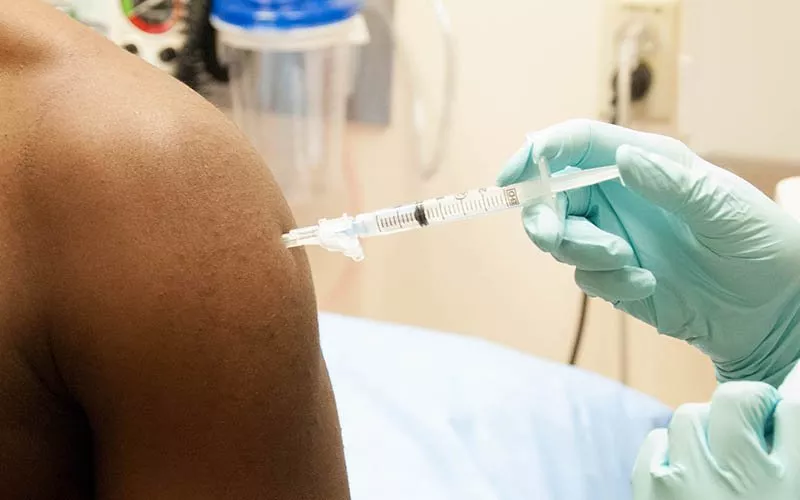
As early as next week, the groups of essential workers and those older than 75 included in the next phase of Pima County’s vaccine distribution plan may have access to the COVID-19 vaccine, the Pima County Health Department announced at a press conference yesterday.
Pima County Chief Medical Officer Dr. Francisco Garcia said the county anticipates rolling out phase 1B of vaccinations at the end of next week.
Phase 1B includes the vaccination of prioritized essential workers in education and protective services, essential workers in fields like transportation and government, adults in congregate settings with high-risk medical conditions and individuals over 75.
Those who qualify in phase 1B can pre-register here.
Every county in Arizona except Pinal and Gila is currently in phase 1A of the vaccination process, which includes healthcare workers, emergency medical service workers, and residents and staff of long-term care facilities.
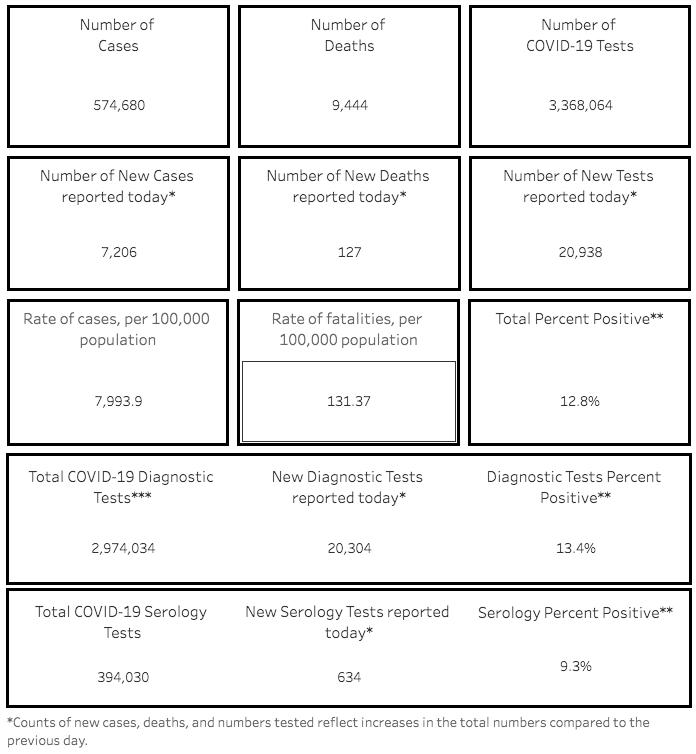
With more than 7,200 new cases reported today, the number of Arizona’s confirmed novel coronavirus cases closed in on 575,000 as of Wednesday, Jan 6, according to the Arizona Department of Health Services.

Pima County, which reported 659 new cases today, has seen 76,243 of the state’s 574,680 confirmed cases.
A total of 9,444 Arizonans have died after contracting COVID-19, including 1,142 deaths in Pima County, according to the Jan. 6 report.
The number of hospitalized COVID cases statewide continues to soar as the virus has begun to spread more rapidly, putting stress on Arizona’s hospitals and surpassing July peaks. ADHS reported that as of Jan. 5, a record 4,877 COVID patients were hospitalized in the state. The summer peak of 3,517 hospitalized COVID patients was set on July 13; that number hit a subsequent low of 468 on Sept. 27, or less than a tenth of the current count.
A total of 2,253 people visited emergency rooms on Jan. 5 with COVID symptoms, down from the record high of 2,341 set on Tuesday, Dec. 29. That number had previously peaked at 2,008 on July 7; it hit a subsequent low of 653 on Sept. 28.
A total of 1,084 COVID-19 patients were in intensive care unit beds on Jan. 5. The summer’s record number of patients in ICU beds was 970, set on July 13. The subsequent low was 114 on Sept. 22.
A website that tracks COVID infections across the globe reports that Arizona now has highest rate of COVID infection in the world.
The website 91-divoc.com, which uses data from Johns Hopkins University, reports that Arizona is seeing 118.3 infections per 100,000 people on a seven-day average, compared to 66.5 infections per 100,000 for the United States as a whole.
The Pima County Health Department reported yesterday that the number of COVID-positive patients in Pima County hospitals jumped by 7 percent to 746. Only 10 ICU beds remained available and only 59 medical/surgical beds were available throughout the county.
A total of 80 people in Pima County hospitals had died in the first five days of 2021, according to PCHD.
As of yesterday morning, 95 patients were waiting in emergency rooms for an inpatient bed, including 64 COVID-positive patients.
The health department continues to ask residents to stay home and minimize activities that involve contact with people outside of their households, stay physically distanced and practice mask-wearing and frequent sanitization.
Tuesday, January 5, 2021
PHOENIX – Arizona State swim coach Bob Bowman has faced many challenges throughout a nearly 35-year-long coaching career, a portion of it guiding Michael Phelps, the most decorated Olympian.
However, Bowman never had to navigate the postponement of the Olympic Games and all of the potential ramifications of the delay.
Welcome to sports in the COVID-19 era.
When the International Olympic Committee announced in March that it was postponing the 2020 Tokyo Olympic Games, which were to take place July 24-Aug.9, because of the global pandemic, it left Olympic hopefuls and their coaches searching for the best ways to proceed with training.
The Games are now scheduled to unfold from July 23-Aug. 8, 2021.
Olympians face enough challenges while training to arrive at the Summer Games in top form, even without the added obstacle of a postponement. There is little precedent for them to know how to prepare for an event they have worked toward for four years when their plan is suddenly pushed forward a year and at a time when people are discouraged from gathering.

