

Monday, December 28, 2020
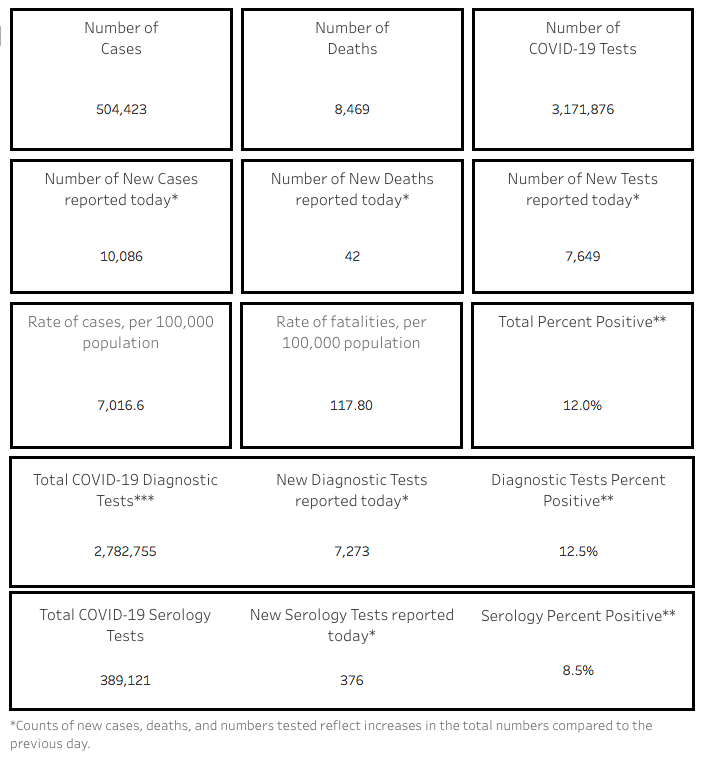
With more than 10,000 new cases reported today, the number of Arizona’s confirmed novel coronavirus cases topped a half-million as of Monday, Dec. 28, according to the Arizona Department of Health Services.

Pima County, which reported 1,313 new cases today, has seen 67,360 of the state’s 504,423 confirmed cases.
A total of 8,469 Arizonans have died after contracting COVID-19, including 983 deaths in Pima County, according to the Dec. 28 report.
The number of hospitalized COVID cases statewide continues to soar as the virus has begun to spread more rapidly, putting stress on Arizona’s hospitals and surpassing July peaks. ADHS reported that as of Dec. 27, a record 4,390 COVID patients were hospitalized in the state. The summer peak of 3,517 hospitalized COVID patients was set on July 13; that number hit a subsequent low of 468 on Sept. 27.
A total of 1,877 people visited emergency rooms on Dec. 27 with COVID symptoms. That number, which hit a new record of 2,166 earlier this month, had previously peaked at 2,008 on July 7; it hit a subsequent low of 653 on Sept. 28.
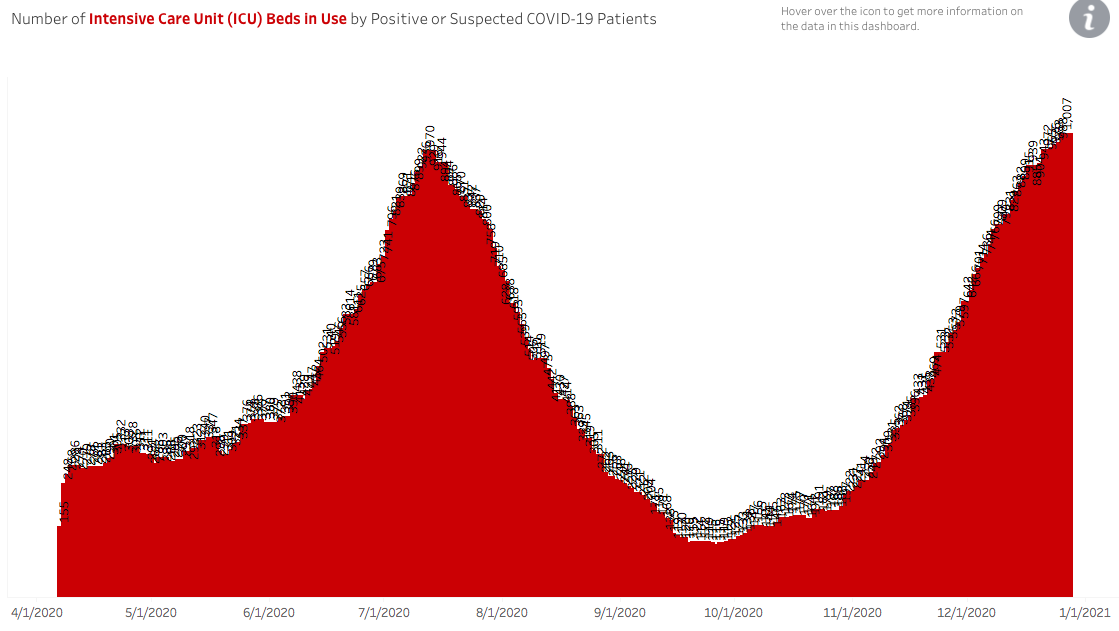
A total of 1,007 COVID-19 patients were in intensive care unit beds on Dec. 27, breaking the 1,000 threshold for the first time. The summer’s record number of patients was 970, set on July 13. The subsequent low was 114 on Sept. 22.
Healthcare leaders continue to plead with public to stay home as much as possible as healthcare system is overloaded
Arizona’s largest hospital system continues to experience record occupancy levels and overflowing morgues, resulting in bodies being stored in refrigerated trucks.
Banner Health’s Chief Clinical Officer Dr. Marjorie Bessel shared in a press conference last week that 58% of the hospitals’ adult ICU beds and 74% of its ventilators are being used by COVID-19 patients.
Compared to a pandemic-free winter season, Banner hospitals are seeing 160% of their peak winter occupancy.
As more patients die from COVID-19, Bessel said Banner hospitals are seeing two to three times more bodies than they typically store in their morgues, causing some hospitals to place bodies in refrigerated trucks.
According to Bessel, nearly half of their deceased patients died from coronavirus.
Bessel said Banner expects the peak of the current COVID-19 surge to hit in early to mid-January.
“The biggest concerns as we go into that significant surge and experience that post-holidays in January will be continued strain on our health care system,” Bessel said. “We've had to take steps to reduce or stop elective surgeries and procedures. These are patients that need these procedures. In addition to that, as we have significant more surge forecasted to happen in January, it will cause additional strain on our staffing.”
Thursday, December 24, 2020
Arizona in Focus is a podcast from Cronkite News, the news division of Arizona PBS. This season we are focusing on science and technology stories that explore everything from driverless cars to innovating a vaccine during the pandemic.
PHOENIX – Paulina Ochoa never had a problem sleeping until the COVID-19 pandemic began in March and life dealt her a series of serious setbacks. She lost both her jobs, her car was stolen and her aunt died – and that’s when the nightmares started. The dreams got so bad they sometimes left her paralyzed in bed.
Ochoa isn’t alone. A sleep study conducted by University of Arizona researchers monitored the role of insomnia during the pandemic, and more than 50% of 1,000 participants reported experiencing insomnia.
Listen to the full podcast here.
Ochoa, a sustainability student at Arizona State University, tried to wear herself out by staying up until 7 a.m. so she’d be forced to finally fall asleep.
Insomnia eventually made her imagine hearing voices or see unsettling shadows.
“I was just so scared, you know? I had two occasions where the ‘voices’ thing started happening,” Ochoa said. “I just didn’t even want to close my eyes.”
Michael Grandner, who runs the Sleep and Health Research Program in the Unversity of Arizona’s Department of Psychiatry, said he has seen a great number of people with sleep problems this year.
“With everything going on during the day, they have a real hard time disconnecting,” he said.
Grandner, who also sees patients at the Behavioral Sleep Medicine Clinic at Banner Health, said insomnia occurs on a spectrum.
“So there’s insomnia, I would say with a lowercase ‘i’, which is just sort of the experience of being unable to sleep sometimes,” he said, adding that many people deal with insomnia at some point in their life.
“Then there’s the line into what we call insomnia disorder, which is actually a diagnosable medical condition that usually does not go away on its own once you meet criteria for it.”
Grandner said if it takes more than 30 minutes to fall asleep for at least three nights a week, and if the pattern has been ongoing for months, you may have insomnia.
Lauri Leadley, president of Valley Sleep Center, a company with several locations in metro Phoenix, said stress is a common cause of insomnia.
“Insomnia is literally the inability to escape your thoughts. And during stressful times, our bodies create cortisol … our ‘awake’ hormone,” Leadley said.
Unable to escape her stressful and frightening thoughts, Ochoa tried to force herself to exhaustion. But even when she finally fell asleep, she said, nightmares would jolt her awake.
Nightmares can do double damage, said Denise Rodriguez, a clinical psychologist who specializes in behavioral sleep medicine to treat insomnia at Banner Health.
“Typically, for a lot of folks who do struggle with nightmare disorders, it’s not just that they’re having a nightmare, but that the nightmare prevents them from going back to sleep,” Rodriguez said.
After losing two jobs and switching to online learning at ASU, Ochoa’s daily routine became less active. Rodriguez said that could cause an increase in dreaming.
“Some of the theories behind why we’re dreaming more is that we’re under-stimulated during our day … and so our brain is trying to give us that extra stimulation at night,” Rodriguez said.
Grandner said inactivity during the day is a common denominator in people with insomnia.
“Sleep difficulties are probably the most reliable predictor of poor mental health,” he said, “and especially in terms of depression and anxiety.”
Poor sleep and suicide rates are directly correlated, Grandner said.
“There have been over 50 studies now that when you pool them together, people who have significant sleep problems, whether it’s nightmares or insomnia, are about three times as likely to be thinking about suicide,” he said.
Ochoa said she was already experiencing stress and anxiety in daily life, which insomnia only made worse. Then, in June, Ochoa tested positive for COVID-19.
“So I was still having trouble sleeping and now I had the added factor of like, (I) can’t breathe right,” she said.
Insomnia can significantly increase the chances of getting sick, Grandner said.
“If you want to have a robust immune system,” he said, “it’s important to sleep. There’s data that shows that people who aren’t getting enough sleep, they’re more likely to get sick, especially for viral infections.”
To get better sleep, Grander suggests reducing screen time, getting sunlight exposure shortly after waking up and exercising during the day rather than at night.
Sleep is programmable, he said, and it’s important to train the brain that the bed is meant for sleep, not for rehashing the day or planning the next.
Before getting in bed, he said, “Check your schedule, process all the stuff that you need to process so that by the time you get into bed, you’ve already done all that work.”
Ochoa took a different approach.
“I actually kind of got it solved. I actually had to go ahead and resolve to getting a blessing from this church,” she said. Her visit to the church was just over two months ago.
The blessing consisted of two missionaries applying oil to her forehead, placing their hands on her head and praying.
“All of a sudden, I could sleep,” she said. “And I think maybe it was just like a mental thing. You know, maybe it was just my fears and anxiety.”
So far, Ochoa said, she’s having fewer nightmares and sleeping much better.
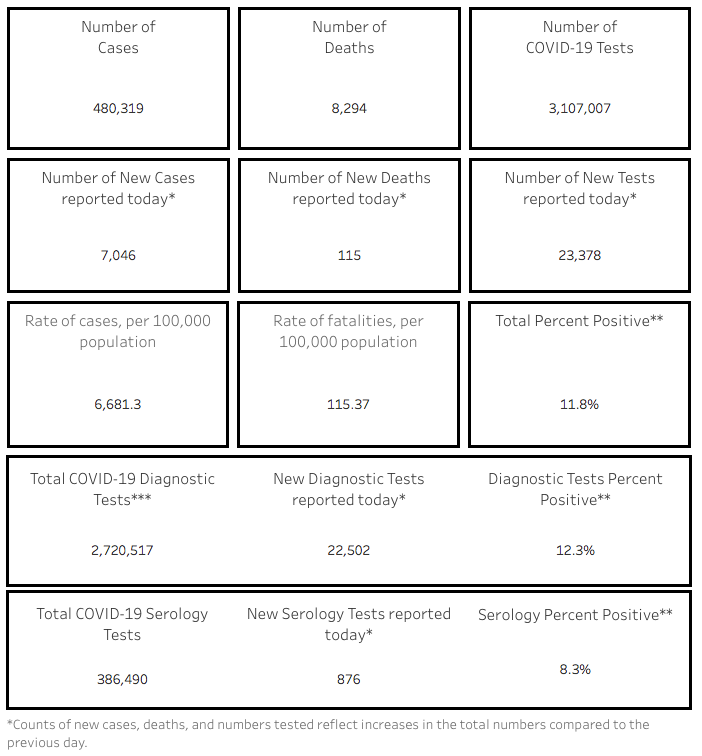
With more than 7,000 new cases reported today, the number of Arizona’s confirmed novel coronavirus cases now stands higher than 480,000 as of Thursday, Dec. 24, according to the Arizona Department of Health Services.

Pima County, which reported 1,313 new cases today, has seen 63,472 of the state’s 480,319 confirmed cases.
A total of 8,294 Arizonans have died after contracting COVID-19, including 962 deaths in Pima County, according to the Dec. 24 report.
The number of hospitalized COVID cases statewide continues to soar as the virus has begun to spread more rapidly, putting stress on Arizona’s hospitals and surpassing July peaks. ADHS reported that as of Dec. 23, a record 4,221 COVID patients were hospitalized in the state. The summer peak of 3,517 hospitalized COVID patients was set on July 13; that number hit a subsequent low of 468 on Sept. 27.
A total of 1,965 people visited emergency rooms on Dec. 23 with COVID symptoms. That number, which hit a new record of 2,166 earlier this month, had previously peaked at 2,008 on July 7; it hit a subsequent low of 653 on Sept. 28.
A total of 965 COVID-19 patients were in intensive care unit beds on Dec. 23. That’s a slight dip from the 972 COVID patients who were in ICU yesterday, breaking the previous high of 970 on July 13. The subsequent low was 114 on Sept. 22.
Healthcare leaders continue to plead with public to stay home as much as possible as healthcare system is overloaded
Arizona’s largest hospital system continues to experience record occupancy levels and overflowing morgues, resulting in bodies being stored in refrigerated trucks.
Banner Health’s Chief Clinical Officer Dr. Marjorie Bessel shared in a press conference yesterday that 58% of the hospitals’ adult ICU beds and 74% of its ventilators are being used by COVID-19 patients.
Compared to a pandemic-free winter season, Banner hospitals are seeing 160% of their peak winter occupancy.
As more patients die from COVID-19, Bessel said Banner hospitals are seeing two to three times more bodies than they typically store in their morgues, causing some hospitals to place bodies in refrigerated trucks.
According to Bessel, nearly half of their deceased patients died from coronavirus.
Bessel said Banner expects the peak of the current COVID-19 surge to hit in early to mid-January.
“The biggest concerns as we go into that significant surge and experience that post-holidays in January will be continued strain on our health care system,” Bessel said. “We've had to take steps to reduce or stop elective surgeries and procedures. These are patients that need these procedures. In addition to that, as we have significant more surge forecasted to happen in January, it will cause additional strain on our staffing.”
Bessel’s warnings come the same week that the Pima County Health Department warned that the healthcare system is in danger of becoming overwhelmed within the next two to three weeks if the spread of COVID-19 continues at its current pace.
According to County Health Director Dr. Theresa Cullen, the county is on track to see more coronavirus infections in December than all previous months of the pandemic combined.
Wednesday, December 23, 2020
Arizona’s largest hospital system continues to experience record occupancy levels and overflowing morgues, resulting in bodies being stored in refrigerated trucks.
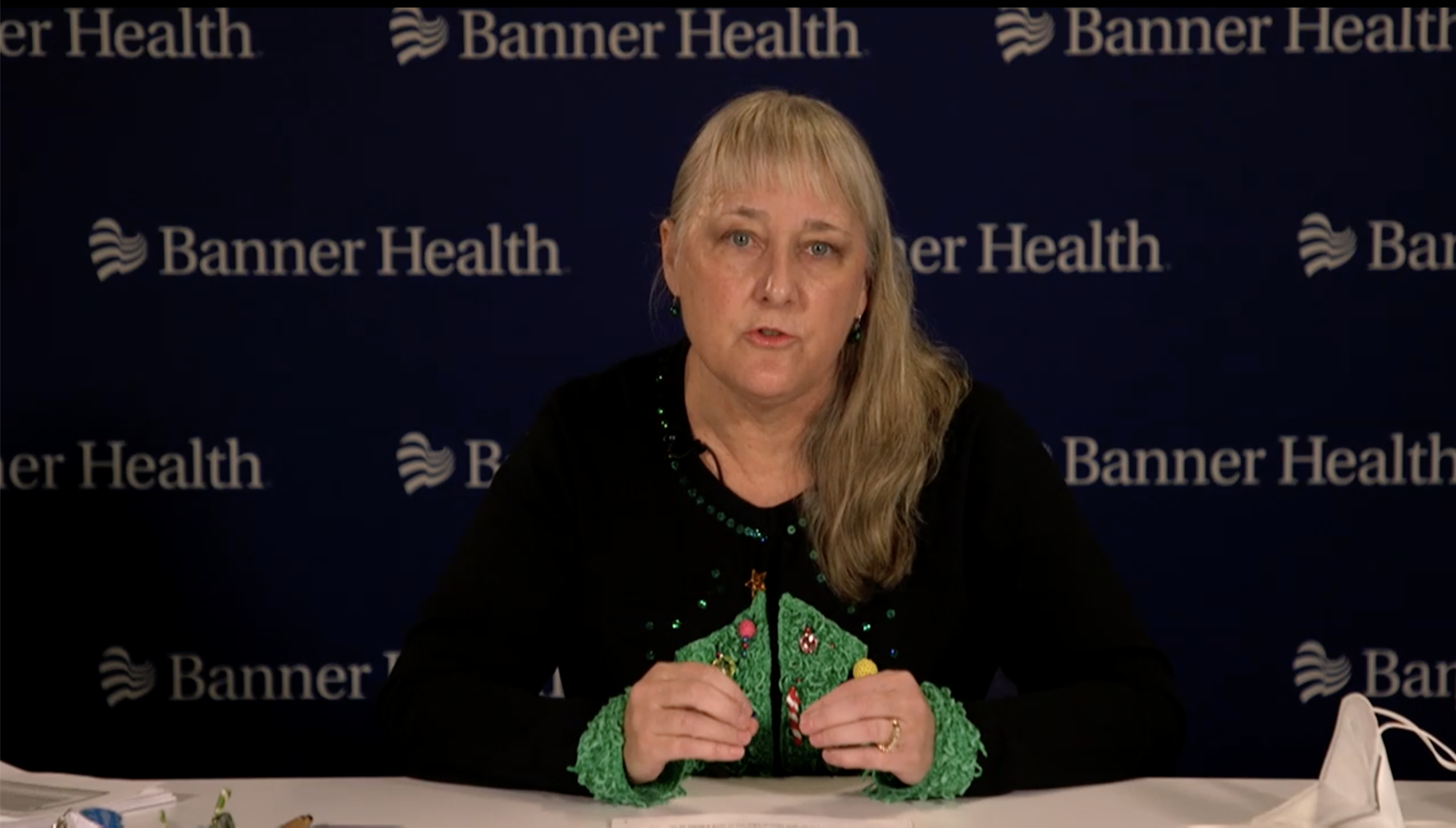
Banner Health’s Chief Clinical Officer Dr. Marjorie Bessel shared in a press conference this morning that 58% of the hospitals’ adult ICU beds and 74% of its ventilators are being used by COVID-19 patients.
Compared to a pandemic-free winter season, Banner hospitals are seeing 160% of their peak winter occupancy.
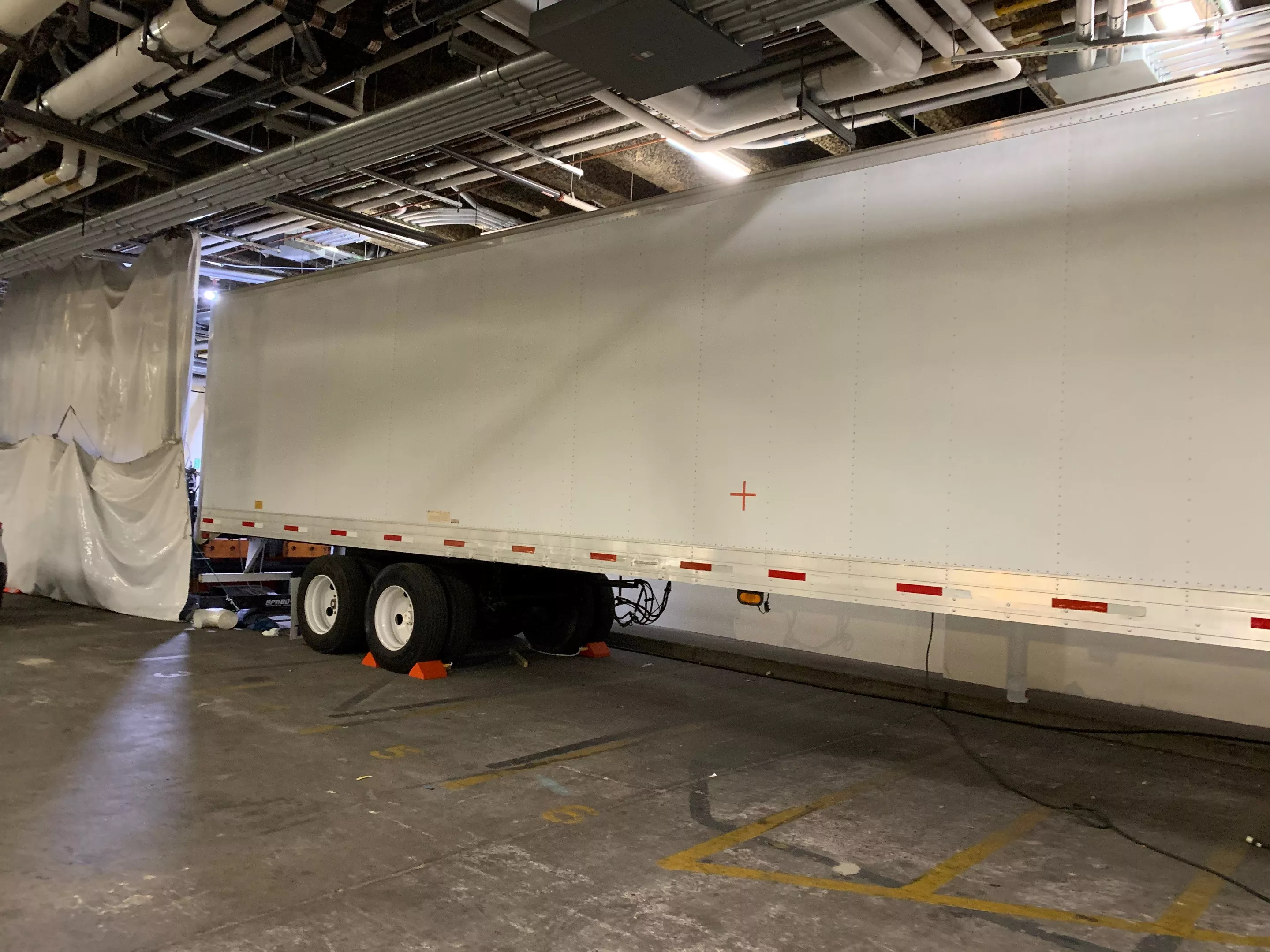
As more patients die from COVID-19, Bessel said Banner hospitals are seeing two to three times more bodies than they typically store in their morgues, causing some hospitals to place bodies in refrigerated trucks.
According to Bessel, nearly half of their deceased patients died from coronavirus.
Dr. Joe Gerald, a professor at the University of Arizona who creates weekly coronavirus epidemiology reports based on ADHS data, estimates by Christmas, Arizona will see more than 500 deaths a week.
With more than 6,058 new cases reported today, the number of Arizona’s confirmed novel coronavirus cases now stands higher than 473,000 as of Wednesday, Dec. 23, according to the Arizona Department of Health Services. Pima County, which reported 815 new cases today, has seen 62,159 of the state’s 473,273 confirmed cases.
A total of 54 Arizonans have died after contracting COVID-19, including 946 deaths in Pima County, according to the Dec. 23 report.
The number of hospitalized COVID cases statewide continues to soar as the virus has begun to spread more rapidly, putting stress on Arizona’s hospitals and surpassing July peaks. ADHS reported that as of Dec. 22, 3,899 COVID patients were hospitalized in the state. The summer peak of 3,517 hospitalized COVID patients was set on July 13; that number hit a subsequent low of 468 on Sept. 27.
A total of 1,961 people visited emergency rooms on Dec. 22 with COVID symptoms. That number, which hit a new record of 2,166 earlier this month, had previously peaked at 2,008 on July 7; it hit a subsequent low of 653 on Sept. 28.
A total of 972 COVID-19 patients were in intensive care unit beds on Dec. 22, breaking the previous high of 970 on July 13. The low was 114 on Sept. 22.

Tuesday, December 22, 2020
With more than 5,800 new cases reported today, the number of Arizona’s confirmed novel coronavirus cases now stands higher than 467,000 as of Tuesday, Dec. 22, according to the Arizona Department of Health Services.
Pima County, which reported 984 new cases today, has seen 61,344 of the state’s 467,215 confirmed cases.
A total of 8,125 Arizonans have died after contracting COVID-19, including 938 deaths in Pima County, according to the Dec. 22 report.
The number of hospitalized COVID cases statewide continues to soar as the virus has begun to spread more rapidly, putting stress on Arizona’s hospitals and surpassing July peaks. ADHS reported that as of Dec. 21, a record number of 4,019 COVID patients were hospitalized in the state. The summer peak of 3,517 hospitalized COVID patients was set on July 13; that number hit a subsequent low of 468 on Sept. 27.
A total of 1,817 people visited emergency rooms on Dec. 21 with COVID symptoms. That number, which hit a new record of 2,166 earlier this month, had previously peaked at 2,008 on July 7; it hit a subsequent low of 653 on Sept. 28.
A total of 943 COVID-19 patients were in intensive care unit beds on Dec. 21. The number of COVID patients in ICUs peaked at 970 on July 13 and hit a subsequent low of 114 on Sept. 22.
Healthcare system on the edge of being “overwhelmed”
In a new public health advisory, the Pima County Health Department warned yesterday that the healthcare system is in danger of becoming overwhelmed within the next two to three weeks if the spread of COVID-19 continues at its current pace.
According to County Health Director Dr. Theresa Cullen, the county is on track to see more coronavirus infections in December than all previous months of the pandemic combined.
The advisory asks for continued adherence to the county’s mandatory mask mandate and 10 p.m. to 5 a.m. curfew.
It also asks to limit all gatherings to less than 10 people and that all businesses reduce their occupancy to 25%.
According to the new advisory, the last week has seen multiple instances of zero ICU bed availability and several days where hospital medical-surgical beds have reached capacity.
Emergency departments and hospitals face staff and critical supply shortages.
The health department is asking residents to stay home and minimize activities that involve contact with people outside of their households, stay physically distanced and practice mask-wearing and frequent sanitization.
“This isn’t just about COVID anymore and whether you think it’s a real problem or not. The patients filling these hospitals are absolutely real and if you have a heart attack, or if you get into a car accident, or your appendix bursts, there is a real possibility that you may not get the timely care you need to save your life if we don’t get control of this virus,” Cullen said. “People are dying yet many of those deaths are preventable if the people of this community stay home, wear their masks and avoid people they don’t live with as much as possible.”
TMC cancels elective surgeries
Tucson Medical Center has canceled elective surgeries through Jan. 4.
A letter from TMC COO Mimi Coomler and CMO Dr. Amy Beiter states that TMC is too crowded with COVID patients to move forward with elective surgeries.
“We have reached the point in the pandemic where the number of COVID patients needing care is exceeding available resources on a daily basis,” they wrote.
The letter also notes that TMC turned away 80 direct admissions in the past week.
For weeks, hospital officials and healthcare experts have been urging the community to stop socializing outside of your immediate household, stay home as much as possible, wear masks and frequently wash hands. They have pleaded with people to cancel holiday celebrations with extended family and friends as the virus has returned to widespread transmission.
Dr. Joe Gerald’s weekly update on COVID’s spread shows that as of Dec. 18, 47% of Arizona’s general ward hospital beds were occupied by COVID patients, a jump of 14% from last week.
“We are now undergoing the great ‘displacement’ such that hospital services are now being rationed so that patients with severe COVID-19 illness are displacing others who have slightly less severe non-COVID medical conditions,” Gerald wrote. “As Covid-19 illness continues to increase, delaying others’ care will become ever more difficult. At some point, hospitals will have to expand their physical capacity. Make no mistake, the COVID-19 crisis is now placing a greater share of Arizonans’ at-risk, not just those unfortunate enough to contract COVID-19.”
“Because cases have been increasing, deaths are also increasing,” he wrote. “Sharper rises are expected over the coming weeks as deaths lag new cases by 14- days and are often only made known weeks later. By Christmas, Arizona will be experiencing >500 deaths per week. However, this toll will not be apparent until mid-January once all deaths are accounted for.”
Gerald said Arizona’s spread was among the worst in the nation.
“For those keeping score, Arizona has the 7 th fastest increasing COVID-19 outbreak as measured by Rt.live,” Gerald wrote. “Arizona’s effective viral reproduction number (Rt) is now 1.11. Arizona ranks 4th in the number of daily reported cases at 92.9 per 100,000 residents. We should move ahead of Rhode Island, 93.7 per 100,000 residents, this week.”
Pima County under curfew
Pima County's voluntary curfew has now become mandatory.
The Pima County Board of Supervisors voted 3-2 last week to instate a mandatory 10 p.m. to 5 a.m. curfew throughout the county in an attempt to combat Southern Arizona's rising number of coronavirus cases.
Supervisor Steve Christy and outgoing Supervisor Ally Miller, who attended her last board meeting this week, voted against the proposal.
Penalties for a nonessential business found violating curfew range from having their business permit suspended or revoked.
The mandatory curfew will stay in place until coronavirus infection rates drop below 100 per 100,000 people, according to county officials.
The transmission rate in Pima County was 357 people per 100,000 people in the two-week period ending Nov. 29, but Pima County Health Department Director Dr. Theresa Cullen expects that number to be significantly higher for the period ending Dec. 13.
The mandatory curfew comes as through the first two weeks of December, COVID-19 cases in the county reached 13,589—2,554 more cases than reported in all of November. Last week saw 70 coronavirus deaths, according to a memorandum from County Administrator Chuck Huckelberry.
While businesses will now face losing their operating permits if they don't comply with the curfew, it "carries no penalty associated with the individual, as it would be difficult to enforce a curfew against individuals without the cooperation of law enforcement," Huckelberry writes in the memo.
First healthcare workers vaccinated
Banner University Medical Center and Tucson Medical Center began the first round of COVID-19 vaccinations in Pima County last week. While a small number of test vaccinations were injected earlier this week, last Thursday, Dec. 17, marks the official beginning of the Pima County Health Department’s three-phase plan, beginning with frontline workers.
At Banner University’s northside campus, Iris Delfakis, a nurse at the University of Arizona’s Cancer Center, volunteered to receive the first injection.
“I’m all for it,” Delfakis said. “I know there are some against the vaccine, but I think everyone should get it. We’ve never seen something like COVID in our lifetimes.”
According to Rebecca Ruiz-McGill, information specialist for Banner UMC, the medical center needs to “walk before we run,” with vaccine administrations. Because COVID-19 testing involves similar logistics, Banner expects its vaccine process to be in full order within a week or two. By the end of the month, they expect to be administering more than 100 vaccines per day.
Banner’s vaccine station was in its parking garage and saw several hospital staff in its first hour. Among the staff was Dr. Melissa Zukowski, who works in Banner's Department of Emergency Medicine and was prioritized for vaccination because she works in a COVID unit. Those who receive their vaccine will need to receive a second booster injection three weeks after their first.
“I’m emotional with joy. It’s been such a long time we’ve waited for this vaccine,” said Zukowski, who received the injection while holding her daughter’s hand. “To the skeptics who still don’t think this is real – it’s very real. We’ve been going non-stop. People are sick, and people are dying . . . There’s a long road ahead, but this is a glimmer of light.”
However, the pace of vaccinations may slow this week due to a reduction in state Pfizer vaccine allocations, according to Pima County Health Department Logistics Manager Spencer Graves.
The state last week informed Pima County it would receive fewer than 2,000 Pfizer vaccines, a significant decrease from the 10,000 expected, according to a health department press release.
Although 17,000 Moderna COVID-19 vaccines are expected to arrive this week, with 6,000 going to the Banner and TMC distribution centers, those who received the Pfizer vaccine must receive a second dose of it 21 days from the first one in order to be considered completely immunized. The two doses must be administered by the same vaccine brand.
“The Pfizer reduction may slow the pace of vaccinations,” the press release said. “The County and the regional medical community hope to have every medical professional who works with COVID patients vaccinated by the end of December.”
The vaccine prioritization plan includes three phases with the most high-risk individuals receiving the vaccine first, according to county officials.
Phase one of vaccine implementation is divided into three groups: 1A, 1B and 1C. Group 1A will begin receiving vaccines this week.
Group 1B, which includes teachers, law enforcement and other essential service workers, are expected to receive vaccines by March, Cullen said.
Group 1C includes adults older than 65 and those with high-risk medical conditions, which contains nearly 70% of the population and is expected to receive vaccinations by “late spring, early summer,” according to Cullen.
The Pfizer vaccine is given in two doses 21 days apart. The health department said if the second dose is not received on its scheduled time, the first dose will still be valid and the recipient is still fully protected.
Get tested: Pima County has free COVID testing
Pima County offers a number of testing centers around town.
You’ll have a nasal swab test at the Kino Event Center (2805 E. Ajo Way) the Udall Center (7200 E. Tanque Verde Road) and downtown (88 E. Broadway).
The center at the northside Ellie Towne Flowing Wells Community Center, 1660 W. Ruthrauff Road, involves a saliva test designed by ASU.
In addition, the Pima County Health Department, Pima Community College and Arizona State University have partnered to create new drive-thru COVID-19 testing sites at three Pima Community College locations. At the drive-thru sites, COVID-19 testing will be offered through spit samples instead of nasal canal swabs. Each site will conduct testing from 9 a.m. to noon, and registration is required in advance. Only patients 5 years or older can be tested.
Schedule an appointment at these or other pop-up sites at pima.gov/covid19testing.
The University of Arizona’s antibody testing has been opened to all Arizonans as the state attempts to get a handle on how many people have been exposed to COVID-19 but were asymptomatic or otherwise did not get a test while they were ill. To sign up for testing, visit https://covid19antibodytesting.arizona.edu/home.
—with additional reporting from Austin Counts, Jeff Gardner, Nicole Ludden and Mike Truelsen
Monday, December 21, 2020
In a new public health advisory, the Pima County Health Department warns the healthcare system is in danger of becoming overwhelmed within the next two to three weeks if the spread of COVID-19 continues at its current pace.
According to County Health Director Dr. Theresa Cullen, the county is on track to see more coronavirus infections in December than all previous months of the pandemic combined.
The advisory asks for continued adherence to the county’s mandatory mask mandate and 10 p.m. to 5 a.m. curfew.
It also asks to limit all gatherings to less than 10 people and that all businesses reduce their occupancy to 25%.
According to the new advisory, the last week has seen multiple instances of zero ICU bed availability and several days where hospital medical-surgical beds have reached capacity.
Tucson Medical Center has canceled its elective surgeries, while emergency departments and hospitals face staff and critical supply shortages.
The health department is asking residents to stay home and minimize activities that involve contact with people outside of their households, stay physically distanced and practice mask-wearing and frequent sanitization.
“This isn’t just about COVID anymore and whether you think it’s a real problem or not. The patients filling these hospitals are absolutely real and if you have a heart attack, or if you get into a car accident, or your appendix bursts, there is a real possibility that you may not get the timely care you need to save your life if we don’t get control of this virus,” Cullen said. “People are dying yet many of those deaths are preventable if the people of this community stay home, wear their masks and avoid people they don’t live with as much as possible.”
The full advisory is below.
As COVID-19 continues to spread substantially throughout the state, Arizona is breaking records for its weekly case count, hospitals are having to cancel elective surgeries to care for an exceeding number of coronavirus patients and the first COVID-19 vaccine may already face shortages among healthcare workers.
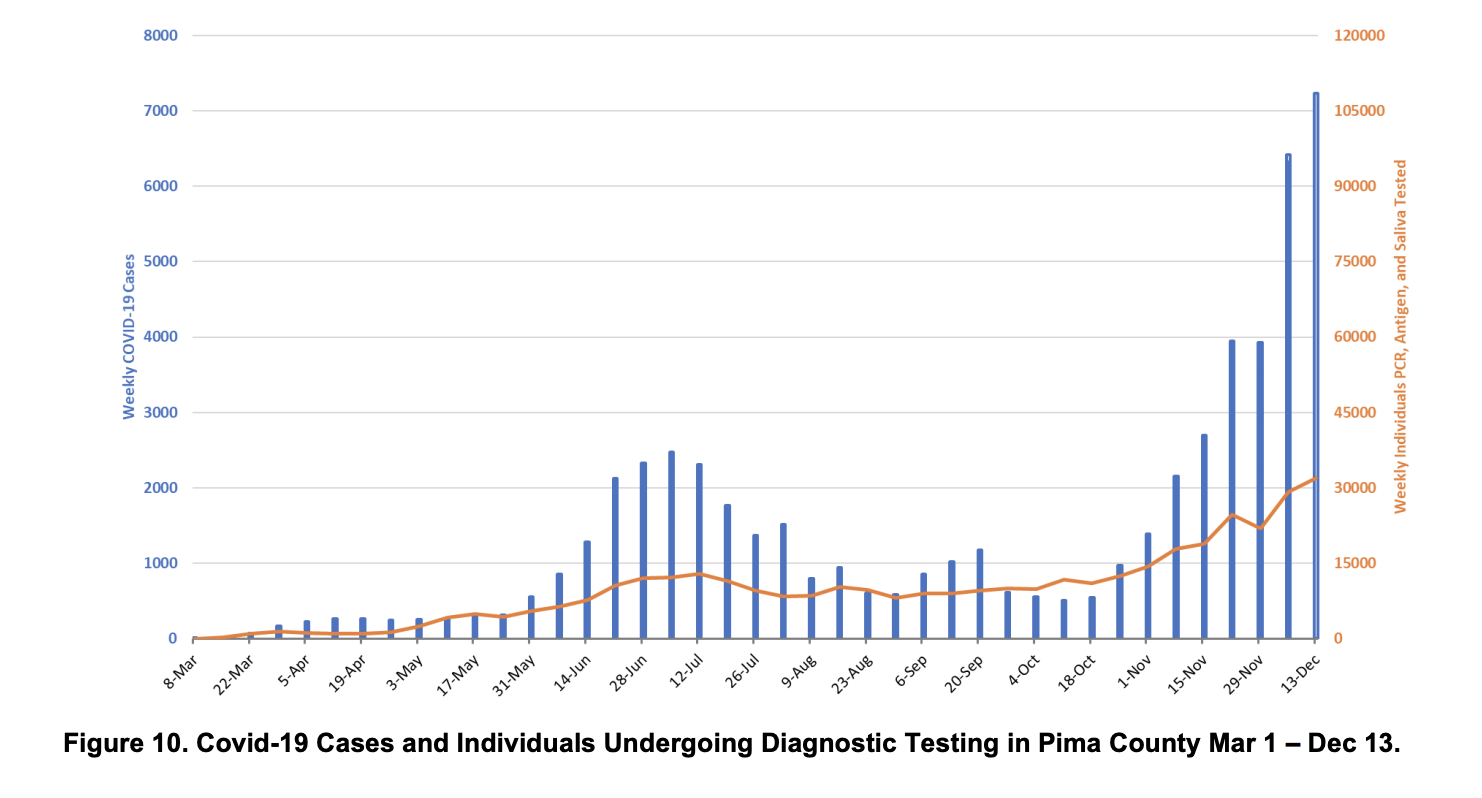
The week ending Dec. 13 saw at least 44,390 new COVID-19 cases in Arizona, a 10% increase from the week prior. This sets a record for weekly case counts in the state, according to Dr. Joe Gerald, a professor at the University of Arizona who creates weekly coronavirus epidemiology reports based on ADHS data.
However, Gerald says this number could be even higher than reported due to a significant lag time in processing COVID-19 tests, as nearly 10,000 patients were told their test could not be completed due to a laboratory backlog.
Coronavirus test positivity also set a record in the state at 26.3% last week, according to Gerald’s report.
Though the state has yet to surpass its deadliest week that ended July 19 with 617 COVID-19 deaths, Gerald estimates by Christmas, Arizona will see more than 500 deaths a week.
Pima County also set a record for cases in a single week with 7,237 coronavirus cases the week ending Dec. 13, a 14% increase from the week prior, Gerald’s report says.
Hospitals dangerously near capacity, cancel elective surgeries
As of Dec. 18, the UA professor’s report says 47% of the state’s general ward beds and 53% of its ICU beds were occupied by COVID-19 patients.
“We are now undergoing the great ‘displacement’ such that hospital services are now being rationed so that patients with severe Covid-19 illness are displacing others who have slightly less severe non-Covid medical conditions. As Covid-19 illness continues to increase, delaying others’ care will become ever more difficult,” Gerald’s said in the report. “Make no mistake, the Covid-19 crisis is now placing a greater share of Arizonans at-risk, not just those unfortunate enough to contract Covid-19.”

With more than 7,600 new cases reported today, the number of Arizona’s confirmed novel coronavirus cases jumped by nearly 19,000 over the weekend and now stands higher than 461,000 as of Monday, Dec. 21, according to the Arizona Department of Health Services.
Pima County, which reported 1,244 new cases today, has seen 60,360 of the state’s 461,345 confirmed cases.
A total of 7,972 Arizonans have died after contracting COVID-19, including 905 deaths in Pima County, according to the Dec. 21 report.
The number of hospitalized COVID cases statewide continues to soar as the virus has begun to spread more rapidly, putting stress on Arizona’s hospitals and surpassing July peaks. ADHS reported that as of Dec. 20, 3,925 COVID patients were hospitalized in the state, slightly lower than the new record of 4,014 set on Dec. 18. The previous peak of 3,517 hospitalized COVID patients was set on July 13; that number hit a subsequent low of 468 on Sept. 27.
A total of 1,795 people visited emergency rooms on Dec. 20 with COVID symptoms. That number, which hit a new record of 2,166 earlier this month, had previously peaked at 2,008 on July 7; it hit a subsequent low of 653 on Sept. 28.
A total of 904 COVID-19 patients were in intensive care unit beds on Dec. 20. The number of COVID patients in ICUs peaked at 970 on July 13 and hit a subsequent low of 114 on Sept. 22.
TMC cancels elective surgeries
Tucson Medical Center has canceled elective surgeries through Jan. 4.
A letter from TMC COO Mimi Coomler and CMO Dr. Amy Beiter states that TMC is too crowded with COVID patients to move forward with elective surgeries.
“We have reached the point in the pandemic where the number of COVID patients needing care is exceeding available resources on a daily basis,” they wrote.

