

Wednesday, December 9, 2020
Arizona is on track to receive 383,750 COVID-19 vaccines by the end of December, according to a news release from Gov. Doug Ducey’s office.
Over the weekend, the Arizona Department of Health Services ordered the first shipment, which is expected to arrive next week, according to the release.
The vaccines will go to Pima and Maricopa counties in the first week of distribution, with Pima receiving 11,000 doses and Maricopa receiving 47,000.
The state’s distribution plan for the vaccines prioritizes health care workers, residents of long-term care facilities, educators and vulnerable populations. The federal government ships COVID-19 vaccines based on states’ populations, and the release says “ADHS will promptly order vaccine doses” as they become available.
In the second week, vaccines will be distributed to all 15 counties and four tribes, according to the release.
The Centers for Disease Control and Prevention and the Pharmacy Partnership program will also receive doses the second week for vaccination at skilled nursing facilities. According to the release, all of Arizona’s skilled nursing facilities opted to participate in the CDC program that will vaccinate all residents and staff in the facilities.
“Throughout Arizona, health care professionals including doctors, nurses, emergency medical technicians, pharmacists and more are partnering to administer the vaccine.”
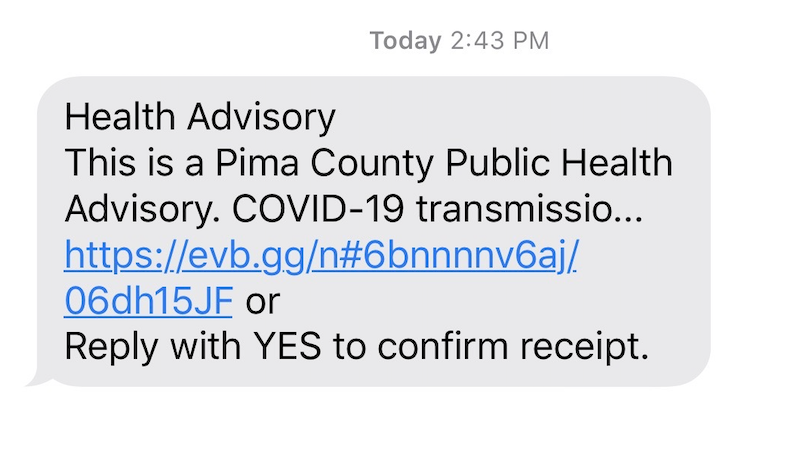
The Pima County Health Department distributed a mass alert Wednesday informing the public of its renewed public health advisory as COVID-19 cases reach alarming levels.
The message was sent to those who signed up for emergency alerts and revealed coronavirus transmission rates are “extremely high” and that local hospitals have reached or are nearing capacity, according to a news release from the health department.
In the message, the health department echoed the COVID-19 mitigation guidelines strengthened by the Board of Supervisors on Dec. 4. These include the continuation of the county’s mask mandate and tougher enforcement for those who don’t comply.
Other guidelines designed to slow the spread of the virus include:
Adhering to a curfew from 10 p.m. to 5 a.m. In Tucson, this curfew is mandatory.
Staying at home as much as possible.
Maintaining a 6-foot distance from those not in your immediate household.
Frequent hand washing and sanitization.
Limiting public and private gatherings of individuals from separate households.
The mass alert comes as Pima County reported 7,711 coronavirus cases in the first nine days of December. According to a news release from Rep. Ann Kirkpatrick, health experts predict at least 500 weekly COVID-19 deaths in the state by January.
“The news of rising cases and deaths is alarming,” Kirkpatrick said in the release. “We must continue to follow the guidance of health professionals in order to alleviate the stress on our hospitals, which are reaching capacity. Arizonans, please continue to socially distance, wear a mask around others, and wash your hands. We will only get through this if we commit to the cause, together.”
With more than 4,400 new cases reported today, the number of Arizona’s confirmed novel coronavirus cases topped 382,000 as of Wednesday, Dec. 9, according to the Arizona Department of Health Services.
Pima County, which reported 957 new cases today, has seen 47,570 of the state’s 382,601 confirmed cases.
With 23 new deaths reported today, a total of 7,081 Arizonans have died after contracting COVID-19, including 746 deaths in Pima County, according to the Dec. 9 report.

The number of hospitalized COVID cases statewide continues to soar upward as the virus has begun to spread more rapidly, putting stress on Arizona’s hospitals and closing in on numbers not seen since July peaks. ADHS reported that as of Dec. 8, 3,287 COVID patients were hospitalized in the state, the highest that number has been since July 16. That number peaked with 3,517 hospitalized COVID patients on July 13; it hit a subsequent low of 468 on Sept. 27.
A total of 1,978 people visited emergency rooms on Dec. 8 with COVID symptoms. That number peaked at 2,008 on July 7; it hit a subsequent low of 653 on Sept. 28.
A total of 766 COVID-19 patients were in intensive care unit beds on Dec. 8, the highest that number has been since July 28. The number of COVID patients in ICUs peaked at 970 on July 13 and hit a subsequent low of 114 on Sept. 22.
Judy Rich, president and CEO of Tucson Medical Center, warned the Tucson City Council last week that local hospitals are near or at capacity.
“I believe stricter measures, like the ones we used earlier this year, are the only path to avert the impending crisis,” Rich told the council. “I recognize that the City might not have the legal authority to mandate such actions, but it should be the position of the City to advocate to state leadership that it is required to prevent unnecessary loss of life and illness.”
Pima County has seen a dramatic rise in cases in recent weeks, according to a Dec. 4 report from the Pima County Health Department. (Numbers in this report are subject to revision.) For the week ending Nov. 7, 2,119 cases were reported; for the week ending Nov. 14, 2,578 cases were reported; and for the week ending Nov. 21, 3,313 cases were reported.
COVID-related deaths in Pima County are down from a peak of 54 in the week ending July 4 but are on the rise. There were six in the week ending Oct. 24; 10 in the week ending Oct. 31 and five in the week ending Nov. 7.
Hospitalization admission peaked the week ending July 18 with 221 COVID patients admitted to Pima County hospitals, but those numbers have been on the rise in recent weeks. In the week ending Nov. 7, 90 people were admitted; in the week ending Nov. 14, 127 people were admitted; and in the week ending Nov. 21, 139 people were admitted.
A curfew in the city of Tucson from 10 p.m. to 5 a.m. continues through Dec. 23.
On Nov. 23, the Pima County Health Department announced a voluntary overnight curfew from 10 p.m. to 5 a.m. every day until Dec. 31—but it’s not enforceable.
As part of the amended curfew agreement among the city’s council members, if Pima County changes their voluntary curfew time, Tucson’s curfew time will follow suit.
The curfew prohibits everyone from being in public places with the following exceptions:
- Emergency response personnel
- Traveling to and from work
- Attending religious services
- Caring for a family member
- Seeking medical care
- Fleeing dangerous circumstances
- Traveling to perform or receive essential functions
- Homeless persons
City Attorney Mike Rankin specified traveling to essential businesses such as grocery, home goods and hardware stores is allowed. Travel to restaurants for consumption off-premises is also allowed by means of take out, delivery, curbside and drive-thru food orders.
“The curfew does not order the closure of any business at any particular time, instead, what it does is it regulates when people can be in public places, which includes traveling on the public streets,” Rankin said at last week’s council’s meeting. “It does not, as presented, prevent people from traveling to or from any essential activity or essential functions, even during the curfew hours.”
Offenders of the curfew will be subject to a civil infraction that holds a fine of up to $300.
Get tested: Pima County has free COVID testing
Pima County offers a number of testing centers around town.
You’ll have a nasal swab test at the Kino Event Center (2805 E. Ajo Way) the Udall Center (7200 E. Tanque Verde Road) and downtown (88 E. Broadway).
The center at the northside Ellie Towne Flowing Wells Community Center, 1660 W. Ruthrauff Road, involves a saliva test designed by ASU.
In addition, the Pima County Health Department, Pima Community College and Arizona State University have partnered to create new drive-thru COVID-19 testing sites at three Pima Community College locations. At the drive-thru sites, COVID-19 testing will be offered through spit samples instead of nasal canal swabs. Each site will conduct testing from 9 a.m. to noon, and registration is required in advance. Only patients 5 years or older can be tested.
Schedule an appointment at pima.gov/covid19testing.
The University of Arizona’s antibody testing has been opened to all Arizonans as the state attempts to get a handle on how many people have been exposed to COVID-19 but were asymptomatic or otherwise did not get a test while they were ill. To sign up for testing, visit https://covid19antibodytesting.arizona.edu/home.
—with additional reporting from Austin Counts, Jeff Gardner, Nicole Ludden and Mike Truelsen

WASHINGTON – The staff at St. Maria Goretti Catholic Church in Scottsdale was planning to go ahead with its annual office Christmas party this year – but with social distancing and other COVID-19 precautions in place.
As coronavirus cases continue to surge in Arizona and across the country, however, the Rev. Thomas Hallsten and parish manager Lynda Melton decided it was safer to pull the plug.
“As much as we’d like to have that bonding and social time, it’s really not essential,” Melton said. “We’ll do it down the road when things improve.”
The church joins offices across the country that are canceling holiday parties this year, finding ways to celebrate virtually or with other precautions in place, like holding the party outdoors and taking partygoers’ temperatures.
Just 23% of companies who responded to a survey by the outplacement company Challenger, Gray and Christmas said they plan a year-end celebration this year, a complete reversal from the 76% who held parties last year. Of the 189 businesses that responded to the annual survey, just 1.3% said they planned to go ahead with a traditional party with no restrictions.
That doesn’t mean the desire for a holiday party is any less, said Andrew Challenger, the senior vice president of Challenger, Gray & Christmas.
“I think the idea is companies still would like to try to get people together,” Challenger said. “Even if it’s only virtually to do something other than talk about business, like getting people together within an organization to connect with each other, in some way is meaningful.”
The annual holiday party is important to staff at the Phoenix IT company Adopt Technologies, said Brett Helgeson, its president and CEO.
Tuesday, December 8, 2020
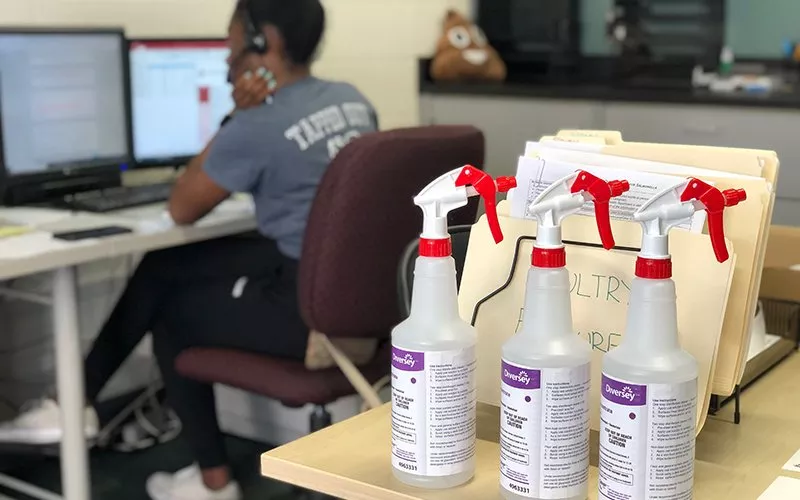
PHOENIX – It’s been a quiet day on Zoom for Kylie Boyd and Alexandra Shilen. Occasionally, some student volunteers pop into their online room to check in or ask a brief question, then pop back out to hit the phones.
On this fall afternoon, Boyd and Shilen are overseeing 13 volunteers who are calling residents in four Arizona counties to ask questions about COVID-19.
The group is executing two functions that health experts say are essential to preventing the spread of the coronavirus that causes COVID-19 and eventually ending the pandemic: contacting people who have tested positive for the disease and tracking down anyone who may have been exposed.
Boyd and Shilen are coordinators for the SAFER team at the University of Arizona. For 15 years, the Student Aid for Field Epidemiology Response program has trained students to investigate public health crises.
Team members used to track local outbreaks of foodborne illnesses and monitor flu cases. Now they’re tackling a pandemic that has killed 1.5 million people across the globe.
“In the beginning, it was like 10 cases … and then it was 100, and then it was 200. And then you really started to feel the growing pains,” said Erika Austhof, an UA epidemiologist who leads SAFER’s call center.
Case investigations and contact tracing are key to fighting COVID-19. Investigations involve calling individuals who have tested positive to gather information about their illness, travel history and recent close contacts. Contact tracing is when exposed individuals are alerted and given guidance about how to get tested and potential self-isolation.
SAFER does both, and it’s just one of a slew of groups nationwide helping underfunded public health agencies with what has become a colossal effort. Since January, more than 14 million people in the U.S. have been infected.
Kristen Pogreba-Brown, an assistant professor of epidemiology at Arizona who leads SAFER, said volunteers who stepped up in the early days of the pandemic were vital in getting the work off the ground.
“We were just kind of running around with our hair on fire … and just having people say, ‘Tell me what you need help with,’ ‘We can help make phone calls,’ ‘I can help do this’ – that was extremely important in the very beginning,” Pogreba-Brown said.
In April, researchers at the Johns Hopkins Center for Health Security estimated that at least 100,000 new contact tracers would be needed in the U.S. to meet the demand caused by rising COVID-19 cases. But funding that many contact tracers would take billions of dollars.
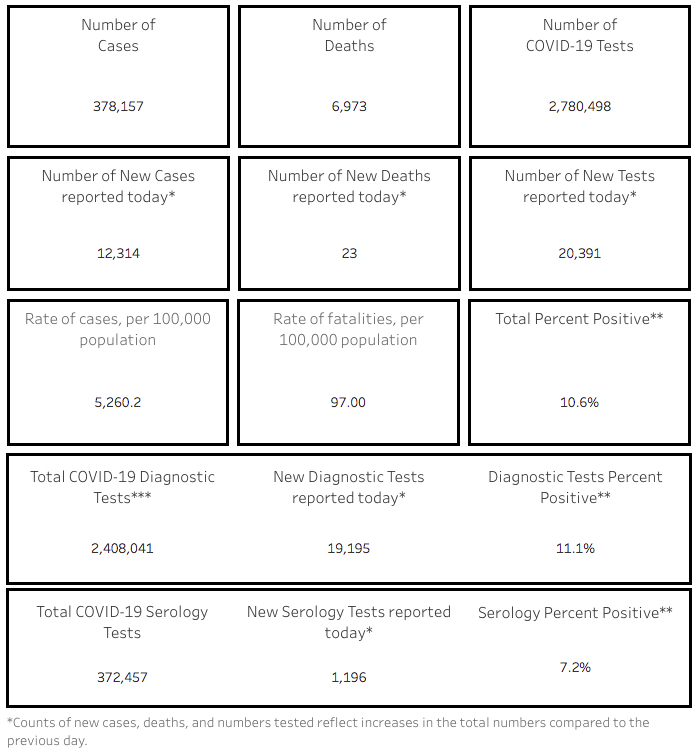
With more than 12,000 new cases reported today, the number of Arizona’s confirmed novel coronavirus cases topped 378,000 as of Tuesday, Dec. 8, according to the Arizona Department of Health Services.

Pima County, which reported 957 new cases today, has seen 46,849 of the state’s 378,157 confirmed cases.
With 23 new deaths reported today, a total of 6,973 Arizonans had died after contracting COVID-19, including 730 deaths in Pima County, according to the Dec. 8 report.
The number of hospitalized COVID cases statewide continues to soar upward as the virus has begun to spread more rapidly, putting stress on Arizona’s hospitals and closing in on numbers not seen since July peaks. ADHS reported that as of Dec. 7, 3,157 COVID patients were hospitalized in the state, the highest that number has been since July 17. That number peaked with 3,517 hospitalized COVID patients on July 13; it hit a subsequent low of 468 on Sept. 27.
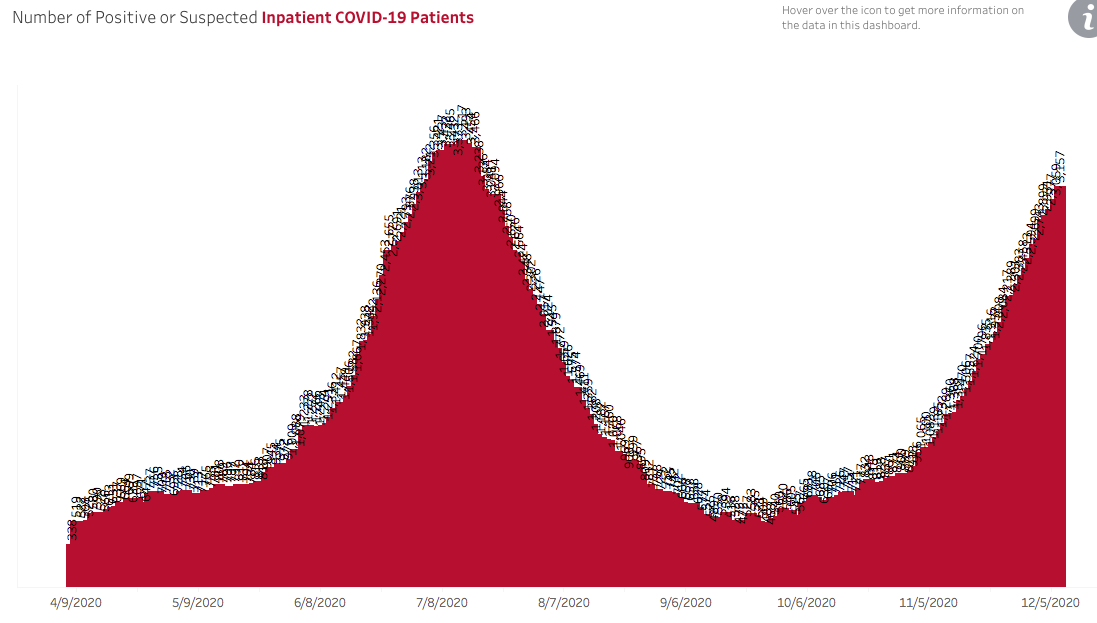
A total of 1,550 people visited emergency rooms on Dec. 7 with COVID symptoms. That number peaked at 2,008 on July 7; it hit a subsequent low of 653 on Sept. 28.
A total of 744 COVID-19 patients were in intensive care unit beds on Dec. 7, the highest that number has been since July 29. The number of COVID patients in ICUs peaked at 970 on July 13 and hit a subsequent low of 114 on Sept. 22.
Judy Rich, president and CEO of Tucson Medical Center, warned the Tucson City Council last week that local hospitals are near or at capacity.
“I believe stricter measures, like the ones we used earlier this year, are the only path to avert the impending crisis,” Rich told the council. “I recognize that the City might not have the legal authority to mandate such actions, but it should be the position of the City to advocate to state leadership that it is required to prevent unnecessary loss of life and illness.”
Pima County has seen a dramatic rise in cases in recent weeks, according to an Dec. 4 report from the Pima County Health Department. (Numbers in this report are subject to revision.) For the week ending Nov. 7, 2,119 cases were reported; for the week ending Nov. 14, 2,578 cases were reported; and for the week ending Nov. 21, 3,313 cases were reported.
Monday, December 7, 2020
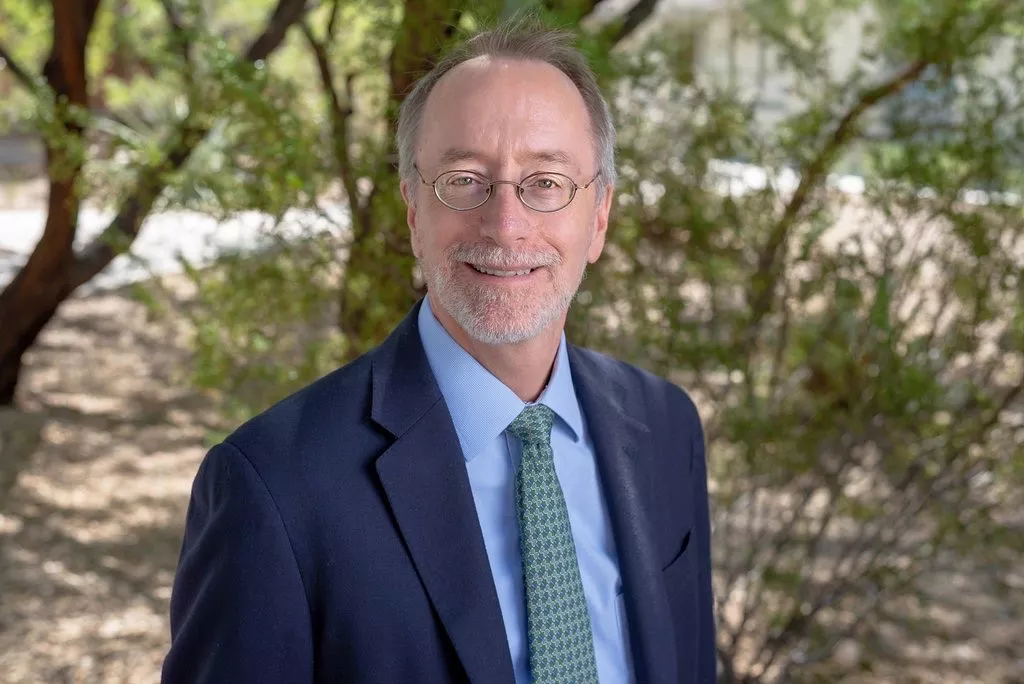
The future of Arizona’s economy is one of uncertainty, UA economist George Hammond made clear at a virtual economic outlook event Friday. Throughout the coronavirus pandemic, the state has fared better in unemployment numbers compared to the rest of the nation, but it has still withstood a heavy loss, according to Hammond, the director of the Economic and Business Research Center at the University of Arizona’s Eller College of Management.
Arizona lost 294,600 jobs from February to April but has replaced 66% of them, according to Hammond. Nationwide, nearly 55% of jobs lost during this time have been replaced. “That's job growth at a pretty rapid pace for the state of Arizona. On average, that translates into almost 14,000 jobs per month,” Hammond said. “If we can sustain that pace, in 2021, we will actually be back to pre-pandemic employment levels by about the middle of the year.” In order to reach pre-pandemic levels, Arizona would have to add 100,700 jobs—an average of 13,900 per month.
“That's a pretty tall order. Adding jobs at a monthly rate of 14,000 is more than double the average monthly job growth rate during the four years before the Great Recession,” Hammond said. “Before the Great Recession . . . we would add, on average, about 6,000 jobs per month. It's not clear that we can sustain that pace.”
The total unemployment rate in Arizona has shown volatility from month to month, with the seasonally adjusted rate decreasing from 10.7% in July to 5.9% in August, then rising to 6.5% in September and 8.0% in October. However, Hammond said this may change when the state receives more precise data in 2021.
“[The unemployment rate] zig-zagged around, with big drops, and then a couple of months of pretty significant increases and then some more drops. The state rate is has looked really weird, and there's a lot of speculation about what might be driving that,” Hammond said. “Probably the best advice is don't put too much weight or spend too much time trying to explain these monthly zigzags...they'll likely be revised away once we get the revised data in March of next year.”
As University of Arizona students finish the fall semester remotely, they’ll return to more stringent guidelines to prevent the spread of coronavirus in the spring semester.
The university will require weekly COVID-19 testing for all students attending in-person classes on its main campus or living in dorms, UA President Robert Robbins said in a press conference this morning.
Any students visiting campus will be required to complete a COVID-19 diagnostic test within the prior week. If students aren’t noted as having completed a test in UA’s system, they will be denied access to the university’s Wi-Fi network.
“We think this is an incentive for people to comply with our mandatory testing,” Robbins said. “We think it’s really going to be important, and we’re changing our approach because we’re going to be able to expand our testing capability.”
Robbins announced a testing blitz to coincide with dorm move-in dates from Jan. 6-12, similar to the one it conducted before fall break. Residents are required to test negatively before moving into their dorm rooms.
While the tests conducted during the testing blitz will still be in the form of antigen nasal swabs, the university has developed a new saline gargle test for its regular weekly testing.
New saline gargle test
Developed by the head of the university’s Department of Ecology and Evolutionary Biology Michael Worobey, the saline gargle test detects present coronavirus material and amplifies it to a traceable amount.
Those receiving the test swish and gargle 5 milliliters of saltwater three times, and spit the solution into a tube to be tested for the presence of COVID-19.
Instead of the oftentimes unpleasant nasal swab that reaches the pharynx, or deep into the back of the nasal cavity, the swish test is “much more tolerable,” according to Worobey.
PHOENIX – Research from Arizona and beyond suggests the coronavirus that causes COVID-19 can spread erratically, making some infected people “superspreaders” and others dead ends for transmission.
This can create clusters or “micro-hotspots” – neighborhoods, schools, towns or other small geographic areas where the virus runs rampant – even while communities next door remain relatively unscathed. These concentrated outbreaks aren’t included in the Arizona Department of Health Service’s COVID-19 data dashboard, which breaks down cases by county.
Dr. Peter Plantes, an internal medicine specialist, works with hc1, a health care data analysis company that recently launched a COVID-19 dashboard explaining the dynamics of the pandemic in new detail.
The company partners with more than 20,000 labs across the U.S. that quickly share the results of COVID-19 tests, along with the patient’s address. The firm then calculates the percentage of positive COVID-19 tests by city and, in some cases, neighborhood. Plantes said the patient information they receive from labs is subject to privacy laws.
For example, the platform’s Maryvale east zone in Phoenix, which is bounded by 27th and 59th avenues and Interstate 10 and Camelback Road, showed a percent positivity of more than 29% over the past week. That rate is nearly double the recent positivity rate for Maricopa County, and is second only to the Yuma zone for highest in the state.
Conversely, the Tempe north zone just 10 miles away had a positivity rate of about 11% over the same time period – the lowest of all zones across Arizona.

