

Wednesday, December 2, 2020
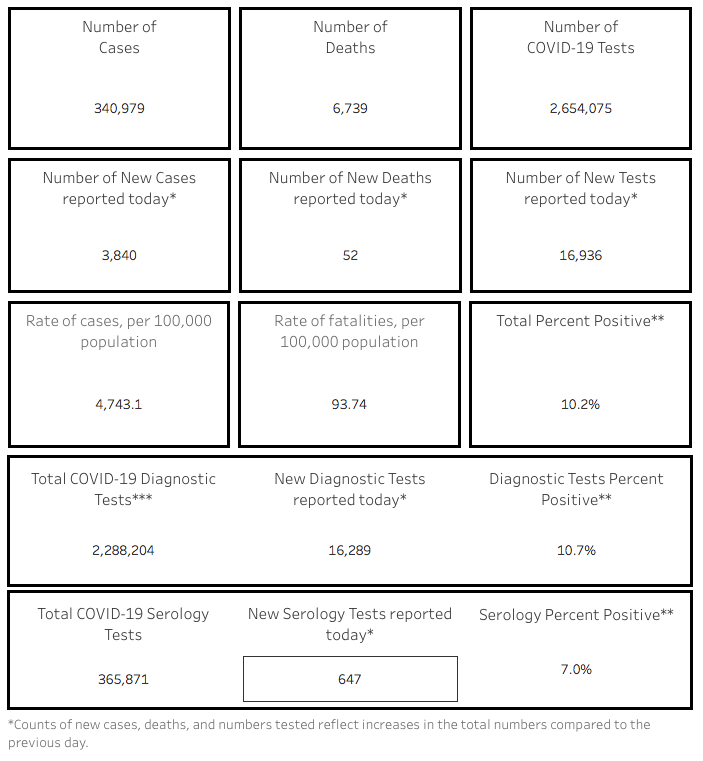
With more than 3,800 new cases reported today, the number of Arizona’s confirmed novel coronavirus cases closed in on 341,000 as of Wednesday, Dec. 2, according to the Arizona Department of Health Services.

Pima County, which reported 994 new cases today, has seen 41,313 of the state’s 340,979 confirmed cases.
With 52 new deaths reported yesterday, a total of 6,739 Arizonans have died after contracting COVID-19, including 697 deaths in Pima County, according to the Dec. 2 report.
The number of hospitalized COVID cases statewide continues to climb upward as the virus has begun to spread more rapidly, putting stress on Arizona’s hospitals. ADHS reported that as of Dec. 1, 2,699 COVID patients were hospitalized in the state, the highest that number has been since July 24 That number peaked with 3,517 hospitalized COVID patients on July 13; it hit a subsequent low of 468 on Sept. 27.
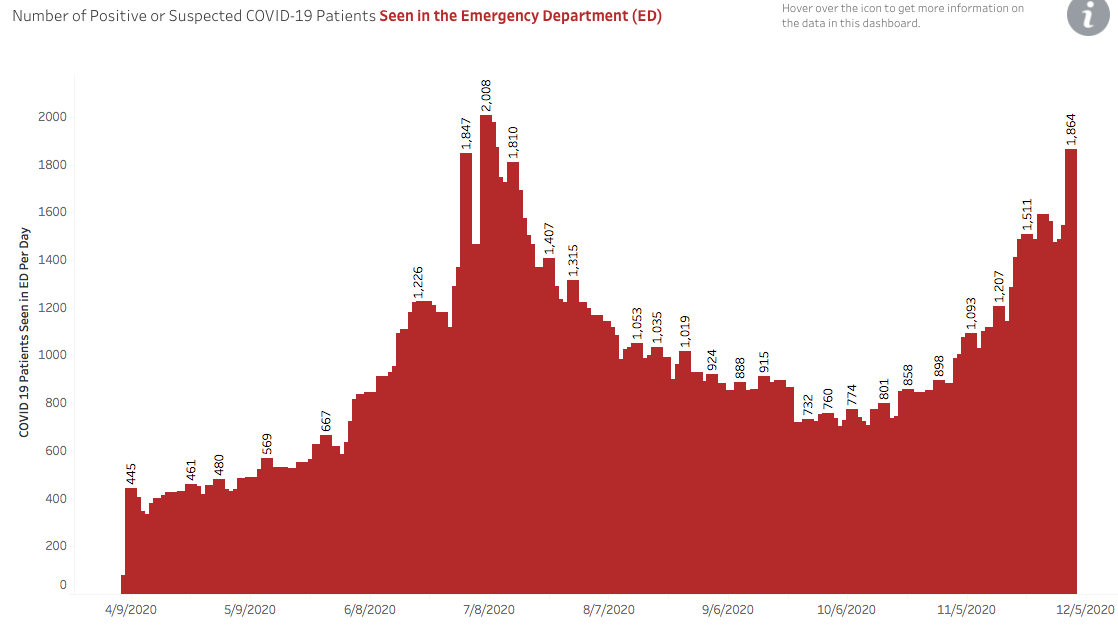
A total of 1,864 people visited emergency rooms on Dec. 1 with COVID symptoms, the highest that number has been since July 9. That number peaked at 2,008 on July 7; it hit a subsequent low of 653 on Sept. 28.
A total of 642 COVID-19 patients were in intensive care unit beds on Dec. 1, the highest that number has been since Aug. 1. The number of COVID patients in ICUs peaked at 970 on July 13 and hit a subsequent low of 114 on Sept. 22.
Judy Rich, president and CEO of Tucson Medical Center, told the Tucson City Council last night that local hospitals are near or at capacity.
“I believe stricter measures, like the ones we used earlier this year, are the only path to avert the impending crisis,” Rich told the council. “I recognize that the City might not have the legal authority to mandate such actions, but it should be the position of the City to advocate to state leadership that it is required to prevent unnecessary loss of life and illness.”
On a week-by-week basis in Pima County, the number of positive COVID tests peaked the week ending July 4 with 2,452 cases, according to an Nov. 25 report from the Pima County Health Department. (Numbers in this report are subject to revision.)
Pima County is seeing a dramatic rise in cases in recent weeks. For the week ending Oct. 31, 1,348 cases were reported; for the week ending Nov. 7, 2,119 cases were reported; and for the week ending Nov. 14, 2,578 cases were reported; for the week ending Nov. 21, 3,313 cases were reported.
COVID-related deaths in Pima County are down from a peak of 54 in the week ending July 4 but are on the rise. There were three deaths in the week ending Oct 10, one in week ending Oct. 17, six in the week ending Oct. 24; 10 in the week ending Oct. 31 and five in the week ending Nov. 7.
Hospitalization admission peaked the week ending July 18 with 221 COVID patients admitted to Pima County hospitals, but those numbers have been on the rise in recent weeks. In the week ending Oct. 31, 66 people were admitted; in the week ending Nov. 7, 90 people were admitted; in the week ending Nov. 14, 127 people were admitted; and in the week ending Nov. 21, 139 people were admitted.
Tucson City Council enacts 10 p.m. to 5 a.m. curfew
The Tucson City council voted to enact a citywide curfew from 10 p.m. to 5 a.m. daily that will go into effect Friday, Dec. 4 until Dec. 23.
The council voted 6-0, amending Tucson Mayor Regina Romero’s initial proclamation to set an 8 p.m. to 5 a.m. curfew that would have begun tonight.
On Nov. 23, the Pima County Health Department announced a voluntary overnight curfew from 10 p.m. to 5 a.m. every day until Dec. 31—but it’s not enforceable.
As part of the amended curfew agreement among the city’s council members, if Pima County changes their voluntary curfew time, Tucson’s curfew time will follow suit.
The proposed curfew would prohibit everyone from being in public places with the following exceptions:
Emergency response personnel
Traveling to and from work
Attending religious services
Caring for a family member
Seeking medical care
Fleeing dangerous circumstances
Traveling to perform or receive essential functions
Homeless persons
City Attorney Mike Rankin specified traveling to essential businesses such as grocery, home goods and hardware stores is allowed. Travel to restaurants for consumption off-premises is also allowed by means of take out, delivery, curbside and drive-thru food orders.
“The curfew does not order the closure of any business at any particular time, instead, what it does is it regulates when people can be in public places, which includes traveling on the public streets,” Rankin said at the council’s meeting. “It does not, as presented, prevent people from traveling to or from any essential activity or essential functions, even during the curfew hours.”
Offenders of the curfew will be subject to a civil infraction that holds a fine of up to $300.
Get tested: Pima County opening new sites alongside existing spots for free COVID testing
Pima County offers a number of testing centers around town.
You’ll have a nasal swab test at the Kino Event Center (2805 E. Ajo Way) the Udall Center (7200 E. Tanque Verde Road) and downtown (88 E. Broadway).
The center at the northside Ellie Towne Flowing Wells Community Center, 1660 W. Ruthrauff Road, involves a saliva test designed by ASU.
In addition, the Pima County Health Department, Pima Community College and Arizona State University have partnered to create new drive-thru COVID-19 testing sites at three Pima Community College locations. At the drive-thru sites, COVID-19 testing will be offered through spit samples instead of nasal canal swabs. Each site will conduct testing from 9 a.m. to noon, and registration is required in advance. Only patients 5 years or older can be tested.
Schedule an appointment at pima.gov/covid19testing.
The University of Arizona’s antibody testing has been opened to all Arizonans as the state attempts to get a handle on how many people have been exposed to COVID-19 but were asymptomatic or otherwise did not get a test while they were ill. To sign up for testing, visit https://covid19antibodytesting.arizona.edu/home.
—with additional reporting from Austin Counts, Jeff Gardner, Nicole Ludden and Mike Truelsen
Tuesday, December 1, 2020
The Tucson City council voted to instate a citywide curfew from 10 p.m. to 5 a.m. daily that will go into effect Friday, Dec. 4 until Dec. 23.
The council voted 6-0, amending Tucson Mayor Regina Romero’s initial proclamation to set an 8 p.m. to 5 a.m. curfew that would have begun tonight.
On Nov. 23, the Pima County Health Department announced a voluntary overnight curfew from 10 p.m. to 5 a.m. every day until Dec. 31—but it’s not enforceable.
As part of the amended curfew agreement among the city’s council members, if Pima County changes their voluntary curfew time—whether voluntary or mandatory—Tucson’s curfew time will follow suit.
The proposed curfew would prohibit everyone from being in public places with the following exceptions:
- Emergency response personnel
- Attending religious services
- Caring for a family member
- Seeking medical care
- Fleeing dangerous circumstances
- Traveling to perform or receive essential functions
- Homeless persons
City Attorney Mike Rankin specified traveling to essential businesses such as grocery, home goods and hardware stores is allowed. Travel to restaurants for consumption off-premises is also allowed by means of take out, delivery, curbside and drive-thru food orders.
“The curfew does not order the closure of any business at any particular time, instead, what it does is it regulates when people can be in public places, which includes traveling on the public streets,” Rankin said at the council’s meeting. “It does not, as presented, prevent people from traveling to or from any essential activity or essential functions, even during the curfew hours.”Offenders of the curfew will be subject to a civil infraction that holds a fine of up to $300.
The council also voted 6-0 to approve a $6 million financial aid package comprised of federal CARES Act funds to be distributed throughout Tucson as follows:
- $3 million for small businesses
- $2 million for workers and families
- $375,000 for arts and culture organizations
- $375,000 for entertainment venues
- $250,000 for child care
To help those who might be impacted by the curfew passed tonight, my colleagues and I also approved additional relief...
Posted by Mayor Regina Romero on Tuesday, December 1, 2020
PHOENIX – After a disrupted 2019-20 season that ended in a bubble at Walt Disney World, the Phoenix Suns have undergone an offseason makeover that they hope will build on their surprising 8-0 run in Orlando that followed the COVID-19 interruption.
The Suns pulled off a blockbuster trade to acquire perennial All-Star point guard Chris Paul. They made a splash in free agency, signing big man Jae Crowder. They opened a new practice facility, the $45-million Verizon 5G Performance Center.
They even broke out new NBA City Edition alternative “The Valley” jerseys.
And earlier this month, the National Basketball Players Association and the NBA agreed to start a shortened and condensed 72-game schedule on Dec. 22.
The new-look Suns are set to start this week in a one-on-one bubble setting at the practice facility, with group workouts beginning Dec. 4, according to General Manager James Jones, who spoke with reporters in a Zoom media conference Monday.
Jones anticipates a challenging season amid the continuing spread of COVID-19, but believes the team can prosper if time is properly managed. Among other challenges, he said the 72-game season will be played in a shorter span, requiring more back-to-back games.
“We look forward to this week, where our guys can be on the court – one coach, one player,” he said. “(And) try to get ourselves back into game rhythm and shape, and then we’ll build up to our five-on-five group activities heading into next week.”
Jones said he feels good about what the club has added to its roster, and is confident new key players will fit right into a group that includes All-Star guard Devin Booker and center Deandre Ayton, who was the first overall pick in the 2018 NBA Draft and figures to benefit from the arrival of the 35-year-old Paul.
“I’m excited for them because this is a competitive environment, I’m looking forward to watching our guys compete. I know that we did some things this summer, as far as improving the team,” Jones said.
“Just adding guys to the team is never, and has never been, the goal. The goal for us is winning, the goal for us is … creating a playoff atmosphere and bringing a playoff approach to every single game.”
After the changes, the Suns are now regarded as a playoff contender. They have not appeared in the postseason since 2010 when they lost in the Western Conference finals to the Los Angeles Lakers.
The Lakers went on to win the NBA championship that season, and they won again last season. But the Lakers, Eastern Conference champion Miami and every other NBA team are faced with one of the shortest offseasons in NBA history, with only a seven-week break for the two finals teams.
Important matters like salaries, COVID-19 testing, and other health and safety issues are still being negotiated. James said Monday that he isn’t privy to discussions regarding vaccinating players for COVID-19, and hasn’t heard that taking a vaccine will be mandatory.
Providing athletes with a vaccine, once one is available, and with a healthy environment is a priority for James as the Suns prepare to tip off the preseason with a pair of games in Utah Dec. 12-13.
“The guys aren’t obligated to take it,” James said of a vaccine. “We will do whatever we can to make sure that we keep our guys healthy and safe, and administer it if we can for those who want it.
“Our best course of action is to continue to adhere to the NBA’s protocols, to isolate as much as we can, maintain distance. We will still have to interact with other teams and players. The hope is that, collectively as a league, we can keep this thing under control and try to mitigate the damage that will come from the positive test that eventually will happen.”
According to the Associated Press, the NBA saw revenues drop by 10% last season because of the pandemic, coming in $1.5-billion short of revenue projections.
The upcoming season is likely to have challenges as well.
Although the Suns have not yet made an official statement saying they will not allow any fans during their games, the Los Angeles Lakers and others have announced that they will not allow fans to attend games until further notice, noting the importance of health and safety for their fans, and working together in hopes to bring them back.
“We appreciate your continued support and look forward to coming together, when it is safe to do so, to celebrate the raising of our banner and the quest for another NBA championship,” the Lakers said in an announcement.
The NBA’s goal is to complete the 2020-21 season before the Tokyo Olympics, which are scheduled to start July 23rd, allowing them to return to their regular season in October.
PHOENIX – The number of COVID-19 infections in Arizona’s most populous county probably is far higher than what official counts show, according to a survey that found 1 in 10 residents have likely had the novel coronavirus that causes the disease.
As health experts worry about a new spike in infections, a study by the Maricopa County Department of Public Health, in partnership with Mayo Clinic and Arizona State University, estimates that 10.7% of the county’s 4.49 million residents have antibodies for the virus.
That means about 470,000 people have potentially been infected in Maricopa County alone, officials said. That’s far more than the 197,000 cases officially reported, and it would surpass the statewide total of 337,000 positive cases.
Marcy Flanagan, executive director of the Maricopa County Department of Public Health, said the results show the need for precaution over the holidays when social events could push numbers even higher.
“Unfortunately, we really would recommend that individuals limit their social gatherings and their family gatherings for the holidays,” she said. “I would really encourage families to think about eating outside with their household family members and being creative to do Zoom check-ins for mealtime and other things with family that can’t come to town.”
The findings stem from an 11-day study conducted in September that tested 260 participants in 169 households across strategically selected areas of Maricopa County to look for the presence of coronavirus antibodies.
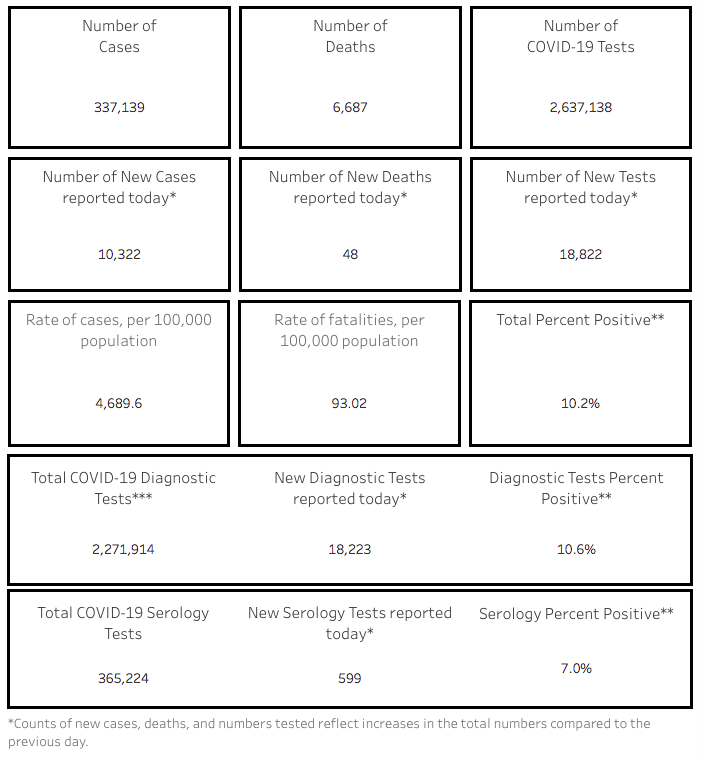
With more than more than 10,000 new cases reported today, the number of Arizona’s confirmed novel coronavirus cases topped 337,000 as of Tuesday, Dec. 1, according to the Arizona Department of Health Services.

Pima County, which reported 994 new cases today, has seen 40,803 of the state’s 337,139 confirmed cases.
ADHS Director Cara Christ said the large number of cases was a result of flow processing of tests over the holiday weekend.
“Most days, local health agencies review and classify newly reported cases (identifying them as confirmed, probable, or not a case),” Christ said in a prepared statement. “They will follow up with healthcare providers and laboratories if there are any questions about details on a case, which may take additional time over the holidays. The confirmed and probable cases identified are then reported out on our dashboard the next day as the number of new cases. With the long weekend, classification was delayed for a large portion of cases, resulting in much higher numbers than usual.”
With 48 new deaths reported yesterday, a total of 6,687 Arizonans had died after contracting COVID-19, including 695 deaths in Pima County, according to the Dec. 1 report.
The number of hospitalized COVID cases statewide continues to climb upward as the virus has begun to spread more rapidly, putting stress on Arizona’s hospitals. ADHS reported that as of Nov. 30, 2,594 COVID patients were hospitalized in the state, the highest that number has been since July 26. That number peaked with 3,517 hospitalized COVID patients on July 13; it hit a subsequent low of 468 on Sept. 27.
A total of 1,545 people visited emergency rooms on Nov. 30 with COVID symptoms. That number peaked at 2,008 on July 7; it hit a subsequent low of 653 on Sept. 28.
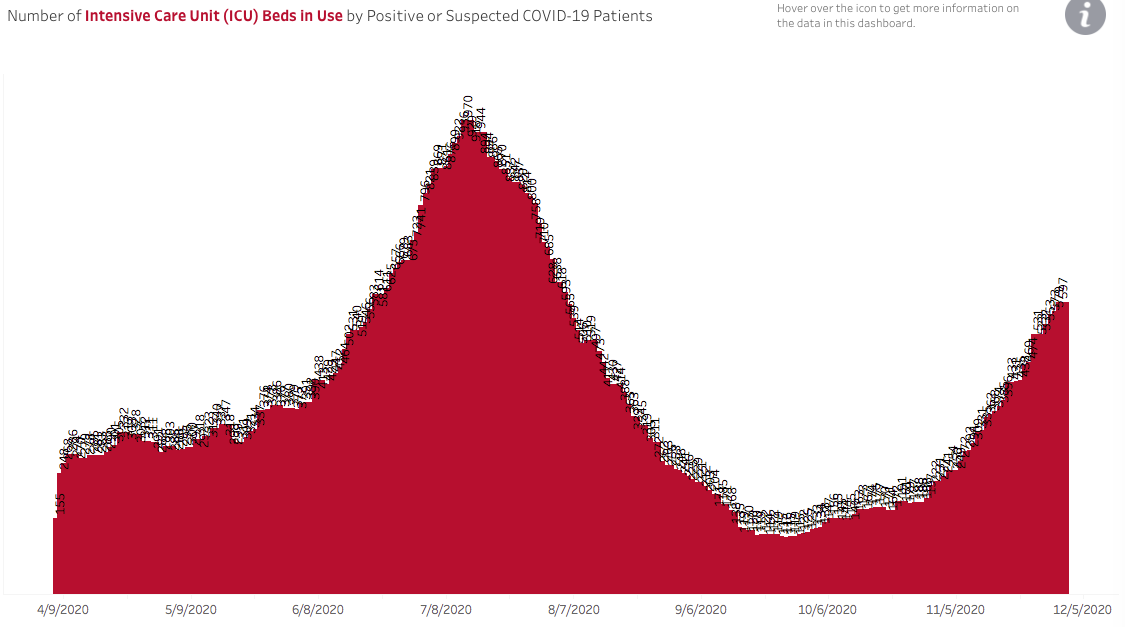
A total of 597 COVID-19 patients were in intensive care unit beds on Nov. 30, the highest that number has been since Aug. 4. The number of COVID patients in ICUs peaked at 970 on July 13 and hit a subsequent low of 114 on Sept. 22.
Monday, November 30, 2020
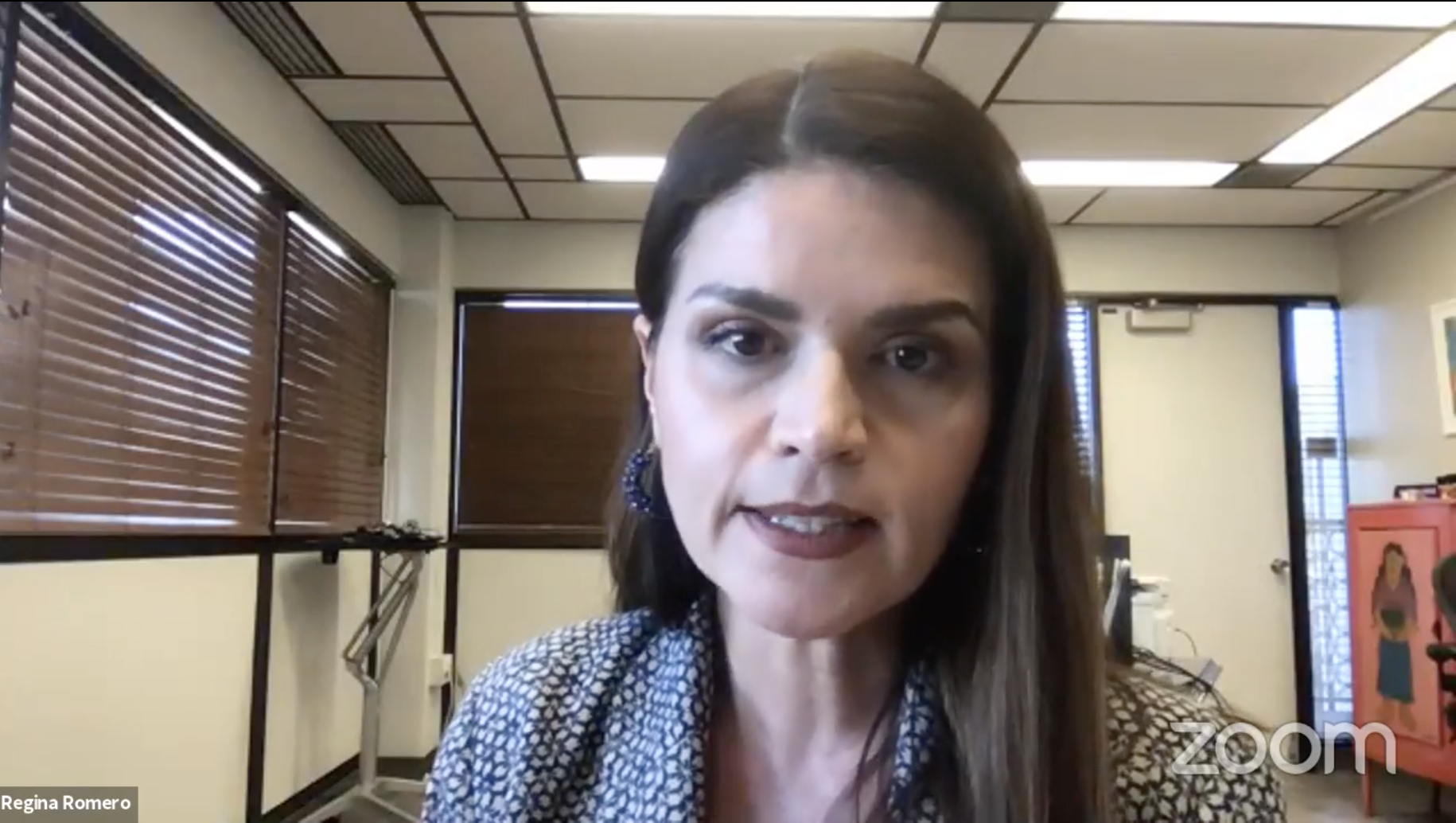
Romero says she’ll be asking the council to consider implementing a mandatory curfew from 8 p.m. to 5 a.m. that would run from Dec. 1 to Dec. 22.
After consulting w/ public health experts and local hospitals, I believe that additional steps are necessary to control...
Posted by Mayor Regina Romero on Monday, November 30, 2020
On Nov. 23, the Pima County Health Department announced a voluntary overnight curfew from 10 p.m. to 5 a.m. every day until Dec. 31—but it’s not enforceable.
At 5 p.m. Tuesday, Romero will ask the city’s council members to vote on the mandatory curfew, which if approved, would go into effect three hours later.
- Emergency response personnel
- Traveling to and from work
- Attending religious services
- Caring for a family member
- Seeking medical care
- Fleeing dangerous circumstances
- Traveling to perform or receive essential functions
- Homeless
“We are hoping that this particular measure will help our community, will help slow the surge of cases and preserve precious hospital capacity,” Romero said at the press conference. “We are also hoping that this curfew, that this step, will help prevent a stay-at-home order or a lockdown.”
How would the curfew be enforced?
City Attorney Mike Rankin said the proclamation will be presented to the council Tuesday to describe how the curfew would be enforced.
Before being subject to a citation, those violating the curfew would be notified of the new provision and given the opportunity to comply. If citations are issued, Rankin said his city attorney’s office has the ability to resolve the citations by offering diversion or “some other noncriminal proceedings.”
Rankin said violation of an emergency proclamation issued by a mayor is a misdemeanor offense, but that “the direction as part of the mayor's proclamation...would be that prosecution would include the opportunity for diversion to avoid the criminal sanction.”
If the offender denies the diversion offer, they could face criminal prosecution. Fines for misdemeanor crimes range from as high as $2,500, according to Rankin.
Is it legal to issue a mandatory local curfew?
The city attorney said the legal basis Romero has to issue a curfew is based on the mayor’s right to take action during a local emergency.
“I don't see this as a challenge to the governor's authority, or the authority that is given to him as the executive of the state. In fact, the proclamation certainly leaves room for the governor to execute all of his emergency powers,” Rankin said. “Arizona law and the charter also gives certain authority at the local level. So this isn't a challenge to state authority, but it is using the local authority that is provided under Arizona law to adopt these kinds of measures that are necessary for public health and safety.”
Experts from the COVID-19 modeling team at the University of Arizona are calling for a shelter-in-place order, mask mandate and emergency economic relief measures statewide as coronavirus metrics increase to alarming levels.
“No matter what actions are taken, Arizona will experience a hospital crisis in the coming weeks. However, if action is not immediately taken, then it risks a catastrophe on a scale of the worst natural disaster the state has ever experienced,” UA’s COVID-19 modeling team wrote in a memo to the Arizona Department of Health Services. “It would be akin to facing a major forest fire without evacuation orders.”
Dr. Joe Gerald, a professor at UA who creates weekly coronavirus epidemiology reports based on ADHS data, also called for further COVID-19 mitigation tactics as his latest report shows an alarming spread of the virus throughout the state.
“Arizona is experiencing a public health crisis where access to critical care services is limited due to shortages of space, personnel, and critical supplies. If not addressed within the next 2-3 weeks, this crisis will evolve into a humanitarian crisis leading to hundreds of preventable deaths,” Gerald wrote in his latest report. “At this point, only shelter-in-place restrictions are certain to quickly and sufficiently curtail viral transmission.”
According to Gerald's latest update, Arizona likely passed concerning thresholds of 30,000 COVID-19 cases per week and 4,000 cases per day this week.
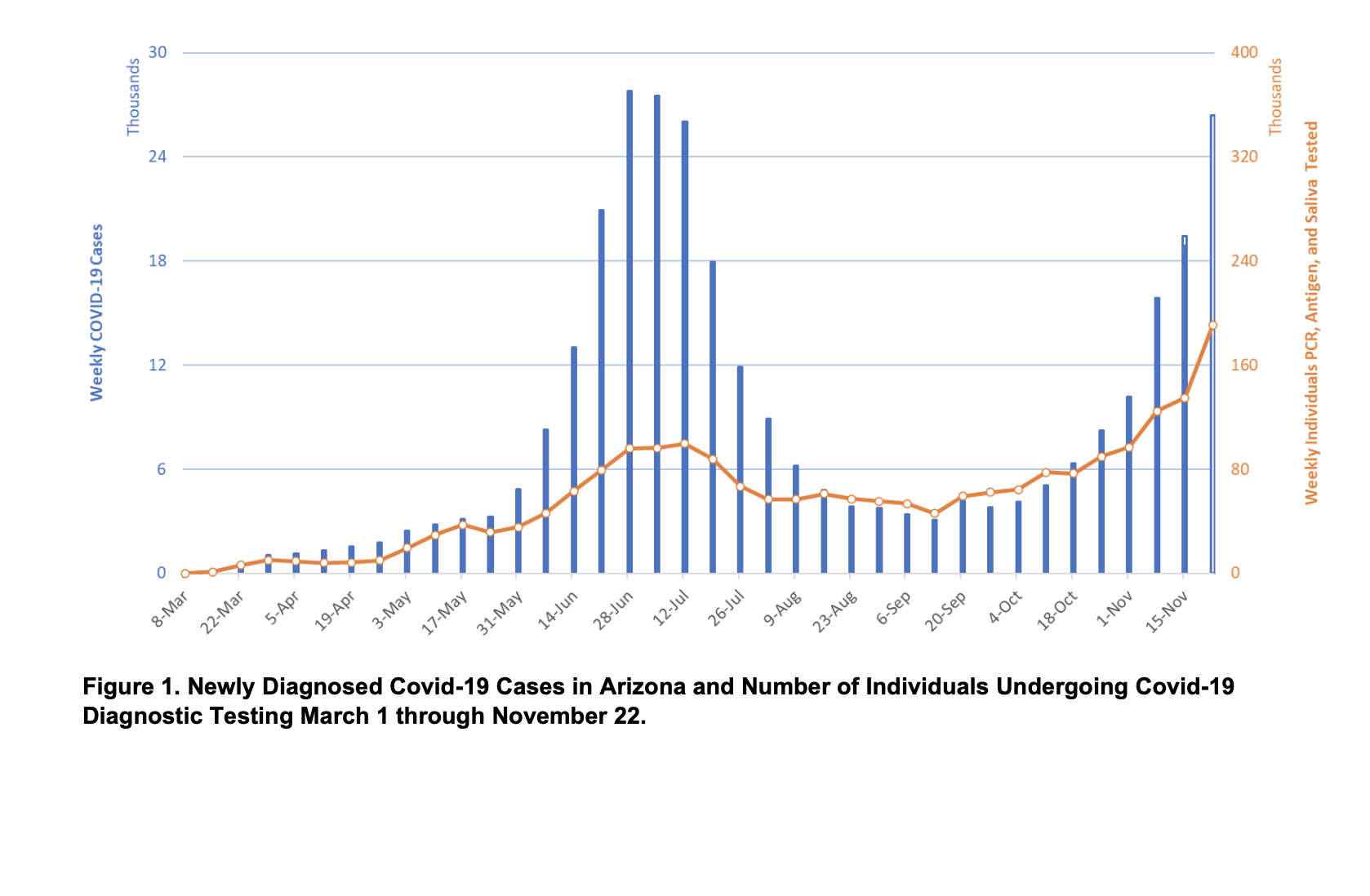
His report says Arizona's COVID-19 test positivity reached 17% the past week, providing “additional evidence that viral transmission continues to increase despite the uncertainty surrounding actual case counts.”
On Friday, Nov. 27, 28% of hospital ward beds were filled by COVID-19 patients, a 24% increase from the week prior. Of the state’s ICU beds, 32% were occupied by coronavirus patients, a 27% increase from last week, according to Gerald’s report.
Members of the COVID-19 modeling team at UA said Arizona State University’s COVID-19 projections predict by early December, hospitalizations will exceed current ICU and general ward capacity throughout the state.
By late December, the ASU COVID-19 modeling team predicts hospitalizations will exceed their total capacity, causing “no additional availability to provide care for routine, urgent, or emergent non-COVID care,” according to the UA modeling team’s memo.
Gerald wrote in his report that if total hospital capacity is reached, “it would represent a humanitarian crisis of unparalleled proportion and would be accompanied by hundreds if not thousands of preventable deaths.”
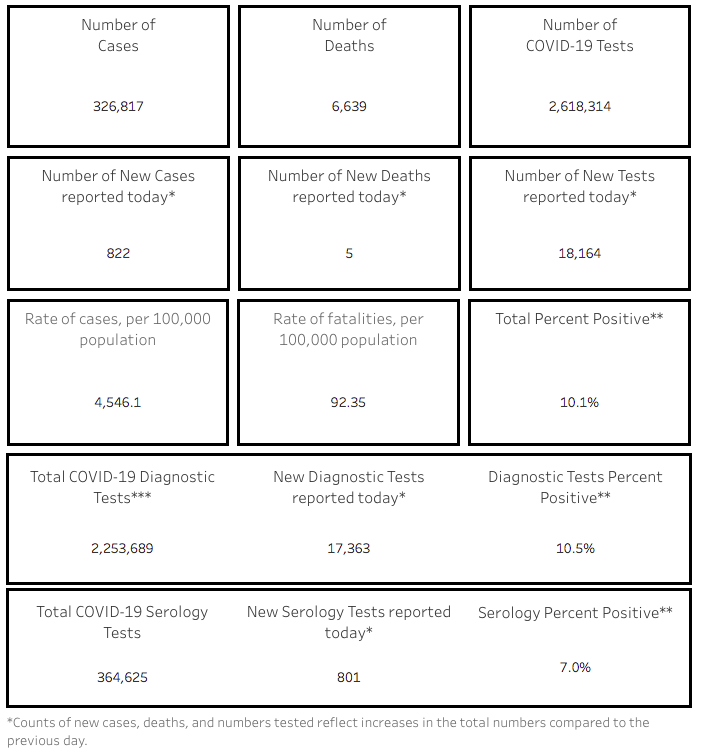
With more than 800 new cases reported today, the number of Arizona’s confirmed novel coronavirus cases closed in on 327,000 as of Monday, Nov. 30, according to the Arizona Department of Health Services.

Pima County, which reported 46 new cases today, has seen 39,859 of the state’s 326,817 confirmed cases.
With five new deaths reported yesterday, a total of 6,639 Arizonans had died after contracting COVID-19, including 691 deaths in Pima County, according to the Nov. 30 report.
The number of hospitalized COVID cases statewide continues to climb upward as the virus has begun to spread more rapidly, putting stress on Arizona’s hospitals. ADHS reported that as of Nov. 29, 2,513 COVID patients were hospitalized in the state, the highest that number has been since July 27. That number peaked with 3,517 hospitalized COVID patients on July 13; it hit a subsequent low of 468 on Sept. 27.
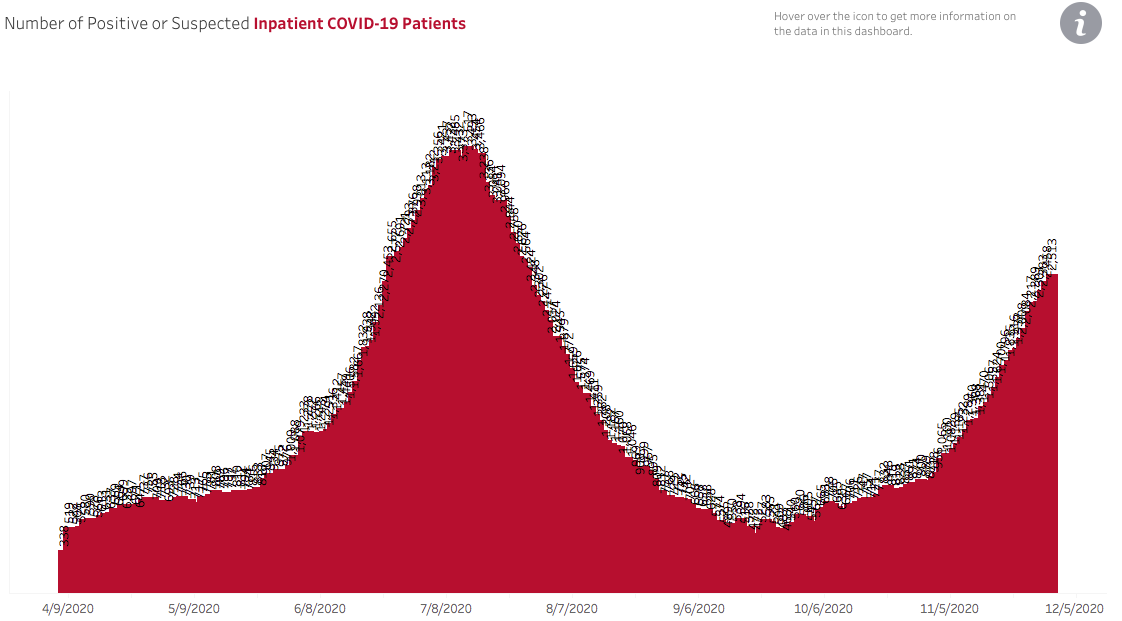
A total of 1,488 people visited emergency rooms on Nov. 29 with COVID symptoms. That number peaked at 2,008 on July 7; it hit a subsequent low of 653 on Sept. 28.
A total of 579 COVID-19 patients were in intensive care unit beds on Nov. 29, the highest that number has been since Aug. 5. The number of COVID patients in ICUs peaked at 970 on July 13 and hit a subsequent low of 114 on Sept. 22.
On a week-by-week basis in Pima County, the number of positive COVID tests peaked the week ending July 4 with 2,452 cases, according to an Nov. 25 report from the Pima County Health Department. (Numbers in this report are subject to revision.)
Pima County is seeing a dramatic rise in cases in recent weeks. For the week ending Oct. 31, 1,348 cases were reported; for the week ending Nov. 7, 2,119 cases were reported; and for the week ending Nov. 14, 2,578 cases were reported; for the week ending Nov. 21, 3,313 cases were reported.
Pima County Administrator Chuck Huckelberry noted last week that the county had seen 4,620 cases in the first 17 days in November.
“For the first 17 days in July, the worst month of COVID-19 case increases to date, there were 5,057 cases,” Huckleberry said in a Nov. 17 memo. “Therefore, we are on pace to exceed the total number of monthly COVID-19 infections in our previous worst month, July.”
Friday, November 27, 2020
PHOENIX – As cases of COVID-19 continue to surge in Arizona and the rest of the nation, the state’s three public universities are wrangling their approaches to the pandemic in similar but separate ways.
Arizona State University developed a saliva-based test and aims to monitor the spread through frequent mass testing.
The University of Arizona, unlike its counterparts, invested in a wastewater test to monitor the spread in highly populated places on campus and suggested a schoolwide shelter-in-place initiative.
Northern Arizona University, the smallest of the three, has changed the least. It adopted ASU’s saliva test and shares UArizona’s system for contact tracing, but it has been the most lenient with in-person education, offering classes with fewer than 45 students.
As the end of the semester nears, holiday travel ramps up and the pandemic reaches a critical juncture, college campuses and their thousands of students are being further scrutinized.
All three Arizona universities will end all in-person classes after the Thanksgiving holiday and recommended students and faculty get tested before any holiday travel and before they return in the spring.
As of Tuesday, Nov. 24, the Arizona Department of Health reported 4,544 new cases with a percent positive rate of 9.9%. In Maricopa County, which includes four of ASU’s campuses, the positivity rate exceeded the state average by nearly 1%.
Nationally, there have been more than 12 million cases of COVID-19 and more than 1 million cases in the past seven days alone, according to the Centers for Disease Control. Johns Hopkins University reports a national seven-day percent positive rate of 9.6%.
“They’re using their strengths,” Will Humble, executive director for the Arizona Public Health Association, said of the slight differences in approaches among Arizona campuses. “But in the end it will be really interesting to see (when) we can look back at the three universities and compare their outcomes and we’ll be able to tell which approaches were most effective.”
Humble said it is too early to draw definitive conclusions, but he praised each university for acting fast.

