

Friday, July 17, 2020
As COVID-19 began to spread across the Southwest in March, lawyers representing incarcerated Arizonans reported “unsanitary conditions,” “inadequate medical staffing and treatment” and a “failure to take strong and sensible precautionary measures” in state prisons.
The combination left prisoners “highly vulnerable to outbreaks,” the attorneys wrote in a letter to the state before asking a federal judge to intervene. The judge did by issuing an order for officials to release more information, but prison advocates say it hasn’t been enough.
Nearly four months later, complaints of insufficient safety measures and subpar medical care continue to plague Arizona prisons. At least 569 prisoners at 13 of the state’s 16 prison complexes had tested positive for COVID-19 as of July 15, according to the Department of Corrections, Rehabilitation and Reentry, and at least 371 staffers have reported positive results.
Justice reform advocates and others with ties to the correctional system worry the state is running out of time to prevent an even more dangerous surge in cases. COVID-19 can spread swiftly in crowded indoor spaces and among individuals with chronic health problems.
“(Inmates) are scared,” said Jared Wagoner, who was incarcerated in the Cibola Unit at the Arizona State Prison Complex in Yuma until June 8. He cited close quarters, insufficient testing and indifferent medical staff as ongoing obstacles.
“They’re scared that their two-year sentence is going to become a life sentence,” Wagoner said.

The combination left prisoners “highly vulnerable to outbreaks,” the attorneys wrote in a letter to the state before asking a federal judge to intervene. The judge did by issuing an order for officials to release more information, but prison advocates say it hasn’t been enough.
Nearly four months later, complaints of insufficient safety measures and subpar medical care continue to plague Arizona prisons. At least 569 prisoners at 13 of the state’s 16 prison complexes had tested positive for COVID-19 as of July 15, according to the Department of Corrections, Rehabilitation and Reentry, and at least 371 staffers have reported positive results.
Justice reform advocates and others with ties to the correctional system worry the state is running out of time to prevent an even more dangerous surge in cases. COVID-19 can spread swiftly in crowded indoor spaces and among individuals with chronic health problems.
“(Inmates) are scared,” said Jared Wagoner, who was incarcerated in the Cibola Unit at the Arizona State Prison Complex in Yuma until June 8. He cited close quarters, insufficient testing and indifferent medical staff as ongoing obstacles.
“They’re scared that their two-year sentence is going to become a life sentence,” Wagoner said.
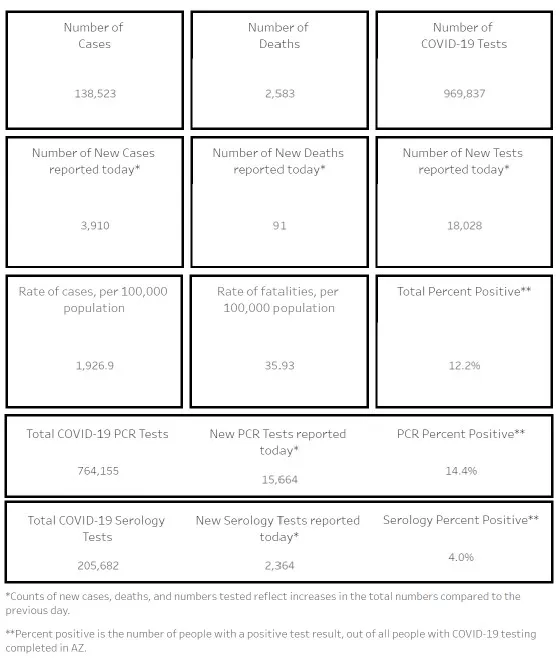
The total number of confirmed coronavirus cases in Arizona climbed past 138K as of Friday, July 17, after the state reported 3,910 new cases this morning, according to the Arizona Department of Health Services.
Pima County had seen 13,058 of the state's 138,523 confirmed cases.
A total of 2,583 people have died after contracting the virus.
Maricopa County has 91,863 of the state's cases.
Hospitals remain under pressure. The report shows that 3,466 COVID patients were hospitalized yesterday in the state.
A total of 1,574 people visited ERs yesterday.
A total of 944 COVID-19 patients were in ICU beds yesterday.
Gov. Doug Ducey said yesterday that mask-wearing and steps to reduce the interaction of people in large groups had resulted in some positive signs regarding the spread of the virus. He cited a slight drop in the percentage of people visiting emergency rooms exhibiting COVID-like illness in the last week, as well as a drop in the total number of cases on a week-to-week basis (although all test results may not be in yet for tests in recent days).
Ducey also said Arizona R-naught number—or the number of people with the virus who are infecting other people—dropped to .98 as of yesterday, meaning the infection rate has slowed. An R-naught of less than 1 means the virus is in decline.
But Ducey warned the state still had a long road ahead in the fight against the deadly virus.
"I want people to get their heads around this," Ducey said. "There's no end in sight today."
Figures from Pima County show that on a week-by-week basis, cases here may have also peaked in the week ending June 27, with new cases reaching 2,300. Pima County Administrator Chuck Huckelberry noted that the two subsequent weeks could still be adjusted upwards, but during the week ending July 4, 2,092 cases were reported. But Huckelberry noted that the week ending July 4, the county saw a peak of 37 deaths so the county is far from out of the woods.
Pima County had seen 13,058 of the state's 138,523 confirmed cases.
A total of 2,583 people have died after contracting the virus.
Maricopa County has 91,863 of the state's cases.
Hospitals remain under pressure. The report shows that 3,466 COVID patients were hospitalized yesterday in the state.
A total of 1,574 people visited ERs yesterday.
A total of 944 COVID-19 patients were in ICU beds yesterday.
Gov. Doug Ducey said yesterday that mask-wearing and steps to reduce the interaction of people in large groups had resulted in some positive signs regarding the spread of the virus. He cited a slight drop in the percentage of people visiting emergency rooms exhibiting COVID-like illness in the last week, as well as a drop in the total number of cases on a week-to-week basis (although all test results may not be in yet for tests in recent days).
AZ Dept of Health Services
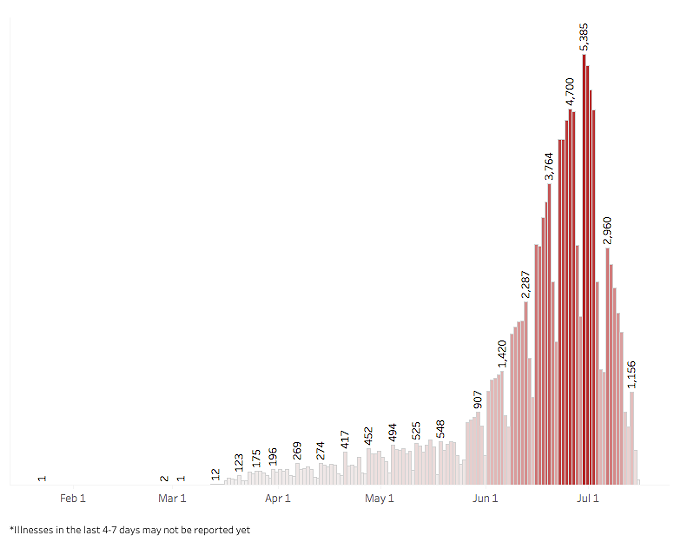
Arizona's epic-curve is seeing a decline in the number of cases reported by day, although all data from recent days is not yet available.
Ducey also said Arizona R-naught number—or the number of people with the virus who are infecting other people—dropped to .98 as of yesterday, meaning the infection rate has slowed. An R-naught of less than 1 means the virus is in decline.
But Ducey warned the state still had a long road ahead in the fight against the deadly virus.
"I want people to get their heads around this," Ducey said. "There's no end in sight today."
Figures from Pima County show that on a week-by-week basis, cases here may have also peaked in the week ending June 27, with new cases reaching 2,300. Pima County Administrator Chuck Huckelberry noted that the two subsequent weeks could still be adjusted upwards, but during the week ending July 4, 2,092 cases were reported. But Huckelberry noted that the week ending July 4, the county saw a peak of 37 deaths so the county is far from out of the woods.
Thursday, July 16, 2020
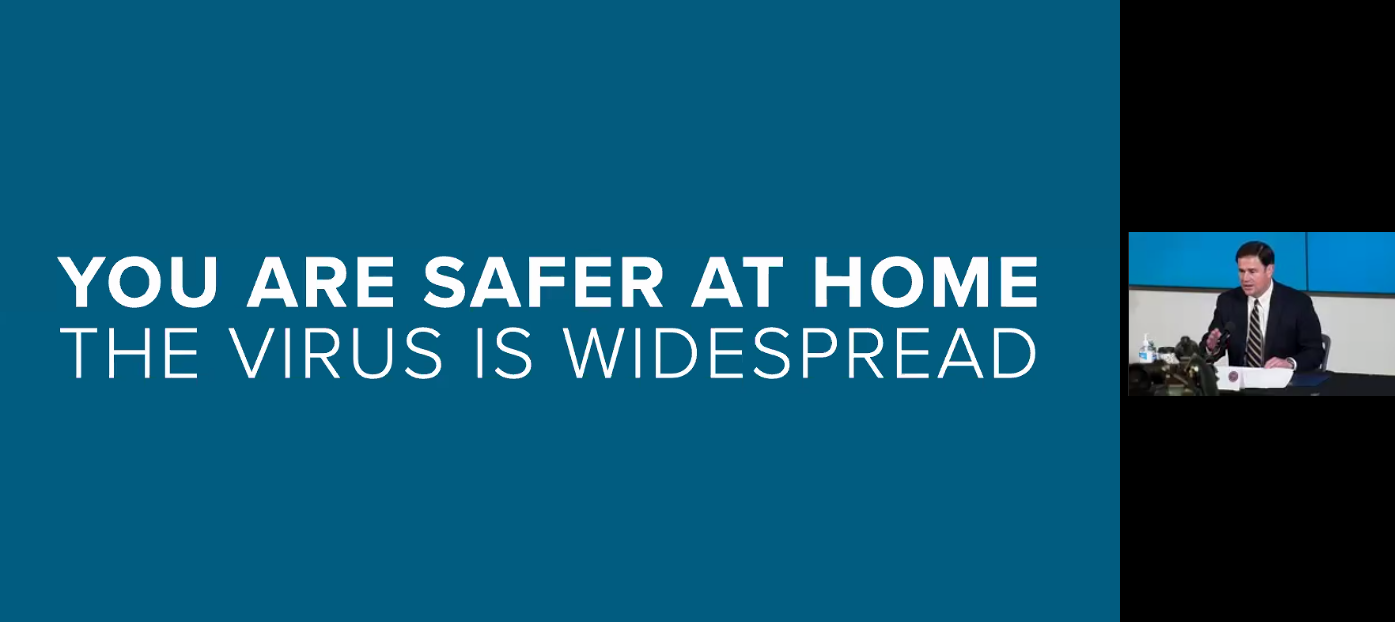
Gov. Doug Ducey said the state was seeing some reduction in the spread of COVID-19 virus but warned the state had a long road ahead in the fight against the deadly virus.
"I want people to get their heads around this," Ducey said. "There's no end in sight today. … There will be no victory laps."
Ducey announced a new executive order extending the residential eviction moratorium until Halloween and said he was in conversations with school leaders and university presidents about the best way to move forward with the school year.
The previous residential eviction moratorium was set to expire on Saturday, July 25.
“It’s been some time since we’ve talked about the March 24 executive order to delay evictions for those impacted by COVID-19,” Ducey said. “I’ve got an update on this along with a new executive order extending the eviction moratorium on residential evictions until Oct. 31."
Ducey announced $650,000 would go to various community action agencies to improve staffing and help administer rental assistance programs for Arizonans statewide. Approximately $1.2 million in assistance has been distributed to Arizona renters since late March, according to the Governor's Office.
Additionally, Ducey announced $5 million to establish the Foreclosure Prevention Program to help residential landlords dependent on rental income to survive.
“This will provide targeted relief to homeowners who rely on income from tenants to help them avoid foreclosure,” Ducey said. “In total, state and local governments have directed more than $80 million on programs to assist renters and prevent homelessness.”
"I want people to get their heads around this," Ducey said. "There's no end in sight today. … There will be no victory laps."
Ducey announced a new executive order extending the residential eviction moratorium until Halloween and said he was in conversations with school leaders and university presidents about the best way to move forward with the school year.
The previous residential eviction moratorium was set to expire on Saturday, July 25.
“It’s been some time since we’ve talked about the March 24 executive order to delay evictions for those impacted by COVID-19,” Ducey said. “I’ve got an update on this along with a new executive order extending the eviction moratorium on residential evictions until Oct. 31."
Ducey announced $650,000 would go to various community action agencies to improve staffing and help administer rental assistance programs for Arizonans statewide. Approximately $1.2 million in assistance has been distributed to Arizona renters since late March, according to the Governor's Office.
Additionally, Ducey announced $5 million to establish the Foreclosure Prevention Program to help residential landlords dependent on rental income to survive.
“This will provide targeted relief to homeowners who rely on income from tenants to help them avoid foreclosure,” Ducey said. “In total, state and local governments have directed more than $80 million on programs to assist renters and prevent homelessness.”
ProPublica is a nonprofit newsroom that investigates abuses of power. Click here to read their biggest stories as soon as they’re published.
In the middle of March, as the coronavirus pandemic was shutting down the country, McKinsey & Co., the giant management consulting firm, saw opportunity. The firm sprang into sales mode, deploying its partners across the country to seek contracts with federal agencies, state governments and city halls. Government organizations had been caught unprepared by the virus, and there was a lot of money to be made advising them on how to address it.
That month, a partner in McKinsey’s Washington, D.C., office, Scott Blackburn, got in touch with an old colleague. Deb Kramer had just been promoted to become an acting assistant undersecretary at the Department of Veterans Affairs, where Blackburn, whom McKinsey declined to make available for an interview, had held senior roles between 2014 and 2018. During that period, the two had overseen a major overhaul of the agency called “MyVA,” a project McKinsey had worked on as well. Blackburn had worked at McKinsey before going to the VA, and he returned to the firm afterward. He and Kramer were in touch repeatedly in the middle of March, according to a person familiar with the exchanges.
On March 19, Kramer made a highly unusual request: The VA, she said, needed to hire McKinsey within 24 hours. The VA runs a sprawling health care system that serves 9 million veterans, many of them older and plagued by chronic health problems, and typically takes many months to solicit and accept bids and vet bidders for a contract. The health system’s leadership wanted to sign a multimillion-dollar contract with McKinsey to spend up to a year consulting on “all aspects” of the system’s operations during the COVID-19 pandemic, Kramer told a VA contracting officer, Nathan Pennington. Pennington memorialized parts of the exchange in a public contracting document.

In the middle of March, as the coronavirus pandemic was shutting down the country, McKinsey & Co., the giant management consulting firm, saw opportunity. The firm sprang into sales mode, deploying its partners across the country to seek contracts with federal agencies, state governments and city halls. Government organizations had been caught unprepared by the virus, and there was a lot of money to be made advising them on how to address it.
That month, a partner in McKinsey’s Washington, D.C., office, Scott Blackburn, got in touch with an old colleague. Deb Kramer had just been promoted to become an acting assistant undersecretary at the Department of Veterans Affairs, where Blackburn, whom McKinsey declined to make available for an interview, had held senior roles between 2014 and 2018. During that period, the two had overseen a major overhaul of the agency called “MyVA,” a project McKinsey had worked on as well. Blackburn had worked at McKinsey before going to the VA, and he returned to the firm afterward. He and Kramer were in touch repeatedly in the middle of March, according to a person familiar with the exchanges.
On March 19, Kramer made a highly unusual request: The VA, she said, needed to hire McKinsey within 24 hours. The VA runs a sprawling health care system that serves 9 million veterans, many of them older and plagued by chronic health problems, and typically takes many months to solicit and accept bids and vet bidders for a contract. The health system’s leadership wanted to sign a multimillion-dollar contract with McKinsey to spend up to a year consulting on “all aspects” of the system’s operations during the COVID-19 pandemic, Kramer told a VA contracting officer, Nathan Pennington. Pennington memorialized parts of the exchange in a public contracting document.
Bertha spent 17 days in her bedroom after testing positive for COVID-19.
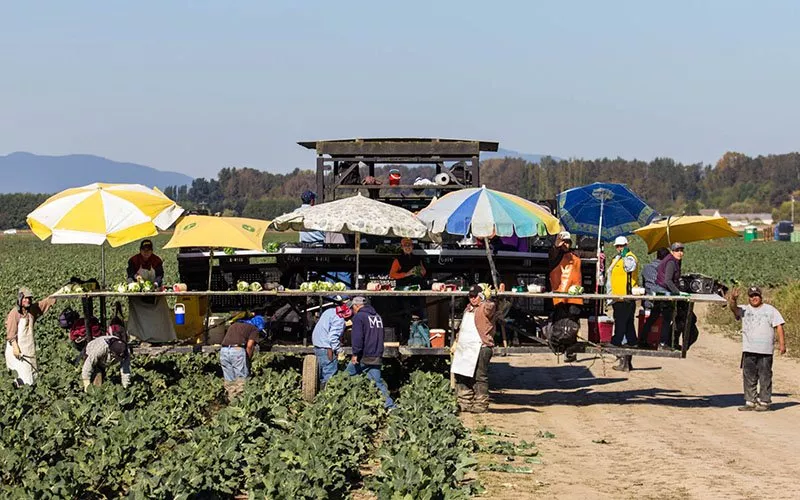
There, she made the soup and the “hot, hot tea” that helped her endure the headaches and coughing fits associated with the contagious respiratory disease. Bertha, an agricultural worker, said she couldn’t risk going to the kitchen or other parts of the house and infecting her 18-year-old daughter.
The two-plus weeks of isolation seem to have paid off: Her doctor recently cleared her to resume normal activities, Bertha said, and her daughter was never infected. But Bertha worries that if she returns to work processing pistachios for Primex Farms LLC – a California-based grower and exporter of nuts and dried fruits – she will bring the virus home again.
Bertha, who agreed to speak on the condition her last name not be published for fear of retaliation, said she doesn’t know whether she can trust the company’s attempts at disinfecting the space and implementing safety measures. Even before she tested positive, she thought the farm’s safety precautions were insufficient.
From a lack of social distancing in dining areas to employees handling pistachios without gloves, she estimates “many pounds” of pistachios passed through the hands of workers infected with COVID-19.
There, she made the soup and the “hot, hot tea” that helped her endure the headaches and coughing fits associated with the contagious respiratory disease. Bertha, an agricultural worker, said she couldn’t risk going to the kitchen or other parts of the house and infecting her 18-year-old daughter.
The two-plus weeks of isolation seem to have paid off: Her doctor recently cleared her to resume normal activities, Bertha said, and her daughter was never infected. But Bertha worries that if she returns to work processing pistachios for Primex Farms LLC – a California-based grower and exporter of nuts and dried fruits – she will bring the virus home again.
Bertha, who agreed to speak on the condition her last name not be published for fear of retaliation, said she doesn’t know whether she can trust the company’s attempts at disinfecting the space and implementing safety measures. Even before she tested positive, she thought the farm’s safety precautions were insufficient.
From a lack of social distancing in dining areas to employees handling pistachios without gloves, she estimates “many pounds” of pistachios passed through the hands of workers infected with COVID-19.
PHOENIX – The head of Arizona State University’s Biodesign Institute painted a glum picture Wednesday of current COVID-19 trends in the state, but he also suggested that the trend could be slowly improving.
Joshua LaBaer, executive director of the Biodesign Institute, noted that virus cases are soaring across the country, and that Arizona is one of the states leading the surge. Some hospitals have temporarily run out of beds in their intensive care units, and death rates are going up, he said during a virtual press briefing Wednesday.
“If you look at each of the different counties here, you’ll see that . . . most of them are trending upwards,” said LaBaer as he showed off a dashboard designed by ASU’s Clinical Testing Laboratory.
The briefing came as the number of cases in the state topped 130,000 and the number of deaths topped 2,400 for the first time.
Joshua LaBaer, executive director of the Biodesign Institute, noted that virus cases are soaring across the country, and that Arizona is one of the states leading the surge. Some hospitals have temporarily run out of beds in their intensive care units, and death rates are going up, he said during a virtual press briefing Wednesday.
“If you look at each of the different counties here, you’ll see that . . . most of them are trending upwards,” said LaBaer as he showed off a dashboard designed by ASU’s Clinical Testing Laboratory.
The briefing came as the number of cases in the state topped 130,000 and the number of deaths topped 2,400 for the first time.
PHOENIX – Arizona Schools Superintendent Kathy Hoffman said Wednesday that the already delayed Aug. 17 start of in-person classes may have to be pushed back again in light of continuing concerns about COVID-19 safety.
Hoffman, during a conference call to criticize a White House push for reopening schools, said she and Gov. Doug Ducey are re-evaluating that date, which was announced by Ducey in an executive order two weeks ago.
“At this time, I am not optimistic that Arizona will be ready to open for in-person instruction on Aug. 17,” Hoffman said. “I would predict that we will have announcements regarding that in the near future, but that has not yet been decided.”
Ducey spoke with superintendents from around the state Wednesday, but his office did not immediately respond to requests for comment.
Hoffman’s comments came during a call in which state Democrats pushed back against the White House, which is leading the charge in favor of reopening schools. They said that push comes with little guidance and “lacks empathy for our educators” at a time of spiraling COVID-19 cases.
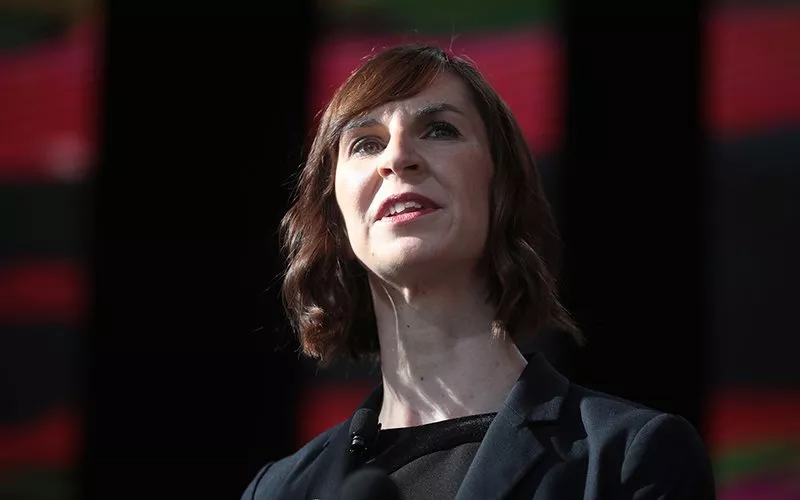
Hoffman, during a conference call to criticize a White House push for reopening schools, said she and Gov. Doug Ducey are re-evaluating that date, which was announced by Ducey in an executive order two weeks ago.
“At this time, I am not optimistic that Arizona will be ready to open for in-person instruction on Aug. 17,” Hoffman said. “I would predict that we will have announcements regarding that in the near future, but that has not yet been decided.”
Ducey spoke with superintendents from around the state Wednesday, but his office did not immediately respond to requests for comment.
Hoffman’s comments came during a call in which state Democrats pushed back against the White House, which is leading the charge in favor of reopening schools. They said that push comes with little guidance and “lacks empathy for our educators” at a time of spiraling COVID-19 cases.
The total number of confirmed coronavirus cases in Arizona climbed past 134K as of Thursday, July 16, after the state reported 3,259 new cases this morning, according to the Arizona Department of Health Services.
Pima County had seen 12,697 of the state's 134,613 confirmed cases.
A total of 2,492 people have died after contracting the virus.
Maricopa County has 88,954 of the state's cases.
Hospitals remain under pressure. The report shows that 3,454 COVID patients were hospitalized yesterday in the state.
A total of 1,695 people visited ERs yesterday.
A total of 918 COVID-19 patients were in ICU beds yesterday.
With cases on the rise, concern continues to mount about opening schools next month. Will Humble, executive director of the Arizona Public Health Association, said last week that while states that have taken more aggressive steps earlier to slow the spread of the virus will be able to reopen schools, he can’t see the same thing happening in Arizona.
“We just have too much community spread,” Humble said.
Humble, who headed up the Arizona Department of Health Services in the administration of former Gov. Jan Brewer, said there are two main factors to consider when opening schools in the fall: mitigation measures alongside the level of community spread within a school district.
“School districts have some really creative folks and I think they could put some effective mitigation measures in place that would make it safe to open schools if we didn’t have so much community spread,” Humble said. “Because we have the level of community spread that we have, I just don’t see that mitigation measures, which help but don’t eliminate transmission, are going to be adequate to make it a safe environment for teachers and schools and families.”
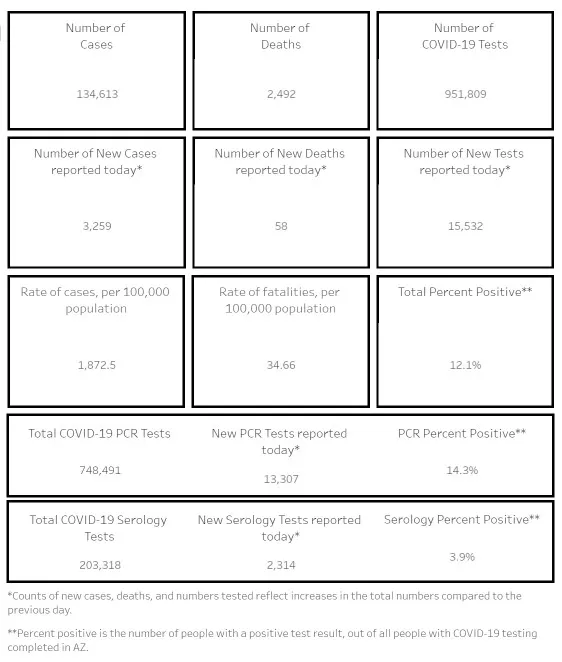
Pima County had seen 12,697 of the state's 134,613 confirmed cases.
A total of 2,492 people have died after contracting the virus.
Maricopa County has 88,954 of the state's cases.
Hospitals remain under pressure. The report shows that 3,454 COVID patients were hospitalized yesterday in the state.
A total of 1,695 people visited ERs yesterday.
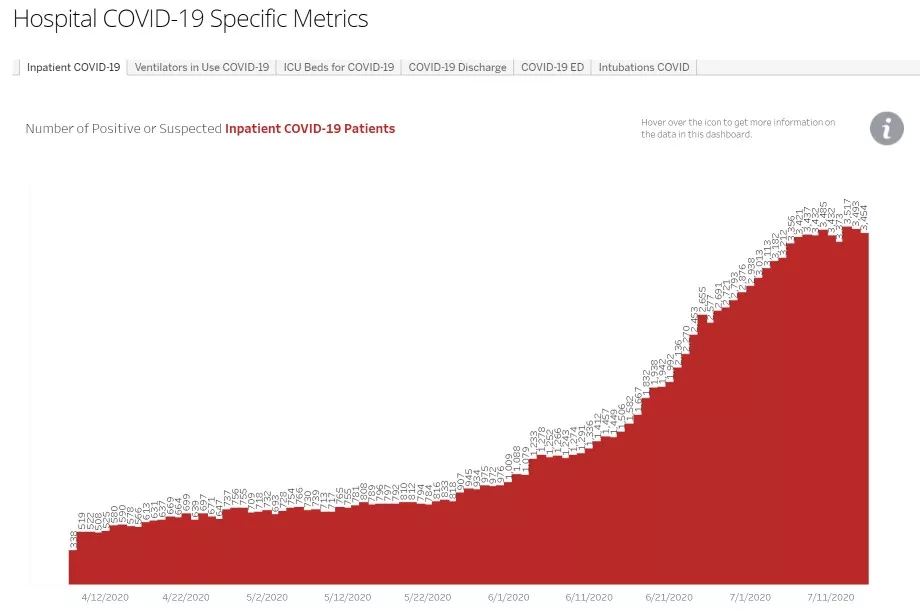
A total of 918 COVID-19 patients were in ICU beds yesterday.
With cases on the rise, concern continues to mount about opening schools next month. Will Humble, executive director of the Arizona Public Health Association, said last week that while states that have taken more aggressive steps earlier to slow the spread of the virus will be able to reopen schools, he can’t see the same thing happening in Arizona.
“We just have too much community spread,” Humble said.

Humble, who headed up the Arizona Department of Health Services in the administration of former Gov. Jan Brewer, said there are two main factors to consider when opening schools in the fall: mitigation measures alongside the level of community spread within a school district.
“School districts have some really creative folks and I think they could put some effective mitigation measures in place that would make it safe to open schools if we didn’t have so much community spread,” Humble said. “Because we have the level of community spread that we have, I just don’t see that mitigation measures, which help but don’t eliminate transmission, are going to be adequate to make it a safe environment for teachers and schools and families.”
Wednesday, July 15, 2020
Just ICYMI, here are the stories we covered today:

- The total number of confirmed coronavirus cases in Arizona climbed past 131K as of Wednesday, July 15, after the state reported 3,257 new cases this morning, according to the Arizona Department of Health Services.
- The Tucson Museum of Art and Historic Block announced that it will reopen its doors on Thursday, July 30.
- As the August 17 school start date grows closer, TUSD has created a unique reopening plan with a completely virtual learning model.
- As fire crews work to snuff out the last hotspots of the Bighorn Fire, a lengthy cleanup process begins.
- The Bar Exam has long been seen as the moment of reckoning for hopeful law students, but with Arizona COVID cases skyrocketing, the test pressure is higher than ever before.
- The July 4th holiday saw examples of what you have correctly called ‘bad actors’ ignoring both mask wearing and social distancing protocols. We will very soon see the impacts of that behavior in increased COVID-19 infection rates.
Honorable Governor Ducey:
The July 4th holiday saw examples of what you have correctly called ‘bad actors’ ignoring both mask wearing and social distancing protocols. We will very soon see the impacts of that behavior in increased COVID-19 infection rates. I feel confident in predicting that surge in sickness because we saw a similar trend in the weeks following the Memorial Day celebrations. During that holiday, scenes such as this were commonplace in the news:
Sir, that photo was taken of you at a party that took place shortly after Memorial Day. If bar operators are "bad actors" needing to be controlled by the State, I suggest your own behavior falls well within that same category.
The residents of Tucson have elected me, along with my City Council colleagues, with the expectation that we will do all we can to ensure the safety of the public. If we cannot count on the Governor of the State to set a ‘good actor’ example, then we will. I once again call on you to rescind the portion of your standing Executive Order in which local jurisdictions are prohibited from taking local action related to COVID-19.
Local conditions call for local solutions. Our hospitals are beyond capacity. Out-of-state health care workers are being flown in to help support our local workers. Through the surge line, our friends and loved ones are being flown out-of-State in order to receive health care. I do not believe the actions your administration has taken go far enough in protecting my constituents. I also do not believe even your own health care advisors feel the measures in place are having the desired effect.
We as elected officials will stand before the voters and be held accountable for decisions we make on the local level. All we need is for the State to step out of the way and return to us that authority.
Sincerely,
Steve Kozachik
Ward 6 Council member
The July 4th holiday saw examples of what you have correctly called ‘bad actors’ ignoring both mask wearing and social distancing protocols. We will very soon see the impacts of that behavior in increased COVID-19 infection rates. I feel confident in predicting that surge in sickness because we saw a similar trend in the weeks following the Memorial Day celebrations. During that holiday, scenes such as this were commonplace in the news:

Sir, that photo was taken of you at a party that took place shortly after Memorial Day. If bar operators are "bad actors" needing to be controlled by the State, I suggest your own behavior falls well within that same category.
The residents of Tucson have elected me, along with my City Council colleagues, with the expectation that we will do all we can to ensure the safety of the public. If we cannot count on the Governor of the State to set a ‘good actor’ example, then we will. I once again call on you to rescind the portion of your standing Executive Order in which local jurisdictions are prohibited from taking local action related to COVID-19.
Local conditions call for local solutions. Our hospitals are beyond capacity. Out-of-state health care workers are being flown in to help support our local workers. Through the surge line, our friends and loved ones are being flown out-of-State in order to receive health care. I do not believe the actions your administration has taken go far enough in protecting my constituents. I also do not believe even your own health care advisors feel the measures in place are having the desired effect.
We as elected officials will stand before the voters and be held accountable for decisions we make on the local level. All we need is for the State to step out of the way and return to us that authority.
Sincerely,
Steve Kozachik
Ward 6 Council member

