

Friday, June 12, 2020
Employees and members of the public now have to wear masks when inside of Pima County facilities, including common areas, lobbies, elevators, and where physical distancing is not possible or there are no protective barriers.
Pima County Administrator Chuck Huckelberry announced the new health and safety procedures in a June 11 memo.
The county will provide cloth masks for employees, and disposable paper masks for the public and vendors. Masks will not be required in parking garages as long as physical distancing is maintained.
According to Huckelberry’s memo, the changes were put in place “due to an increase in the number of COVID-19 cases, and to prevent the spread of the disease.”

Pima County Administrator Chuck Huckelberry announced the new health and safety procedures in a June 11 memo.
The county will provide cloth masks for employees, and disposable paper masks for the public and vendors. Masks will not be required in parking garages as long as physical distancing is maintained.
According to Huckelberry’s memo, the changes were put in place “due to an increase in the number of COVID-19 cases, and to prevent the spread of the disease.”
PHOENIX – Gov. Doug Ducey defended his plan to reopen the state Thursday, attributing concerns about the stark increase in the number of positive cases to misinformation and increased testing.
“We put the stay-at-home order in place so that we can prepare for what we’re going through right now,” he told reporters at a news conference.
The rise in Arizona COVID-19 cases has piqued concern from national experts, drawing attention to the growing infection rate and uptick in hospitalizations. The increase in cases comes just a few weeks after Ducey lifted stay-at-home orders on May 15 and Arizonans flocked to Memorial Day events across the state.
“It’s important that people know we are not seeing an increase in patient volume, we are prepared if that increase should come,” Ducey said. “The facts are, we got an increase in testing, an increase in testing and an increase in positive test results. So we’re going to continue to stay laser-focused on COVID-19.”
According to data from the COVID-19 Tracking Project, Arizona and South Carolina are the two states that “appear to have the most dire situations right now.”
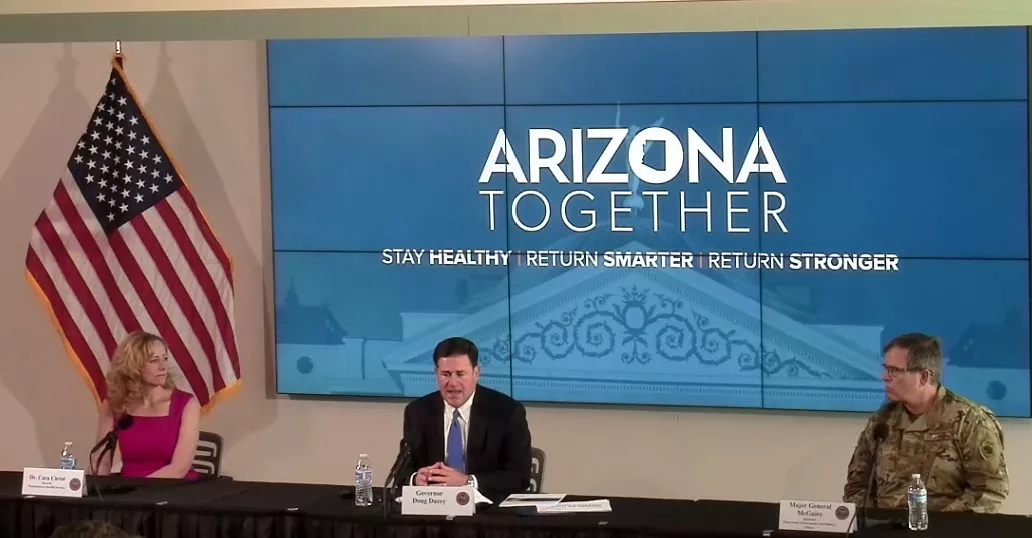
“We put the stay-at-home order in place so that we can prepare for what we’re going through right now,” he told reporters at a news conference.
The rise in Arizona COVID-19 cases has piqued concern from national experts, drawing attention to the growing infection rate and uptick in hospitalizations. The increase in cases comes just a few weeks after Ducey lifted stay-at-home orders on May 15 and Arizonans flocked to Memorial Day events across the state.
“It’s important that people know we are not seeing an increase in patient volume, we are prepared if that increase should come,” Ducey said. “The facts are, we got an increase in testing, an increase in testing and an increase in positive test results. So we’re going to continue to stay laser-focused on COVID-19.”
According to data from the COVID-19 Tracking Project, Arizona and South Carolina are the two states that “appear to have the most dire situations right now.”

CDEL Family/Creative Commons)
Protesters speak out against racism amid the COVID-19 pandemic during a demonstration Feb. 29, 2020, in San Francisco’s Chinatown. The pandemic and its link to Wuhan, the Chinese industrial city where the virus was first detected, has prompted harassment of Asian Americans and concerns among experts of longer-lasting effects on emotional and mental health.
The 30-year-old international student from China reported the incident, but it has stuck with him even months later.
“I’m confused why they’d treat me like that,” Zhou said.
The COVID-19 pandemic and its link to Wuhan, the Chinese industrial city where the virus was first detected in December, has prompted harassment and racial violence against Asian Americans and concerns among experts of longer-lasting effects on emotional and mental health.
Cynthia Choi, co-executive director of the San Francisco group Chinese for Affirmative Action, recalls one mother who contacted the group to report her child was being bullied at school and called “coronavirus.”
“She said that she noticed that her child was very depressed and very quiet and said that she did not want to be Asian,” Choi recalled. “So obviously there is a mental health impact.”
Thursday, June 11, 2020
The Pima County Board of Supervisors has taken several steps in an effort to slow the spread of COVID-19 in Pima County, including voting on March 19 to close down all nonessential businesses, and later when the state reopened the economy, voting to implement and then revise new health regulations for restaurants and bars offering dine-in service once again.
The board’s decisions have been met with some criticism across the political spectrum, with some critics saying the county has not done enough and others saying it has gone too far, according to Pima County Administrator Chuck Huckelberry.
Democratic supervisors Ramon Valadez, Sharon Bronson and Betty Villegas said they voted for the regulations to ensure public safety, while Republicans Steve Christy and Ally Miller say the new rules make it harder for beleaguered businesses to reopen. At the request of three GOP lawmakers, Attorney General Mark Brnovich investigated whether the county exceeded its legal authority by enacting the regulations but the AG’s Office dismissed the case on a legal technicality.
Tucson Weekly asked the candidates running for Board of Supervisors seats this year if they approved of those decisions and if they would have done anything differently.
In Pima County’s District 1, which includes Marana, Oro Valley, Casas Adobes and the Catalina Foothills, Pima County Supervisor Ally Miller is retiring. There’s a four-way GOP primary and a two-way Democratic primary for the open seat.
The Republicans include: Oro Valley Councilmember Rhonda Piña, former state lawmaker Vic Williams, former Pima County Republican Party Chair Bill Beard and political newcomer Steve Spain, who has worked developing technology for hotels.
All of the Republican candidates were critical of the county’s emergency regulations.
Beard, who has been critical of efforts to combat the outbreak by requiring businesses to shut down, condemned the board’s actions.
The board’s decisions have been met with some criticism across the political spectrum, with some critics saying the county has not done enough and others saying it has gone too far, according to Pima County Administrator Chuck Huckelberry.
Democratic supervisors Ramon Valadez, Sharon Bronson and Betty Villegas said they voted for the regulations to ensure public safety, while Republicans Steve Christy and Ally Miller say the new rules make it harder for beleaguered businesses to reopen. At the request of three GOP lawmakers, Attorney General Mark Brnovich investigated whether the county exceeded its legal authority by enacting the regulations but the AG’s Office dismissed the case on a legal technicality.
Tucson Weekly asked the candidates running for Board of Supervisors seats this year if they approved of those decisions and if they would have done anything differently.
In Pima County’s District 1, which includes Marana, Oro Valley, Casas Adobes and the Catalina Foothills, Pima County Supervisor Ally Miller is retiring. There’s a four-way GOP primary and a two-way Democratic primary for the open seat.
The Republicans include: Oro Valley Councilmember Rhonda Piña, former state lawmaker Vic Williams, former Pima County Republican Party Chair Bill Beard and political newcomer Steve Spain, who has worked developing technology for hotels.
All of the Republican candidates were critical of the county’s emergency regulations.
Beard, who has been critical of efforts to combat the outbreak by requiring businesses to shut down, condemned the board’s actions.
There's an important safety tip missing from this safety tip from Gov. Doug Ducey: He's still not encouraging people to wear masks when they're out in public, despite Arizona's soaring positive COVID-19 tests and the advice of medical professionals. It's past time to set an example here, Gov. Ducey. Why the reluctance?We all play a role in protecting public health and safety.
— Doug Ducey (@dougducey) June 9, 2020
Wash your hands✔️ Stay home when you are sick✔️ Disinfect frequently touched surfaces✔️ pic.twitter.com/wsdKZfE5D0
The number of confirmed coronavirus cases in Arizona surpassed 31,000 as of Thursday, June 11, with another jump of 1,412 new cases reported this morning, according to the Arizona Department of Health Services.
Pima County had 3,479 of the state's 31,264 confirmed cases.
A total of 1,127 people have died after contracting the virus, including 218 in Pima County, according to the report.
In Maricopa County, the number of confirmed COVID-19 cases hit 16,018.
Because symptoms can take as long as two weeks to appear after exposure to the virus (while some people can remain entirely asymptomatic), health officials continue to urge the public to avoid unnecessary trips and gatherings of more than 10 people, especially if you have underlying health conditions, and have advised people to cover their faces with masks in public.
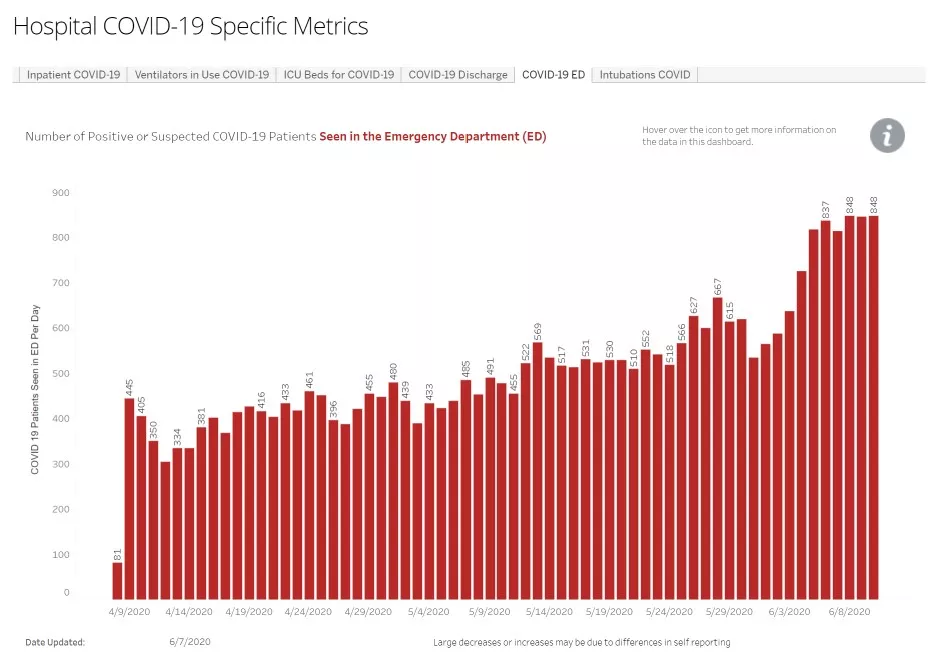
Arizona hospitals continue to see a rise in the number of people hospitalized with COVID symptoms, as well as more people visiting emergency rooms. This morning's Arizona Department of Health Services report shows that as of yesterday, 1,291 Arizonans were hospitalized. There are 429 COVID patients in ICU units and 848 people arrived at emergency rooms with COVID-like symptoms on June 10, according to the report.
When Ducey lifted Arizona's stay-at-home order on May 16, he noted that CDC gating criteria included two weeks of falling cases or two weeks decreasing positive cases as a percentage of total tests. Total cases continue to rise, as does the number of positive cases as a percentage of total tests. On May 17, the percentage of positive tests to total tests was 6 percent; on May 24, it was 9 percent; on May 31, it was 12 percent, according to figure on the ADHS website.
At a June 4 press conference, Ducey said he and Department of Health Services Director Dr. Cara Christ anticipated the current increase in positive COVID-19 cases because testing has “dramatically increased” within the state. Christ downplayed the alarm about the recent increase in cases, which some have attributed to the end of the stay-at-home order on May 15, saying “as people come back together, we know there will be transmissions of COVID-19.”
While they admitted new cases are to be expected when people begin to interact again, Ducey and Christ said their main focus was to ensure that hospitals had the capacity for an increase in cases. They reported that the current use of hospital beds, ICU beds, and ventilators were all within capacity last week.
“The fact that we were going to focus on having more tests means we were going to have more cases,” Ducey said. “We anticipated that. What we wanted to do was to be prepared for this.”
But Banner Health officials warned last week that unless current trends changed, they would have to activate a reserve bed plan as their ICU beds were nearly full.
In other news:
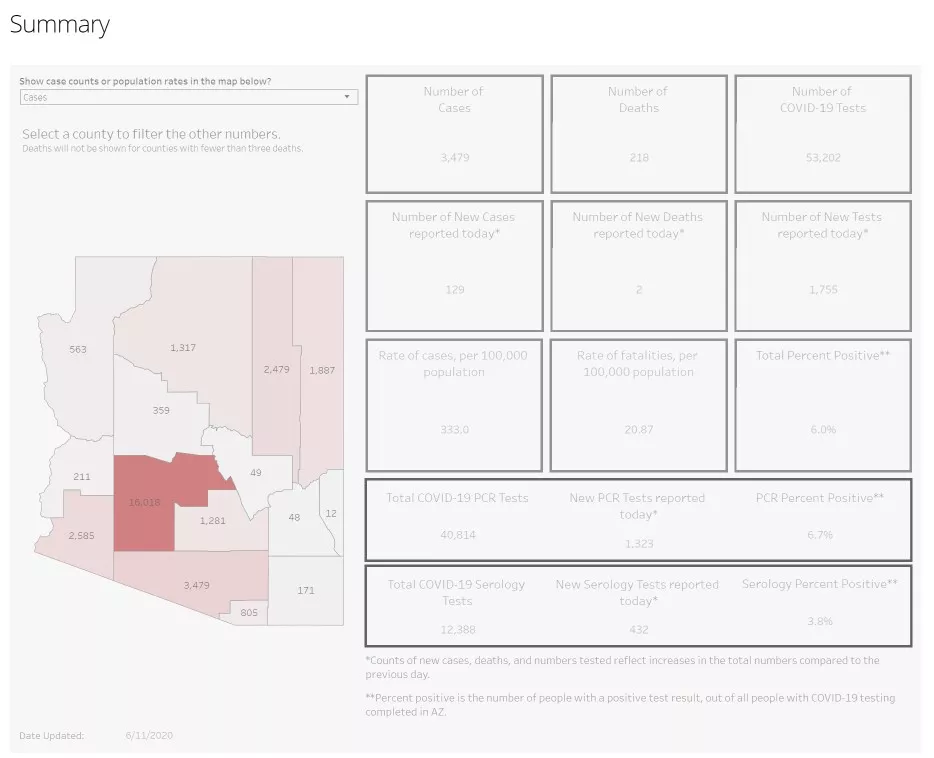
Pima County had 3,479 of the state's 31,264 confirmed cases.

A total of 1,127 people have died after contracting the virus, including 218 in Pima County, according to the report.
In Maricopa County, the number of confirmed COVID-19 cases hit 16,018.
Because symptoms can take as long as two weeks to appear after exposure to the virus (while some people can remain entirely asymptomatic), health officials continue to urge the public to avoid unnecessary trips and gatherings of more than 10 people, especially if you have underlying health conditions, and have advised people to cover their faces with masks in public.
Arizona hospitals continue to see a rise in the number of people hospitalized with COVID symptoms, as well as more people visiting emergency rooms. This morning's Arizona Department of Health Services report shows that as of yesterday, 1,291 Arizonans were hospitalized. There are 429 COVID patients in ICU units and 848 people arrived at emergency rooms with COVID-like symptoms on June 10, according to the report.
When Ducey lifted Arizona's stay-at-home order on May 16, he noted that CDC gating criteria included two weeks of falling cases or two weeks decreasing positive cases as a percentage of total tests. Total cases continue to rise, as does the number of positive cases as a percentage of total tests. On May 17, the percentage of positive tests to total tests was 6 percent; on May 24, it was 9 percent; on May 31, it was 12 percent, according to figure on the ADHS website.
At a June 4 press conference, Ducey said he and Department of Health Services Director Dr. Cara Christ anticipated the current increase in positive COVID-19 cases because testing has “dramatically increased” within the state. Christ downplayed the alarm about the recent increase in cases, which some have attributed to the end of the stay-at-home order on May 15, saying “as people come back together, we know there will be transmissions of COVID-19.”
While they admitted new cases are to be expected when people begin to interact again, Ducey and Christ said their main focus was to ensure that hospitals had the capacity for an increase in cases. They reported that the current use of hospital beds, ICU beds, and ventilators were all within capacity last week.
“The fact that we were going to focus on having more tests means we were going to have more cases,” Ducey said. “We anticipated that. What we wanted to do was to be prepared for this.”
But Banner Health officials warned last week that unless current trends changed, they would have to activate a reserve bed plan as their ICU beds were nearly full.
In other news:
Wednesday, June 10, 2020
The Best of Tucson 2020® is ready to go and waiting for your nominations! After you're done, you can take a look at the other stories we covered today, just in case you missed them earlier.

- The number of confirmed coronavirus cases in Arizona surpassed 29,000 as of Wednesday, June 10, with another jump of 1,556 new cases reported this morning, according to the Arizona Department of Health Services.
- So, the first uncomfortable reality of your slow home internet is that it’s likely there’s an infrastructure problem that will not be addressed until the customer complaints reach the intolerable level.
- More Arizona residents who want a COVID-19 antibody test may do so after the University of Arizona and the state announced expanded testing eligibility.
- More than two months have passed since The Loft Cinema closed their theaters due to COVID-19.
- The Tucson City Council unanimously voted to reopen discussions on the controversial ordinance prohibiting the public to enter and film a crime scene without having officer permission during Tuesday’s study session.
- The Eighth Amendment to the Constitution of the United States prohibits cruel and unusual punishment. It states: “Excessive bail shall not be required, nor excessive fines imposed, nor cruel and unusual punishments inflicted.”
More Arizona residents who want a COVID-19 antibody test may do so after the University of Arizona and the state announced expanded testing eligibility.
Hospital employees, healthcare professionals licensed by the boards of naturopathy, homeopathy, podiatry, chiropractic examiners, optometry and nine other health care categories are all eligible, as well as corrections officers and child safety workers employed by the state.
The university also announced a new testing site in Nogales, Arizona.
According to UA, the roughly 6,000 blood samples analyzed during the first phase of testing in Pima County resulted in no false positives. The tests measure the amount of antibodies in a person’s blood.
Registration for the test is available at this website, where participants also can find a list of all the groups eligible for testing.
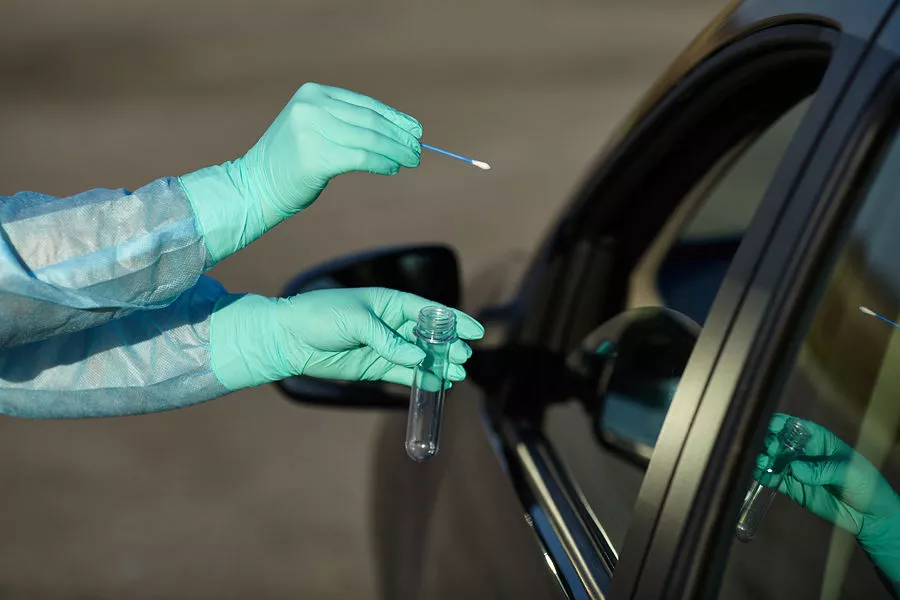
Hospital employees, healthcare professionals licensed by the boards of naturopathy, homeopathy, podiatry, chiropractic examiners, optometry and nine other health care categories are all eligible, as well as corrections officers and child safety workers employed by the state.
The university also announced a new testing site in Nogales, Arizona.
According to UA, the roughly 6,000 blood samples analyzed during the first phase of testing in Pima County resulted in no false positives. The tests measure the amount of antibodies in a person’s blood.
Registration for the test is available at this website, where participants also can find a list of all the groups eligible for testing.

I recently flagged down a technician from my local internet provider about why the service seems so darn slow all the time. He confirmed one problem I’d always suspected. Upgrading infrastructure is expensive so a company tends to put far too many customers onto the bandwidth than can ever hope to achieve the promised upload and download speeds.
So, the first uncomfortable reality of your slow home internet is that it’s likely there’s an infrastructure problem that will not be addressed until the customer complaints reach the intolerable level.
Even after local economies return to whatever passes for normal in the near future, expect that many who went home to work during the pandemic will not return to the office, thus creating even more demand for the finite resource of internet bandwidth.
The good news is that there’s a solid chance that a few tweaks to your router and applying other tricks of the trade can speed things up considerably while you wait for your provider to crack open the wallet and undertake a full-scale upgrade.
Test Your Speed First
There’s not much point in changing anything until you know what you’re working with. That means you should test upload and download speeds to see if they happen to be anywhere near what was promised in the package you signed up for.
Once you have numbers for both your upload and download speed (the latter is typically much faster), compare them against what area providers say they deliver. Maybe you’ll be pleasantly surprised, but there’s a good chance you won’t. If your real world numbers are too far removed from your plan numbers, a phone call to the home office might be in order.
Advertised speed is usually calculated as a “best case” scenario and intended to be used as the top end of a range.
Turn Off Unused Devices
Every single internet device in your house is sipping (maybe even gulping) data at all times unless it’s turned off or the wifi capability is switched off. Wait! Don’t just speed through this suggestion as too Mickey Mouse to try. It really can help.
Tuesday, June 9, 2020
ProPublica is a nonprofit newsroom that investigates abuses of power. Click here to read their biggest stories as soon as they’re published.
Since 2018, Capital One has been a looming presence in Julio Lugo’s life, ever since the company sued him, as it did 29,000 other New Yorkers that year, over an unpaid credit card. But when the coronavirus hit the city this March, it wasn’t on his mind.
At Mount Sinai in Manhattan, where he works, he’d been drafted into the hospital’s frenzied effort against the virus. He normally gathered patient information at the front desk of a radiology clinic in orderly shifts, 9 to 5. Now he was working 16-hour days, often overnight. At one moment he might be enlisted to help a team of doctors or nurses put on their full-body protective equipment and then he would rush to disinfect another team. He lost track of the days, only orienting himself by the need to juggle care with his ex-wife of their two young children who were now out of school.
But despite a global pandemic, Capital One didn’t forget about him. The company began in late March to seize a portion of his wages to collect on that debt — one that he says wasn’t even his.
Federal, state and local officials have all taken some steps to protect Americans from the ravages of the economic crash due to COVID-19. Congress halted a substantial portion of evictions, foreclosures and collection on student loans. And when it sent $300 billion in stimulus checks out to families, many states took steps to make sure that debt collectors didn’t grab the money. But one of the most aggressive and common forms of debt collection has generally been allowed to continue: seizure of wages for old consumer debts.

Since 2018, Capital One has been a looming presence in Julio Lugo’s life, ever since the company sued him, as it did 29,000 other New Yorkers that year, over an unpaid credit card. But when the coronavirus hit the city this March, it wasn’t on his mind.
At Mount Sinai in Manhattan, where he works, he’d been drafted into the hospital’s frenzied effort against the virus. He normally gathered patient information at the front desk of a radiology clinic in orderly shifts, 9 to 5. Now he was working 16-hour days, often overnight. At one moment he might be enlisted to help a team of doctors or nurses put on their full-body protective equipment and then he would rush to disinfect another team. He lost track of the days, only orienting himself by the need to juggle care with his ex-wife of their two young children who were now out of school.
But despite a global pandemic, Capital One didn’t forget about him. The company began in late March to seize a portion of his wages to collect on that debt — one that he says wasn’t even his.
Federal, state and local officials have all taken some steps to protect Americans from the ravages of the economic crash due to COVID-19. Congress halted a substantial portion of evictions, foreclosures and collection on student loans. And when it sent $300 billion in stimulus checks out to families, many states took steps to make sure that debt collectors didn’t grab the money. But one of the most aggressive and common forms of debt collection has generally been allowed to continue: seizure of wages for old consumer debts.

