

Wednesday, May 6, 2020
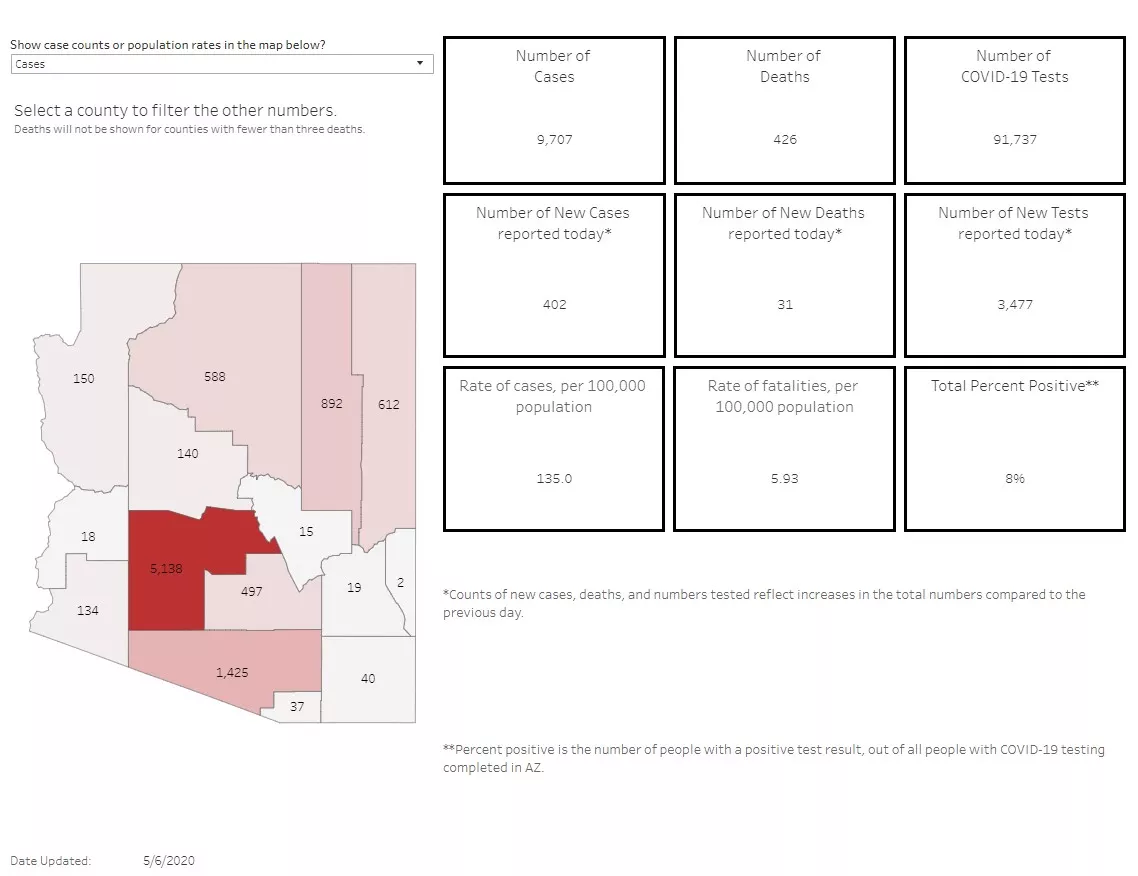
The number of confirmed coronavirus cases in Arizona hit 9,707 as of Wednesday, May 6, according to the morning report from the Arizona Department of Health Services.
Pima County had 1,425 confirmed cases.
The coronavirus had killed 426 people statewide, including 116 in Pima County, according to the report.
In Maricopa County, the number of confirmed COVID-19 cases had risen to 5,138.
Although the state began a “testing blitz” over the weekend, Arizona lags other states in testing for COVID-19. Because symptoms can take as long as two weeks to appear after exposure to the virus (while some people can remain entirely asymptomatic), health officials continue to urge the public to avoid unnecessary trips and gatherings of more than 10 people and have advised people to cover their faces with masks in public.
Arizona remains under a stay-at-home order through May 15, but Gov. Doug Ducey has modified his emergency declaration. Stores can now reopen with curbside and delivery business. Customers will be able to browse inside stores and get haircuts beginning on Friday, while restaurants can begin serving customers next week. Ducey has set up various new regulations, including requirements to wear masks and a heightened cleaning regimen.
People are still advised to limit contact and many businesses must remain closed, but Ducey said he wanted the state’s economy to gradually reopen.
“These habits we've acquired over the last 45 days will not be with us forever, but they will be with us for the time being,” Ducey said.
But some members of the medical community said Ducey’s move may have come soon and will result in a greater spread of the virus. Dr. Bob England, the outgoing director of the Pima County Health Department, warned yesterday that by relaxing so many standards so quickly, Ducey was risking losing all the progress that state has made in stemming the disease, but the true results wouldn’t be known for weeks as test results tend to lag behind the actual spread of the virus.
“It will take a few weeks to know the impact of this so we won’t know until early June what all of this is doing to the epidemic curve,” England said in a daily briefing.
Pima County had 1,425 confirmed cases.

The coronavirus had killed 426 people statewide, including 116 in Pima County, according to the report.
In Maricopa County, the number of confirmed COVID-19 cases had risen to 5,138.
Although the state began a “testing blitz” over the weekend, Arizona lags other states in testing for COVID-19. Because symptoms can take as long as two weeks to appear after exposure to the virus (while some people can remain entirely asymptomatic), health officials continue to urge the public to avoid unnecessary trips and gatherings of more than 10 people and have advised people to cover their faces with masks in public.
Arizona remains under a stay-at-home order through May 15, but Gov. Doug Ducey has modified his emergency declaration. Stores can now reopen with curbside and delivery business. Customers will be able to browse inside stores and get haircuts beginning on Friday, while restaurants can begin serving customers next week. Ducey has set up various new regulations, including requirements to wear masks and a heightened cleaning regimen.
People are still advised to limit contact and many businesses must remain closed, but Ducey said he wanted the state’s economy to gradually reopen.
“These habits we've acquired over the last 45 days will not be with us forever, but they will be with us for the time being,” Ducey said.
But some members of the medical community said Ducey’s move may have come soon and will result in a greater spread of the virus. Dr. Bob England, the outgoing director of the Pima County Health Department, warned yesterday that by relaxing so many standards so quickly, Ducey was risking losing all the progress that state has made in stemming the disease, but the true results wouldn’t be known for weeks as test results tend to lag behind the actual spread of the virus.
“It will take a few weeks to know the impact of this so we won’t know until early June what all of this is doing to the epidemic curve,” England said in a daily briefing.
Tuesday, May 5, 2020
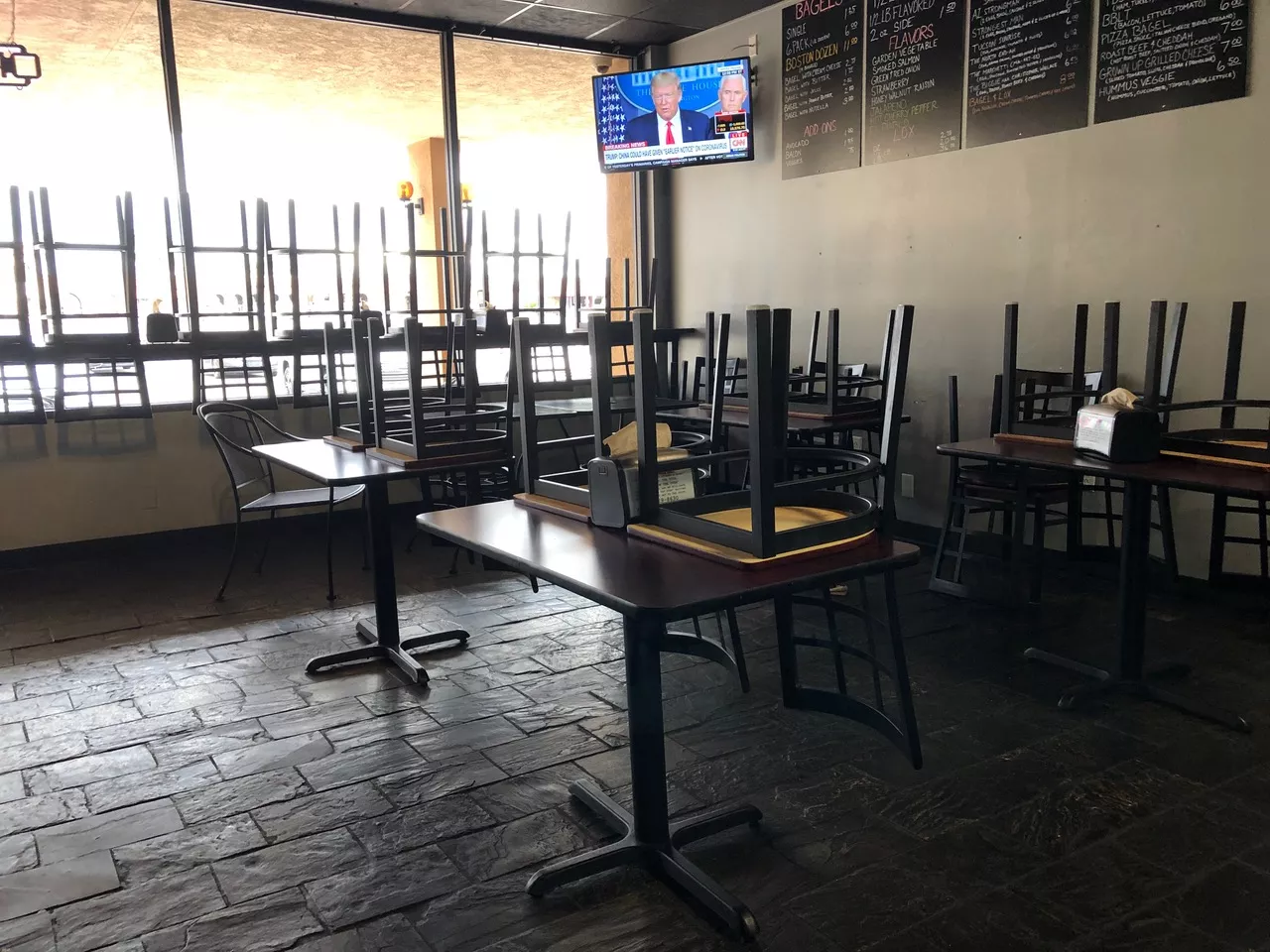
Gov. Doug Ducey has given restaurants the green light to resume dine-in service next week as long as they follow new sanitation regulations and ensure physical distancing between patrons, but some Tucson restaurateurs aren't sure they—or the public—are ready for the change.
“There will be more to follow on this but I want the restaurant industry to know that this is what’s going to happen next week,” Ducey said yesterday. “This is a safe and good option at this time and they’ll have a full week in which to prepare.”
Lindy Reilly, co-owner of Fire N’ Smoke Wood Fired Pizza and BBQ, is not so sure he’s ready to allow dine-in service. Reily isn’t as concerned about contracting COVID-19 as he is about the cost of restaffing his restaurant for a public already leery of take-out and delivery.
“As far as I’m concerned, I don’t know if I’ll be ready by Monday and I don’t know if we’ll do (dine-in) right away,” Reilly said. “If people already have an unforeseen fear of takeout food already, I don’t need that to compound.”
When Reily does open the doors to the public, he said his restaurant won’t return to full-service dining, instead opting for a fast-casual enviornment. It’s the limited capacity aspect that drives his decision to cut full service. “I just can’t afford the staff,” Reilly said.
“If you’re going to open and carry a full staff, you need a full-service restaurant to make that machine work,” said Reilly, who sees opening partially as a recipe for disaster. "I think you’re going to watch some restaurants fold.”
Ray Flores, king of the El Charro empire, said he was surprised by Gov. Ducey’s announcement since it allows restaurants to open a day earlier than the governor previously discussed.
“It kind of caught me off-guard, to be honest,” Flores said. “(Gov. Ducey) had came out and said he was going to work on something for potentially (May) 12, if not May 15.”
Flores is unsure of when they will reopen as they decide the best way to conduct business. In the meantime, the family developed a 100-point-plan to address future protocols from federal, state and local governing bodies, Flores said.
“There will be more to follow on this but I want the restaurant industry to know that this is what’s going to happen next week,” Ducey said yesterday. “This is a safe and good option at this time and they’ll have a full week in which to prepare.”
Lindy Reilly, co-owner of Fire N’ Smoke Wood Fired Pizza and BBQ, is not so sure he’s ready to allow dine-in service. Reily isn’t as concerned about contracting COVID-19 as he is about the cost of restaffing his restaurant for a public already leery of take-out and delivery.
“As far as I’m concerned, I don’t know if I’ll be ready by Monday and I don’t know if we’ll do (dine-in) right away,” Reilly said. “If people already have an unforeseen fear of takeout food already, I don’t need that to compound.”
When Reily does open the doors to the public, he said his restaurant won’t return to full-service dining, instead opting for a fast-casual enviornment. It’s the limited capacity aspect that drives his decision to cut full service. “I just can’t afford the staff,” Reilly said.
“If you’re going to open and carry a full staff, you need a full-service restaurant to make that machine work,” said Reilly, who sees opening partially as a recipe for disaster. "I think you’re going to watch some restaurants fold.”
Ray Flores, king of the El Charro empire, said he was surprised by Gov. Ducey’s announcement since it allows restaurants to open a day earlier than the governor previously discussed.
“It kind of caught me off-guard, to be honest,” Flores said. “(Gov. Ducey) had came out and said he was going to work on something for potentially (May) 12, if not May 15.”
Flores is unsure of when they will reopen as they decide the best way to conduct business. In the meantime, the family developed a 100-point-plan to address future protocols from federal, state and local governing bodies, Flores said.
PHOENIX – As Miss Shoshone-Bannock, Stormie Perdash has represented her people all across the United States. Now, amid the coronavirus pandemic, she’s representing them in a different way.
Growing up on the Fort Hall Reservation in Idaho, Perdash remembers just how badly she wanted the Miss Shoshone-Bannock title – or Miss Sho-Ban for short.
“She was like the coolest thing ever,” Perdash said.
She spent her preteen years on the Flathead Indian Reservation in Montana and lived in Los Angeles after graduating from high school, and figured her pageant dream was over. But last summer, she returned to Fort Hall for a visit and decided to enter the pageant for 18 to 25 year olds – which she won.
“My first six months were amazing. I went and represented in Hawaii, South Dakota, Los Angeles,” she said in an interview. “Oh, Wisconsin! Also, our local community events – I’ve been here for those as well.
“And then COVID happened.”

Growing up on the Fort Hall Reservation in Idaho, Perdash remembers just how badly she wanted the Miss Shoshone-Bannock title – or Miss Sho-Ban for short.
“She was like the coolest thing ever,” Perdash said.
She spent her preteen years on the Flathead Indian Reservation in Montana and lived in Los Angeles after graduating from high school, and figured her pageant dream was over. But last summer, she returned to Fort Hall for a visit and decided to enter the pageant for 18 to 25 year olds – which she won.
“My first six months were amazing. I went and represented in Hawaii, South Dakota, Los Angeles,” she said in an interview. “Oh, Wisconsin! Also, our local community events – I’ve been here for those as well.
“And then COVID happened.”
The University of Arizona announced Tuesday that there are additional testing slots available for healthcare workers, first responders, and the general public in Pima County.
The tests determine if an individual has developed antibodies against the virus that causes COVID-19. Last month, UA announced it would begin testing 250,000 of Arizona’s health care workers and first responders as part of a partnership with the state government. The university received $3.5 million in funding to produce tests.
Anyone interested in a test should go online to the UA COVID-19 antibody testing website.
The number of confirmed coronavirus cases in Arizona topped 9,000 as of Tuesday, May 5, according to the morning report from the Arizona Department of Health Services. Pima County had 1,379 of the states’ 9,305 confirmed cases. The coronavirus had killed 395 people statewide, including 105 in Pima County, according to the report.

The tests determine if an individual has developed antibodies against the virus that causes COVID-19. Last month, UA announced it would begin testing 250,000 of Arizona’s health care workers and first responders as part of a partnership with the state government. The university received $3.5 million in funding to produce tests.
Anyone interested in a test should go online to the UA COVID-19 antibody testing website.
The number of confirmed coronavirus cases in Arizona topped 9,000 as of Tuesday, May 5, according to the morning report from the Arizona Department of Health Services. Pima County had 1,379 of the states’ 9,305 confirmed cases. The coronavirus had killed 395 people statewide, including 105 in Pima County, according to the report.

Thomas Vlerick/ Flickr
McClendon’s Select, a family owned farm in Peoria and Goodyear, normally sells its organic produce, citrus and honey to restaurants and farmers markets. Since Arizona banned gatherings of more than 10 people and ordered restaurants without takeout services to shut down March 19, McClendon’s Select has seen a huge drop in business.
“Literally overnight with the COVID-19 restrictions, we watched our restaurant business drop by 95 percent. So 75 percent of our business – almost all of that went away overnight,” said Kate McClendon, owner of McClendon’s Select.
According to the Arizona Farm Bureau, farms and ranches cover about 26 million acres in the state, and their contribution to the state’s economy is more than $423 billion a year.
The first round of the federal Coronavirus Aid Relief and Economic Security Act, or CARES, which was signed into law in late March, included $376 billion for American workers and small businesses. Through the U.S. Small Business Administration, businesses could apply for an Economic Injury Disaster Loan, known as an EIDL, for up to $10,000.
But there was a stipulation.
Austin Counts
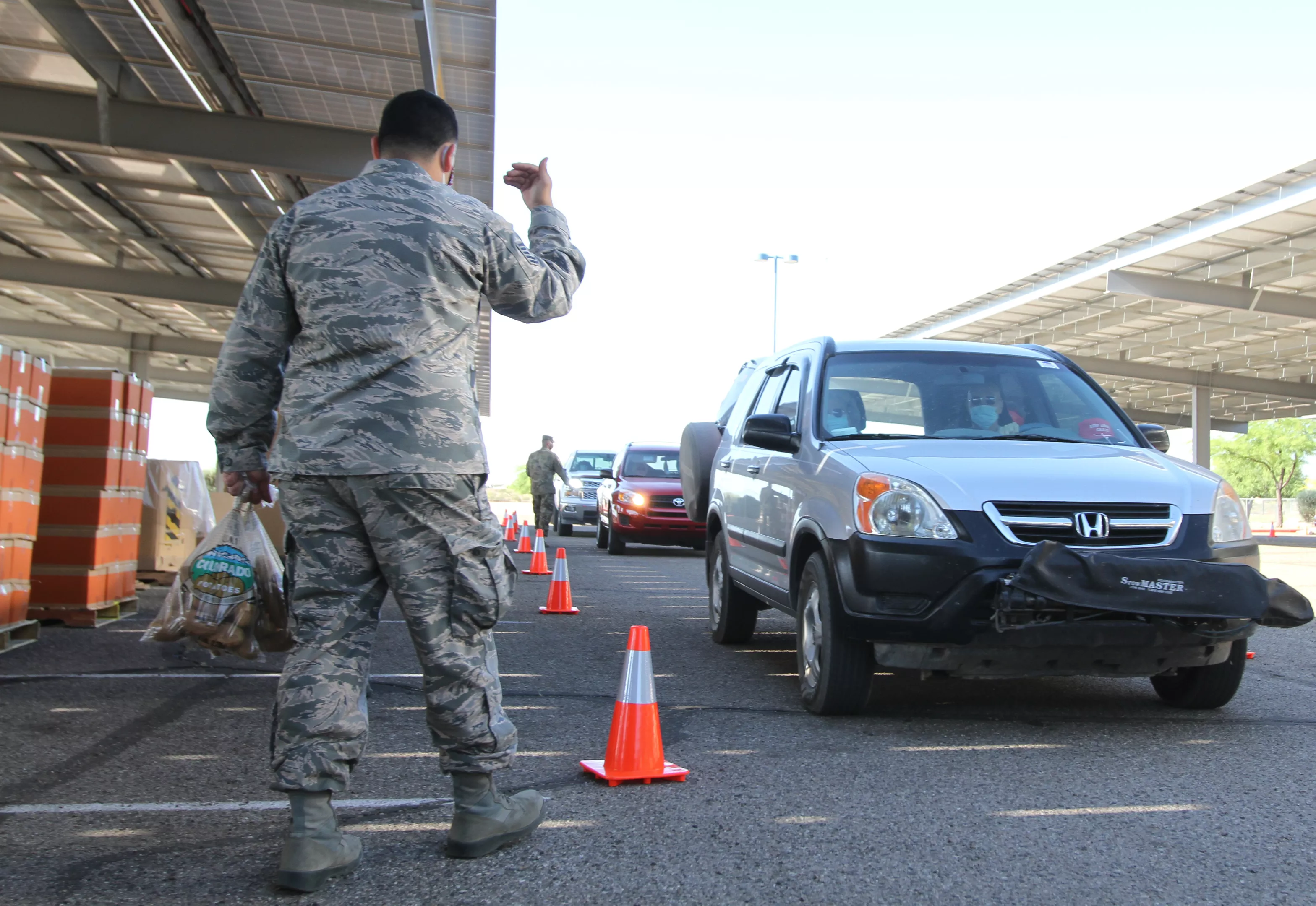
Troops from the National Guard hand out food boxes to those in need during the COVID-19 pandemic as Poison's "Nothin' But a Good Time" plays from a Bluetooth speaker on Monday, May 5 at Kino Veteran's Memorial Stadium located at 2500 E Ajo Way. Today is the first day of The Community Food Bank of Southern Arizona's drive-thru service at the new location.
"Because unemployment is so high, job loss is so high and people are being furloughed, people are strapped," said Community Food Bank of Southern Arizona CEO Michael McDonald. "It's been a long haul and so many people need food."
Troops from the National Guard quickly place boxes of produce, milk, bread, and other essential goods into people's vehicles while Poison's 80s anthem, "Nothin' But a Good Time", blasts from a Bluetooth speaker. The atmosphere at the new location felt more like a summer camp, warmer in spirit than one would expect considering the circumstances.
"It's larger, it's faster, we got a sufficient food supply, we got the National Guard, we got librarians from Pima County and lots of other volunteers and staff. We're getting through the line quickly," McDonald said. "It was a long line almost to the exit off the freeway at Kino earlier though."
Tags: national guard , food bank , donations , helping people , covid19 , Image
Stay up to date about WNYC and ProPublica’s investigations into the president’s business practices.
This story was co-published with WNYC.
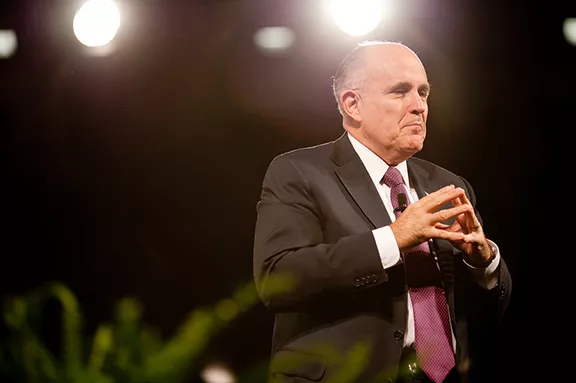
Presidential lawyer and former New York City Mayor Rudy Giuliani has largely fallen out of the public eye since his starring role in President Donald Trump’s impeachment. But Giuliani hasn’t gone silent.
Instead, he’s in his home, doing a call-in radio show and a podcast — “Common Sense” — during which he has repeatedly gone on bigoted rants about China and its government.
“They have no morals,” he said on his April 28 radio show. “They’re amoral in the sense that human life means something in Western civilization, it means a lot. Human life doesn’t mean the same thing to them.”
This story was co-published with WNYC.
Presidential lawyer and former New York City Mayor Rudy Giuliani has largely fallen out of the public eye since his starring role in President Donald Trump’s impeachment. But Giuliani hasn’t gone silent.
Instead, he’s in his home, doing a call-in radio show and a podcast — “Common Sense” — during which he has repeatedly gone on bigoted rants about China and its government.
20200504-giulianai-podcast-no-morals.mp3
“They have no morals,” he said on his April 28 radio show. “They’re amoral in the sense that human life means something in Western civilization, it means a lot. Human life doesn’t mean the same thing to them.”
PHOENIX – To get an idea of how fast scams are developing around the coronavirus, just ask Katie Conner, a spokesperson for Arizona Attorney General Mark Brnovich.
“It seems like every day … a new scam pops up,” said Conner, who said the attorney general’s office has been closely monitoring consumer fraud claims. “And we are really trying to stay ahead and get these warnings out there.”
But Brnovich’s office and other consumer groups said the threat of COVID-19 and the national focus on it have combined with the speed and anonymity of the internet to spread scams that have left watchdogs across the country scrambling.
“We are updating our site about every 30 minutes, working to provide tips to consumers and information to consumers as frequently as possible,” said Diane Brown, executive director of the Arizona Public Interest Research Group.
Groups say the scams themselves are not new, coming in the form of phishing emails, investment scams and supposed miracle products. What’s different, they say, is the intense focus on COVID-19 and the “creative” use of the internet to spread messages, often false, about it.
“With social media, scammers can quickly spread the news about a fake miracle cure or fake product. We have seen just about everything in the last couple weeks,” Conner said. “That’s why we really want consumers to remember there is no cure for COVID-19.”
That was echoed by Dr. Joshua Sharfstein, vice dean of public health at Johns Hopkins University, who said that sham treatment can be fatal. That was the case in Arizona, where a man died after he and his wife drank fish-tank cleaner because it contained a chemical that President Donald Trump had cited as a possible treatment.

“It seems like every day … a new scam pops up,” said Conner, who said the attorney general’s office has been closely monitoring consumer fraud claims. “And we are really trying to stay ahead and get these warnings out there.”
But Brnovich’s office and other consumer groups said the threat of COVID-19 and the national focus on it have combined with the speed and anonymity of the internet to spread scams that have left watchdogs across the country scrambling.
“We are updating our site about every 30 minutes, working to provide tips to consumers and information to consumers as frequently as possible,” said Diane Brown, executive director of the Arizona Public Interest Research Group.
Groups say the scams themselves are not new, coming in the form of phishing emails, investment scams and supposed miracle products. What’s different, they say, is the intense focus on COVID-19 and the “creative” use of the internet to spread messages, often false, about it.
“With social media, scammers can quickly spread the news about a fake miracle cure or fake product. We have seen just about everything in the last couple weeks,” Conner said. “That’s why we really want consumers to remember there is no cure for COVID-19.”
That was echoed by Dr. Joshua Sharfstein, vice dean of public health at Johns Hopkins University, who said that sham treatment can be fatal. That was the case in Arizona, where a man died after he and his wife drank fish-tank cleaner because it contained a chemical that President Donald Trump had cited as a possible treatment.
The number of confirmed coronavirus cases in Arizona topped 9,000 as of Tuesday, May 5, according to the morning report from the Arizona Department of Health Services.
Pima County had 1,379 of the states’ 9,305 confirmed cases.
The coronavirus had killed 395 people statewide, including 105 in Pima County, according to the report.
In Maricopa County, the number of confirmed COVID-19 cases had risen to 4,929.
Although the state began a “testing blitz” over the weekend, Arizona lags other states in testing for COVID-19. Because symptoms can take as long as two weeks to appear after exposure to the virus (while some people can remain entirely asymptomatic), health officials continue to urge the public to avoid unnecessary trips and gatherings of more than 10 people and have advised people to cover their faces with masks in public.
Arizona remains under a stay-at-home order through May 15, but Gov. Doug Ducey has modified his emergency declaration. Many stores have reopened with curbside and delivery business. Customers will be able to browse inside stores and get haircuts beginning on Friday, while restaurants can begin serving customers next week. Ducey has set up various new regulations, including requirements to wear masks and a heightened cleaning regimen.
People are still advised to limit contact and many businesses must remain closed, but Ducey said he wanted the state’s economy to gradually reopen.
“These habits we've acquired over the last 45 days will not be with us forever, but they will be with us for the time being,” Ducey said.
Ducey said that he will decide how to move forward based on what future testing shows regarding the spread of the virus, but explained it would be a gradual reopening of businesses now closed.
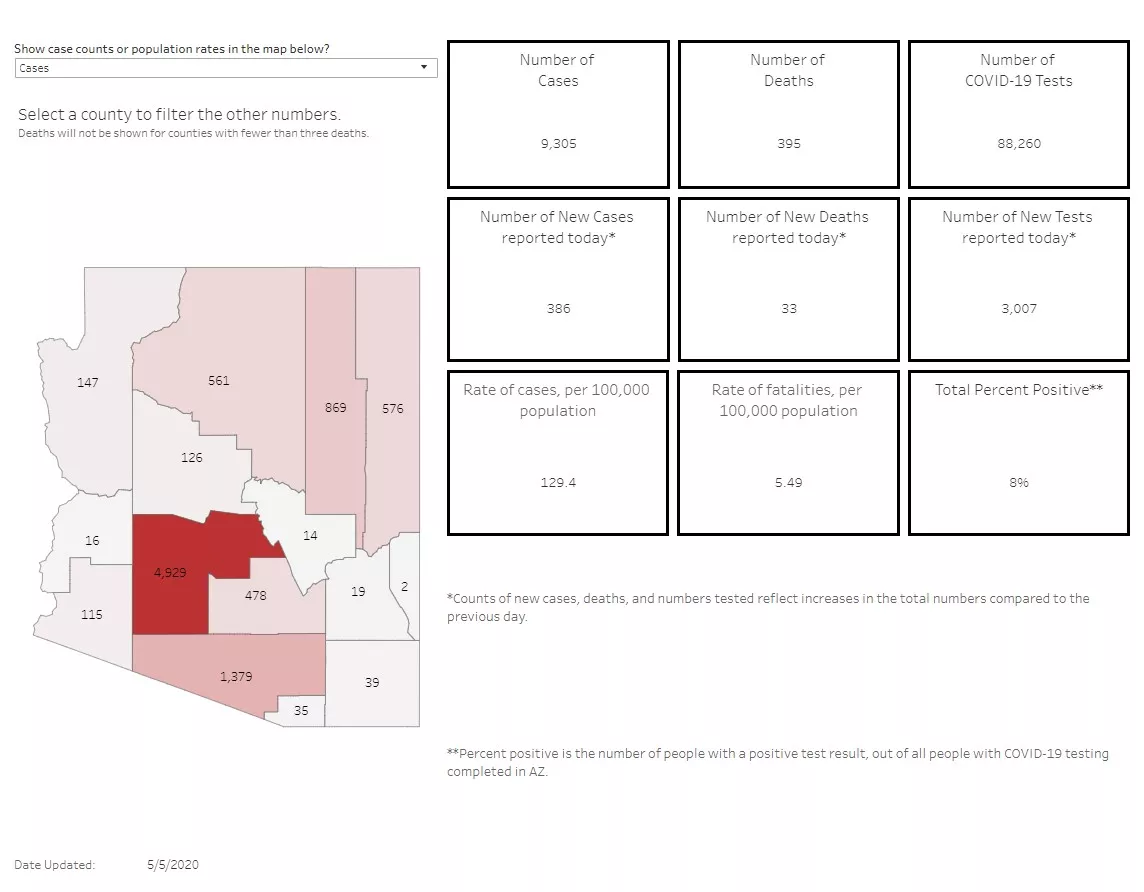
Pima County had 1,379 of the states’ 9,305 confirmed cases.

The coronavirus had killed 395 people statewide, including 105 in Pima County, according to the report.
In Maricopa County, the number of confirmed COVID-19 cases had risen to 4,929.
Although the state began a “testing blitz” over the weekend, Arizona lags other states in testing for COVID-19. Because symptoms can take as long as two weeks to appear after exposure to the virus (while some people can remain entirely asymptomatic), health officials continue to urge the public to avoid unnecessary trips and gatherings of more than 10 people and have advised people to cover their faces with masks in public.
Arizona remains under a stay-at-home order through May 15, but Gov. Doug Ducey has modified his emergency declaration. Many stores have reopened with curbside and delivery business. Customers will be able to browse inside stores and get haircuts beginning on Friday, while restaurants can begin serving customers next week. Ducey has set up various new regulations, including requirements to wear masks and a heightened cleaning regimen.
People are still advised to limit contact and many businesses must remain closed, but Ducey said he wanted the state’s economy to gradually reopen.
“These habits we've acquired over the last 45 days will not be with us forever, but they will be with us for the time being,” Ducey said.
Ducey said that he will decide how to move forward based on what future testing shows regarding the spread of the virus, but explained it would be a gradual reopening of businesses now closed.
Monday, May 4, 2020
May the Fourth be with you. Here are the stories that we covered today.

- The number of confirmed coronavirus cases in Arizona topped 8,900 as of Monday, May 4, according to the morning report from the Arizona Department of Health Services.
- Arizona Gov. Doug Ducey gave a “green light” to reopen more businesses, he announced during a Monday press conference, including dine-in services at restaurants and barbers and salons.
- While local Democratic officials have been cautiously supportive of Gov. Doug Ducey's decision to keep Arizona's stay-at-home order in place through May 15 while lifting some restrictions for retail businesses, some Republican state lawmakers say Ducey isn't moving fast enough to reopen Arizona.
- The YMCA of Southern Arizona is accepting childcare applications from healthcare workers, first responders and other essential workers through May 22, the company announced.
- The Town of Sahuarita will reopen all town services and facilities this Friday, May 8, including the town clerk’s office, planning, and building, the Anamax Recreation Center, and more—although programming is still delayed.
- Arizona assisted living communities are gearing up to hire aspiring caregivers after Gov. Doug Ducey signed an executive order last month allowing on-the-job training for caregiver certification amid an entry-level healthcare worker shortage.
- Two physicians from the University of Arizona are among the authors of a new research paper detailing the best practice guidelines for patients in intensive care units requiring advanced life-saving therapies due to COVID-19.
- Antibody tests are meant to recognize a past infection. Many of these have hit the market in recent weeks and are being offered at local clinics.
- Democratic members of Congress are urging President Donald Trump to authorize FEMA to reimburse funeral expenses for victims of the coronavirus pandemic, citing ProPublica’s reporting about the administration’s policies.
- In an April report that warns of the risks of fraud in mail-in voting, a conservative legal group significantly inflated a key statistic, a ProPublica analysis found.
- Before restrictions are raised, there are still plenty of restaurants that are open for take-out and delivery services.

