

Tuesday, May 4, 2021
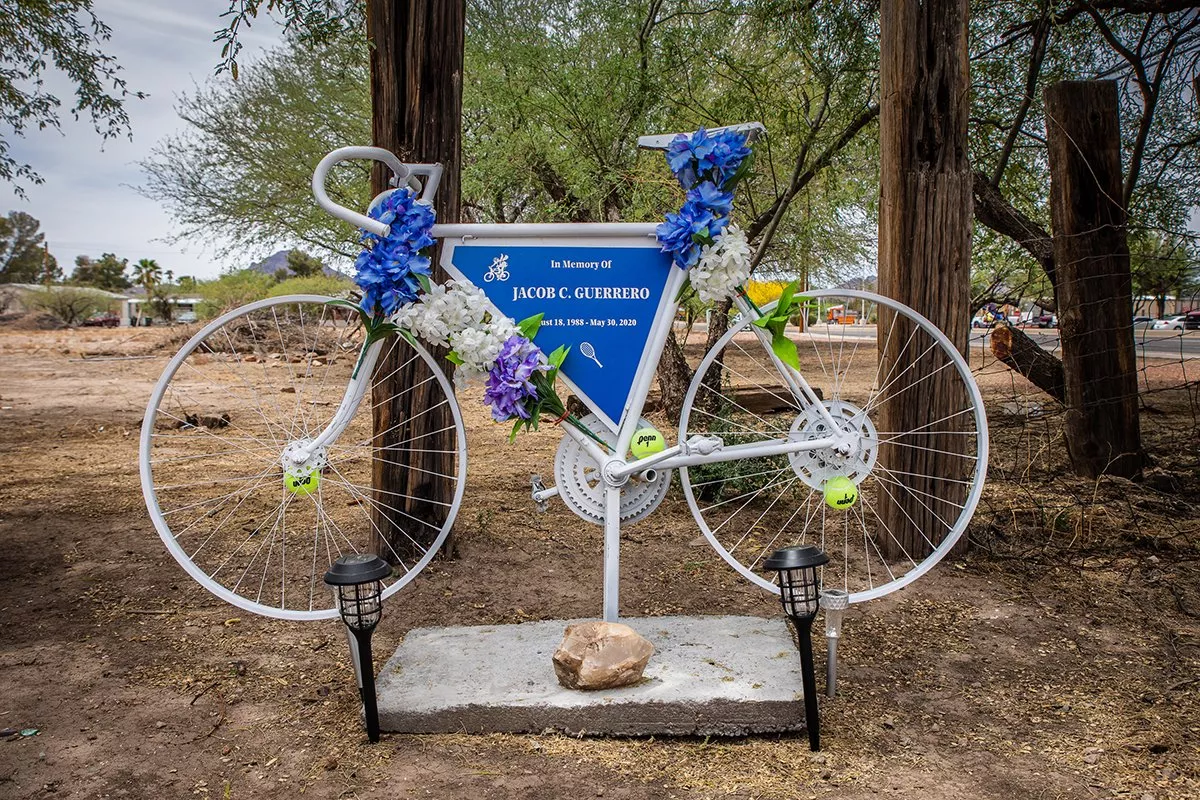
TUCSON – It was a Tuesday afternoon, two months into the pandemic, when Theresa Guerrero got the call from her brother-in-law: Her son, Jacob, had been found unresponsive.
She was standing in the middle of a Ross store in south Tucson picking out a pillow he’d asked for, throwing it to the floor as she raced toward the exit.
Jacob was a cyclist, a tennis player – a trusting, good man – but he’d grown lethargic of late and quit pursuing his active lifestyle. The pandemic only made things worse.
He’d been working as a Postmates driver for a couple of months. One day, his mother saw straws in his car and wondered whether he was using cocaine. But when she confronted Jacob, he brushed her off.
“He was, like so many other people, really lonely, and I remember he would go on drives by himself just to get out of the house,” Guerrero said. “I have to wonder if he had been able to see other people, would they have noticed what he was going through before I did?”
By the time she drove the seven miles to Jacob’s house last May 30, six paramedics hovered over him. Guerrero doesn’t remember a lot about that moment, other than screaming out to strangers as they loaded her only son into an ambulance, assuming their silence meant the inevitable was coming.
She followed the lights and sirens to the hospital, but due to COVID-19 regulations, she had to stay outside and wait.
And wait.
Monday, May 3, 2021
This week, Pima County and the Federal Emergency Management Agency (FEMA) are teaming up to launch mobile vaccination units to reach vulnerable communities with high risks of COVID-19 exposure and infection.
The operation includes two mobile vaccination units (MVUs), able to administer 250 vaccines per day each, along with administrative staff and federal vaccinators with 70 personnel from FEMA, Health and Human Services, the Environmental Protection Agency and Department of Labor, according to a county press release.
The units will run through June 26, operating at two concurrent locations for three days, with one day to tear down and move to the next location. The locations were selected based on census tract data and the Social Vulnerability Index of the area to identify highly vulnerable communities.
“We’re extremely grateful to FEMA for partnering with us on this effort to reach pockets of the community who may not have easy access to this life-saving vaccine,” said Pima County Administrator Chuck Huckelberry. “The ability to offer vaccines during evenings and weekends will enable us to reach folks whose work or school schedules prevent them from getting a vaccine now. With this effort, there’s truly no reason not to roll up your sleeve and get your shot so we can start putting this pandemic behind us.”
The sites will offer walk-up vaccinations of both the Moderna and Johnson & Johnson vaccine for those 18 and older on a first-come, first-served basis. Vaccinators will return to the same mobile site 28 days after their first visit to receive their second dose, following CDC guidance. Help will be available to all who need assistance with mobility, language or other accommodations.
Here are the planned mobile clinics:
May 7-9, 10 a.m. to 8 p.m.
- Casino del Sol, 5655 W. Valencia Road
- Desert Diamond Casino, 7350 S. Nogales Hwy.
May 11-13, 10 a.m. to 8 p.m.
- Greyhound Park, 2601 S. Third Ave.
- Wheeler Taft Library, 7800 N. Schisler Drive
May 15-17, 10 a.m. to 8 p.m.
- Rillito Race Track, 4502 N. First Ave.
- Curtis Park, 2110 W. Curtis Road
The county continues to offer vaccinations at several vaccination centers, mobile pop-up clinics and pharmacies. Visit pima.gov/covid19vaccine for more information.
No appointment necessary for the UA vax POD
You no longer need an appointment to get a shot at the UA vaccination point of distribution. The POD will now accept anyone over the age of 16 who comes in for a shot.
The pod has closed its drive-thru clinic because of rising temperatures, but still offers a sit-down clinic in the Ina E. Gittings Building (1737 E. University Blvd.) from 10 a.m. to 10 p.m. daily.
If you’d rather schedule an appointment, the state is expected to open new first-dose appointments daily at podvaccine.azdhs.gov. Call 602-542-1000 or 844-542-8201 for help in English or Spanish.
If you need help, call the COVID Ambassador Team hotline at 520-848-4045 between 7 a.m. and 7 p.m. daily or email [email protected].
Meanwhile, Pima County officials are shifting to indoor vaccination sites to avoid making staff and volunteers endure long days in triple-degree temperatures.
Tucson Medical Center has shut down its drive-thru vaccination clinics and transferred its operations to the Udall Center, 7200 E. Tanque Verde Road. The site is open 8 a.m. to 5 p.m. Monday, Thursday and Friday and 8 a.m. to 7 p.m. Tuesday and Wednesday. Register at https://vaccine.tmcaz.com/MyChart/OpenScheduling.
Pima County has opened a new indoor vaccine site at the Kino Event Center, where the county had earlier been doing COVID testing. That site is open 9 a.m. to 7 p.m., Monday through Saturday. Register at azdhs.gov.
The county has also opened an indoor vaccination POD at El Pueblo Center, 101 W. Irvington Road, which is open Monday, Wednesday and Friday from 9:30 a.m. to 1:30 p.m. No appointment is necessary.
The drive-through POD at Banner-South Kino Stadium, 2500 E. Ajo Way, is now offering appointments between 7:30 a.m. and 12:30 p.m. and will close permanently on May 14.
As of Sunday, May 2, 402,679 people in Pima County had received at least one shot of the virus, accounting for 38.5% of the population. A total of 322,792 people were fully vaccinated.
For more information or additional mobile clinics, visit pima.gov/covid19vaccineregistration or call 520-222-0119.
Many local pharmacies are now receiving vaccine doses. To find one near you, visit the ADHS website.
Get tested: Pima County has free COVID testing
Pima County is continuing to offer a number of testing centers and pop-up testing sites around town, including the northside Ellie Towne Flowing Wells Community Center, 1660 W. Ruthrauff Road. Schedule an appointment at pima.gov/covid19testing.
The University of Arizona’s antibody testing can determine if you have had COVID and now have antibodies. To sign up for testing, visit https://covid19antibodytesting.arizona.edu/home.
Today’s numbers
With 652 new cases reported today, the total number of Arizona’s confirmed novel coronavirus cases rose past 864,000 as of Monday, May 3, according to the Arizona Department of Health Services.
Pima County, which reported 72 new cases today, has seen 115,361 of the state’s 864,579 confirmed cases.
With no new deaths reported this morning, a total of 17,344 Arizonans have died after contracting COVID-19, including 2,395 deaths in Pima County, according to the May 3 report.
A total of 607 coronavirus patients were in the hospital as of May 2. That’s roughly 12% of the number hospitalized at the peak of the winter surge, which reached 5,082 on Jan. 12. The summer peak was 3,517, which was set on July 13, 2020. The subsequent lowest number of hospitalized COVID patients was 468, set on Sept. 27, 2020.
A total of 833 people visited emergency rooms with COVID-like symptoms on May 2. That number represents 35.5% of the record high of 2,341 set on Tuesday, Dec. 29, 2020. That number had peaked during the summer wave at 2,008 on July 7, 2020; it hit a subsequent low of 653 on Sept. 28, 2020.
A total of 189 COVID-19 patients were in intensive care unit beds on May 2, which roughly 16% of the record 1,183 ICU patients set on Jan. 11. The summer’s record number of patients in ICU beds was 970, set on July 13, 2020. The subsequent low was 114 on Sept. 22, 2020.
—with additional reporting from Austin Counts, Christina Duran, Jeff Gardner and Mike Truelsen
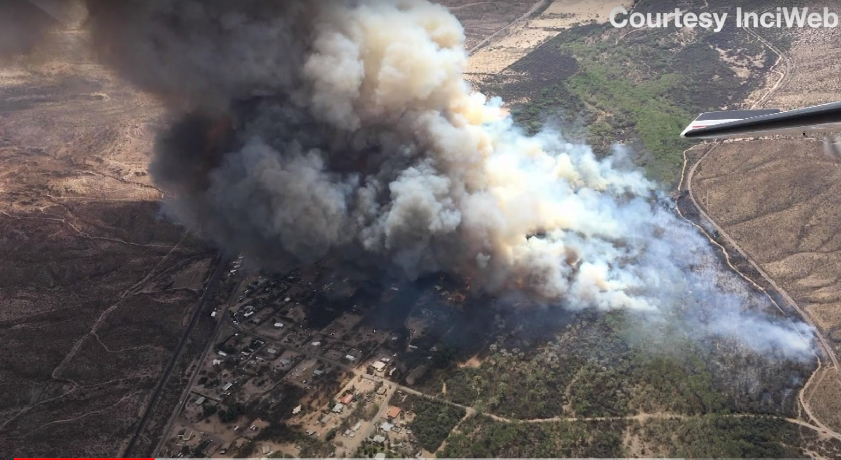
Arizona already has seen a few fires this year, and experts say the state is likely to experience another major year for wildfires.
In April alone, the Margo Fire in Pinal County burned about 1,100 acres, and another blaze continues to burn southwest of Heber. On Monday, a fire started southeast of Whiteriver and has burned 1,300 acres, according to InciWeb. Tiffany Davila, public affairs officer for the Arizona Department of Forestry and Fire Management, said there likely will be widespread fire activity across the state by June.
One reason, Davila said, is plentiful dried vegetation that fuels fire.
“When we’re talking about early activity in those particular areas, central and southern Arizona, we still have a carryover of fine fuel from last year and some unburned areas,” Davila said. “It’s just pretty much an abundance of this grass fuel type.”
Arizona had one of the driest monsoon seasons on record last year, and much of the state is in severe to exceptional drought. That’s not expected to change any time soon.
Friday, April 30, 2021
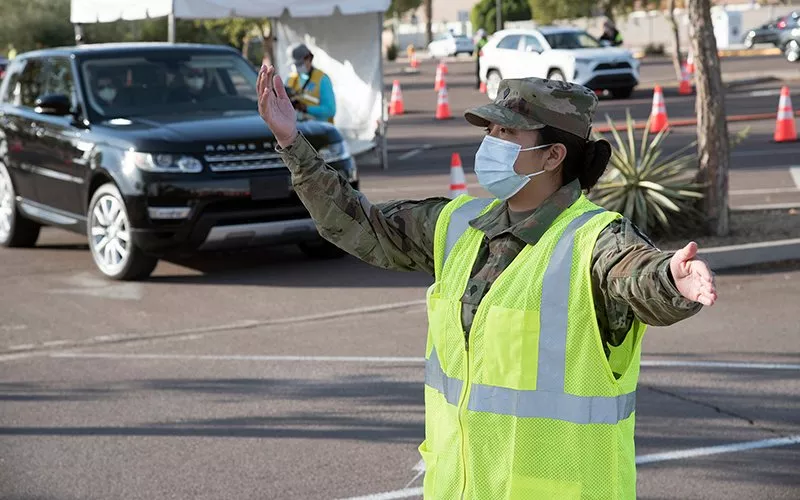
WASHINGTON – When Gov. Doug Ducey sent hundreds of National Guard members to help at the border last week, the move may have been unexpected – but it was not unusual for the troops that have spent a year shuttling from one crisis to another.
From stocking pandemic-depleted grocery shelves to fighting wildfires, from setting up vaccination sites to providing support in cities hit by civil unrest, the nearly 8,300 members of the Arizona National Guard have been constantly pulled in different directions.
“I haven’t been bored one day since we started this,” said Col. Tom Leeper, who was charged with running the Arizona National Guard’s Task Force Medical last year.
Maj. Gen. Michael McGuire, who was adjutant general of the state guard until retiring earlier this month, said the last time the guard was this busy was in the days following Sept. 11, 2001. The outbreak of COVID-19 was the first time since then that Arizona had a major statewide declaration of emergency, he said.
“Kind of interesting bookends to my career, in the years from 2002 to 2020,” McGuire said recently.
Arizona Guard members were not alone. According to the National Guard Bureau, Guard units nationwide spent more than 10.3 million days in the field last year, four times more than they did in 2019, said Nahaku McFadden, media operations chief of the National Guard public affairs bureau.
Nationally, McFadden said in an email, Guard units last year “provided nearly 550 million meals to families in need; delivered nearly 37 million masks to frontline workers; tested nearly 13 million people; and disinfected over 9,600 nursing homes and long-term care facilities.”
McGuire said Arizona has not had “that level of mobilization and participation since World War II.”
Thursday, April 29, 2021
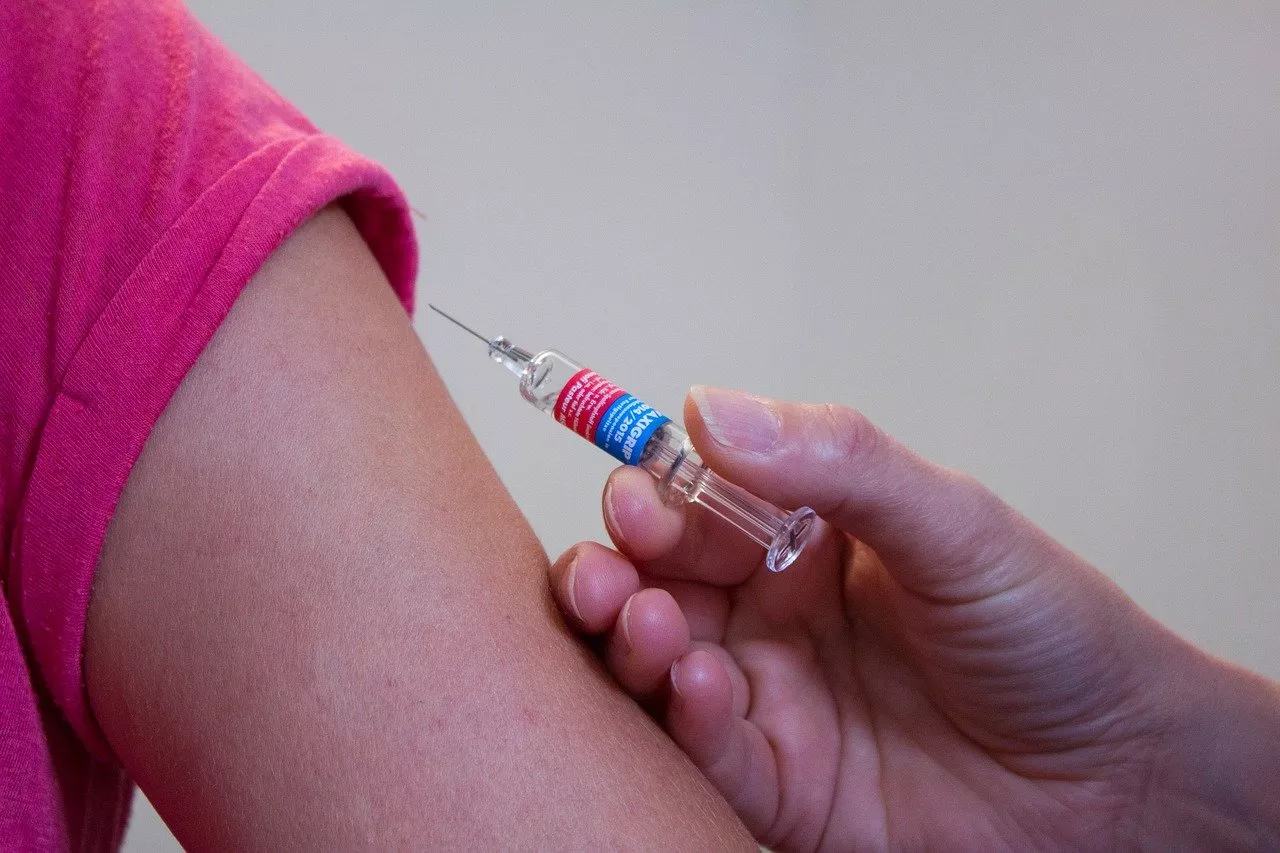
University of Arizona faculty and students will provide up to 1,000 COVID-19 vaccines on Saturday.
The vaccination event, open to the public, will be led by Kristie Hoch, a member of the American Association of Nurse Anesthetists, volunteer Certified Registered Nurse Anesthetists and student registered nurse anesthetists at the university.
The event offers only the Pfizer vaccine and no appointment is needed. It will be held from 1 to 6 p.m. Saturday at the Ina E. Gittings Building, Room 129.
For Hoch, the event not only serves the community, but also honors the memory of her family members who passed away due to COVID-19.
“My father-in-law and brother-in-law both passed away due to COVID-19 at the beginning of this year. To me, playing a role in the vaccine rollout is my way of honoring their memory and ensuring others do not suffer their fate,” said Hoch. “It’s heartwarming to see my students joining the effort. As ICU practicing nurses, they’ve seen the effects of COVID from the frontlines, and share my passion for putting an end to the pandemic."

In a statement released Wednesday, Rep. Alma Hernandez (D-Tucson, District 3) said she tested positive for the virus COVID-19, despite being vaccinated.
“I have taken COVID-19 very seriously and have worn my mask, washed my hands, socially distanced. Yet despite those measures and being vaccinated I have come down with the COVID,” she said. “I encourage all to take this seriously and continue practicing COVID protocols. Be courteous to your colleagues and loved ones who are more susceptible. The pandemic has not come to an end. Be safe, take care, do not let your guard down even after you have been vaccinated.”
Hernandez tweeted that she tested positive 11 weeks after being fully vaccinated with the Pfizer vaccine. She said she had a severe migraine, fever, cannot taste or smell and “[felt] terrible right now.”
She emphasized that as a health professional she is encouraging people to still get vaccinated.
“If you have not already done so, please do so as soon as possible. This is just to let you know that just because you got vaccinated does not mean you are immune to contracting COVID. I happen to be one of the few who still got it. Hopefully, my symptoms don’t worsen; however, I am very fortunate to have been vaccinated.”
Hernandez said she will be in quarantine until Wednesday.
Her case is not the first in Arizona. The Arizona Department of Health Services has 947 similar cases across the 15 counties with no deaths, said ADHS Communications Director Steve Elliott.
70% of patients were symptomatic and 16% were hospitalized, said Elliott. They were able to get information for about half of the cases. He also noted that the increase from previous reports “has more to do with classification of cases since vaccinations began than a spike in recent weeks.”
As of Thursday, the state has fully vaccinated 2,241,092 people, "breakthrough" cases account for 0.04% of fully vaccinated individuals.
Breakthrough cases are expected, as “no vaccines are 100% effective at preventing illness,” according to the CDC
As of April 20, the CDC reported 7,157 breakthrough infections in the U.S. with more than 87 million people fully vaccinated nationwide. Of those reported cases, 64 % were female and almost half were people 60 or older. Further, only about 7% of the breakthrough infections resulted in hospitalization and 1% led to death. On Wednesday, the CDC presented data that showed fully vaccinated adults, age 65 and older are 94% less likely to be hospitalized with COVID-19.
“COVID-19 vaccines are effective and are a critical tool to bring the pandemic under control,” said Elliott. “All of the available COVID-19 vaccines are effective at preventing severe illness, hospitalizations, and deaths. As a result, symptomatic vaccine breakthrough cases will tend to be less severe than infections in people who are not vaccinated. Asymptomatic infections among vaccinated people also will occur.”
The Pima County Health Department is seeking young adults to encourage vaccination amongst youth through a video challenge.
“We have come so far in our battle against COVID-19,” said Dr. Theresa Cullen, Pima County Health Department director. “We are excited and eager to engage with and vaccinate young adults to continue our march to herd immunity and get back to the things we love in life. We know that peer influence is significant for this age group and the #VaxTruthChallenge encourages people to share their experiences.”
As part of the VaxTruthChallenge contest, residents no older than 24 years old must create a video addressing any of the following questions:
- • What’s the truth about COVID-19 and getting the vaccine?
- • Set the record straight – say no to misinformation!
- • Why does it matter?
- • What do people need to know so they can get their shot?
Participants have the chance to win the grand prize of either a Nintendo Switch, Chromebook or an approved prize of choice valued at up to $350, while the runner-up would win a choice of AirPods, Fitbit or an approved prize of choice up to $150 in value.
The video entries must be shared on Tiktok, Instagram, Facebook, or YouTube, using the use the hashtag #VaxTruthChallenge in the video description. The videos can be in any language spoken by communities in Pima County, including English, Spanish, O’odham and Yaqui/Yoeme.
Winners must be younger than 24 years old at the time of submission and must agree to allow Pima County to use their video on other outlets. The deadline to enter is May 17, 2021. For more information visit VaxChallenge.com.
Wednesday, April 28, 2021
The Centers for Disease Control announced Tuesday that people who are vaccinated do not need to wear masks outside unless they are in thick crowds.

The new recommendations say it’s safe to not wear a mask when you go out for a walk, run or bike outdoors with members of your household; attend a small outdoor gathering with vaccinated family and friends; and dine at outdoor restaurants with friends from multiple households. However, if you attend a crowded outdoor sports event, a concert or a similar outing, masks are still recommended. See more details here.
Vaccine walk-ins welcome; appointments available
You no longer need an appointment to get a shot at the UA vaccination point of distribution. The POD will now accept anyone over the age of 16 who comes in for a shot.
The pod, which offers both a drive-thru clinic on the UA Mall and a sit-down clinic in the Ina E. Gittings Building (1737 E. University Blvd.), is open from 10 a.m. to 10 p.m. daily.
If you’d rather schedule an appointment, the state is expected to open new first-dose appointments daily at podvaccine.azdhs.gov. Call 602-542-1000 or 844-542-8201 for help in English or Spanish.
Because of rising temperatures, the drive-thru clinic will close on May 3.
If you need help, call the COVID Ambassador Team hotline at 520-848-4045 between 7 a.m. and 7 p.m. daily or email [email protected].
Meanwhile, Pima County officials are shifting to indoor vaccination sites to avoid making staff and volunteers endure long days in triple-degree temperatures.
Tucson Medical Center has shut down its drive-thru vaccination clinics and transferred its operations to the Udall Center, 7200 E. Tanque Verde Road. The site is open 8 a.m. to 5 p.m. Monday, Thursday and Friday and 8 a.m. to 7 p.m. Tuesday and Wednesday. Register at https://vaccine.tmcaz.com/MyChart/OpenScheduling.
Pima County has opened a new indoor vaccine site at the Kino Event Center, where the county had earlier been doing COVID testing. That site is open 9 a.m. to 7 p.m., Monday through Saturday. Register at azdhs.gov.
The county has also opened an indoor vaccination POD at El Pueblo Center, 101 W. Irvington Road, which is open Monday, Wednesday and Friday from 9:30 a.m. to 1:30 p.m. No appointment is necessary.
The drive-through POD at Banner-South Kino Stadium, 2500 E. Ajo Way, is now offering appointments between 7:30 a.m. and 12:30 p.m. and will close permanently on May 14.
As of Tuesday, April 27, 395,301 people in Pima County had received at least one shot of the virus, accounting for 37.8% of the population. A total of 308,465 people are fully vaccinated.
For more information or additional mobile clinics, visit pima.gov/covid19vaccineregistration or call 520-222-0119.
Many local pharmacies are now receiving vaccine doses. To find one near you, visit the ADHS website.
Get tested: Pima County has free COVID testing
Pima County is continuing to offer a number of testing centers and pop-up testing sites around town, including the northside Ellie Towne Flowing Wells Community Center, 1660 W. Ruthrauff Road. Schedule an appointment at pima.gov/covid19testing.
The University of Arizona’s antibody testing can determine if you have had COVID and now have antibodies. To sign up for testing, visit https://covid19antibodytesting.arizona.edu/home.
Today’s numbers
With 603 new cases reported today, the total number of Arizona’s confirmed novel coronavirus cases continued to climb as of Wednesday, April 28, according to the Arizona Department of Health Services.
Pima County, which reported 35 new cases today, has seen 114,991 of the state’s 860,772 confirmed cases.
With 6 new deaths reported this morning, a total of 17,282 Arizonans have died after contracting COVID-19, including 2,389 deaths in Pima County, according to the April 28 report.
A total of 622 coronavirus patients were in the hospital as of April 27. That’s roughly 12% of the number hospitalized at the peak of the winter surge, which reached 5,082 on Jan. 12. The summer peak was 3,517, which was set on July 13, 2020. The subsequent lowest number of hospitalized COVID patients was 468, set on Sept. 27, 2020.
A total of 1,043 people visited emergency rooms with COVID-like symptoms on April 27. That number represents 44.5% of the record high of 2,341 set on Tuesday, Dec. 29, 2020. That number had peaked during the summer wave at 2,008 on July 7, 2020; it hit a subsequent low of 653 on Sept. 28, 2020.
A total of 190 COVID-19 patients were in intensive care unit beds on April 27, which roughly 16% of the record 1,183 ICU patients set on Jan. 11. The summer’s record number of patients in ICU beds was 970, set on July 13, 2020. The subsequent low was 114 on Sept. 22, 2020.
—with additional reporting from Austin Counts, Christina Duran, Jeff Gardner and Mike Truelsen

