
Wednesday, April 10, 2019

Ernesto Portillo, in a column in the Star, criticized Stegeman for his vote. Stegeman, never one to allow a criticism to go unanswered, wrote an op-ed defending himself.
Portillo is right. Stegeman is wrong.
I guess I could have said I respectfully disagree with Stegeman. But the reasoning which led Stegeman to his No vote is the same cold reasoning which so often leads him to take destructive educational stands on the school board. So, no.
My respect goes to all the students in the district who deserve a better board representation than Stegeman offers them. My respect goes to the district's Native American students and members of their community who worked hard to have their flags in the board room, and won despite Stegeman's objections. No respect for Stegeman on this one.
It's not just that Stegeman voted against hanging the flags. It's the argument he leaned on to support his vote: that placing the flags in the board room is mere symbolism and has no substantive educational value. It's not just this one vote. After ten years of serving on the TUSD school board, Stegeman continues to act like he is incapable of understanding that K-12 education is about more than factual knowledge and academic skill building.
Let's take a look at what Stegeman wrote in his op-ed. In explaining his No vote, Stegeman complained,
"TUSD too often focuses on symbolism rather than substance."He criticized a board member for saying that hanging the flags in the board room is related to education.
"I respectfully disagree. Education means teaching facts and skills."The two statements encapsulate why Stegeman gets so much wrong when it comes to K-12 education. He believes "substance" in education is synonymous with "facts and skills." Other parts of schooling — symbolism, emotional responses, personal interaction — are peripheral.
He's wrong. K-12 education has an essential emotive level. Our schools should be helping students grow as people at the same time they learn facts and skills. In a functioning education system, the two realms reinforce one another. Often, the best way to promote academic learning is for teachers, administrators and school districts to create an emotional connection with the young people they are striving to educate, making it clear they respect who the students are and what they are capable of becoming.
Tags: TUSD school board , Mark Stegeman , Flags , Tohono O’odham , Pascua Yaqui , students , education , K-12 , learning , Image
Friday, April 5, 2019
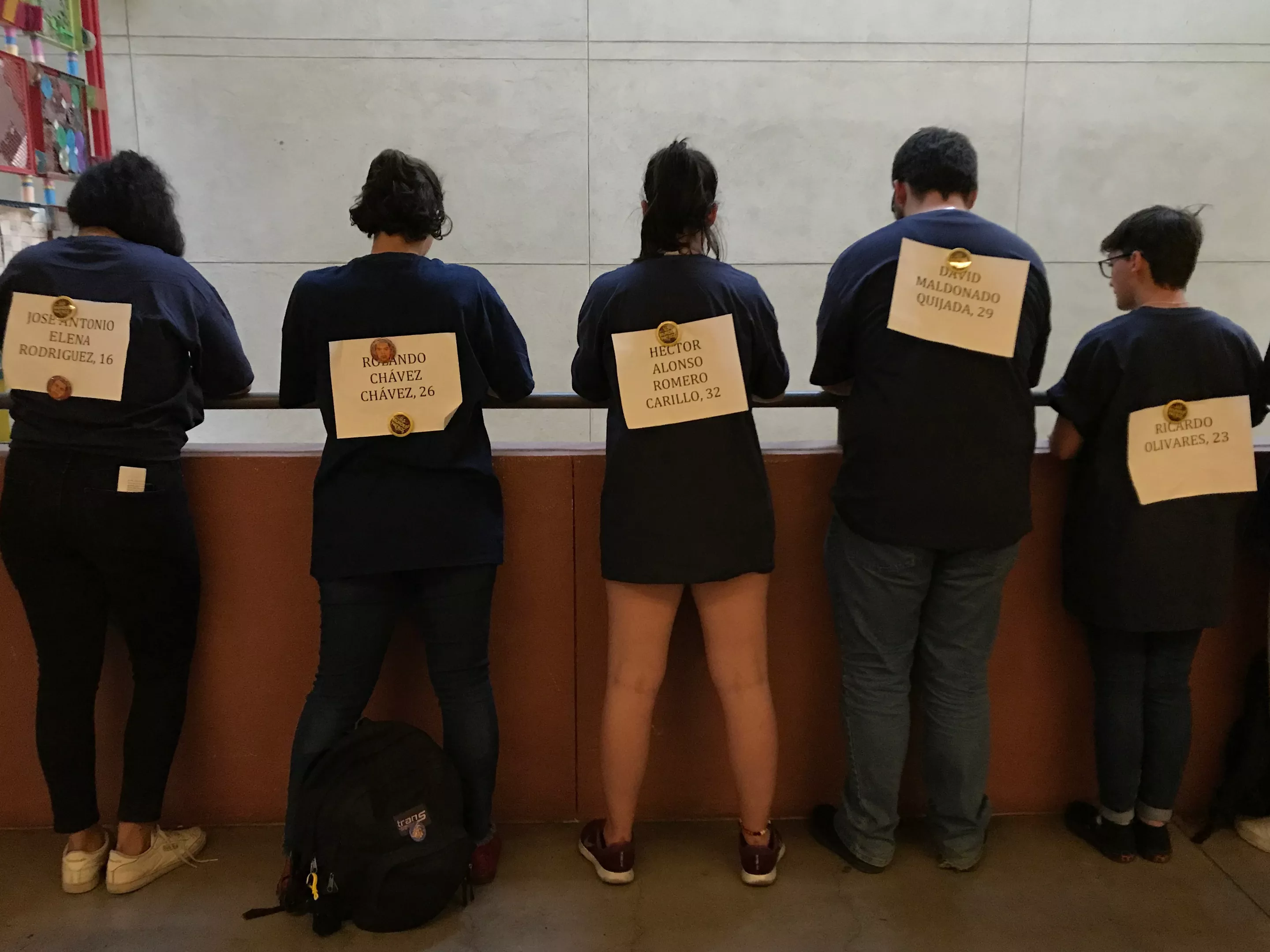
National Border Patrol Council Vice President Art Del Cueto spoke to a group of about 20 college students and invited guests at last night's UA College Republicans Club meeting at the UA Student Union Memorial Center.
Outside the Santa Cruz Room, dozens of student and community activists protested Del Cueto's visit in silence, clad in Navy blue T-shirts with the Border Patrol's logo, except the shirts read "Murder Patrol" instead.
UA staff members were also outside the room monitoring the meeting and silent protest.
The event follows a tense three weeks on campus, after a March 19 incident that resulted in three students being charged with misdemeanor crimes.
As previously reported, Border Patrol agents were on campus that day in the Modern Languages building as guests of an event hosted by the Criminal Justice Association, a university club. There was no previous school-wide announcement that BP agents would be present on campus that day.
Student activists protested and confronted the BP agents' unexpected presence. A video that captured the exchange was posted online and went viral. As a result, the students involved in the protest received an overwhelming amount of personal threats online.
Del Cueto called on the university to investigate whether the students violated the university's code of conduct or Arizona law regarding disorderly conduct.
UA President Robert Robbins indicated in a school-wide email on Friday, March 29 that the UA Police Department determined they will charge two students with interference with the peaceful conduct of an educational institution. A third student was later charged after being recognized by a UA police officer at an unrelated traffic accident.
Tags: DACA , Art Del Cueto , Border Patrol , Border Patrol Union , Border , Wall , Trump , College Republicans , University of Arizona , Protest , Image
Thursday, April 4, 2019
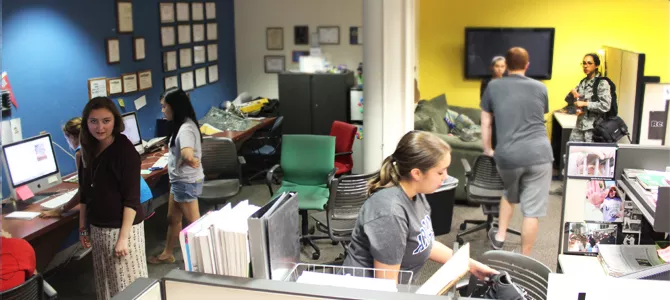
The University of Arizona's Park Student Union, located at 615 N. Park Avenue, will undergo extensive renovations as part of its transition to a facility called the UA Global Center.
It is envisioned to be the one-stop shop for services provided by UA Global, a department that serves international students and faculty who are entering or leaving. Currently, UA Global's operations are spread out across campus, making it difficult to navigate.
The new center will house International Student Services, International Faculty and Scholars, UA Study Abroad, UA Passports and International Recruitment, Admissions and Marketing, according to a Daily Wildcat report.
As a consequence of the upcoming change, the university's entire student-run media department (which includes The Daily Wildcat, a weekly newspaper; UATV, a broadcast news service and KAMP Radio, a free-format AM radio station) will be displaced from their long-time headquarters along with a handful of other services.
While UA Space Management staff is working to find a new home for Arizona Student Media, the current newsroom was custom-built with 6,200 square feet of space to accommodate about 200 student media staff members, offices for full-time administrative staff, technological capability for large data transfers and more.
With limited free space on the main campus, finding a comparable replacement will be difficult.
According to a letter sent by student media leadership to UA President Robert Robbins on Tuesday, April 2, the staff at Arizona Student Media was only made aware of these plans at the beginning of the semester, and they are expected to move this summer, only a few months away. No one at the department was consulted before the decision was made.
Tags: University of Arizona , Arizona Student Media , Park Student Union , Daily Wildcat , KAMP , UATV , UA Global , Image
Tuesday, April 2, 2019

Remember Proposition 204 in the 2017 election, also known as Strong Start Tucson? If it passed, it would have raised local taxes to provide quality early childhood education to children in Tucson whose parents can't afford to pay for it. The proposition went down by a wide margin.
In a reasonably progressive town like Tucson which regularly elects Democratic mayors, city council members and legislators, you might expect Prop. 204 to do better than it did. The problem was, progressives were split. I was for the measure, but lots of people I usually agree with were against it. They supported the idea of expanding early childhood education to reach more children, especially children of low income parents, but they objected to the funding mechanism, the way the program was to be administrated and the fact that it stopped at the Tucson city limits. Those were valid concerns. I just thought, as a strong supporter of early childhood education, the city couldn't afford to pass up the opportunity to give a literal Strong Start to our children and our city. Both will benefit from giving young children a high quality, early start on their educations. Prop. 204 was an opportunity I feared would never come again.
Well, the idea is back in a new form. It's being called Pima County Preschool Investment Program. It's no longer limited to Tucson, it covers all of Pima county. It doesn't create any new taxes. And it will be administered through a contract with First Things First, a statewide program with funds which are earmarked to address early childhood development, education, and health concerns for children from birth to age 5, but doesn't have nearly enough funding to meet the statewide need.
A broad group of people and organizations in Pima county's public and private sectors, many of whom opposed Prop. 204, have coalesced around PCPIP. The Southern Arizona Leadership Council supports it. So does Chris Magnus, Tucson Police Chief. The list includes Children’s Action Alliance, the University of Arizona, First Things First, Metropolitan Education Commission and Center for Economic Integrity. Local school superintendents support it and school districts have agreed to participate by providing early childhood education or adding to what they're already providing if PCPIP becomes a reality. Some organizations have pledged financial support.
What's needed is a funding base. As happens so often, money is the sticking point.
Tags: Proposition 204 , Strong Start Tucson , Pima County Preschool Investment Program , First Things First , Southern Arizona Leadership Council , Pima County Board of Supervisors , Image
Monday, April 1, 2019
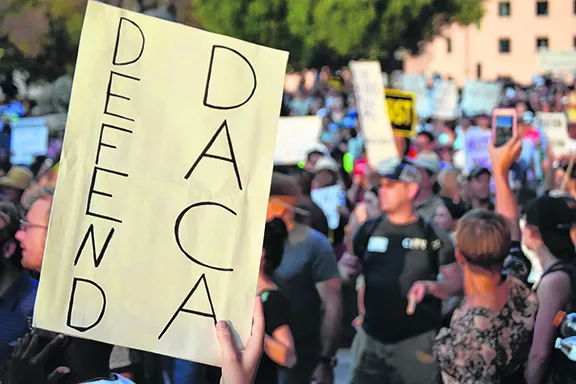
Student activists protested and confronted the CBP agents' unexpected presence. President Robert Robbins indicated in a school-wide email on Friday, March 29 that university police determined they will be charging two students with interference with the peaceful conduct of an educational institution, a misdemeanor crime.
In the email, Robbins wrote that the university is committed to free speech, but the student club and the CBP officers should have been able to hold their event without disruption. "Student protest is protected by our support for free speech, but disruption is not," he wrote.
The letter from DACA students titled "We Will Not Be Silent" states:
Tags: DACA , Border Patrol , President Robbins , Student , Activist , Criminal Justice Association , University of Arizona , UAPD , Image
Thursday, March 28, 2019
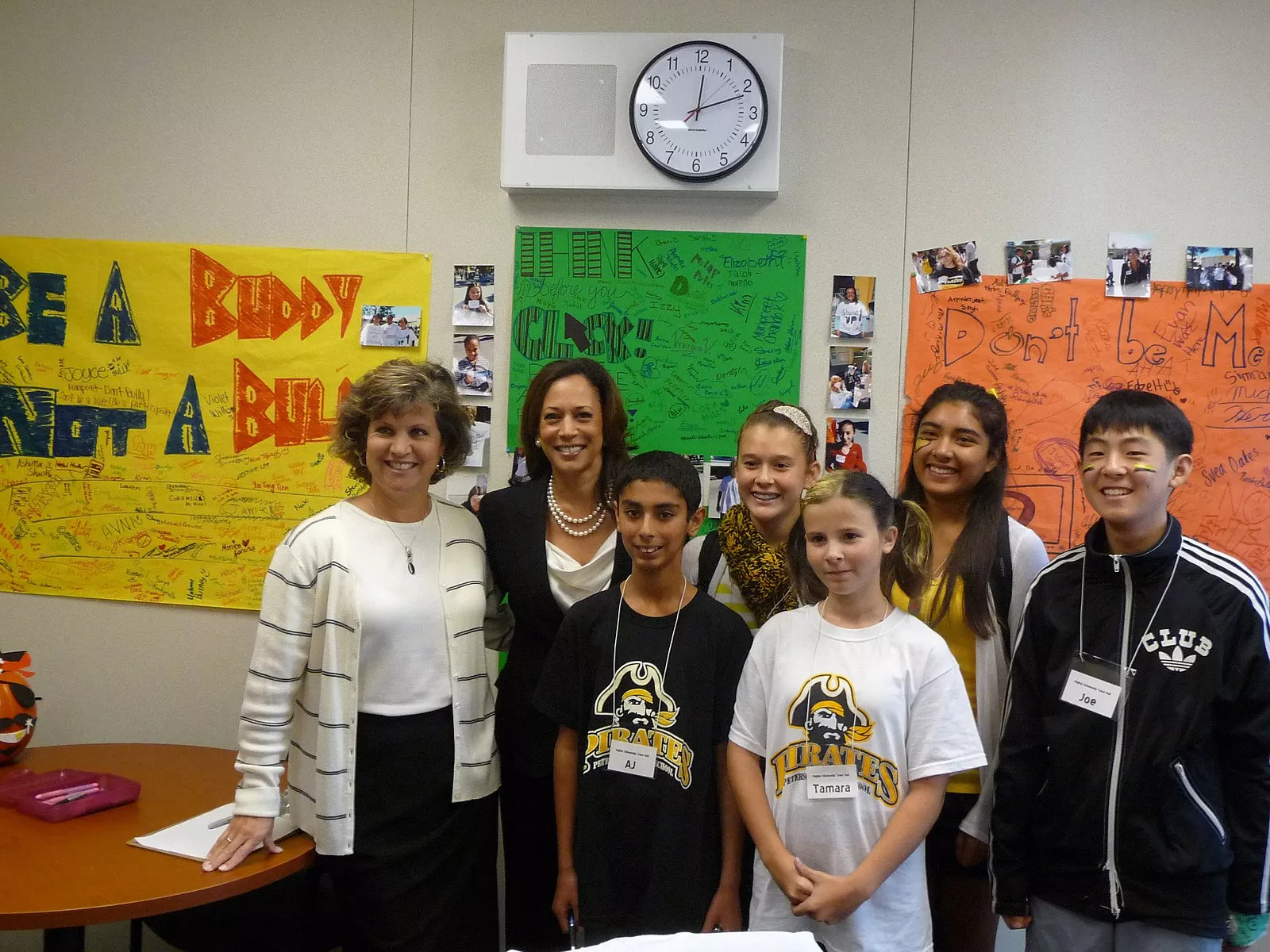
The Green New Deal is an aspirational list of ideas of ways we can improve the environment and lift people's standards of living.
Do we need a Green New Deal? Is it doable? Can we afford it? Democrats are asking those questions seriously while Republicans pretend the GND would mean an end to hamburgers, milkshakes and airplanes.
The best thing about the Green New Deal is people are forced to talk about climate change and the environment. The topics now have a place at the political table. The more politicians and others talk about them, the better the chances we'll do something to address them.
On another front, some Democratic presidential candidates are advocating for Medicare for All. Others are calling for a private/public partnership which guarantees health care for everyone.
What's the best way to deliver health care to the most people? How will we pay for it? Democrats are holding a vigorous debate on the topic while Republicans make another stab at killing Obamacare and claim to have a plan of their own, something which they've been talking about for years but have yet to unveil.
This is another issue which no presidential candidate can avoid talking about. Like the environment, health care has a seat at the political table. It cannot be ignored, and that's a good thing.
Kamala Harris, Democratic candidate for president, has pulled another chair up to the table, this one for teachers. Harris says teachers are underpaid and under-appreciated, and she wants to increase their salaries using a combination of federal and state funding.
Should we increase teacher pay? Can we afford it? What's the best way to do it? Thanks to Harris, every Democratic candidate will have to address those issues, and Republicans will have to figure out how to fight against a salary increase without sounding like they hate teachers and children. The discussion and debate will increase the possibility that teachers around the country will see a substantial pay increase sometime in the not-too-distant future.
Thank you, Kamala Harris.
Tags: Kamala Harris , Teacher salaries , Health care , Green New Deal , Presidential politics , Image
Tuesday, March 26, 2019

It looks like the charter school bill making its way through the legislature isn't going anywhere. After it passed the Senate, House Speaker Rusty Bowers stopped the bill from getting a hearing in committee. Bowers said he doesn't have the votes to pass it and he's probably right.
The bill's purported goal is to clean up the corruption and profiteering running rampant in some charter schools. People who have been paying attention have known about this for years but a series of articles in the Arizona Republic exposed the seamy underbelly of the charter world to more people, including some Republican politicians who have done their best to look the other way. Not all charters are guilty. Many are run with the primary intent of educating their students, not fatten people's wallets. But as The Republic demonstrated, the bad charter operators are truly bad operators.
The bill's sponsors claim its purpose is to increase charter transparency and lay down some regulations, making it harder for people to game the system. Actually, it does very little, and it does that badly.
Before we look at the bill itself, let's take a look at what's been going on around the bill to see what we can learn.
Here's one clue to what's in the bill: when it passed the Senate 17-13, all the Republicans voted for it. All the Democrats voted against it after trying to amend it to give it more teeth. Seeing as how Republicans created Arizona's charter schools a few decades back and have protected charters from greater regulation and accountability ever since while Democrats have been the ones calling for more transparency and regulation, it makes you think the bill is meant to act as a fig leaf to cover up the naked corruption taking place in some charters, not improve the charter school system.
Tags: Charter schools , Arizona legislature , Arizona Charter School Association , Sen. Kate Brophy McGee , Rep. Eddie Farnsworth , Image
Monday, March 25, 2019

Each month the organization runs a Teacher Excellence Award program and are currently running a special contest for Teacher Appreciation Week, May 6 to 10. Students can submit a video explaining why their teacher should be nominated and recognized. The videos can be a group or individual project and adult help is allowed.
All K-12 teachers in southern Arizona are eligible to be nominated and five teachers will be chosen for the award. Winners will receive $250 cash from Tucson Values Teachers, a $100 gift card to Office Depot/OfficeMax, a plaque recognizing their achievement, flowers, a mini bell from Ben's Bells and pizza for their class.
So, if you know a teacher who deserves to win, work with your kids and nominate now! Videos must be under a minute long and in MP4 or MOV format. Nominations can be submitted now until April 25.
Find the nomination form here.
Tags: education , students , teachers , Tucson Values Teachers , k-12 , video , nominations , projects , kids project , school , Image
Thursday, March 21, 2019

I have a column in the print edition of the Weekly discussing Edbuild's national study on per student funding. The fact is, Arizona does a reasonably good job of balancing its funding across districts, but Edbuild's study says Arizona's funding gap between predominantly white and nonwhite districts is the worst in the country — a $7,613 difference. That figure is wildly wrong.
This post is a short-version review of how badly Edbuild crunched the numbers. We're going to take a look at a hypothetical school district to see where Edbuild went wrong.
The Gulliver Valley School District is a small district with only two schools, Liliput School and Brobdingnag School. Because Liliput is in a sparsely populated area, it only has 47 students, and it spends $19,700 per student. That sounds like a lot of money, but it costs more to educate a small number of students.
Brobdingnag is in a more populated area. It has 2,425 students. Because of economies of scale, it is able to educate its students for $6,400 per student.
Here's a math problem. How much does Gulliver Valley District spend per student overall?
Now, you might decide to take the per-student funding number for each school and average the two. If you did, you would say the district spends $13,050 per student.
But that's not right. You can't just average the per student cost of two schools when one has 50 times more students than the other. It's more complicated than that.
If you weight the funding figures for the two schools based on the number of students in each school, you come up with a figure of $6,653 per student for the entire district. That's the right answer.
Edbuild, for some reason, chose the first, overly simplistic way of arriving at the average per student funding over a number of districts rather than the second. That's why Edbuild's numbers are so wrong.
If you want to know more, go to my column in the Weekly.
Tags: Edbuild , Funding per student , Methodology , math , education , funding , study , Arizona , schools , students , Image
Wednesday, March 20, 2019
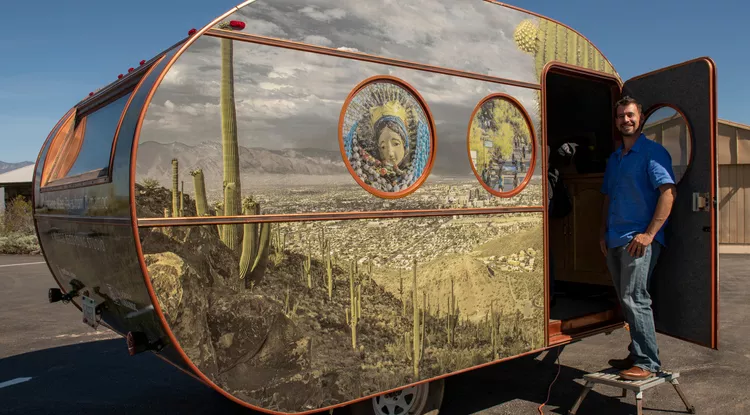
As part of an interdisciplinary oral history project run by scholars from the University of Arizona, a mobile recording studio has been set up to collect stories of hikers walking by.
"It is essentially Story Corps for Tumamoc," said Ben Wilder, director of Tumamoc Hill, in a release. "We want to hear what Tumamoc Hill means to you to better understand the unique connection between people and this place."
The UA Confluencenter for Creative Inquiry and the Desert Laboratory Tumamoc Hill have collaborated on this project and the camper, which opened for storytelling on March 12.
On select days between now and April 7, the camper will be open for hikers to stop by and share their stories. The tales will be taken down on audio, and each speaker has the option of having their photo taken by National Geographic photographer Bill Hatcher.
The images and stories will be shared via Desert Lab and Confluencenter on Instagram at @confluencenteruofa and @desert.laboratory.
"Just as Humans of New York is able to give you a sense of the vibrant culture of a city and intimate stories we all have, Tales From Tumamoc will capture the remarkable stories right here in the heart of our city," said Javier Duran, director of the Confluencenter for Creative Inquiry in a release.
To find out when the camper will be open and collecting stories, and to learn more about the project, click here.
Tags: Tumamoc , "ales From Tumamoc , Cuéntame Más , Camper , oral history , stories , hiking , UA , Image