

Friday, August 17, 2018

Research has shown that mothers are penalized in the workplace as it is assumed that they are less focused or dedicated because of their children.
According to the UA, research has shown that mothers in the U.S. are subject to a net wage penalty of 5-7 percent per child and they are often placed in "mommy-track" jobs, characterized by fewer opportunities for career advancement and financial security.
Men, on the other hand, benefit at work once they have children, as they are viewed as the family breadwinner.
This phenomenon is known as the motherhood penalty and fatherhood premium. Researchers at the University of Arizona studied how this changes for married versus single parents.
UA Sociology doctoral student Jurgita Abromaviciute conducted an experimental study and found that when parents are not married, the motherhood penalty and fatherhood premium disappear.
Abromaviciute discussed her research in a UA press release.
"When a woman is known to be single and when she has children, then in addition to being a caregiver, she's also a breadwinner. So, in addition to caregiving, she now also has to provide for her family and she has no one to fall back on. My research shows that single mothers are not perceived as less competent or less committed than single childless women, and they are not less likely to be hired or promoted compared to their childless counterparts. In other words, while the motherhood penalty holds for married mothers, it disappears in the subsample of single mothers."It is important to note that while single mothers do not suffer from the motherhood penalty, they also do not receive the fatherhood premium. However, neither do single fathers, research found.
"Single fathers, in addition to being breadwinners, are caregivers to their offspring," Abromaviciute said in a UA press release. "Likely, this triggers an assumption that they are more focused on their family than a married father might be, which eliminates the fatherhood premium."
When conducting her research, Abromaviciute asked 160 college students to evaluate job applications including resumes and notes from a human resources interviewer, for fake applicants with comparable experience all applying for an upper management position with a communication company.
The students were aware of the applicants' gender, whether they were married and if they had children.
"For the subsample of single mothers and single fathers, there's no premium or penalty," she said, "which suggests that marital status operates as a strong status cue that, combined with gender and parenthood status, leads evaluators to make assumptions about one's anticipated performance at work.”
Abromaviciute said that she hopes to continue her research with a broader demographic of study participants and across a broader representation of possible jobs.
Tags: single moms , parents , wage gap , UA , research , parenting , motherhood , fatherhood , study , Image
Thursday, August 16, 2018
This grant enables NAMI of Southern Arizona to expand stigma reduction education and advocacy for youth mental health statewide. The program also works to increase help-seeking for mental issues among youth ages 10 to 24.
“With suicide now the second leading cause of death for ages 10 to 24, we want young people to know they are not alone and there is hope for their future” said H. Clarke Romans, executive director of NAMI Southern Arizona. “Stigma is still the greatest deterrent to seeking help.”
This NAMI funding comes in addition to a recent block grant received from the Substance Abuse and Mental Health Services Administration. The block grant is to bring an educational program called “Ending the Silence” to schools in Pima, Cochise, Santa Cruz and Pinal Counties.
Since 1983, NAMI has worked to treat mental illness in a professional and medical fashion, stating, “These mental disorders are like any other medical condition; they are common AND treatable.”
Schools and other youth-serving organizations can contact NAMI Southern Arizona to request the 50-minute “Ending the Silence” presentation for their students by calling 622-5582 or emailing [email protected].
Tags: grant , mental health , mental illness , end the stigma , NAMI , schools , youth , Image
Wednesday, August 15, 2018

Doug Ducey and his Republican legislative cronies had $56 million in federal money waiting to be spent to help cover the cost of child care and early childhood education for low income families. They refused to spend it.
The state didn't have to put up a penny. All it had to do was add a $56 million line item to its budget, and more low income children would have access to child care services. Ducey and the Republican legislative leaders knew the money was there, they were urged to put it in the budget by child care advocates and by Democrats in the legislature. They just decided not to do it.
When a story in the Sunday Star brought the unspent $56 million to my attention, I contacted Michelle Crow, Southern Arizona Director of the Children's Action Alliance, for more details. Next I talked to Democratic Rep. Randy Friese, who represents LD-9, my legislative district, to find out why the money didn't make it into the budget. The more I learned, the worse things got.
In March the federal government included $5.2 billion in its budget to increase the quality of child care and early childhood education across the country. Arizona's cut of the funds is $56 million, which is supposed to be added to the $125 million Arizona already receives to subsidize child care and early childhood education for children from low income families.
Right now, there's not enough money to subsidize child care for all the children who need it. As bad or worse, the amount the state allocates per child doesn't cover the child care provider's costs. The state Department of Economic Security's "Reimbursement Rates for Child Care" schedule is based on what the services should cost. The problem is, the reimbursement rates haven't changed since 2000. The state is still using an 18 year old rate schedule created at a time when the minimum wage was $5.15 an hour. Today it's $10.50.
It's actually worse than that. The DES reimbursement is only 75 percent of going rate in 2000. It's no surprise Arizona has among the lowest reimbursement rates in the country.
Tags: Child care subsidies , $56 million , Department of Economic Security , Michelle Crow , Rep. Randy Friese , Rep. Pamela Powers Hannley , Image
Monday, August 13, 2018

Are you tired of all those political robocalls and calls from earnest volunteers? Did you know, they're tired of talking to you too?
Are you tired of all those glossy, oversized postcards from candidates touting their accomplishments — and maybe running down their opponents? Did you know, they're tired of sending them to you too?
Just vote. When campaigns find out you've sent in your ballot, they'll leave you alone. No more (or almost no more) calls. No more (or almost no more) oversized postcards. You can sit back with the beverage of your choice and watch the political circus unfold before your eyes, knowing you've done your patriotic chore. Better yet, volunteer for the candidate(s) of your choice and be one of those phoners or the doorbell ringers helping to get out the vote.
Send in your ballot!

Speech-language pathologists, or SLP's, have many standardized tests they can use to assess English-language-only children, but there is only one test for bilingual children.
"School-based speech-language pathologists, or SLPs, are required to provide culturally competent services to all children, including those who speak both English and Spanish," Fabiano-Smith said in a UA press release. "They face a great clinical challenge: accurate identification of speech sound disorders in children who speak two languages."
With the 5-year grant from the National Institute on Deafness and other Communication Disorders, Fabiano-Smith will continue her research to reduce health and educational disparities for bilingual children.
Fabiano-Smith and her research team have partnered with Sunnyside Unified School District, which has about 82 percent Latino students, to make solid determinations if students need help with pronunciation due to being bilingual, or due to a speech disorder.
"SLPs have some confidence when assessing bilingual children whose primary language is English, but lack confidence when assessing bilingual children whose primary language is Spanish," Fabiano-Smith said in a UA press release. "What helps is if you look at both the English and Spanish of Latino children together, instead of just looking at one or the other to make a diagnosis. By combining skills in both languages together, you get a much more accurate diagnosis."
Research focusing on bilingual children's education is becoming increasingly important in Arizona and nationwide as the percentage of bilingual children increases. According to the National Center for Education Statistics, Latino children make up 25 percent of U.S. elementary school students. This number is expected to reach 30 percent by 2030.
The research grant will help Fabiano-Smith address an increasingly time sensitive issue.
"We are in danger of misdiagnosing a generation if this problem is not solved now," Fabiano-Smith said in a UA press release.
UA President Robert C. Robbins acknowledged the grant, mentioning the commitment the UA has to students of all ages and linguistic backgrounds.
"The UA's status as a Hispanic-Serving Institution is driven by our commitment to the academic success of every member of our community, and Dr. Fabiano-Smith’s work with bilingual children is a vital contribution to this part of our mission," Robbins said. "I am very excited by what this grant will enable."
Tags: UA , research , grant , bilingual children , bilingual , elementary school students , speech , language , Image
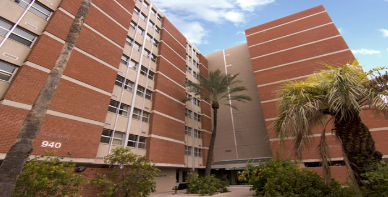
General move-in days are:
Aug. 15, 7 a.m. - noon
Aug. 16, 7 a.m. - 4 p.m.
Aug. 17, 7 a.m. - noon
Aug. 18, all day
UA Housing and Residential Life are gearing up to move in more than 6,800 students into the 23 dorms for this upcoming fall semester. Classes start August 20. Find more information here.
Tags: UA , University of Arizona , fall semester , move in , dates , dorms , residence halls , dorm life , Image
Friday, August 10, 2018
Thursday, a post on Blog for Arizona by Larry Bodine sent minor shockwaves through the Democratic primary race for governor. Bodine wrote a scathing review of a book David Garcia wrote titled School Choice, which will be published September 28. According to Bodine, Garcia's book is pro-school privatization and, in the words of the headline "a Blueprint to Dismantle Public Education."
Bodine's post was the first I heard of the book. I asked him if he would share his review copy with me, and he did gladly. I read the book — or to be completely honest, I read the beginning carefully, then skimmed the rest of the 196-page book attentively enough to understand its content.
Bodine's depiction of the book is, in a word, wrong.
Of the people who have had a chance to read the book and comment on it in the media, I probably have the most experience reading education books. I have amassed a significant number of postgraduate units in the field, and I've continued reading education works, ranging from blog posts to articles to books, on a daily basis. Though I have expressed my support for Garcia, I also know how to read these kinds of texts for content and possible political leanings without letting my personal opinions interfere.
What Garcia has written is a book on the history of school choice beginning in colonial days and continuing through 2017. It is meant to be an objective overview of the subject, and it succeeds in that regard. If I had never heard of David Garcia and read this book, I wouldn't know his personal opinions on the subject. Though it is written for general consumption, it would be a valuable book to assign in any college course on the history of education, from Education 101 through graduate school.
I'm not the only one to arrive at the conclusion that Bodine's post is a distortion of the contents of Garcia's book. Brahm Resnik, one of Arizona's top journalists, came to a similar conclusion. So did Maria Polletta of the Arizona Republic. I'll quote some of what they wrote at the end of the post.
Tags: David Garcia , Blog for Arizona , Larry Bodine , School Choice , MIT Press Essential Knowledge Series , Image

Gun legislation in Arizona remains a hot-button issue going into election season. Gov. Doug Ducey’s proposed school safety plan, which was unveiled in March, was a contentious bill since Arizona lawmakers can’t agree whether “school safety” and “gun reform” are synonymous.
The bill was proposed as a proactive measure towards preventing any more school shootings like the February attack Marjory Stoneman Douglas High School in Parkland, Florida. The bill passed in the Senate with full support from Republicans and none from Democrats. But ultimately, the legislation stalled in the House.
“Governor Ducey was disappointed that the Safe Arizona Schools Plan was not passed by the Legislature, but that doesn’t mean that our work is done on the issue,” said Ducey Press Secretary Elizabeth Berry in an email. “School safety is a top priority and the governor is committed to fighting for the common-sense reforms included in the [bill].”
Ducey says that passing his school safety bill is one of his highest priorities going into the next legislative session, should he win re-election. But with his plan facing criticism from both Republicans and Democrats, he will have a challenge seeing it become law if he’s reelected.
Democrats cite the lack of universal background checks as one of the bill’s biggest pitfalls. Ducey’s plan intends to strengthen the existing criminal background check system, allocating $600,000 to do so, but that doesn’t take into account that person-to-person sales aren’t regulated because only federally licensed firearm dealers are required to perform background checks at the point of sale. This is commonly referred to as the “gun show loophole.”
Congressional candidate, Arizona Sen. Steve Smith (R-Maricopa), who sponsored the Safe Arizona Schools Plan, says that while he’s confident that Ducey will be re-elected, the issue is still important enough that it will be addressed—and fast—if he’s not. Smith also thinks gun reform should be addressed at the state level not nationally.
“This is not a gun bill; this is a school safety bill,” Smith said. “We’re talking about keeping people safe as it relates to mass shootings. We aren’t going to get into bump stocks and all of those other areas. If you want to have a debate about that, then run a bill about it.”
The Arizona House of Representatives voted 34-25 in February against a bill to ban bump stocks, House Bill 2023. Ducey’s bill initially had several types of STOP orders—Severe Threat Orders of Protection—that would allow both members of the public and law enforcement to petition Arizona courts to advocate for the removal of firearms from individuals exhibiting severe and imminent signs of threatening behavior.
The bill states that after law enforcement presents a judge with evidence that an individual is dangerous, the judge can require that the person in question undergoes a 21-day observation and mental health examination to determine whether or not the person is a risk.
The bill saw multiple revisions throughout April and was significantly watered down before it got to the floor for a vote. That final version removed the aspect of the STOP order that allowed concerned citizens to petition for one, allowing only members of law enforcement to do so.
Smith says that most people don’t know how to petition a court anyway, so removing that part will allow law enforcement to properly handle concerns.
The STOP orders are one of the most contentious parts of the bill, as Democrats argue that they won’t do enough while Republicans argue that they are an overstep by the government.
Republican gubernatorial candidate Ken Bennett says Ducey’s plan focuses too heavily on seizing guns and that the state should instead arm willing teachers to keep schools safe, referring to the oft-used slogan: “The best way to stop a bad guy with a gun is a good guy with a gun.”
Smith also argues that the addition of armed forces, whether it be through security resource officers or the arming of teachers, is necessary to keep Arizona schools safe.
“The majority of the people that talk to me want to see the schools be better protected, and inevitably that means that they want somebody on campus to be able to use force and have force available if needed,” he says.
Ducey’s plan would increase the amount of armed security resource officers on school campuses in Arizona. It also would allocate more funds for more trained mental health professionals on school campuses, with $3 million for behavioral and mental health specialists, according to Berry.
While Smith, Ducey and Bennett believe that it is necessary to arm more people to combat mass shooters, Democratic gubernatorial candidate David Garcia doesn’t believe placing more armed officers in schools would create the support system that is necessary to prevent school shootings.
“Those who firmly believe that a crisis would be resolved with a gun fight have been playing too many video games and watching too many movies,” Garcia said. “What we need is eyes, ears and communication . . . in the form of support, not enforcement.”
Garcia argues that in order for Democrats and Republicans to mend the division regarding topics of gun control, Arizona needs a governor who doesn’t receive praise from the NRA.
The NRA publicly supports Ducey’s school safety plan, which Smith praises.
Marissa Ryan is a University of Arizona journalism student and a Tucson Weekly intern.
Tags: guns , school safety , school shooting , officers , politics , policy change , Image
Thursday, August 9, 2018
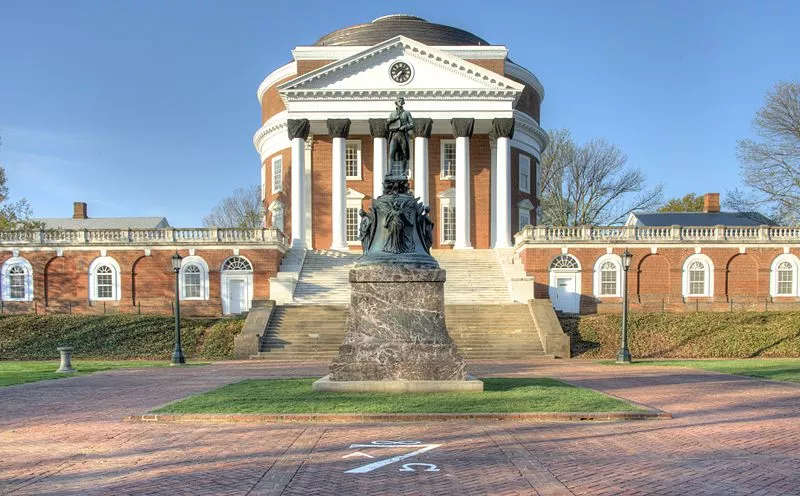
Here's my suggestion to UVA: Pay back by paying forward.
• Extend the meaning of "legacy student" from the children of UVA alumni to include the descendants of slaves who were forced to build and maintain the school.The first anniversary of the Unite the Right rally in Charlottesville, Virginia, home of UVA, comes in a few days. Coinciding with the anniversary is the publication of the final report of the UVA's Slavery and the University Commission, which began its work in 2013. Together, the two events put the issues of pre-Civil War slavery and present-day racism into stark perspective.
• Create a UVA fund dedicated to the educations of their descendants based on the monetary value of their ancestors' contribution to the university.
The racism of the Unite the Right participants is well known. The history of slavery at UVA, however, like the history of slavery in the U.S., is clouded by our national determination to paint our country's original sin in broad strokes and ignore its disturbing details. The UVA report is one of the recent attempts to bring the full, accurate history of slavery to light.
Based on the commission report, it's fair to call UVA the university that slavery built. According to the report, "Slavery, in every way imaginable, was central to the project of designing, funding, building, and maintaining the school."
The dollar value of the slave labor which directly contributed to the building and maintenance of the university is only one part of the story. The people who funded the building of the school were Virginians who owed their wealth to the state's slave-based economy, including the country's third, fourth and fifth presidents, Thomas Jefferson, James Madison and James Monroe.
Tags: University of Virginia , Slavery and the University Commission , Slavery , Unite the Right , Thomas Jefferson , Reparations , Image
Tuesday, August 7, 2018

According to a 2017 study by National Education Policy Center, 279,000 students attend virtual schools in 34 states. To put that number in perspective, Arizona has about a million K-12 students, so the national virtual school enrollment is less than a third of Arizona's school-aged population. It's less than half a percent of all public school students in the country. But still, 279,000 is a lot of students sitting at home in front of a lot of computers. I don't understand why the number is that high.
It's true, for some students, virtual schools make a lot of sense.
Some students are involved in activities that take up large amounts of time, like intensive training or work in sports, music or drama. It's great for them to be able to fit their educations into their schedules. When I taught in the Portland area, I had a few high school students who were training for olympic-level skiing and spent months every year on Mt. Hood. I would send lesson plans with them and tutors would help them out, but they probably would have been better off with a good online curriculum.
Some parents who home school their children for religious or other reasons like the idea of using the set curriculum provided by virtual schools rather than being responsible for finding or creating the curriculum, then teaching it to their kids.
Some students have illnesses which keep them at home. Others have been bullied mercilessly at school, and getting their educations at home is a way of avoiding further emotional trauma.
For students like these who are motivated enough to follow through on their work without the physical presence of a teacher, or have enough parental pressure to keep them motivated, virtual education can work well. But they make up a relatively small group. There's no way they're a large percentage of the 279,000 virtual school students.
Tags: Virtual schools , education , students , K-12 , schools , Arizona , computers , online , Image

