Friday, April 13, 2018
Did Ducey Blink?
Ducey didn’t just blink. His knees buckled, he reached for the white handkerchief in his breast pocket, straightened himself out, waved the kerchief over his head, put on his best smile and tried to pretend his offer of a 19 percent raise for teachers is what he wanted to do all along.
It wasn’t. The teachers forced his hand. Instead of demonstrating, patting themselves on the back and retreating to their classrooms, they refused to go away. They were out last week, they were out this week, and they’ll be out next week in ever growing numbers. It’s a rolling thunder sweeping across the nation, from West Virginia to Oklahoma to Kentucky to Arizona, and the storm is building in intensity. First the media covered the spectacle, then it covered the issues. (Lesson learned: If you want media coverage, earn it. Make a spectacle of yourself, then do it again. Say something outrageous, then say it again. That's catnip for journalists.) Nearly all the coverage has been on the teachers’ side, because the teachers are right and because they impressed the nation with their tenacity, their unity, their fearlessness.
If I sounds like I’m proud of the practicing members of my profession . . . you goddam betcha I am.
Did I See This Coming?
Nope. Didn’t even imagine this moment was possible, let alone that it could come this soon.
Should Teachers Cheer?
Absolutely. They won a big victory. They should cheer for a full minute. Hell, this is a biggie, make it ten minutes. Then get back to the business of guaranteeing increased funding levels for teacher salaries, for support staff salaries, for school repairs, for school supplies — for all the stuff the "Dismantle public schools" Republicans who run this state have refused to pay for.
Tags: Doug Ducey , Teacher raises , Image
Wednesday, April 11, 2018
The one near-strike I participated in was way back in the 1970s in a district outside of Portland, Oregon. I remember sitting in the band room after school with the rest of the faculty as the school's union leaders discussed our options with us. Unannounced, the principal walked through the door. "If any of you plan to go on strike," he said, looking around the room, "I want you to come to my office and tell me first."
His words set off a mild rumbling of fear inside my 20-something body. But when he opened his mouth to continue, one of the union leaders, a mild mannered older teacher, interrupted him. "We are holding a union meeting," the teacher said quietly but firmly. "It's after school hours, so we're on our own time. You are not allowed in here. I ask that you leave, now." The principal stood still for a few moments, then turned and left. If we weren't absolutely united before, we were when the door closed behind him.
The district settled with the teachers the next day, so the strike was averted. Otherwise, we were more than ready to walk. [This story isn't a knock on principals or administrators in general, by the way, many of whom are very supportive of their staff. It's just this one guy and this one situation I'm talking about.]
That near-strike moment came to mind as I listened to the way our "education governor" has responded to teacher activism. Ducey's tactic, like my principal back then, is divide and conquer.
Tags: #RedforEd , Walk-in , Cough Ducey , Arizona Educators United , Noah Karvelis , Arizona Education Association , Joe Thomas , Image
Well, lookie here: the Arizona Republic reports that movement is afoot on that front:
A Republican state lawmaker is discussing with colleagues and outside groups a plan that could knock Proposition 305 off the November ballot before voters can decide the fate of Arizona's expanded school-voucher program.The effort could backfire. Last year, Save Our Schools Arizona was able to gather enough signatures to force a referendum on the voucher plan. Making them go out and do it all over again with this kind of chickenshit dirty trick will energize teachers and other public ed supporters, which will make it even easier to turn them out in November—which is the last thing that Gov. Doug Ducey needs as he runs for reelection.
The goal is to repeal last year's legislation that expanded the ESA program to all 1.1 million public-school students and replace it with legislation intended to address criticisms of the expansion, according to more than a half-dozen people familiar with the wide-ranging discussions.
Tuesday, April 10, 2018
Full Disclosure: I haven't decided who I'm going to vote for in the Democratic gubernatorial primary, though I do know who I'm voting for in the general: the last Democrat standing. Any one of them will be a vast improvement over the current officeholder, who somehow manages to call himself "the education governor" with a straight face. So I'm reporting what I heard at the debate, not expressing any personal preferences.
Though the three Democrats varied a bit, they stand pretty close together in their overall views about education and miles away from Doug Ducey, meaning they're for strong, well funded public education, including a substantial raise for teachers. All three agreed teachers should get at least a 20 percent raise. Fryer wants it to be 25 percent. Farley wants a 20 percent raise for the classified staff as well.
The only direct question about education in the debate was about where the new education money will come from.
The three had different proposals for how to add money to the state budget: raising taxes on the wealthy, getting rid of corporate tax exemptions or a combination of the two. None of them suggested we increase the sales tax.
David Garcia presented a both/and funding proposal. He wants to reverse corporate tax exemptions — carve-outs which allow specific corporations to pay lower taxes — and get rid of private school tax credits. He also wants to increase taxes on the one percenters. The result, he said, will be a more progressive tax structure in Arizona, which is currently one of the most regressive in the country. Garcia didn't put a dollar figure on the amount his plan would bring in.
Steve Farley said the state has 330 corporate tax loopholes, and by ending some of the loopholes, we can bring in $3 billion. He will use $2 billion for education spending, which is more than enough to cover a 20 percent raise for teachers as well as classified staff. The remaining billion dollars will be used to lower the sales tax by one percent.
Kelly Fryer doesn't believe much money can be raised by getting rid of corporate tax loopholes, so she essentially discarded that idea. She recommended a variety of ways to tax the rich. She wants to increase taxes for people who make over a million a year. According to the Economic Policy Institute, the income of Arizona's one percenters begins at $309,000, so she's looking at a smaller pool of taxpayers than Garcia. However, she also wants to put a sales property tax on every home over a million dollars, as well as what she calls a "vacation tax" on people who own homes in Arizona but don't actually live here. Fryer said her plan will raise $2.7 billion, and she'll give teachers a 25 percent raise.
Tags: Governor , Elections , Steve Farley , David Garcia , Kelly Fryer , Doug Ducey , Education funding , Image
Friday, April 6, 2018
The University of Arizona recently responded to a records request from Kochs Off Campus to list all funders of the Freedom Center since 2008 and the amount each contributed. It doesn't appear to be a complete list, but it paints a picture of the political and economic leanings of the people whose money makes the Center's existence possible.
The UA response to the Kochs Off Campus request lists 14 donors whose contributions total $8,325,000. That number is far short of what Michael McKenna, then the director of the Freedom Center, wrote in a November 2, 2017, response to my column about the high school course created by the Center. McKenna wrote,
According to [David Schmitz, founding director of the Freedom Center], since 2004 the Center for the Philosophy of Freedom has received $16 million dollars from roughly two dozen donors.The reason for the discrepancy could be the dates. Kochs Off Campus asked for a list of donations beginning in 2008 while McKenna begins in 2004. David Schmidtz is in the best position to reconcile the two figures. In an article in UA's paper, The Wildcat, the reporter said Schmidtz promised to share a donor list with the paper, but at the time of publication, she had not received one. Maybe Schmidtz is ready to share a complete list now.
Here's the list of Freedom Center donors supplied by the UA.
Templeton Foundation: $2,900,000I looked into some of the major funders to find their political and economic leanings. Not surprisingly, they tilt to the political right. Many of them tend toward libertarianism, and their contributions, along with their ideology, follow closely on the heels of the Koch brothers. Here's what I found.
Randy and Ken Kendrick: $1,500,000
Charles G. Koch Foundation: $1,345,500
Thomas W. Smith Foundation: $1,326,000
Donors Trust: $380,000
Jerry Fullinwider: $380,000
Karl and Stevie Eller: $350,000
APGAR Foundation: $67,000
Garland and Carolyn Cox: $31,000
Michael Kasser: $25,000
Nancy and Jack Weiss: $10,000
Gerry Ohrstrom: $5,000
Jim Click, Jr.: $5,000
Irv Mindes: $500
Tags: University of Arizona , Kochs Off Campus , Freedom Center , Michael McKenna , David Schmitz , Templeton Foundation , Randy and Ken Kendrick , Charles G. Koch Foundation , Thomas W. Smith Foundation , Donors Trust , Jerry Fullinwider , APGAR Foundation , Image
Wednesday, April 4, 2018

He continued,
"I am a gun owner and an avid hunter. Over the years I have agreed with most of N.R.A.’s objectives, particularly your educational and training efforts, and your fundamental stance in favor of owning guns."Bush made it sound like the N.R.A was a good ol' association gone bad. But when we go back to the 60s and look at the way it fought gun regulation, it looks more like a bad ol' organization gone worse.
It was 1968. Martin Luther King Jr. had been shot and killed. Nine weeks later, it was Bobby Kennedy's turn. President Lyndon Johnson decided, if there was ever a moment to pass his Gun Control Act, this was it.
An article in the New York Times describes the events. To that point, the country's high rate of gun violence wasn't enough to prod Congress to pass gun regulation. California was one of the few states to pass gun control measures, but it wasn't because of the violence. The legislature was reacting to the sight of Black Panthers on patrol, carrying loaded rifles.
The mood in Congress changed after the King assassination.
The King assassination spurred the legislation not just because it horrified the nation, but also because it prompted unrest across the country, including in Washington, where lawmakers watched rioters come within blocks of the White House as thousands of federal troops were mobilized.After Bobby Kennedy's assassination, Congress made a small change in the law, raising the age when people could buy handguns to 21.
Mr. Johnson wanted something far more sweeping. He proposed to treat guns like cars: They would be registered and their owners would be licensed.Johnson knew he had no more than two weeks to get the bill through Congress or "the N.R.A. will kill us." Which is exactly what happened.
Tags: N.R.A. , George H. W. Bush , Martin Luther King , Bobby Kennedy , Lyndon Johnson , Gun regulation , Image
Monday, April 2, 2018
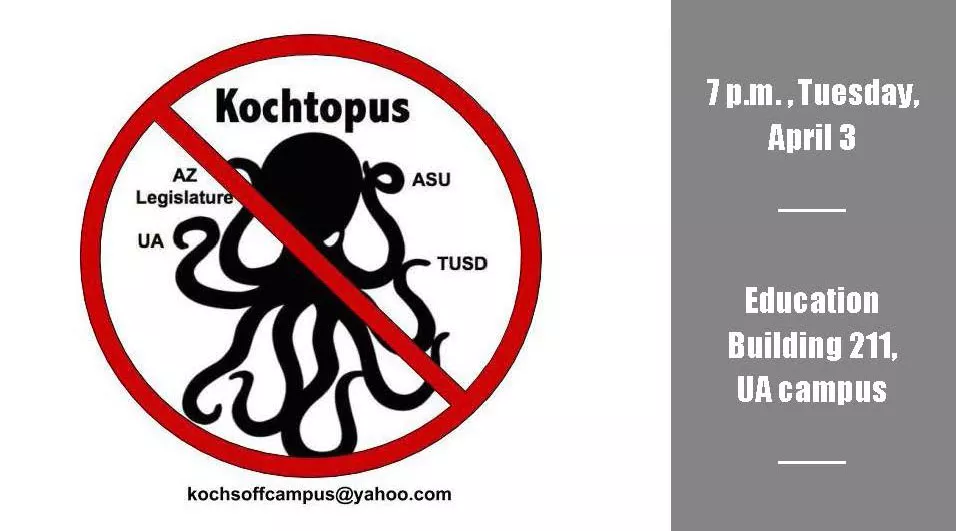
Kochs Off Campus is hosting a panel discussion, "Dark Money, Charles Koch, and the UA Freedom Center," Tuesday, April 3, 7pm, in Education Building 211 on the University of Arizona campus. I will be one of the panel members, along with: David Gibbs, Professor of History, Moderator; Samantha Parsons, UnKoch My Campus Grassroots Campaign Strategist; Douglas Weiner, Professor of History; and Jeremy Vetter, Associate Professor of History. The public is invited to attend.
The panel will discuss the history and current status of UA's Freedom Center as well as the course it created, "Phil 101: Ethics, Economy, and Entrepreneurship,” which is being taught in four local school districts.
Before setting up the panel discussion, Kochs Off Campus invited David Schmidtz, the founding director of the Freedom Center, to participate in a public forum where he and David Gibbs would debate the topic, “Is the Freedom Center an Asset or a Liability for the University of Arizona?" Schmidtz refused the invitation.
Tags: Kochs Off Campus , UnKoch My Campus , University of Arizona , Freedom Center , David Schmidtz , David Gibbs , Samantha Parsons , Douglas Weiner , Jeremy Vetter. , Image
Saturday, March 31, 2018

That #RedforEd protest on March 21 was great and all, but it was supposed to be a one-and-done, right? Teachers got to wear those nice, new red t shirts. They went to the Capitol. They told legislators and the press, "We want decent salaries! We want more funding for schools!" They got their few hours of fame. Time to pat themselves on the back and return to their crappy salaries and underfunded classrooms.
That's what they were supposed to do, based on recent Arizona teacher history anyway. Instead, they came out the next Wednesday for another #RedforEd rally and demanded a 20 percent raise.
A 20 percent raise? Are you out of your minds?
The next day, the rally was getting positive press all over Arizona. And CNN. And ABC. And Education Week. And who knows how many other national news outlets.
Who designed those kickass red shirts anyway?
Meanwhile, Ducey's bully pulpit looked more like a kiddie stool. "Hey, c'mon guys, look at me. You know, the governor? I gave teachers a one percent raise, and there's more where that came from. I managed to pass a tax bill that means, well, it means schools won't get any more money, but they won't lose any either. That's something, right?"
Tags: #RedforEd , Arizona teacher salaries , 20 percent raise , West Virginia teachers , Oklahoma teachers , Kentucky teachers , Image
Wednesday, March 28, 2018

What could possibly go wrong?
Seven states joined in. (Arizona wasn't one of them, by the way.) People on the left and the right went nuts about the intrusion into the privacy of students and their families. I was one of the people who wrote about of the potential dangers of Big Data amassing all this information on our children. In reaction to the uproar, the seven states pulled out one by one. Soon, inBloom, another one of Bill Gates' boneheaded, wrongheaded educational ideas, was gone.
In light of the growing revelations about the exploitation of personal data by Facebook and Cambridge Analytica, it looks like inBloom's opponents were more right than we knew. Cambridge Analytica took a few wisps of data and created political profiles on hundreds of millions of Americans. InBloom would have 12 years of records about every student's family, school attendance, academic performance, health history, disciplinary and psychological history — a mind-boggling treasure trove of data. Private companies who gained access to this frighteningly rich data pool could mine it for personal, political and commercial gain. Bad actors could wield embarrassing or incriminating bits of information as weapons against students for the rest of their lives.
Tags: inBloom , Bill & Melinda Gates Foundation , Facebook , Cambridge Analytica , Educational software , Image
Tuesday, March 27, 2018
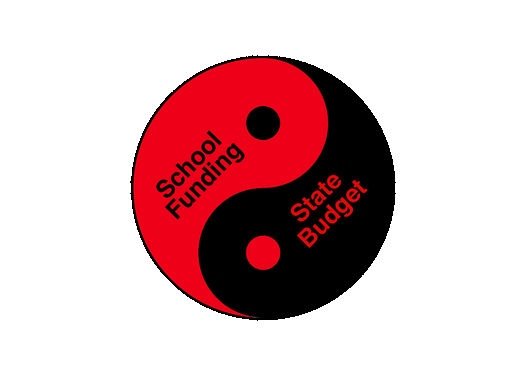
Well, not a tax hike exactly. SB 1390 is a new tax, but it's not a new new tax. Prop 301, the six-tenths of a cent sales tax for education, is set to expire in 2020, and the new law gives it another 20 years of life. It's a new tax without any new money attached.
It's taken 26 years for the legislature to pass any kind of new tax because in 1992, voters passed Prop 108 which says tax increases of any kind need a two-thirds majority in both the House and the Senate.
Under most circumstances, two-thirds of our Republican-controlled legislature voting for a tax hike is an impossibly steep climb. I don't know of another instance when the legislature voted for a revenue increase since 1992, and neither does AZ Blue Meanie from Blog for Arizona, who first told me about Prop 108 and has been pushing to get rid of it for as long as I can remember. SB 1390 is a rare alignment of Democratic and Republican interests. Everyone but 4 senators and 6 representatives — all Republicans — voted for it. Then "No New Taxes" Ducey signed it.
Passing this new tax isn't exactly a cause for celebration for public education supporters. It doesn't bring an extra penny to schools. It just means schools won't lose $600 million a year. Actually, the new law could come back and bite schools in the ass if Republicans decide to tinker with it during another legislative session, as they say they might. Still, it's being greeted with a sigh of relief from public education supporters. These days if you're an educator, not losing feels almost like winning.
We may have to wait another 26 years for another moment like this roll around if we stay under Prop 108's supermajority rule. That means no substantial raise in state revenue in the foreseeable future, which means schools won't see the kind of revenue boost they need to pay teachers a decent wage, put more money into educational equipment and supplies, or fix our crumbling educational infrastructure.
If we want significantly more money for schools, the first step is to allow the legislature to pass revenue increases with a simple majority, and that means the voters will have to get rid of Prop 108.