Monday, December 23, 2013
Tags: Marylee Pangman , container gardens , potted desert garden , summer flowers , Winter flowers , potted cactus , Potted Desert , Tucson garden , Southern Arizona , snowbird garden
Monday, December 16, 2013

- The Potted Desert
- Winter Color with Mexican Bird of Paradise
Hopefully you have heard me say that you should ‘blast´ your flowers and potted plants with a jet-spray of water on a regular basis. I know many in my potted gardening classes have looked at me funny when I tell them to do this.
So why do I push this activity on you? A jet spray applied to the structure of your potted plants, flowers, roses and even cactus will do several things. It will blow off any existing pests and it aerates the plants resulting in a proactive method of deterring any pests and disease that might adversely affect the plants. A healthy plant is more resistant to disease such as powdery mildew and pests such as spider mites and aphids.
Once newly planted gardens are well-rooted and show signs of new growth, it is safe to begin your regime of the jet blast spray. New buds and blossoms will not break off unless they are not well-tethered to their stem anyhow. Also, you do not need to worry about wetting the leaves in the sun. Recent research showed that the water droplets do not stay long enough on the plant to create a magnification of the sun on the leaves.
Here are the steps to take in planning your cooling jet program in your desert garden:
1. Before applying water to the plants, be sure the temperature coming out of your hose is cool. In order not to waste this first water, spray it into a bucket and let it cool off before using that water to water another plant, spray it into your pool or set the nozzle onto a shower setting and spray it through the air allowing the cooled water to gently fall on a vegetated area.
2. Jet spray your plants in the early morning hours.
3. You may do this daily in the summer and every few days in the winter. I suggest only spraying off cactus once a month.
4. Set your hose nozzle to the jet spray setting.
5. Stand back three to four feet from the plants.
6. Spray across the structure of the plants, NOT into the soil, and move the hose around so you are hitting them from all sides. Each pot will only need about 10-15 seconds of spraying.
7. When you are done, be sure to turn off the hose at the spigot and run the final water out of the hose by opening up the nozzle for a last spray.
You will find that your plants are much happier and healthier with this treatment. It is a pleasant way to start your day with a cup of tea or coffee in one hand and your trusty hose in the other. On hotter mornings, a little mist drifting around you is not such a bad thing either.
Tags: Marylee Pangman , container gardens , potted desert garden , summer flowers , Winter flowers , potted cactus , Potted Desert , Tucson garden , Southern Arizona , snowbird garden
Monday, December 2, 2013
- The Potted Desert
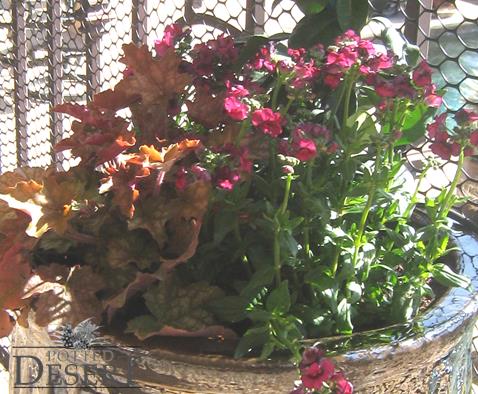
- Rose Nemesia with Heuchera
Even beginning gardeners are familiar with annual flowers such as pansies, violas, snapdragons and petunias. Mid-westerners and northern state residents plant then in the summer but here in the desert, they are part of our winter mix, holding up very well in potted gardens and flower bed. In addition to these old favorites, I enjoy exploring lesser known plants and mix them up in my container gardens to invite people to ask “What’s that plant?”
Nemesia is a fascinating cool-season annual with little snapdragon-shape flowers that bloom in a wide range of colors. It does best in our desert winters, though I had a nice surprise this past summer when my Nemesia continued to grow and flower throughout the summer! It did get some afternoon shade and regular water so I am sure that helped. Nemesia prefers moist, well-drained soil that's rich in organic matter. Originally from South Africa, the small flowers resemble snapdragons and linaria, to which they are related.
Nemesia grows from one to two feet tall, but tend to stay smaller in our heat. You will want to deadhead regularly to prolong their bloom as is true with most of our annual flowers. When flowers do start to decline, cut the plant back to stimulate new growth. Expect your plants’ performance to slow down as the weather heats up.
Designing with Nemesia:
Since Nemesia has such a small flower and its flower clusters will never fill a bed with color, I recommend using it in pots that are closer to the viewing area of that pot. Good locations are near a patio seating area, close to a window you pass by frequently and one that gets 6 hours of sun each day. The flowers bloom in large clusters at the top of the branching stems. There's a wide color range, including yellow, orange, pink, red, and lavender-blue. I team up the plants with strong bloomers around the base of the Nemesia and mix in other larger flowers at the mid-height range so the Nemesia is a delicate surprise popping out among the color.
Tags: Marylee Pangman , container gardens , potted desert garden , summer flowers , Winter flowers , potted cactus , Potted Desert , Tucson garden , Southern Arizona , snowbird garden
Monday, November 25, 2013
- The Potted Desert
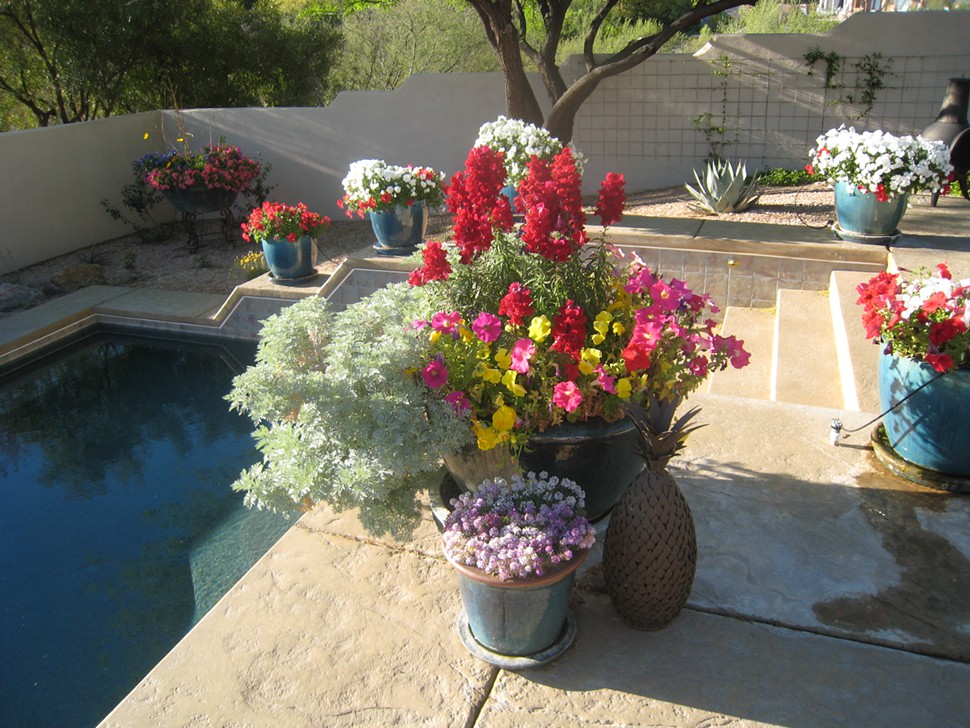
- Winter Garden Glory
Winter annual flowers supply brilliant color, grow quickly, and provide a "wow" factor to your desert landscape. Adding annuals to pots that have an established central plant and fill smaller pots with bouquets of your favorites will give you a garden that will thrill you all winter long. See the list of appropriate plants in the neighboring sidebar.
Note: If you have pots that you are not planting new plants, be sure to add fertilizer and water thoroughly with the application.
Step 1:
Remove all dead plants, dying plants or past their prime plants. Be somewhat careful of the roots of the central plant. Be sure to get out all old roots and anything that does not seem healthy.
Step 2:
Add fresh potting soil and a handful of time release fertilizer and mix it in with the old soil as much as possible. NOTE: If the old soil is entirely root bound, you are going to need to remove the central plant, discard the soil and start with fresh.)
Step 3:
Plant your new flowers leaving about 1-2” between plants.
Step 4:
Pack additional soil in around the plants, making sure you do not bury the stems deeper than originally planted in their nursery container.
Step 5:
Water in thoroughly with a gentle shower.
NOTE:
Advice for flower shopping: Grab a cart at the nursery and an empty flat or carton and place your selections on the flat and then step back and look at it. Look at it hard and long and be sure it sits right with you. A 24” pot with one central planting will need approximately fourteen (14) “4” inch” plants. If you select any gallon plants, they can replace 3-4 smaller ones. I urge you to use 4” plants and not six-packs.
Important: When you go shopping and bring your plants home, water them in well and plant as soon as possible — as in the same day. If you have to wait until the next morning, place them in the shade to rest until the morning.
Tags: Marylee Pangman , container gardens , potted desert garden , winter flowers , Potted Desert , southern Arizona garden , snowbird garden
Monday, November 11, 2013
What is free in our gardens? Volunteer plants! We often get surprises of something we did not plant shooting up after our monsoon rains and cooling temperatures. They can come from previous plantings, seeds carried in by the wind and even bird droppings.

We know cacti propagate readily — through ‘pups’ and seeds. One year I had a hanging succulent wreath on my gate and a snapdragon volunteer popped up. I could not believe it!! I did not even know that was possible.
Here is another sampling of my ‘freebies’ from this summer including gopher plants, a pine tree and a 'pup' from a Yucca Marginata.

- The Potted Desert
- Volunteer Landscape Plants

Want to keep your money out of the compost heap? Sign up for the Desert Potted View and our Free Monthly Potted Garden tips - sign up at Potted Desert Newsletter.

Marylee is the founder and former owner of Tucson’s The Contained Gardener. With more than 15 years of successfully designing and growing potted gardens in the desert’s challenging and oftentimes harsh climate, Marylee has become known as the Desert’s Potted Garden Expert. Marylee is available for in-home or digital consultations and you can always email her with your questions and comments. Follow The Potted Desert on Facebook!
Tags: Marylee Pangman , container gardens , potted desert garden , summer flowers , Winter flowers , potted cactus , Potted Desert , Tucson garden , Southern Arizona , snowbird garden
Monday, November 4, 2013

- The Potted Desert
- Five foot pots become huge “raised beds”
A large pot — meaning one that is greater than 28” in diameter offers you a tremendous opportunity to express yourself in living color. With our temperate climate in our desert landscape, we can enjoy winter seasonal color for a long time in our desert container gardens. What we plant in late October or early November will last long into the spring…. or is that early summer?
When combining colors in this large of a pot, you can almost treat it like a flower bed. However, you do not want to combine every color in the flower spectrum in one pot or one area. Too many colors, although pretty on first glance, quickly become too busy — the eye does not know where to rest and the brain becomes overwhelmed with all that it is trying to assimilate.
Before deciding on your color palette for this pot, there are a few things to consider:
1. The color of the pot itself.
2. Your colors of your décor.
3. Other plantings in the area and color of any flowers that will bloom during the same period of time.
4. Your personal preferences.
The same way you decorate your home and decide on your colors, you want to plan the colors in your pot.
Color of the pot
Organic colors such as those of the desert can really handle any color combination you might choose. You will find brown, umber, green and even matte blue pots in what I call more natural colors. These pots are purely the vessel that hold your bouquet.
Pots of bold colors need to have flower arrangements that complement the color of the pot. Bright blue pots might hold a combination of pinks, primary colors, pastels and are strong enough in their own color that one might decide to plant only one color in the pot.
Tags: Marylee Pangman , container gardens , potted desert garden , summer flowers , Winter flowers , potted cactus , Potted Desert , Tucson garden , Southern Arizona , snowbird garden
Monday, October 28, 2013
One of the most often asked questions I receive about potted gardens is “How often do I need to change the soil in my pots?” As in the case of many questions concerning potted gardens, it is not a simple answer. As I write this and see the length of these instructions, please do not hesitate to simply email me with your specific question.
(Note: potting soil is a ‘soilless’ mix. Be sure to select a quality product that is rich, deep brown and smells earthy.)

- The Potted Desert
- Desert Landscape Shade Pot
24” diameter and less pots — ones that you can somewhat easily move —— you will want to replace the soil in the following situations:
1. The pot is root bound with its plants
2. The plants that were in the pot died due to disease or pests (in which case you need to sterilize the pot before reusing.)
3. The soil no longer holds water
4. There is a lack of richness or ‘earthiness’ characteristic of new potting soil.
*Always add new fertilizer (organic and/or time release) each time you newly plant a pot.
However, pots that are larger than 24” are very cumbersome to change out entirely, especially if planted with a large plant. As I continue to talk about ‘really big pots’ that are 32” in diameter and larger, the difficulty intensifies. There are certain circumstances where I would suggest that you do get some strong bodies to help and the plant is taken out and soil changed.

- The Potted Desert
- Potted Lime Tree - Repot?
Even in large pots, plants can become root bound. The choice then is to either take the plant out and give it a permanent place in your landscape by planting it in the ground or to trim the roots. In the former, be sure to plant it during the appropriate season for your specific climate and the plant’s needs and tolerance.
The other option is if the plant can tolerate a root pruning, you can remove it from the pot by laying the pot down on its side (this is where the muscle is needed!) and gently extracting it from the pot. Then you can reduce the root volume by up to one third and repot the plant into the same pot with all new potting soil. Citrus trees and many shrubs such as the myrtle family of boxwoods respond very well to root trimming. Palms do not do very well with root pruning in my experience. Be sure to water the plant very thoroughly after repotting.
Tags: Marylee Pangman , container gardens , potted desert garden , summer flowers , Winter flowers , potted cactus , Potted Desert , Tucson garden , Southern Arizona , snowbird garden
Monday, October 21, 2013
Problem: Bare spot in your desert landscape, travel often, desire to have a strong focal point in your Arizona desert home.
Solution: An architectural plant, very low water and that works perfectly in a large pot.

- The Potted Desert
- Potted Giant Hesperaloe — The Desert Solution
The Giant Hesperaloe with its bold form serves you well as a dramatic focal point and accent plant in the desert landscape. With its stiff six foot long deep-lime green leaves, curly white fibers run along its edges and add to its character. This hardy Chihuahuan Desert native handles full and reflected sun making it a natural fit for a sun —drenched yard (i.e. Hot) while remaining a low worry addition. The plant will shoot up a 12-15 foot stalk of creamy white lily-like flowers in the summer. Although neither plant is part of the yucca family, the Giant Hesperaloe (Herperaloe funifera) is related to the common Hesperaloe, the Red Yucca,.
Because of the open nature of the clumping leaf structure and the fact that the leaves are very stiff, when potted the Giant will not be a high tipping risk in our desert winds. I recommend that you use a pot that will be proportionate to the size of the plant. The one pictured above is in a 32” pot (diameter.) Fill the entire pot with cactus soil as it needs excellent drainage. Be sure the pot has a good hole — 2” would be great! Or several 1” holes would suffice. The only maintenance required is to cut the dead stalk at its baseafter it is done flowering.
Plant the “Giant” so that the base of the plant is only 3-4 inches from the top of the pot so that the pot serves as a pedestal for the plant. You can also ‘dress’ the top of the soil with rock. I like using 4-5 inch straight sided rock with sharp edges and angles as I feel it complements the strong lines of the plant.

- The Potted Desert
- Finish a Potted Cactus with Rock
If you only have 20 minutes in your desert potted garden this week —
~Water your potted cactus deeply with a water soluble fertilizer at half strength (of the recommended directions on the fertilizer container.)
If you would like to receive Monthly Potted Garden tips - sign up for the Potted Desert Newsletter.
Marylee is the founder and former owner of Tucson’s The Contained Gardener. With more than 15 years of successfully designing and growing potted gardens in the desert’s challenging and oftentimes harsh climate, Marylee has become known as the Desert’s Potted Garden Expert. Marylee is available for local and digital consultations and you can always email her with your questions and comments. Follow The Potted Desert on Facebook!
Tags: Marylee Pangman , container gardens , potted desert garden , summer flowers , Winter flowers , potted cactus , Potted Desert , Tucson garden , Southern Arizona , snowbird garden
Tuesday, October 8, 2013
Super-jumbo pots in my book are those that are at least 32 inches in diameter. I often have to chuckle to myself when I ask someone, “What size pot do you have?” They tell me it is a “really big pot” and when I ask them to measure it, they say it is 18” or maybe even 20”. In the desert heat, for successful full sun potted gardens, we must plant in large pots. But when I refer to large pots, I am talking about nothing smaller than 20” and I prefer much larger. With the soil volume you have in these larger pots, the roots of your plants have a fighting chance to keep their cool. For the sake of conversation, let’s refer to “really big pots” as “RBP’s”.
Since they do take up a lot of space, you want to think about using RBP’s where they can serve a specific function in your home’s exterior design. They might become a focal point — with or without a planting. They might break up the monotony of a large flat wall of your back yard. Another use might be to support a large planting of a vine, shrub or small tree. This planting may serve the purpose of hiding an eyesore, provide screening from your nosy neighbors or provide you with fruit from a fruit tree.

- A Really Big Pot at Harlow Gardens
Your best bet when deciding what to plant in super-sized pots is to choose plants that you will either be replacing each year such as annual flowers or to plant slow growing plants. Most nursery plant tags will say what the rate of growth is for that particular plant. I made the mistake one year of planting evergreen pistache trees in 32” pots. Those trees, with all the love and care of regular water and food outgrew the pots in less than a year. The trees were not overly large but the root system could not grow large enough in the pots to support their canopy.
Here are some basic tips on how to handle your RBP’”.
1. Make a firm decision as to where you want the pot placed before planting it. Ever tried to lift a 22” container garden filled with dirt and plants? I have, and it can be overwhelmingly heavy. Once planted, an “RBP” will be virtually impossible to move. To do so will require that you empty it of all the plants and soil. Therefore — be sure!!
2. This is the question I get asked the most: If you know you are planting shallow or medium rooted plants in an RBP, do not fill the entire pot with soil. If you are planting small perennials or annuals, you can fill the lower 2/3 of the pot with other material. When planting a small shrub type plant, you need more soil volume but you can still fill the bottom 1/3 with non-organic material. Gardeners have used soda bottles or cans, packing peanuts and nursery cans to bottom fill their pots. (DO NOT use rocks!! — they just make the pot heavier!)
NOTE: I recommend that you cover whatever material you use with a sheet of landscape fabric. This will also water to go through but will help maintain the soil above the fillers.
3. Do not fill your pot with soil from your garden — even if your garden has the very best soil on the planet. Garden soil is heavy and "dirty" (you know, replete with weed seeds, bugs and their eggs, bacteria — stuff that you don't want in your pots), and it will not drain properly in a pot.
Instead, use a good potting soil (also called potting mix or container mix). Potting soil is well aerated, sterile, lightweight, and made of a good balance of organic material and mineral particles like peat, sand, or perlite. (Potting soil is actually soil less. That is, it doesn't contain any dirt.) When choosing a potting soil, it should smell and feel rich. It will not be sandy or smell like manure.
4. When planting a tree in an RBP, DO fill it completely full with soil. Trees also need to be planted in solidly based pots in order to reduce the tipping factor. The base of the pot should be almost as large as the top of the pot when a tree is planted. Our desert winds have been known to blow over many pots even when super-sized!
5. If you plant a large plant in an RBP, you do not need to change out all the soil every few years like you do in smaller pots. Instead, each year remove a top layer of old soil and add new soil along with time-release fertilizer. Mix it all in with the old soil as much as you can without severely disturbing the root system. Keep the soil level at the same depth as before to not entirely cover the root or trunk any deeper than it was originally planted.
By following these guidelines and standard methods of planting in pots, you can enjoy terrific potted gardens for many, many years!
If you would like to receive Monthly Potted Garden tips - sign up for the Potted Desert Newsletter.
Marylee is the founder and former owner of Tucson’s The Contained Gardener. With more than 15 years of successfully designing and growing potted gardens in the desert’s challenging and oftentimes harsh climate, Marylee has become known as the Desert’s Potted Garden Expert. Marylee is available for in-home or digital consultations and you can always email her with your questions and comments. Follow The Potted Desert on Facebook!
Tags: Marylee Pangman , container gardens , potted desert garden , summer flowers , Winter flowers , potted cactus , Potted Desert , Tucson garden , Southern Arizona , snowbird garden
Monday, September 30, 2013
Want to keep your money out of the compost heap? Sign up for the Desert Potted View and our Free Monthly Potted Garden tips.

- The Potted Desert
- My Desert Garden Pinks Must be BOLD
I have to admit. I have a resistance to pink. I am not sure why — maybe because I had a pink bedroom growing up. Pepto-BismolTM pink that is. Now I am sure it was my choice, maybe? Well — maybe not since I must have been very young. I do remember when I was given a choice of room color, it was a soft green. Go figure!! Green — gardening — was my color choice directing my future path?
As I came into my own with designing flower gardens for our desert landscape, I had similar negative reactions to pinks in the garden. And I absolutely abhorred pink with orange to the point that I told my staff — never, never put pink near orange. That was one of those rules!!
Then, one day… I saw a rich fuchsia (pink) bougainvillea as a backdrop to some gorgeous orange lantana. At first, I was resistant and then it struck me — I liked it! So I started experimenting in the nursery putting together some different pinks, oranges, purples or blues and reds to see what I liked. I came up with what you might call jewel tones — a rich, deep pink, an orange with a red hue and a deep red. A touch of purple or blue seemed to support the other colors.
I even planted my “pass by every day” pots at my own home with these colors. And each time I saw the combination out the window or from the patio, it took me a moment to stop my pink and orange resistance but I soon became hooked by the colors.
Lessons to be learned from this?
1. Experiment with plant and color combinations at the nursery.
2. Try things that you might not normally combine — well, at least in your clothing choices!
3. Keep it simple with how many colors you put together in one pot. Combine and repeat.
4. Enjoy playing with color!
This week in your desert potted garden:
1. Deadhead your flowers this week. Be sure to cut them back to the main stem when removing spent flowers.
2. Prune any leggy plants to create new growth and a well-shaped plant.
3. Feed your potted plants a water soluble fertilizer.
4. Follow the directions on the label. I prefer using a hose applicator to get thorough feeding.
Tags: Marylee Pangman , container gardens , potted desert garden , summer flowers , Winter flowers , potted cactus , Potted Desert , Tucson garden , Southern Arizona , snowbird garden