Wednesday, July 18, 2018
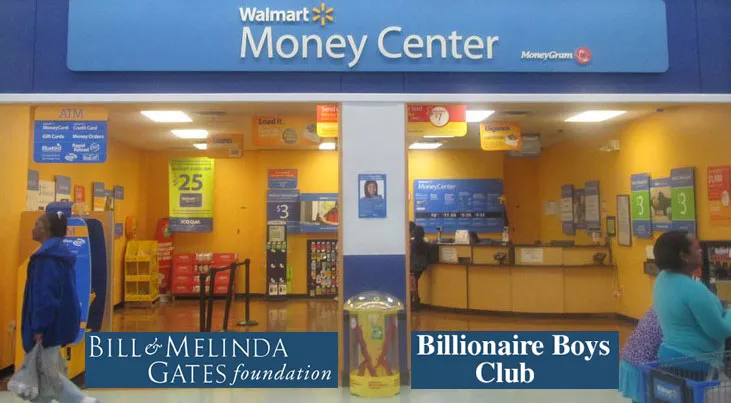
A story on the front page of the Star.
AP Exclusive: Billionaires fuel US charter schools movementBe still my heart!
Last week I wrote a post about the amount of money the Walton Family Foundation — the Walmart fortune — has poured into charter schools, with a promise of a billion dollars total between 2015 and 2020. The AP story looked beyond the Walton Foundation. It began with a Bill Gates connection I didn't know about. Washington state is one of the last states to resist the charter school movement. Gates put millions into creating a charter school law, then funded the Washington State Charter Schools Association. When the courts ruled the law unconstitutional, Gates spent more money to keep six charters open while they fight to reinstate the law.
Along with charter supporters like Gates and the Waltons, the article mentions the Dell computer family and Facebook's Mark Zuckerberg. The Billionaire Boys Club stretches much farther than that. A recent example. In the California gubernatorial primary, Netflix founder Reed Hastings plowed $7 million into the candidacy of ex-Los Angeles mayor Antonio Villaraigosa, a big charter school supporter. He did it under the cover of a group named Families & Teachers for Antonio Villaraigosa for Governor 2018, which put more than $13 million into the campaign, almost all of it from a few rich donors. Villaraigosa lost in spite of the funding.
In my earlier post, I wrote that the charter presence in Arizona and around the country would be much smaller if it weren't for the billions of private dollars spent on their behalf. Sometimes it's spent openly, but often it's done by stealth. A favorite method is the use of dozens of pro-charter astroturf groups, supposedly grassroots organizations, with impressive websites and an office address. Often they claim to represent specific groups, like African Americans or Hispanics, to give the impression of a groundswell of support. The actual organization can be a small office with one employee or even a post office box. But in advertising and public relations, perception is everything.
Tags: Walton Family Foundation , Bill Gates , Mark Zuckerberg , Reed Hastings , Democracy in Chains , Dark Money , Image
Monday, July 16, 2018
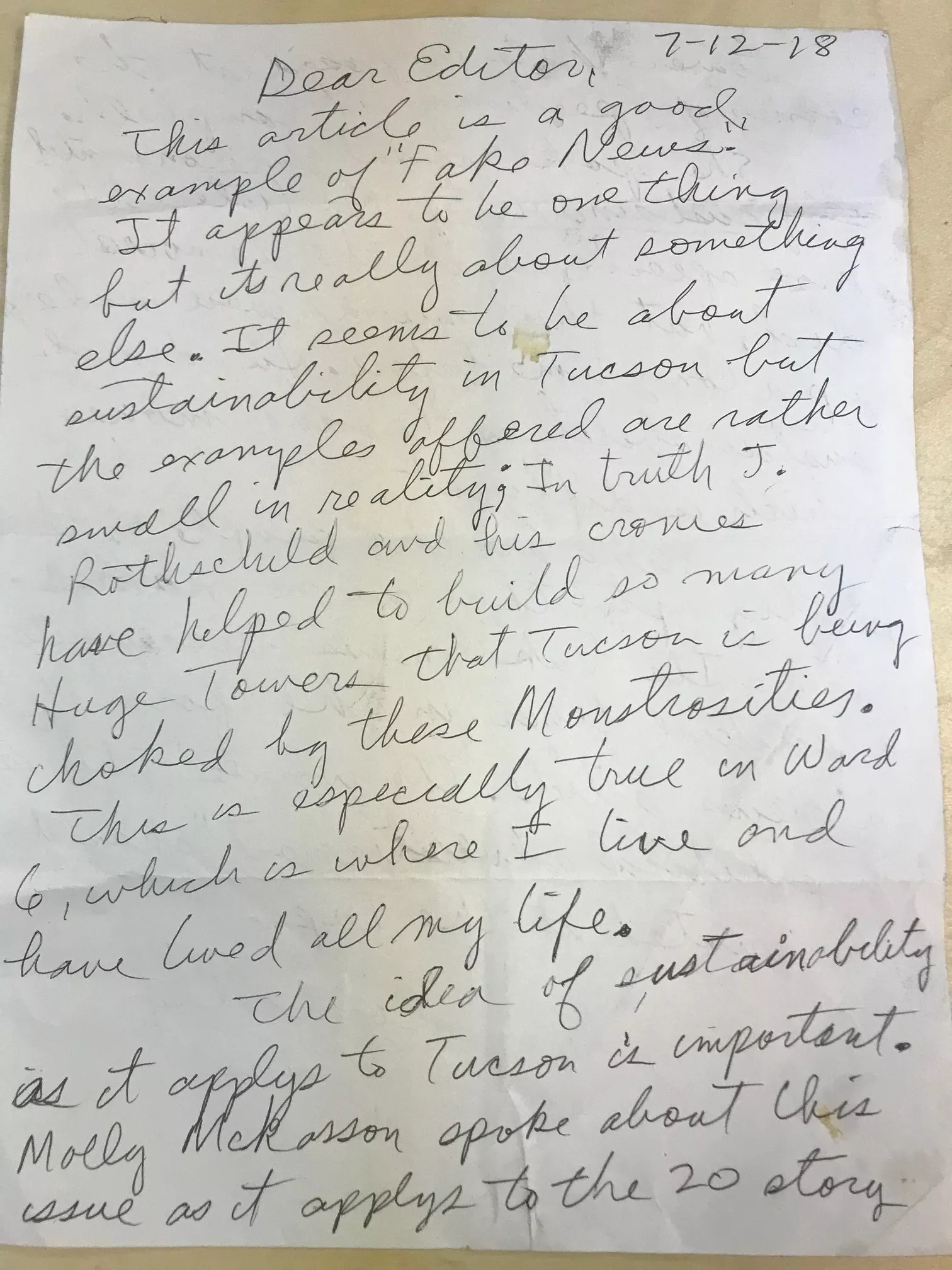
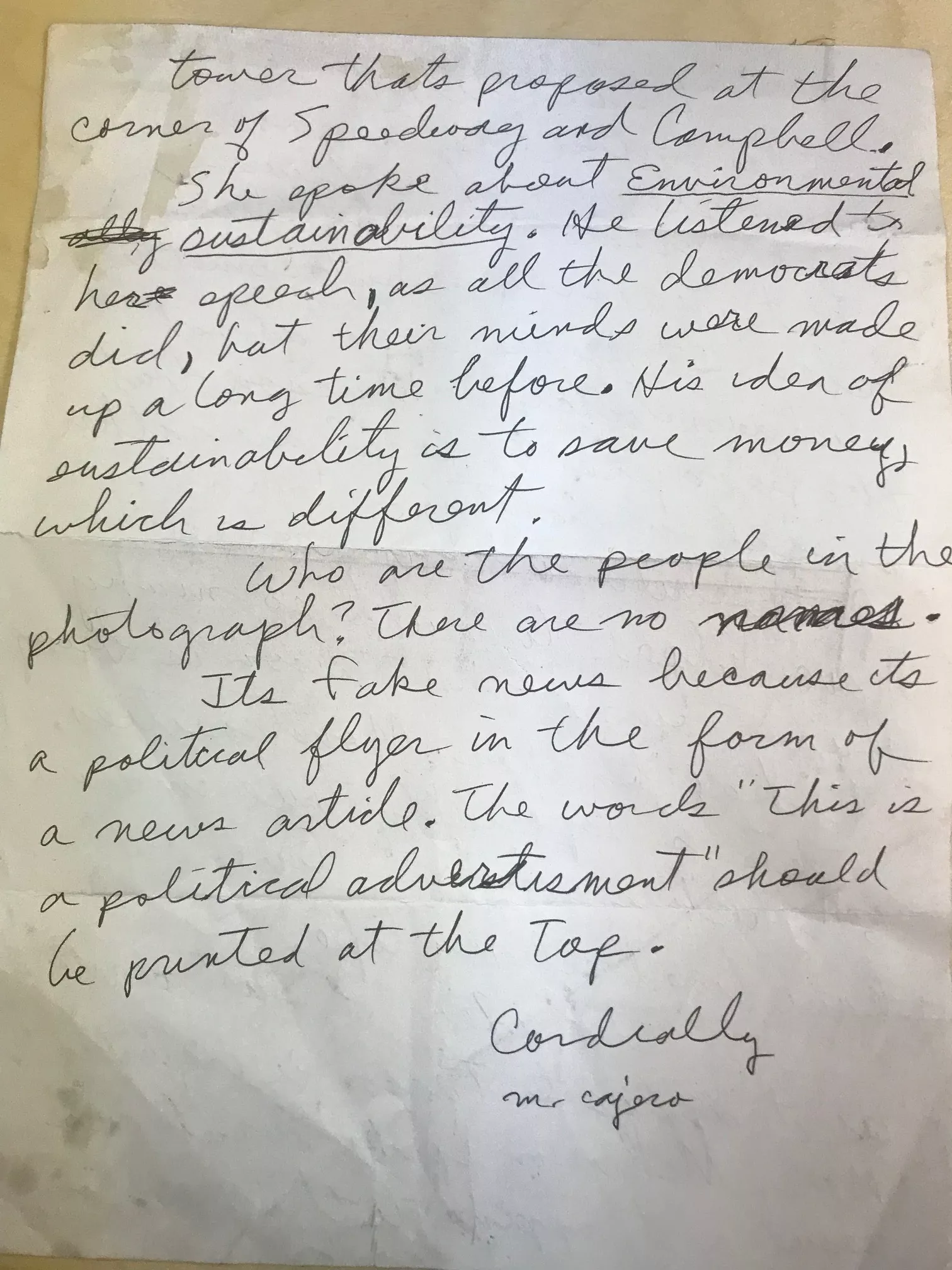
Tags: letter to the editor , hard copy , paper , letter , write to us , reader voice , opinion , response , snail mail , Image
Friday, July 13, 2018

Teachers, here's a pop quiz. How will you receive information trying to convince you to drop ties with the teachers union? (a) Email. (b) Snail mail. (c) Phone call. (d) Knock on your door. The correct answer is (e) Any or all of the above.
The Public School Wrecking Crew scored a huge win when the Supreme Court decided public-employee unions cannot make nonmembers contribute to collective bargaining in its recent Janus v. American Federation of State, County, and Municipal Employees decision. The ink was barely dry on the written arguments when right wing money began pouring into campaigns to persuade teachers to walk away from their unions.
Right-leaning think tanks and advocacy organizations have placed anti-union ads on Google and social media and sent targeted emails to teachers across the country. Some plan to go door to door to reach educators during the summer.One group is trying to uses states' open records laws to get the email addresses of union members to make targeting even easier.
Two groups spearheading the campaign are The Mackinac Center and The Freedom Foundation. Both have strong libertarian, "free market" leanings. That puts them in the same ideological camp, and funding stream, as UA's "Freedom Center," which created the high school course, Philosophy 101: Ethics, Economy, and Entrepreneurship, currently on hold in TUSD, though it's still being taught in other local school districts as well as charter and private schools. (To give you the complete buzz word, dog whistle experience, the center's full name is the Center for the Philosophy of Freedom. It is housed in the recently created Department of Political Economy & Moral Science.)
Let's look at the two groups funding the anti-union push.
Tags: Janus v. American Federation of State , County , and Municipal Employees , Mackinac Center , Freedom Foundation , Koch Brothers , Freedom Center , Betsy DeVos , Image
Thursday, July 12, 2018

The TUSD Governing Board decided to table a vote on reinstating the course, Phil 101: Ethics, Economy, and Entrepreneurship. The course was created by UA's Koch Brothers-infused Freedom Center and has met with controversy and skepticism since people found out about it.
It looks like the main reason for delaying the vote is the textbook. New textbooks are supposed go through a review process and be on display in the district office for 60 days before the board votes on adoption, which hasn't happened. Up to this point, the district has played fast and loose with the course. The board wasn't even involved in approving it. It would have been difficult to justify fast tracking the textbook after all the prior shenanigans.
So, no Phil 101 course at TUSD. For now. The issue will almost certainly come to a board vote sometime during this school year after the textbook has gone through the 60 day review process, which means the board could decide to reinstate the course.
That's the end of the news. Now, for your amusement...
Tags: Phil 101: Ethics , Economy , and Entrepreneurship , Freedom Center , Koch Brothers , TUSD governing board , Image
Tuesday, July 10, 2018
Take the private donors out of the charter school biz, and we'd have a backwater education movement with significant outposts around the country, a band of ardent supporters and occasional articles in the media, including thought pieces like "Will charter schools ever catch on?"
A number of the deep-pocketed charter supporters are men who made their money in high tech and hedge funds. Their allegiance has less to do with an objective analysis of charters than their dislike of government regulations and their oversized, self-made-man egos. Other donors are billionaires who made their money the old fashioned way, they inherited it. Together, they've plowed billions into charter schools. That's on top of taxpayer funding, of course. Charters get per student dollars from state budgets, just like district schools.
I used "billions" to describe the money going to charters. Did I add a zero to the total to exaggerate the contributions to charter schools? The answer is, no. Billions it is, no exaggeration necessary. To get a sense of the kind of money that flows to charters from private sources, let's push aside all the donors except one, not because the others' contributions are insignificant, but because this one money machine cranks out cash for charters at an amazing rate. I'm talking about the Walton Foundation.
Tags: Walton Family Foundation , Walmart , Charter schools , Arizona Charter School Association , Image
Friday, July 6, 2018

Tuesday, July 10, the TUSD school board will vote on bringing back a course created by the University of Arizona's Freedom Center — Philosophy 101: Ethics, Economy and Entrepreneurship.
I expect we'll see some post-July 4 fireworks during the meeting's Call to the Audience. How will the board vote? I don't have a clue, though I expect it'll go 3-2 either way.
Last October I wrote a column in the Weekly print edition about the Phil 101 course. Some of what I wrote was news to members of the school board who didn't know the course existed (it never went to the board for approval), much less that it was created and sponsored by the Koch Brothers-backed Freedom Center at University of Arizona. It was also news to most of Tucson.
In December, the board voted 4-1 to cancel the course at the end of the 2017-18 school year. Tuesday they're taking a second look. If the item passes, the course will no longer fulfill the state economics requirement as it did before. It will be an elective. However, it will still be a dual credit course, meaning students can take it for both UA and high school credit.
Some UA profs who know more about economics than I do say Phil 101 is a shoddy course using a shoddy textbook (Course and textbook were created by the same people at the Freedom Center).
What I know is, the course was designed to promote a libertarian agenda, and it's no more than two degrees of separation from the billionaire Koch Brothers' decades-long campaign to push their agenda in Congress, state legislatures, colleges and high schools around the country. UA's Freedom Center and the Phil 101 course are among the campaign's recent success stories.
The course was created and promoted using a $2.9 million grant from a private foundation. The price tag alone is a warning sign that some folks with deep pockets really, really want this to happen. I can't think of another instance where someone put that kind of money behind the creation of a single high school course.
Another warning sign. The foundation's website said it hopes by 2025, the course "will reach some 25,000 high school students — roughly 25 percent of Arizona's high school student population."
They're looking to see some serious libertarian-infused bang for their bucks. It's likely the vote isn't a done deal. If you want to make your opinions known to board members before the Tuesday meeting, here are the emails they list on the TUSD website:
Michael Hicks: [email protected]Stay tuned.
Kristel Foster: [email protected]
Adelita Grijalva: [email protected]
Rachael Sedgwick: [email protected]
Mark Stegeman: [email protected]
Tags: Philosophy 101: Ethics , Economy and Entrepreneurship , University of Arizona , TUSD , Freedom Center , Koch brothers , Image
Thursday, July 5, 2018

My last post was all about how wrong-headed and destructive high stakes tests are to schools, teachers and students. We need to get rid of the yearly tests. Not jigger with them. Not improve them. Not replace them with complex, multi-faceted rubrics to rank schools' effectiveness. Get rid of them. Repeal and don't replace.
There's only so much we can know about education, and it's far less than the tests pretend to tell us. Learn to live with uncertainty. It beats being certain and wrong.
We lived with uncertainty before No Child Left Behind came along fifteen years ago and created our yearly high stakes testing ritual. We've always argued about schools. The difference is, before NCLB, we didn't have yearly test scores from students around the country to "prove" our point. The scores didn't prove anything. All we learned from running those millions of data points through sophisticated computer analyses is that we can arrive at mathematically precise conclusions that are wrong four places to the right of the decimal point.
We can live with uncertainty again. We can continue to disagree about our schools on educational, political and financial grounds, using whatever arguments and data we can pull together to make our cases. But let's not back up our claims with bad data which has been passed off by politicians as educational gospel. It cheapens and distorts the conversation, and it hurts the students.
Tags: High stakes tests , Standardized tests , No Child Left Behind , NAEP tests , Image
Tuesday, July 3, 2018

Back when I was a younger man and a big Kurt Vonnegut fan, his novel Sirens of Titan was required reading. (Everything of his was required reading.) The book's main character wrote down a list of things he wanted to be sure to remember. I only recall one item: "If the questions don't make sense, neither will the answers." The statement hit me like a lightning bolt. It explained why, when I tried to answer some questions, I found myself tied up in knots. If a question was based on false assumptions and I answered it directly, I had to wrap my answer around the bad assumptions. Vonnegut's insight helped me realize that a direct response to a ridiculous question has to begin with, "Your question doesn't make sense."
I wrote Vonnegut's words down immediately. Decades later, they're among the 30 Stickies residing on my Mac desktop.
Now I'm adapting Vonnegut's statement to high stakes test results, which, since No Child Left Behind became the law of the land 16 years ago, have been the way we've answered the question, "Which schools are succeeding and which are failing?" The "answer" assumes the test results are a reliable way of determining school effectiveness. That's nonsense. Which leads me to the conclusion, if the high stakes tests don't make sense, neither will the results.
TUSD has decided to get rid of the AzMERIT tests at the high school level and replace them with a single ACT test given to 11th graders. I'm all for the change, for a few reasons. (1) It disrupts the A-F state grading system for schools. How do you compare the scores of high school students taking ACT, SAT and AzMERIT tests? It's apples and oranges, or maybe Granny Smith and Red Delicious apples. (2) It takes the "standard" out of "standardized testing," which weakens the whole high stakes testing movement. (3) As an unintended bonus, it takes a baby step toward democratizing the college admissions process.
Let's review what's wrong with AzMERIT and other high stakes standardized tests.
Tags: AzMERIT , High stakes testing , ACT , SAT , Image
Thursday, June 28, 2018
AP — Advanced Placement — is the first name that comes to most people's minds when they think about college credit courses in high school. But the courses may not be a good as their sales pitch. The fact is, lots of colleges don't give wholesale credit to students who pass their AP exams. And the way teachers are forced to present the material can be constraining. Those are reasons some top flight private schools are dropping their AP classes. Meanwhile, a major battle is raging over AP's decision to begin its world history course in 1450 AD — meaning the "world" would pretty much be boiled down to Europe and the U.S. along with a host of minor players.
The folks who create U.S. News & World Report's high school rankings may think the best, in fact the only way to judge school quality is by counting the number of AP, or IB (International Baccalaureate), courses students take and how well they do on the final tests. But others have their doubts.
Advanced Placement courses are created by the nonprofit College Board, which is also responsible for SAT exams. College Board designs the courses, but more importantly, it sends out the end-of-the-year tests which determine whether students earn college credit. That puts pressure on high school AP teachers to stick closely to the set curriculum and make sure to cover all the topics and minutiae which are likely to crop up on the test. AP teachers are in an academic straitjacket, and students are forced to put too much emphasis on memorizing facts and figures, often at the expense of a more conceptual grasp of the material.
A sidelight: The high school where I taught made the decision not to use AP or IB courses. We contracted with local colleges and universities to grant college credit through their institutions. The teachers had control over the curriculum and made the decisions about who deserved college credit for the courses. I never heard a college complain about lack of preparation of our graduates, nor did I hear graduates say the coursework wasn't college level. The lack of AP courses on student transcripts didn't stop them from getting into some of the country's top colleges and universities.
Tags: Advanced Placement , College Board , International Baccalaureate , SAT exam , Image
Wednesday, June 27, 2018
Before we look at Arizona, let's take a trip to Oklahoma, a state that hates taxes as much as Arizona—it hadn't passed a new tax in 30 years—and has cut school funding as drastically as we have. In March, its state Senate pulled together the needed three-quarters majority to pass a tax hike. The result was a substantial raise for Oklahoma teachers whose pay, like Arizona's teachers, is near the bottom of the national heap. But like the teacher salary hike the legislature passed in Arizona, Oklahoma's barely moved the salary needle compared to other states, so
teachers weren't happy with the outcome. They staged a nine day walkout in April. They gained a lot of attention, but no more money for their efforts.
Oklahoma held its primary Tuesday. How did the voters react to having their taxes raised and watching the never-satisfied teachers demand more, more, more? They probably turned on the teachers, right? Wrong. The opposite happened.
Over a hundred educators ran for office, from both parties. Dozens either won their primaries outright or made it into a runoff. One of the runoffs is between two Democratic educators.
Back in March when the tax hike bill was in the legislature, ten House Republicans voted against it. Two of them lost their primaries outright. Seven others face runoffs. Remember, these are Republican incumbents in a state that hasn't voted for a tax hike in three decades, yet voting against the increase was a losing issue for them.
What should Arizona's state candidates learn from the Oklahoma primaries? That #RedforEd is alive and well, and Arizona may vote more than ever with students and teachers, and less than usual with candidates who push an anti-tax, anti-public school agenda. Voters may be ready for a few more Democrats in the legislature and in statewide offices. Who knows, they may even vote for a tax increase.
Tags: #RedforEd , Oklahoma teachers , Arizona teachers , Doug Ducey , Invest in Education , Immigration , Image