
Friday, July 5, 2019
Two men I admire, Jim Nintzel, the editor here at the Weekly, and talk show host John C. Scott, have frustrated the hell out of me recently. Both men know more about Tucson and Arizona than I would if I lived another lifetime. Both are intelligent, perceptive analysts of the political scene. Neither accepts the “common wisdom” just because it’s what other people think.
Well, they don’t accept the common wisdom in most cases, anyway. When it comes to TUSD, though, Scott and Nintzel seem to go along with the prevailing notion that the school district is doing a terrible job and has brought its problems, specifically its loss of students, on itself.
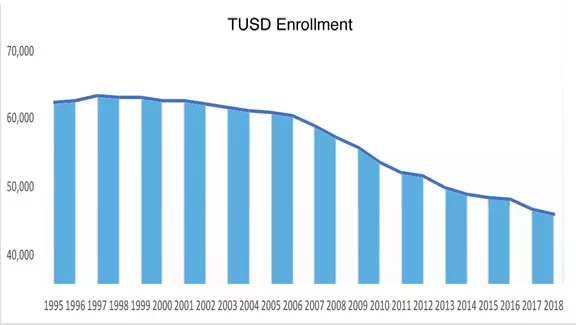
Common wisdom always has a kernel of logic to it. If TUSD has lost an average of 900 students a year for the past 18 years, it’s only logical, it's something they’ve done. Isn't it? How can it not be the district's fault?
The problem is, the common wisdom about TUSD is wrong.
This all came up because of one of my recent posts, A Multi-Factored Look At TUSD's Enrollment Decline. My main point was that the district’s precipitous enrollment decline over the past 18 years has more to do with outside factors than with the district itself. Two of the factors were created by the state legislature when it green-lighted charter schools and open enrollment in 1994, creating two new forms of competition for students. The third factor is the city’s population, which essentially stopped growing around 2000, meaning TUSD hasn’t had an influx of new students to replace the ones who left.
When I talked about this on John C. Scott’s show, he came back with a litany of sins TUSD has committed which have led to parents pulling their children out of the district — problems with student discipline, poor administration, poor money management and so on.
Most of what Scott said about TUSD is true, but not his contention that the problems he listed are the primary reasons students have left the district.
Nintzel agreed with me about the mechanism for TUSD’s enrollment decline, but said I haven’t paid enough attention to parents' dissatisfaction with the district which led them to send their children elsewhere.
Nintzel is right that dissatisfaction with TUSD leads many parents to seek other options for their children, but often, their dissatisfaction has more to do with the changing ethnic and economic makeup of Tucson than anything the district has done.
The arguments made by Scott and Nintzel aren’t wrong factually. They’re wrong in emphasis, putting too much blame on the district and too little on national demographic shifts and Arizona’s Republican politicians’ continuing efforts to dismantle our district-based, publicly run school system by encouraging school privatization. Compound those factors with Tuscon’s glacial population growth over the past few decades, and you have a recipe for plummeting enrollment.
Unfortunately, their views mirror the local “common wisdom” about TUSD. Attacking TUSD has turned into a blood sport, and that’s bad news for the district and the city. When people magnify TUSD’s problems, it encourages even more people to leave the district. And the notion that TUSD is responsible for the problems it faces gives the impression that the district should be able to turn this thing around if it can just get its act together. What the district actually needs is thoughtful, incremental improvements to help it better serve the needs of the community.
Let me lay out what I believe to be true about the changing nature of TUSD and many similar urban districts across the country. Admittedly, this is a subjective view, but it’s based on extensive study of urban education in the U.S.
Tags: TUSD , Enrollment decline , Charter schools , Open enrollment , Image
Wednesday, June 26, 2019

Last week I wrote that Arizona's open enrollment policy is one of the three major factors leading to the decline in TUSD enrollment since 2000, the others being charters schools and a slowdown in Tucson's population growth. I estimated somewhere between 1,500 and 3,000 students living inside district boundaries attend schools in other districts.
It looks like I low-balled my estimate. The actual figure appears to be at least double what I came up with, meaning the impact of open enrollment on TUSD's loss of students, and on Arizona's education landscape, is more significant than I realized.
Since Arizona's new open enrollment policy was put into operation in 1995, students can attend any public school that has an empty desk. In district, out of district, it doesn't matter so long as parents can find a way to transport their children to the schoolhouse door. Students inside a school's attendance area and inside the district get first shot at going to a school, but after that, it's open to everyone.
So how many students living in the TUSD attendance area go to schools in other districts? In my post I arrived at a range of students by the back door. I looked at the number of open enrollment students in the Catalina Foothills School District — a whopping 3,000 out of a total student population of 5,200 — along with anecdotal information from Vail School District and used that to arrive at an estimate of 1,500 to 3,000 students. I was pretty sure that was low, but I wanted to stay on the conservative side.
A few days after I finished the post, by one of those odd coincidences which happen all the time, an Arizona Charter Schools Association piece came across my desktop with figures about how many students participate in open enrollment. In the study it cited, 31 percent of students in 9 Maricopa County school districts went to public, non-charter schools which weren't their neighborhood schools. That's twice the 16 percent who attend charter schools.
Tags: Open enrollment , TUSD , Charter schools , Arizona legislature , Arizona Charter Schools Association , Image
Monday, June 24, 2019

Well, here's some fake news for you: In CNN's roundup of congressional Democrats calling for the impeachment of President Donal Trump, the crack news organization identifies "Rep. Raul Grijalva of New Mexico."
We know Silver City is attractive and all this time of the year, but we're pretty sure Raul is still representing Arizona's Third Congressional District.
(h/t `Tom Miller)
Thursday, June 20, 2019
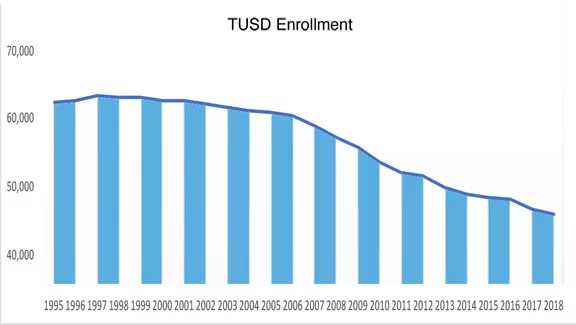
Tucson Unified School District has been losing students steadily since 2000. Lots of students. At its turn-of-the-millenium high point, the district had 62,500 students. This school year, the number was 46,000. That's a loss of 16,500 students, over 900 a year.
Why is TUSD losing students year after year? The answer you're most likely to hear is, the district is the problem. It's the administration. It's the teachers. It's the curriculum. It's "D," all of the above. Fix the administration, fix the teachers, fix the curriculum, and the numbers will climb.
But the standard answer is far too simple. The district may deserve part of the blame for declining enrollment, but most of the drop was inevitable, created by changes in Arizona's educational landscape and a slowing of Tucson's population growth.
For the sake of argument, let's start with the assumption that TUSD is no better or worse now than it was at its 2000 high water mark of 62,500 students and see what else is causing the district to lose students.
I see three factors beyond the control of the district as the major reasons for the enrollment decline.
Two of the factors were created by the Arizona legislature's push for "school choice." The first is the emergence of charter schools. The competition for a limited pool of students means that every student inside the TUSD boundaries who attends a charter is one less student in the district. The second is the state's open enrollment policy, which lets parents send their children to schools in nearby districts. Open enrollment gets far less attention than charter schools, but it is a significant force pulling students living inside the TUSD boundaries to suburban school districts with more affluent, whiter populations.
The third important factor is the slowdown of Tucson's population growth. Students lost to charter schools and open enrollment haven't been replaced by an influx of new students.
Let's look at the factors one by one.
Charter Schools
Arizona's first charter schools opened their doors in 1995. They grew steadily, but since they started from zero, it took awhile for them to have an impact on school districts' enrollment numbers.
In 2000, 50,000 Arizona students were enrolled in charters. I don't have any direct data on how many of those charter students lived inside the TUSD boundaries, but a reasonable estimate is about 3,500. TUSD students made up about 7 percent of the state's public school population in 2000, and 3,500 is 7 percent of the state's charter school population.
Tags: TUSD , Charter schools , Open enrollment , Population growth , Arizona legislature , Image
Monday, June 10, 2019

"The charter school movement is in trouble." So begins an article in the Washington Post. I think that's an exaggeration. Charter schools aren't in trouble as such — their numbers are still on the rise — but they may be cresting. Their once-shiny reputation is tarnishing. Charter proponents' mouths have made too many promises the schools can't keep, and people are beginning to take notice.
Some folks who have read my charter-related posts think I'm opposed to charter schools. Not so. I support any school — district, charter or private — with good teachers, a good curriculum and a strong overall educational philosophy. Plenty of charters fit that description. I would have no problem recommending a charter school to parents if I thought it was a good fit for their children.
What I'm against is the charter school PR machine, part of the ridiculously well funded "education reform"/privatization movement. Hundreds of millions of dollars are spent every year demonizing public education while praising charters as the answer to our educational prayers, then propping up the schools with funding above and beyond what they get from the state.
District schools deserve criticism, but not the "failing schools" slam they get from privatizers, and charters hardly deserve the lavish praise they receive from their financial patrons. That's why I go heavy on charter criticism. With all the money and effort perpetuating the myth of charter school superiority, I feel it's my duty to debunk their myth-making whenever I can.
The first charters began in the early nineties. Arizona's charters opened for business in 1995. The schools have had nearly 30 years to prove their worth. Yet when you look at legitimate studies comparing charters and district schools, the results are pretty much a wash. In one state, charter school students have better scores than similar students in district schools. In another state it's the district schools that have the edge. Charter students may have higher test scores in fourth grade math while district schools top charters in eighth grade English, or vice versa.
People on both sides of the argument can cherry-pick the data to fit their narrative, but when you look at the numbers as a whole, the differences in student achievement are so slight as to be insignificant. If parents choose well, they can send their children to excellent charter schools, but if they fall prey to false advertising, they might end up sending their children to some of the worst schools you'll find anywhere.
Tags: Charter schools , "Education reform , " School privatization , NAACP , Image
Wednesday, June 5, 2019

Arizona's Department of Education may begin taking a more active role in charter school accountability, thanks to some terrific investigative reporting from the Arizona Republic, which woke people up to the potential for corruption and profiteering in the charter sector, and a Department of Education headed by Superintendent Kathy Hoffman who cares about such things.
Two connected southern Arizona charters, Lifelong Learning Academy in Tucson and Jack Thoman Air and Space Academy and Performing Arts Studio in Green Valley, have been denied alternative-school status by the state, the first denial in five years.
Getting alternative-school status is a big deal. Because the schools are supposed to serve students who are potential drop-outs, they don't get an A-F grade from the state.
That makes sense. Students enrolled in alternative schools are likely to be behind academically, meaning their state test scores will be low. As a result, the schools' state grades, which are mainly based on student scores, would usually be D's and F's even when they are serving their students well. Two F's in a row and a school loses its contract with the state. So, to allow alternative schools to remain in operation, the state doesn't give them grades.
The problem is, if no one is paying attention, a charter school doing a lousy job can slide under the radar by calling itself an alternative school. It looks like that's been happening. According to the Republic article, the number of students in alternative schools has increased 40 percent since 2010.
Tags: Charter schools , Arizona's Department of Education , Alternative schools , Lifelong Learning Academy , Jack Thoman Air and Space Academy and Performing Arts Studio , Kathy Hoffman , Image
Friday, May 31, 2019

If you look at the numbers in next year's state budget, you might think education made out pretty well. There's all this new money: $136 million in additional assistance for schools; $130 million for teacher raises; $20 million to hire counselors or security officers; $30 million for results based funding.
You might also think I made out pretty well if I told you my boss said I'm doing a great job and handed me a crisp new hundred dollar bill. Until I told you the boss cut my salary by five hundred dollars.
Same thing with the state budget. All that brand spanking new education money sounds good until you realize, the decade-long cuts to education have been so deep, even with the new money, schools are a billion dollars behind where they were in 2008. And back then, Arizona had the lowest per student spending in the country.
To see how we dug ourselves in a hole so deep that adding $300 million to the education budget still leaves the schools a billion dollars behind, we need to start back in 2008 with the Great Recession.
Like most other states, Arizona was hit hard when the economy sank like a stone. The state was desperately short of funds. The budget had to be cut, and education took a big hit. The Republicans in charge told us, shaking their heads sadly, we have no choice. There just isn't enough money to go around.
A few years later in 2010, after more cuts to education, Governor Jan Brewer decided we did have a choice. She defied the standard Republican "No new taxes" mantra and supported a ballot measure for a one cent sales tax increase for education. The voters agreed with Brewer. The measure passed with 64 percent of the vote.
The problem was, it only lasted three years.
Tags: Arizona state budget , Doug Ducey , education , funding , dollars , recession , students , K-12 , schools , budgets , Image
The photos in Issue 2 are all taken using his Kodak Brownie Hawkeye box camera. He described the camera as being meant for the amateur photographer "who was more interested in taking pictures of the family vacation or a child's birthday party."
"I decided to use the Hawkeye to take these photographs as a personal challenge to see what results could obtain from such a basic camera."
The combination of Wilkins' use of the Hawkeye and old film creates a sun bleached, dreamy image. The colors drift into dusty pastels and feel like they're from a different time. He photographs familiar landmarks, old cars, images of childhood.
This issue features views of the flooded Rillito river at the Camino de la Tierra crossing, the downtown jazz fiesta, some cars of Tucson and neighborhood views in a self-published book. The 44-page issue is printed in high quality color and black & white on gloss paper.
Issues can be picked up for $15 at Wooden Tooth Records at 426 E 7th Street, Tucson, AZ 85705, or ordered directly from Kikie for $12.
Contact: [email protected]
Instagram: @kikiewilkins
Tags: Kikie Wilkins , Photography , Film , Zine , Image
Wednesday, May 29, 2019
My posts about Douglas were sighs of relief that she wasn't acting like the fire-breathing ultraconservative she played on the campaign trail. In the early going, Douglas was making reasonable, inclusive statements about Arizona's schools and students. She was doing no harm, which was the best I could hope for. To my surprise, she even did some good. So I offered her praise and encouragement during the early going. When Trump came into the picture, Douglas reverted to wingnut type, but that was years later.
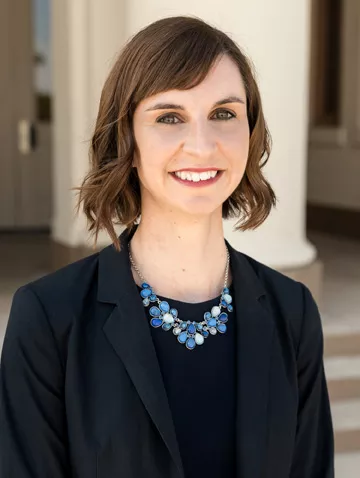
Hoffman, meanwhile, began doing the kind of job I hoped she would from her first days in office. I've been waiting to see if the trend would continue, and it has. Almost halfway through her first year, Hoffman has created enough of a track record for me to say, I'm impressed.
It's important to understand the nature of the superintendent' job to put Hoffman's accomplishments in perspective. She administers a multi-billion dollar budget but has no direct impact on legislators or legislation. Any political clout Hoffman has comes from the way she uses her bully pulpit. Thus far, she's used it effectively. She continues to emphasize her perspective as an educator, which is a welcome relief after three decades of non-educators running the Department of Education. Hoffman makes it clear, she knows teachers, she knows students, she knows public schools.
Hoffman took her oath of office with her hand on a children's book. That could be called gimmicky, I suppose, but I appreciated the symbolism. She was swearing an oath to serve the students, to put their needs foremost. Most teachers make a similar oath to themselves every year before the first day of school. It was a promising start.
There was no symbolism involved in Hoffman's strong stance against the Arizona law stating that sex education courses can't say anything positive about what the law calls "a homosexual life-style." Referring to it as the "no promo homo law" in her State of Education speech, Hoffman said the policy is "outdated . . . harmful and wrong."
The law may have been on the way out regardless. The board of education was facing a suit over the statute, and Attorney General Mark Brnovich said he wouldn't come to its defense. The board of education voted unanimously against it, then in April the legislature repealed the law. Whether or not Hoffman's aggressive stance on the topic moved votes, her full-throated condemnation of the old law helped clarify the issue and boost it into statewide prominence.
Tags: Kathy Hoffman , Superintendent of Public Instruction , English Language Learners , "No Promo Homo" law , Empowerment Scholarship Accounts , Image
Tuesday, April 16, 2019
Is Trump our Racist/Antisemite-in-chief, or does he just play at it on TV and Twitter?
The nicest thing you can say about Trump's racist and antisemitic comments and tweets is what Andrew Gillum said about Ron DeSantis when the two of them were running for Florida governor: "I’m not calling Mr. Desantis a racist," Gillum said. "I’m simply saying the racists believe he’s a racist."
I'm not running for office so I don't have to be as careful as Gillum. I'll say it without equivocation: Trump is an antisemite. Trump is a racist. Full stop.
Except that, some will counter, we know Trump will say or do anything to win the news cycle, pander to his base and vilify his enemies. Can we separate the actual prejudices festering inside his fevered brain from his slash-and-burn political tactics?
After the 2018 clashes between participants in the neo-Nazi rally in Charlottesville, Virginia, and protestors, Trump said there were "fine people on both sides." Was that Trump's honest opinion or a way to assure the continued allegiance of people like neo-Nazi leader Richard B. Spencer whose post-election speech praising Trump's victory included Nazi salutes and the triumphant call, “Hail Trump. Hail our people. Hail victory!”
Me, I'd say anyone who can find a way to defend people chanting "Jews will not replace us" is an antisemite. But we're talking about Trump who lies whenever it suits his needs, so the point is open to debate.
Trump has joined other Republicans in turning Rep. Ilhan Omar, who is black, Muslim and has a foreign accent (she was born in Somalia) — she's a bigot's trifecta — into the Democratic villain du jour. Is he just looking toward 2020, or does he despise Omar as much as he says?
It's hard to tell the difference in Trump's most public statements, but we can get at the genuine bigotry inside that twisted head of his by looking at less publicized moments.
Let's start with his antisemitism. Yes, I know Jared, Trump's son-in-law, is Jewish and Ivanka converted, making her children, his grandchildren, Jewish. He dotes on his daughter and, to the extent he's capable of affection, it's possible he may actually love his grandchildren, but as anyone who has taken a close look at bigotry knows, that doesn't stop him from accepting stereotypes and harboring ill feelings toward Jews.
Tags: Donald Trump , Antisemitism , Racism , Jews , African Americans , Image