

Friday, June 12, 2020
PHOENIX – Gov. Doug Ducey defended his plan to reopen the state Thursday, attributing concerns about the stark increase in the number of positive cases to misinformation and increased testing.
“We put the stay-at-home order in place so that we can prepare for what we’re going through right now,” he told reporters at a news conference.
The rise in Arizona COVID-19 cases has piqued concern from national experts, drawing attention to the growing infection rate and uptick in hospitalizations. The increase in cases comes just a few weeks after Ducey lifted stay-at-home orders on May 15 and Arizonans flocked to Memorial Day events across the state.
“It’s important that people know we are not seeing an increase in patient volume, we are prepared if that increase should come,” Ducey said. “The facts are, we got an increase in testing, an increase in testing and an increase in positive test results. So we’re going to continue to stay laser-focused on COVID-19.”
According to data from the COVID-19 Tracking Project, Arizona and South Carolina are the two states that “appear to have the most dire situations right now.”

“We put the stay-at-home order in place so that we can prepare for what we’re going through right now,” he told reporters at a news conference.
The rise in Arizona COVID-19 cases has piqued concern from national experts, drawing attention to the growing infection rate and uptick in hospitalizations. The increase in cases comes just a few weeks after Ducey lifted stay-at-home orders on May 15 and Arizonans flocked to Memorial Day events across the state.
“It’s important that people know we are not seeing an increase in patient volume, we are prepared if that increase should come,” Ducey said. “The facts are, we got an increase in testing, an increase in testing and an increase in positive test results. So we’re going to continue to stay laser-focused on COVID-19.”
According to data from the COVID-19 Tracking Project, Arizona and South Carolina are the two states that “appear to have the most dire situations right now.”

After battling the Bighorn Fire on the slopes of the Catalina Mountains, fire crews will experience the highest temperatures yet today, at 107 degrees. This gusty and hot weather is one of the main reasons the Bighorn Fire is so difficult to manage; it has remained at 10 percent contained for multiple days and has grown almost a thousand acres every day since a lightning storm first ignited it on June 5.
Tags: fire , bighorn , police , burning , evacuation , update , Image
Thursday, June 11, 2020
As protesters across the world demand justice for George Floyd, Breonna Taylor, Eric Garner and other Black people who were murdered by police, calls for disbanding law enforcement have gained unprecedented support.
 Widespread conversations about whether law enforcement actually keeps communities safe are ongoing, with a focus on the institutional racism that is tied to the policing profession. Black people in America are five times more likely to be arrested and incarcerated than white people.
Black men are also more than twice as likely to be killed by police than white men.
Many believe that police department budgets have become bloated over the past few years, and that money could be better used to address the underlying causes of crime. Members of this movement want to see a more proactive approach rather than the reactive practice of responding to crime with government-funded force.
Tucson Police Department Chief Chris Magnus is doing his best to separate his department from others across the country who have been exposed as perpetrators of police brutality. He claims (and Tucson City Council members agree) that his police department is one of the most progressive in the country.
At this week’s study session, Magnus gave a summary of how they have been working on these issues for years. He said the department’s use of force protocol is modeled after the PERF 30 Guiding Principles on Use of Force and incorporates guidelines from Campaign Zero and President Barack Obama’s 21st Century Policing Report.
“I think our use of force guidelines are some of the best you will find,” Magnus told the council.
He said all officers have participated in de-escalation, crisis intervention, implicit bias and cultural awareness training, and all officers wear body cameras. TPD adopted the “8 Can’t Wait” guidelines that ban chokeholds, require de-escalations and warnings before firing a weapon, among other things.
Magnus has been asked about what went wrong in Minneapolis, where George Floyd was murdered by a white police officer on May 25. He said it’s interesting because Minneapolis has had a series of “very progressive” police chiefs and have put all the right policies in place. They even have a lot of the same policies as TPD.
He argued that Floyd’s murder happened because the Minneapolis Police Department’s leadership-level philosophies were never instilled in each officer due to a lack of supervision.
“Our supervisors and commanders really understand that they are expected to help us develop that healthy organizational culture,” Magnus said.

Tucson Police Chief Chris Magnus: “I think our use of force guidelines are some of the best you will find."
Black men are also more than twice as likely to be killed by police than white men.
Many believe that police department budgets have become bloated over the past few years, and that money could be better used to address the underlying causes of crime. Members of this movement want to see a more proactive approach rather than the reactive practice of responding to crime with government-funded force.
Tucson Police Department Chief Chris Magnus is doing his best to separate his department from others across the country who have been exposed as perpetrators of police brutality. He claims (and Tucson City Council members agree) that his police department is one of the most progressive in the country.
At this week’s study session, Magnus gave a summary of how they have been working on these issues for years. He said the department’s use of force protocol is modeled after the PERF 30 Guiding Principles on Use of Force and incorporates guidelines from Campaign Zero and President Barack Obama’s 21st Century Policing Report.
“I think our use of force guidelines are some of the best you will find,” Magnus told the council.
He said all officers have participated in de-escalation, crisis intervention, implicit bias and cultural awareness training, and all officers wear body cameras. TPD adopted the “8 Can’t Wait” guidelines that ban chokeholds, require de-escalations and warnings before firing a weapon, among other things.
Magnus has been asked about what went wrong in Minneapolis, where George Floyd was murdered by a white police officer on May 25. He said it’s interesting because Minneapolis has had a series of “very progressive” police chiefs and have put all the right policies in place. They even have a lot of the same policies as TPD.
He argued that Floyd’s murder happened because the Minneapolis Police Department’s leadership-level philosophies were never instilled in each officer due to a lack of supervision.
“Our supervisors and commanders really understand that they are expected to help us develop that healthy organizational culture,” Magnus said.
The Pima County Board of Supervisors has taken several steps in an effort to slow the spread of COVID-19 in Pima County, including voting on March 19 to close down all nonessential businesses, and later when the state reopened the economy, voting to implement and then revise new health regulations for restaurants and bars offering dine-in service once again.
The board’s decisions have been met with some criticism across the political spectrum, with some critics saying the county has not done enough and others saying it has gone too far, according to Pima County Administrator Chuck Huckelberry.
Democratic supervisors Ramon Valadez, Sharon Bronson and Betty Villegas said they voted for the regulations to ensure public safety, while Republicans Steve Christy and Ally Miller say the new rules make it harder for beleaguered businesses to reopen. At the request of three GOP lawmakers, Attorney General Mark Brnovich investigated whether the county exceeded its legal authority by enacting the regulations but the AG’s Office dismissed the case on a legal technicality.
Tucson Weekly asked the candidates running for Board of Supervisors seats this year if they approved of those decisions and if they would have done anything differently.
In Pima County’s District 1, which includes Marana, Oro Valley, Casas Adobes and the Catalina Foothills, Pima County Supervisor Ally Miller is retiring. There’s a four-way GOP primary and a two-way Democratic primary for the open seat.
The Republicans include: Oro Valley Councilmember Rhonda Piña, former state lawmaker Vic Williams, former Pima County Republican Party Chair Bill Beard and political newcomer Steve Spain, who has worked developing technology for hotels.
All of the Republican candidates were critical of the county’s emergency regulations.
Beard, who has been critical of efforts to combat the outbreak by requiring businesses to shut down, condemned the board’s actions.
The board’s decisions have been met with some criticism across the political spectrum, with some critics saying the county has not done enough and others saying it has gone too far, according to Pima County Administrator Chuck Huckelberry.
Democratic supervisors Ramon Valadez, Sharon Bronson and Betty Villegas said they voted for the regulations to ensure public safety, while Republicans Steve Christy and Ally Miller say the new rules make it harder for beleaguered businesses to reopen. At the request of three GOP lawmakers, Attorney General Mark Brnovich investigated whether the county exceeded its legal authority by enacting the regulations but the AG’s Office dismissed the case on a legal technicality.
Tucson Weekly asked the candidates running for Board of Supervisors seats this year if they approved of those decisions and if they would have done anything differently.
In Pima County’s District 1, which includes Marana, Oro Valley, Casas Adobes and the Catalina Foothills, Pima County Supervisor Ally Miller is retiring. There’s a four-way GOP primary and a two-way Democratic primary for the open seat.
The Republicans include: Oro Valley Councilmember Rhonda Piña, former state lawmaker Vic Williams, former Pima County Republican Party Chair Bill Beard and political newcomer Steve Spain, who has worked developing technology for hotels.
All of the Republican candidates were critical of the county’s emergency regulations.
Beard, who has been critical of efforts to combat the outbreak by requiring businesses to shut down, condemned the board’s actions.
There's an important safety tip missing from this safety tip from Gov. Doug Ducey: He's still not encouraging people to wear masks when they're out in public, despite Arizona's soaring positive COVID-19 tests and the advice of medical professionals. It's past time to set an example here, Gov. Ducey. Why the reluctance?We all play a role in protecting public health and safety.
— Doug Ducey (@dougducey) June 9, 2020
Wash your hands✔️ Stay home when you are sick✔️ Disinfect frequently touched surfaces✔️ pic.twitter.com/wsdKZfE5D0
The number of confirmed coronavirus cases in Arizona surpassed 31,000 as of Thursday, June 11, with another jump of 1,412 new cases reported this morning, according to the Arizona Department of Health Services.
Pima County had 3,479 of the state's 31,264 confirmed cases.
A total of 1,127 people have died after contracting the virus, including 218 in Pima County, according to the report.
In Maricopa County, the number of confirmed COVID-19 cases hit 16,018.
Because symptoms can take as long as two weeks to appear after exposure to the virus (while some people can remain entirely asymptomatic), health officials continue to urge the public to avoid unnecessary trips and gatherings of more than 10 people, especially if you have underlying health conditions, and have advised people to cover their faces with masks in public.
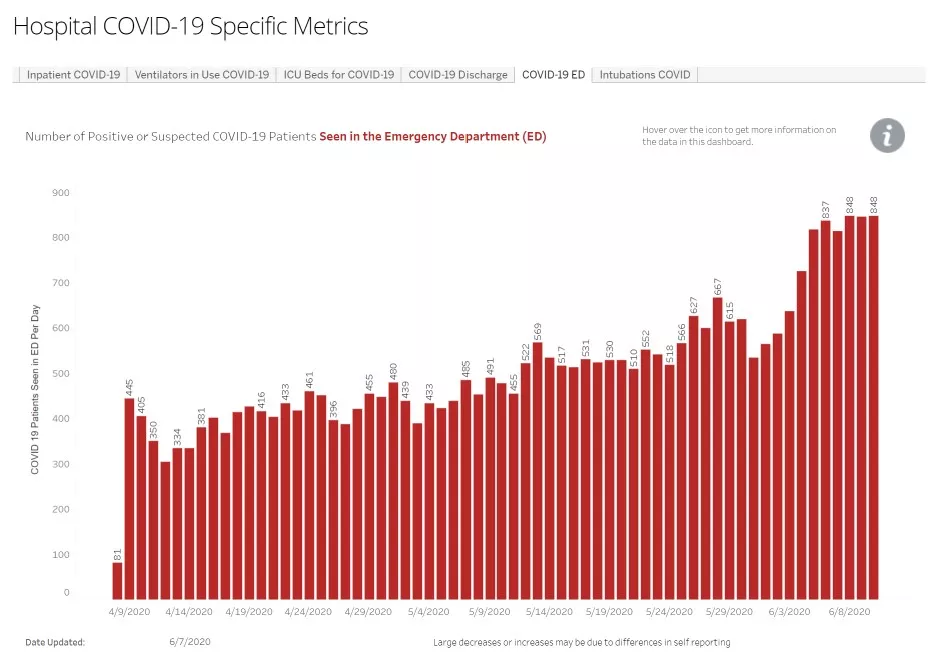
Arizona hospitals continue to see a rise in the number of people hospitalized with COVID symptoms, as well as more people visiting emergency rooms. This morning's Arizona Department of Health Services report shows that as of yesterday, 1,291 Arizonans were hospitalized. There are 429 COVID patients in ICU units and 848 people arrived at emergency rooms with COVID-like symptoms on June 10, according to the report.
When Ducey lifted Arizona's stay-at-home order on May 16, he noted that CDC gating criteria included two weeks of falling cases or two weeks decreasing positive cases as a percentage of total tests. Total cases continue to rise, as does the number of positive cases as a percentage of total tests. On May 17, the percentage of positive tests to total tests was 6 percent; on May 24, it was 9 percent; on May 31, it was 12 percent, according to figure on the ADHS website.
At a June 4 press conference, Ducey said he and Department of Health Services Director Dr. Cara Christ anticipated the current increase in positive COVID-19 cases because testing has “dramatically increased” within the state. Christ downplayed the alarm about the recent increase in cases, which some have attributed to the end of the stay-at-home order on May 15, saying “as people come back together, we know there will be transmissions of COVID-19.”
While they admitted new cases are to be expected when people begin to interact again, Ducey and Christ said their main focus was to ensure that hospitals had the capacity for an increase in cases. They reported that the current use of hospital beds, ICU beds, and ventilators were all within capacity last week.
“The fact that we were going to focus on having more tests means we were going to have more cases,” Ducey said. “We anticipated that. What we wanted to do was to be prepared for this.”
But Banner Health officials warned last week that unless current trends changed, they would have to activate a reserve bed plan as their ICU beds were nearly full.
In other news:
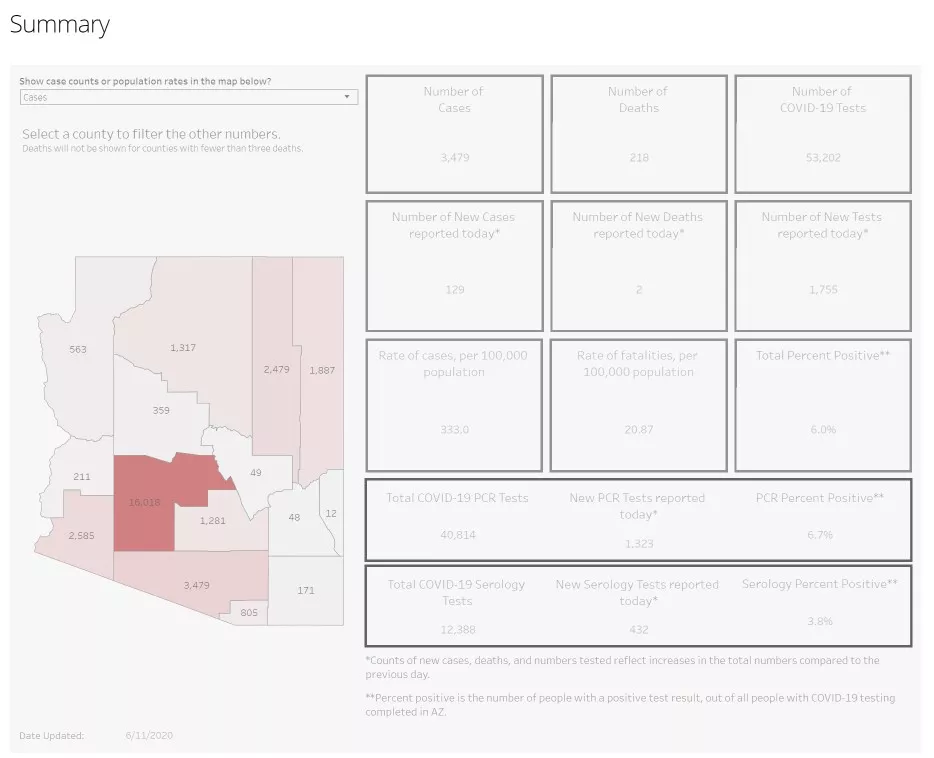
Pima County had 3,479 of the state's 31,264 confirmed cases.

A total of 1,127 people have died after contracting the virus, including 218 in Pima County, according to the report.
In Maricopa County, the number of confirmed COVID-19 cases hit 16,018.
Because symptoms can take as long as two weeks to appear after exposure to the virus (while some people can remain entirely asymptomatic), health officials continue to urge the public to avoid unnecessary trips and gatherings of more than 10 people, especially if you have underlying health conditions, and have advised people to cover their faces with masks in public.
Arizona hospitals continue to see a rise in the number of people hospitalized with COVID symptoms, as well as more people visiting emergency rooms. This morning's Arizona Department of Health Services report shows that as of yesterday, 1,291 Arizonans were hospitalized. There are 429 COVID patients in ICU units and 848 people arrived at emergency rooms with COVID-like symptoms on June 10, according to the report.
When Ducey lifted Arizona's stay-at-home order on May 16, he noted that CDC gating criteria included two weeks of falling cases or two weeks decreasing positive cases as a percentage of total tests. Total cases continue to rise, as does the number of positive cases as a percentage of total tests. On May 17, the percentage of positive tests to total tests was 6 percent; on May 24, it was 9 percent; on May 31, it was 12 percent, according to figure on the ADHS website.
At a June 4 press conference, Ducey said he and Department of Health Services Director Dr. Cara Christ anticipated the current increase in positive COVID-19 cases because testing has “dramatically increased” within the state. Christ downplayed the alarm about the recent increase in cases, which some have attributed to the end of the stay-at-home order on May 15, saying “as people come back together, we know there will be transmissions of COVID-19.”
While they admitted new cases are to be expected when people begin to interact again, Ducey and Christ said their main focus was to ensure that hospitals had the capacity for an increase in cases. They reported that the current use of hospital beds, ICU beds, and ventilators were all within capacity last week.
“The fact that we were going to focus on having more tests means we were going to have more cases,” Ducey said. “We anticipated that. What we wanted to do was to be prepared for this.”
But Banner Health officials warned last week that unless current trends changed, they would have to activate a reserve bed plan as their ICU beds were nearly full.
In other news:
Wednesday, June 10, 2020
The Best of Tucson 2020® is ready to go and waiting for your nominations! After you're done, you can take a look at the other stories we covered today, just in case you missed them earlier.

- The number of confirmed coronavirus cases in Arizona surpassed 29,000 as of Wednesday, June 10, with another jump of 1,556 new cases reported this morning, according to the Arizona Department of Health Services.
- So, the first uncomfortable reality of your slow home internet is that it’s likely there’s an infrastructure problem that will not be addressed until the customer complaints reach the intolerable level.
- More Arizona residents who want a COVID-19 antibody test may do so after the University of Arizona and the state announced expanded testing eligibility.
- More than two months have passed since The Loft Cinema closed their theaters due to COVID-19.
- The Tucson City Council unanimously voted to reopen discussions on the controversial ordinance prohibiting the public to enter and film a crime scene without having officer permission during Tuesday’s study session.
- The Eighth Amendment to the Constitution of the United States prohibits cruel and unusual punishment. It states: “Excessive bail shall not be required, nor excessive fines imposed, nor cruel and unusual punishments inflicted.”
Tuesday, June 9, 2020
ProPublica is a nonprofit newsroom that investigates abuses of power. Click here to read their biggest stories as soon as they’re published.
Since 2018, Capital One has been a looming presence in Julio Lugo’s life, ever since the company sued him, as it did 29,000 other New Yorkers that year, over an unpaid credit card. But when the coronavirus hit the city this March, it wasn’t on his mind.
At Mount Sinai in Manhattan, where he works, he’d been drafted into the hospital’s frenzied effort against the virus. He normally gathered patient information at the front desk of a radiology clinic in orderly shifts, 9 to 5. Now he was working 16-hour days, often overnight. At one moment he might be enlisted to help a team of doctors or nurses put on their full-body protective equipment and then he would rush to disinfect another team. He lost track of the days, only orienting himself by the need to juggle care with his ex-wife of their two young children who were now out of school.
But despite a global pandemic, Capital One didn’t forget about him. The company began in late March to seize a portion of his wages to collect on that debt — one that he says wasn’t even his.
Federal, state and local officials have all taken some steps to protect Americans from the ravages of the economic crash due to COVID-19. Congress halted a substantial portion of evictions, foreclosures and collection on student loans. And when it sent $300 billion in stimulus checks out to families, many states took steps to make sure that debt collectors didn’t grab the money. But one of the most aggressive and common forms of debt collection has generally been allowed to continue: seizure of wages for old consumer debts.

Since 2018, Capital One has been a looming presence in Julio Lugo’s life, ever since the company sued him, as it did 29,000 other New Yorkers that year, over an unpaid credit card. But when the coronavirus hit the city this March, it wasn’t on his mind.
At Mount Sinai in Manhattan, where he works, he’d been drafted into the hospital’s frenzied effort against the virus. He normally gathered patient information at the front desk of a radiology clinic in orderly shifts, 9 to 5. Now he was working 16-hour days, often overnight. At one moment he might be enlisted to help a team of doctors or nurses put on their full-body protective equipment and then he would rush to disinfect another team. He lost track of the days, only orienting himself by the need to juggle care with his ex-wife of their two young children who were now out of school.
But despite a global pandemic, Capital One didn’t forget about him. The company began in late March to seize a portion of his wages to collect on that debt — one that he says wasn’t even his.
Federal, state and local officials have all taken some steps to protect Americans from the ravages of the economic crash due to COVID-19. Congress halted a substantial portion of evictions, foreclosures and collection on student loans. And when it sent $300 billion in stimulus checks out to families, many states took steps to make sure that debt collectors didn’t grab the money. But one of the most aggressive and common forms of debt collection has generally been allowed to continue: seizure of wages for old consumer debts.
ProPublica is a nonprofit newsroom that investigates abuses of power. Click here to read their biggest stories as soon as they’re published.
Do you want to see how legislation that was supposed to be a bailout for our economy ended up committing almost as much taxpayer money to help a relative handful of the non-needy as it spent to help tens of millions of people in need? Then let’s step back and revisit parts of the Coronavirus Aid, Relief and Economic Security Act and look at some of the numbers involved.
The best-known feature of the CARES Act, as it’s known, is the cash grant of up to $1,200 per adult and $500 per child for households whose income was less than $99,000 for single taxpayers and $198,000 for couples. These grants are nontaxable, which makes them even more valuable. Some 159 million stimulus payments have gone out, according to the IRS.
The income limits suggested that the plan benefits the people most in need, those most likely to spend their stimulus payments and thus help the economy. The rhetoric conveyed the same: “The CARES Act Provides Assistance to Workers And Their Families” is how the Treasury’s website puts it. There were no grants to more-fortunate people, who for the most part aren’t in financial distress and are less likely than the less-fortunate to spend any money that Uncle Sam sent them.

Do you want to see how legislation that was supposed to be a bailout for our economy ended up committing almost as much taxpayer money to help a relative handful of the non-needy as it spent to help tens of millions of people in need? Then let’s step back and revisit parts of the Coronavirus Aid, Relief and Economic Security Act and look at some of the numbers involved.
The best-known feature of the CARES Act, as it’s known, is the cash grant of up to $1,200 per adult and $500 per child for households whose income was less than $99,000 for single taxpayers and $198,000 for couples. These grants are nontaxable, which makes them even more valuable. Some 159 million stimulus payments have gone out, according to the IRS.
The income limits suggested that the plan benefits the people most in need, those most likely to spend their stimulus payments and thus help the economy. The rhetoric conveyed the same: “The CARES Act Provides Assistance to Workers And Their Families” is how the Treasury’s website puts it. There were no grants to more-fortunate people, who for the most part aren’t in financial distress and are less likely than the less-fortunate to spend any money that Uncle Sam sent them.
PHOENIX – The $2.2 trillion coronavirus aid package that Congress passed in March has provided medical and financial relief to millions of Americans, including allocations for low-income, rural and uninsured populations.
Many immigrants, however, have been excluded from benefits under the CARES Act – leaving local advocacy groups to step in to provide economic, medical and emotional support.
José Patiño, education and policy director for Mesa-based Aliento, said his staff foresaw the havoc the pandemic could unleash on immigrant families after workers started getting laid off or furloughed, especially from the construction and hospitality industries.
“We asked ourselves: What is a goal we can set for ourselves that is ambitious enough but also realistic?” Patiño said.
The organization, which helps the children of those living in the country illegally as well as mixed-status families whose members include citizens and noncitizens, established a relief fund to provide $500 checks to cover rent, utilities and health care, if needed, for families ineligible for federal aid.
About 200 families across the U.S. and Puerto Rico have been helped so far, and another 200 are on a waiting list for assistance.
According to the Pew Research Center, only 37% of American adults think immigrants in the country without legal permission should receive financial aid related to the pandemic, although nearly two-thirds of those surveyed believe the government has a responsibility to provide medical services to those immigrants if they are stricken with coronavirus.

Many immigrants, however, have been excluded from benefits under the CARES Act – leaving local advocacy groups to step in to provide economic, medical and emotional support.
José Patiño, education and policy director for Mesa-based Aliento, said his staff foresaw the havoc the pandemic could unleash on immigrant families after workers started getting laid off or furloughed, especially from the construction and hospitality industries.
“We asked ourselves: What is a goal we can set for ourselves that is ambitious enough but also realistic?” Patiño said.
The organization, which helps the children of those living in the country illegally as well as mixed-status families whose members include citizens and noncitizens, established a relief fund to provide $500 checks to cover rent, utilities and health care, if needed, for families ineligible for federal aid.
About 200 families across the U.S. and Puerto Rico have been helped so far, and another 200 are on a waiting list for assistance.
According to the Pew Research Center, only 37% of American adults think immigrants in the country without legal permission should receive financial aid related to the pandemic, although nearly two-thirds of those surveyed believe the government has a responsibility to provide medical services to those immigrants if they are stricken with coronavirus.

