

Thursday, April 9, 2020
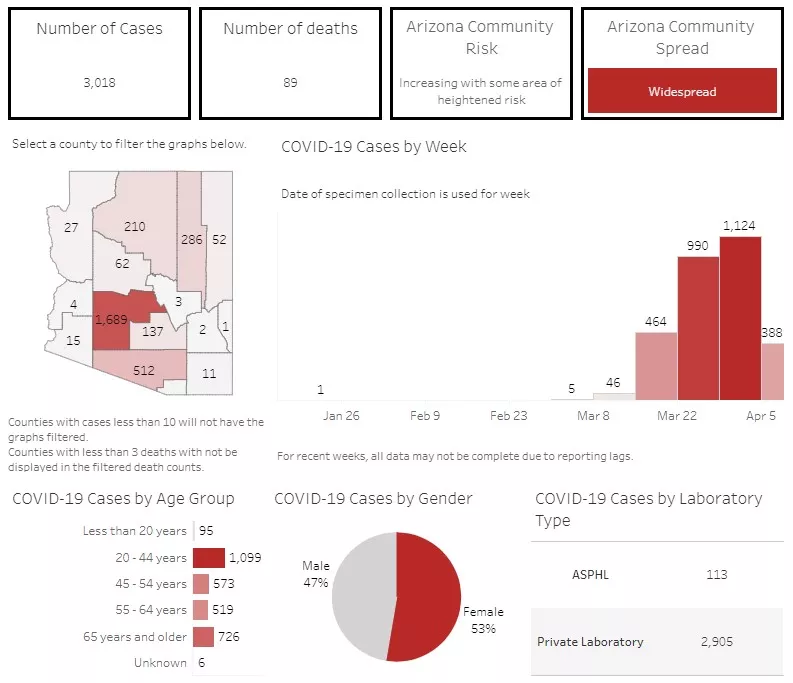
The number of confirmed coronavirus cases in Arizona had reached 3,018 as of Thursday, April 9, according to the morning report from the Arizona Department of Health Services.
Pima County had seen 512 of the state’s confirmed cases.
The coronavirus had killed 89 people statewide, including 16 in Pima County, according to the state and county health department.
In Maricopa County, the number of confirmed COVID-19 cases had risen to 1,689.
The state remains under Gov. Doug Ducey’s stay-at-home order that has closed a wide number of “non-essential” businesses, including many retail stores, barbershops, salons, and swap meets. Public parks remain open but amenities such as playgrounds and restrooms are closed.
Under the stay-at-home order, Arizonans are still able to shop for groceries, medical and household needs, and pet supplies. They can also go work, pick up a take-out meal from a restaurant, travel to take care of a family member, friend or pet, and can still go walking, hiking, biking and golfing, provided that they adhere to social distancing guidelines.
Ducey announced four new executive orders this week:
• Visitors from areas with major community spread of COVID-19 must enter quarantine for two weeks if they come to Arizona.
Pima County had seen 512 of the state’s confirmed cases.
The coronavirus had killed 89 people statewide, including 16 in Pima County, according to the state and county health department.
In Maricopa County, the number of confirmed COVID-19 cases had risen to 1,689.
The state remains under Gov. Doug Ducey’s stay-at-home order that has closed a wide number of “non-essential” businesses, including many retail stores, barbershops, salons, and swap meets. Public parks remain open but amenities such as playgrounds and restrooms are closed.
Under the stay-at-home order, Arizonans are still able to shop for groceries, medical and household needs, and pet supplies. They can also go work, pick up a take-out meal from a restaurant, travel to take care of a family member, friend or pet, and can still go walking, hiking, biking and golfing, provided that they adhere to social distancing guidelines.
Ducey announced four new executive orders this week:
• Visitors from areas with major community spread of COVID-19 must enter quarantine for two weeks if they come to Arizona.
Wednesday, April 8, 2020
A roundup of the stories The Range has been following today:
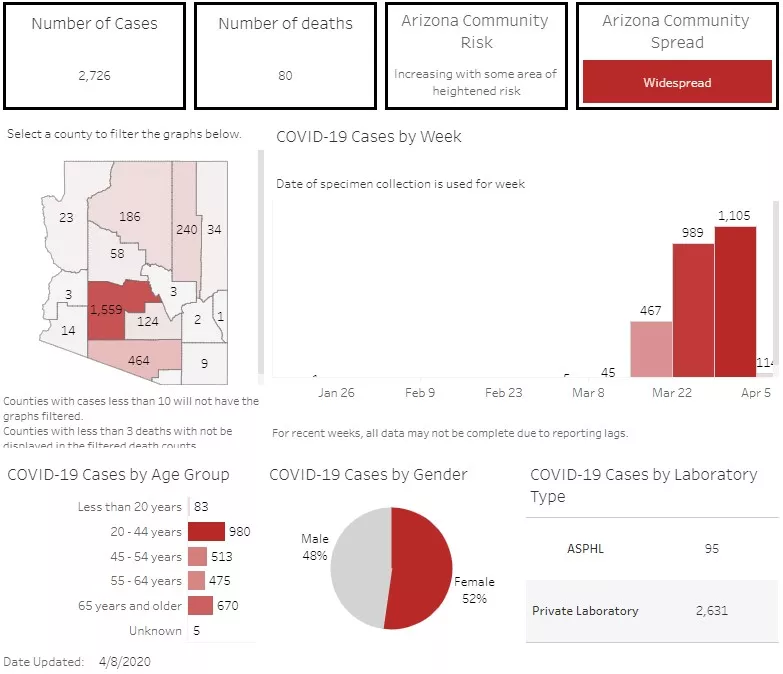
• Pima County has had 464 of the state's 2,726 confirmed coronavirus cases in Arizona as of Wednesday, April 8, according to the morning report from the Arizona Department of Health Services. The coronavirus had killed 80 people statewide, including 15 in Pima County, according to the state and county health departments.
• Tucson Mayor Regina Romero relaxed city regulations to allow restaurants to become pop-up grocery stores.
• The Arizona Department of Corrections has announced two cases of COVID-19 among prisoners.
• Here's a rundown of the 2020 candidates for Pima County Board of Supervisors.
• From ProPublica: Cancer surgeries and organ transplants are being put off thanks to COVID-19. Can they want? Meanwhile, Democratic senators are demanding answers about the Trump administration's push to deport thousands of migrants seeking asylum.
• A new logo for eegee's!
• The Arts Foundation for Southern Arizona is offering $50,000 in emergency arts grants while Tucson Federal Credit Union donated $65,000 in grants to the Community Food Bank of Southern Arizona, Old Pueblo Community Services, Emerge! Center Against Domestic Abuse and the Children's Clinics' Comprehensive Services for Children and Teens.

Courtesy Photo
Pima County Supervisor Sharon Bronson is facing both primary and general election challenges as she seeks a seventh term.
But candidates may face legal challenges to their nominating petitions if their opponents can find deficiencies among their signatures, which were due Monday, April 6.
In District 1, where Miller is stepping down after two contentious terms on the Board of Supervisor, the GOP candidates include Oro Valley Town Council member Rhonda Pina; Bill Beard, a former Pima County Republican Party chair; former state lawmaker Vic Williams; and Steve Spain, a political newcomer who has already won Miller’s endorsement.
District 1, which includes Oro Valley, Marana, Casas Adobes and the Catalina Foothills areas, leans Republican. But an underdog status hasn’t prevented two Democrats from climbing into the Democratic primary ring: retired school administrator Rex Scott, who has campaign experience on both sides of the aisle, and Brian Radford, a political newcomer who previously worked in corrections. But Radford only filed 224 signatures on his petitions, just three over the necessary 221 valid signatures to appear on the ballot, leaving him vulnerable to a legal challenge.
In District 4, Supervisor Steve Christy faces a Republican primary challenge from John Backer as he seeks a second term in the largely rural district that includes eastern Pima County and Green Valley. Backer is a political ally of the departing Miller, who has frequently clashed with Christy and briefly employed Backer as an aide.
Last night the Arizona Department of Corrections announced that two prisoners within their facilities have tested positive for COVID-19.
The first person has been housed at a community hospital since March 27, due to "several non-COVID related symptoms." They received a positive test result after two previous tests that came up negative and were administered at the same hospital. The release did not state which prison the individual is usually housed in.
The other person who tested positive is housed at Arizona State Prison - Marana, which is operated by the private contractor Management and Training Corporation. It is located in the northwest Tucson area and houses 500 males who are serving nonviolent drug convictions.
Both are currently receiving treatment.
The department's press release says 60 incarcerated people have been tested, 48 have tested negative and 10 more are pending.

The first person has been housed at a community hospital since March 27, due to "several non-COVID related symptoms." They received a positive test result after two previous tests that came up negative and were administered at the same hospital. The release did not state which prison the individual is usually housed in.
The other person who tested positive is housed at Arizona State Prison - Marana, which is operated by the private contractor Management and Training Corporation. It is located in the northwest Tucson area and houses 500 males who are serving nonviolent drug convictions.
Both are currently receiving treatment.
The department's press release says 60 incarcerated people have been tested, 48 have tested negative and 10 more are pending.
Tags: COVID19 , Coronavirus , Arizona Department of Corrections , Marana Prison , Image
With local eateries pushed to the edge by stay-at-home orders that limit their service to take out and delivery during the COVID-19 outbreak, Tucson Mayor Regina Romero announced today that restaurants can operate as pop-up grocery stores and start selling packaged food, fresh produce, paper goods and cleaning supplies to customers without asking for changes to their certificates of occupancy that allow them to operate.
The announcement comes on the heels of Gov. Doug Ducey's executive order yesterday allowing restaurants to begin selling supplies normally labeled "not for resale."
“Our restaurant community is at the heart of Tucson’s cultural, social, and economic fabric,” said Romero in a prepared statement. “I encourage all Tucsonans to continue rallying around our restaurants by ordering takeout, purchasing gift cards, and now, by visiting them for their grocery needs.”
The new policy will be reassessed every two weeks, according to Romero's office.
The decision to allow retail sales was developed in partnership with the Tucson City of Gastronomy Board of Directors. Restaurants will be required to collect sales taxes on the sale of goods, which must be labeled in accordance with new FDA guidelines.
“As a chef and Tucson City of Gastronomy Board President, I appreciate and support this change in public policy," said chef Janos Wilder in a press release. "It will promote public safety and allow our restaurants to be another needed resource during these trying time.”

The announcement comes on the heels of Gov. Doug Ducey's executive order yesterday allowing restaurants to begin selling supplies normally labeled "not for resale."
“Our restaurant community is at the heart of Tucson’s cultural, social, and economic fabric,” said Romero in a prepared statement. “I encourage all Tucsonans to continue rallying around our restaurants by ordering takeout, purchasing gift cards, and now, by visiting them for their grocery needs.”
The new policy will be reassessed every two weeks, according to Romero's office.
The decision to allow retail sales was developed in partnership with the Tucson City of Gastronomy Board of Directors. Restaurants will be required to collect sales taxes on the sale of goods, which must be labeled in accordance with new FDA guidelines.
“As a chef and Tucson City of Gastronomy Board President, I appreciate and support this change in public policy," said chef Janos Wilder in a press release. "It will promote public safety and allow our restaurants to be another needed resource during these trying time.”
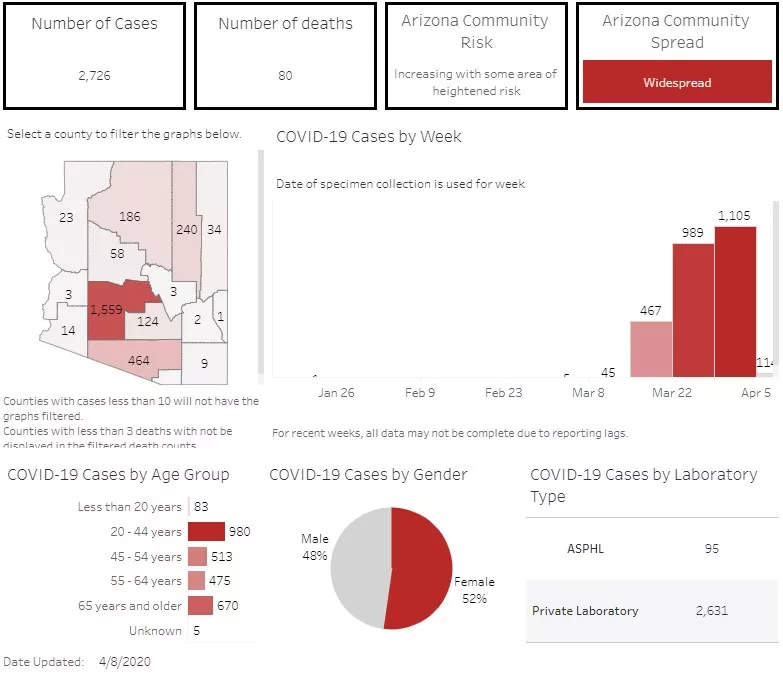
The number of confirmed coronavirus cases in Arizona had reached 2,726 as of Wednesday, April 8, according to the morning report from the Arizona Department of Health Services.
Pima County had seen 464 of the state’s confirmed cases.
The coronavirus had killed 80 people statewide, including 15 in Pima County, according to the state and county health departments.
In Maricopa County, the number of confirmed COVID-19 cases had risen to 1,559.
The state remains under Gov. Doug Ducey’s stay-at-home order that has closed a wide number of “non-essential” businesses, including many retail stores, barbershops, salons, and swap meets. Public parks remain open but amenities such as playgrounds and restrooms are closed.
Under the stay-at-home order, Arizonans are still able to shop for groceries, medical and household needs, and pet supplies. They can also go work, pick up a take-out meal from a restaurant, travel to take care of a family member, friend or pet, and can still go walking, hiking, biking and golfing, provided that they adhere to social distancing guidelines.
Ducey announced four new executive orders yesterday:
Pima County had seen 464 of the state’s confirmed cases.
The coronavirus had killed 80 people statewide, including 15 in Pima County, according to the state and county health departments.
In Maricopa County, the number of confirmed COVID-19 cases had risen to 1,559.
The state remains under Gov. Doug Ducey’s stay-at-home order that has closed a wide number of “non-essential” businesses, including many retail stores, barbershops, salons, and swap meets. Public parks remain open but amenities such as playgrounds and restrooms are closed.
Under the stay-at-home order, Arizonans are still able to shop for groceries, medical and household needs, and pet supplies. They can also go work, pick up a take-out meal from a restaurant, travel to take care of a family member, friend or pet, and can still go walking, hiking, biking and golfing, provided that they adhere to social distancing guidelines.
Ducey announced four new executive orders yesterday:
Tuesday, April 7, 2020
Here are the stories The Range has been following today:
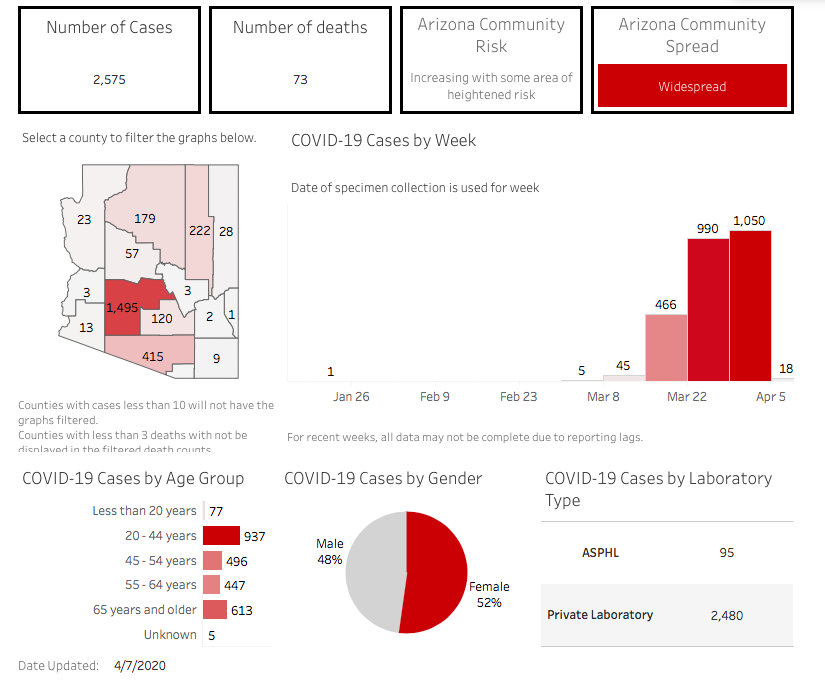
• Pima County had 415 of the state’s 2,575 confirmed COVID-19 cases of Tuesday, April 7, according to the morning report from the Arizona Department of Health Services. The coronavirus had killed 73 people statewide, the report said. A total of 15 people in Pima County have died after contracting the infection, according to a later report from the Pima County Health Department.
• Travelers to Arizona from areas of widespread COVID-19 spread will have to quarantine for two weeks upon arrival in the state under a new executive order from Gov. Doug Ducey, who issues a number of other directives today that included new guidelines for nursing homes and similar institutions; loosened regulations for restaurants that want to sell their inventory as grocery items; and increased data collection by hospital and healthcare professionals.
• Democrat Betty Villegas was named to the Pima County Board of Supervisors to fill the seat of the late Richard Elias. Because of the viral outbreak, supervisors forewent any process involving town halls and interviews with potential candidates.
• Congressman Raul Grijalva is one of 41 House Democrats calling for blue-collar workers to get hazard pay.
• A coalition of advocates for criminal justice reform is calling for health inspections of state prisons.
• Dr. Bob England, Pima County's health director, says creating a map of local cases of COVID-19 is "meaningless."
• Arizona may the temporary home of Major League Baseball.
• High school students reflect on the year without a graduation.
• Tucson Values Teachers is seeking video nominations from students and their parents for a special edition of its monthly award program.
• Midtown institution Kingfisher is closing for the duration of of the outbreak as of 6 p.m. Wednesday, April 8.
• Here's some guidance on using your face mask properly.
• Pima County had 415 of the state’s 2,575 confirmed COVID-19 cases of Tuesday, April 7, according to the morning report from the Arizona Department of Health Services. The coronavirus had killed 73 people statewide, the report said. A total of 15 people in Pima County have died after contracting the infection, according to a later report from the Pima County Health Department.
• Travelers to Arizona from areas of widespread COVID-19 spread will have to quarantine for two weeks upon arrival in the state under a new executive order from Gov. Doug Ducey, who issues a number of other directives today that included new guidelines for nursing homes and similar institutions; loosened regulations for restaurants that want to sell their inventory as grocery items; and increased data collection by hospital and healthcare professionals.
• Democrat Betty Villegas was named to the Pima County Board of Supervisors to fill the seat of the late Richard Elias. Because of the viral outbreak, supervisors forewent any process involving town halls and interviews with potential candidates.
• Congressman Raul Grijalva is one of 41 House Democrats calling for blue-collar workers to get hazard pay.
• A coalition of advocates for criminal justice reform is calling for health inspections of state prisons.
• Dr. Bob England, Pima County's health director, says creating a map of local cases of COVID-19 is "meaningless."
• Arizona may the temporary home of Major League Baseball.
• High school students reflect on the year without a graduation.
• Tucson Values Teachers is seeking video nominations from students and their parents for a special edition of its monthly award program.
• Midtown institution Kingfisher is closing for the duration of of the outbreak as of 6 p.m. Wednesday, April 8.
• Here's some guidance on using your face mask properly.
A coalition of state and nationwide criminal justice reform organizations have called for the Arizona Department of Health Services to perform health inspections in all state prisons, as the risk for the spread of COVID-19 grows each day.
The group consists of the Arizona Office of American Friends Service Committee, the American Civil Liberties Union, Arizona Attorneys for Criminal Justice, the Cree Project, the William E. Morris Institute for Justice, FAMM, the Prison Law Office, FWD.us and more.
In a letter to DHS Director Dr. Cara Christ, they urged her and other health officials to make sure that Center for Disease Control and Prevention guidelines are being followed consistently inside prisons. They want the results of the inspections to be distributed to the public within 24 hours.
The letter calls for clear directives to be given to the Department of Corrections if any deficiencies are found during inspections, along with public reports of the department's response.
They included examples of why they believe the department is putting people at great risk of becoming seriously ill, where numerous accounts show "serious inconsistencies between what ADCRR has publicly announced it is doing to adhere to CDC guidelines and the reality of what people who live and work in these facilities are seeing."
AFSC-AZ's survey of 65 families connected to incarcerated people in Arizona's prisons showed:
The letter stated most families rely on television or print news to get updates about how the Department of Corrections is dealing with COVID-19.
The department has said they posted bulletins in each prison advising incarcerated people and staff to wash hands, sanitize surfaces and cover coughs and sneezes. Employees were encouraged to stay home if they are sick.
But AFSC-AZ's survey of 110 family members connected to incarcerated people showed that only 30 of them saw this information posted in their units, while 55 said no such information was available and 25 said they didn't know.
The CDC recommends cleaning all surfaces and objects that are frequently touched several times a day. The letter points out that the Department of Corrections has only committed to weekly cleanings of these types of surfaces.
The department also said they would provide "free hand soap, paper towels and hygiene items" to prisoners and staff, but the letter cites a motion filed March 16 by the Prison Law Office in the Parsons v. Shinn medical class action lawsuit saying “incarcerated people reported that they were not provided any disinfectant cleaning supplies to clean their cells or personal bed space, but rather were told to use their personal supplies of shampoo or soap to clean hard surfaces.”
The letter continues:

The group consists of the Arizona Office of American Friends Service Committee, the American Civil Liberties Union, Arizona Attorneys for Criminal Justice, the Cree Project, the William E. Morris Institute for Justice, FAMM, the Prison Law Office, FWD.us and more.
In a letter to DHS Director Dr. Cara Christ, they urged her and other health officials to make sure that Center for Disease Control and Prevention guidelines are being followed consistently inside prisons. They want the results of the inspections to be distributed to the public within 24 hours.
The letter calls for clear directives to be given to the Department of Corrections if any deficiencies are found during inspections, along with public reports of the department's response.
They included examples of why they believe the department is putting people at great risk of becoming seriously ill, where numerous accounts show "serious inconsistencies between what ADCRR has publicly announced it is doing to adhere to CDC guidelines and the reality of what people who live and work in these facilities are seeing."
AFSC-AZ's survey of 65 families connected to incarcerated people in Arizona's prisons showed:
- Sixty-four percent (64%) of respondents said they had received little to no information about COVID-19 in the prison where their loved one is living. Some indicated they had spoken to their loved one, but no information was disseminated to the people inside.
- Only 3 respondents (4%) said their loved one received information from a prison warden or “meeting” inside.
The letter stated most families rely on television or print news to get updates about how the Department of Corrections is dealing with COVID-19.
The department has said they posted bulletins in each prison advising incarcerated people and staff to wash hands, sanitize surfaces and cover coughs and sneezes. Employees were encouraged to stay home if they are sick.
But AFSC-AZ's survey of 110 family members connected to incarcerated people showed that only 30 of them saw this information posted in their units, while 55 said no such information was available and 25 said they didn't know.
The CDC recommends cleaning all surfaces and objects that are frequently touched several times a day. The letter points out that the Department of Corrections has only committed to weekly cleanings of these types of surfaces.
The department also said they would provide "free hand soap, paper towels and hygiene items" to prisoners and staff, but the letter cites a motion filed March 16 by the Prison Law Office in the Parsons v. Shinn medical class action lawsuit saying “incarcerated people reported that they were not provided any disinfectant cleaning supplies to clean their cells or personal bed space, but rather were told to use their personal supplies of shampoo or soap to clean hard surfaces.”
The letter continues:
Tags: Arizona Department of Corrections , Arizona Department of Health Services , Prison , COVID19 , Coronavirus , Image
Out-of-state travelers from areas with substantial community spread of COVID-19 will have to isolate or quarantine themselves for 14 days under a new executive order from Gov. Doug Ducey.
“Slowing the spread of COVID-19 remains our top priority,” said Ducey. “Today’s action aligns with guidance from public health officials, while ensuring those traveling for essential functions can continue to do so. We will take all necessary precautions to keep Arizonans safe.”
The order does not apply to airline employees, military personnel, healthcare workers, human services personnel, workers conducting essential infrastructure operations and workers providing essential governmental functions.
Ducey issued a number of other executive orders today regarding the outbreak. He instituted new guidelines for residential care facilities, nursing homes and other similar institutions. Staff will have to use appropriate personal protection equipment and institute symptom checks for anyone entering facilities. The order also requires healthcare facilities to supply residents with some kind of video device so they can stay in touch with family and loved ones.
“Arizona will continue to take proactive measures to protect our seniors and vulnerable populations,” said Ducey. “This order helps protect seniors and those living in health care facilities, as well as the staff and health care professionals caring for patients. My thanks to these individuals working to protect Arizona’s most vulnerable as we work to slow the spread of COVID-19.”
Ducey also loosened restrictions on restaurants so they can repackage sell grocery items they have on hand even if packaging labels say “not for resale.”
“Even with dine-in and carry-out options still available to patrons, many Arizona restaurants are struggling due to COVID-19,” Ducey said. “Today’s executive order provides flexibility for restaurant owners to safely sell prepared and bulk foods or supplies they have on hand and can’t use right now. We are proud to support Arizona restaurants with this reform.”
Hospital and health care providers will have to better track data related to COVID-19, including the number of ICU beds and ventilators in use by COVID-19 patients, the number of suspected COVID-19 patients visiting emergency rooms and estimated amount of personal protective equipment being used each day.
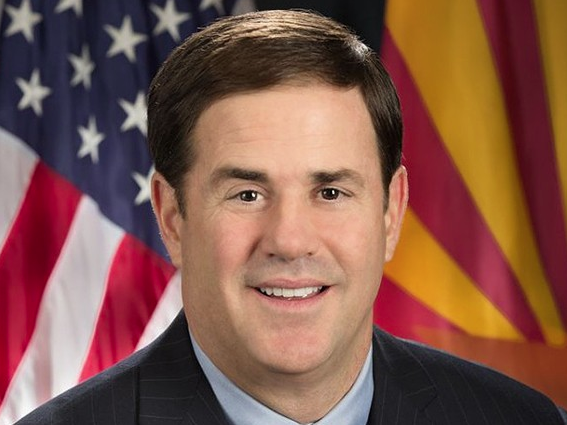
“Slowing the spread of COVID-19 remains our top priority,” said Ducey. “Today’s action aligns with guidance from public health officials, while ensuring those traveling for essential functions can continue to do so. We will take all necessary precautions to keep Arizonans safe.”
The order does not apply to airline employees, military personnel, healthcare workers, human services personnel, workers conducting essential infrastructure operations and workers providing essential governmental functions.
Ducey issued a number of other executive orders today regarding the outbreak. He instituted new guidelines for residential care facilities, nursing homes and other similar institutions. Staff will have to use appropriate personal protection equipment and institute symptom checks for anyone entering facilities. The order also requires healthcare facilities to supply residents with some kind of video device so they can stay in touch with family and loved ones.
“Arizona will continue to take proactive measures to protect our seniors and vulnerable populations,” said Ducey. “This order helps protect seniors and those living in health care facilities, as well as the staff and health care professionals caring for patients. My thanks to these individuals working to protect Arizona’s most vulnerable as we work to slow the spread of COVID-19.”
Ducey also loosened restrictions on restaurants so they can repackage sell grocery items they have on hand even if packaging labels say “not for resale.”
“Even with dine-in and carry-out options still available to patrons, many Arizona restaurants are struggling due to COVID-19,” Ducey said. “Today’s executive order provides flexibility for restaurant owners to safely sell prepared and bulk foods or supplies they have on hand and can’t use right now. We are proud to support Arizona restaurants with this reform.”
Hospital and health care providers will have to better track data related to COVID-19, including the number of ICU beds and ventilators in use by COVID-19 patients, the number of suspected COVID-19 patients visiting emergency rooms and estimated amount of personal protective equipment being used each day.

Rep. Raúl Grijalva: "While many white-collar professionals can follow social distancing guidelines, essential bluecollar workers are tasked with holding our country together by delivering the hands-on vital services we need to survive."
An excerpt from the letter:
As the COVID-19 crisis expands so do obvious distinctions between socio-economic classes. While many white-collar professionals can follow social distancing guidelines, essential bluecollar workers are tasked with holding our country together by delivering the hands-on vital services we need to survive. We ask that the next COVID-19 bill require employers take action to protect workers and include premium pay to supplement low-income workers and to ensure this crisis doesn’t further exacerbate class inequalities.
Future legislation should support supplemental pay that reflects the work and hazards these individuals are encountering on a daily basis. Eligibility for the additional pay should include, but not be limited to, health care workers along the spectrum of care, grocery workers, restaurant workers, child care providers, public sector workers (including police, fire, corrections, postal), farmworkers, utility workers, transportation workers, sanitation workers and other hourly employees deemed essential. Federal employees who are required to report to work, including Title 38 employees with the Department of Veterans Affairs, the Transportation Security Administration, and the Federal Aviation Administration should also be included. Federal workers who cannot work remotely are in immediate danger of exposure, and current protocols have no guarantees of protection. The legislation should include a full tax credit or other form of reimbursement for businesses under 500, to be appropriately scaled down for larger employers. Business participation in the supplemental compensation should be mandatory.
We are asking these individuals and their families to sacrifice so much for our nation. It is imperative that we make every effort to prevent this crisis from being one that is disproportionately borne by the working class. Instead we should use this as an opportunity to pay them their full worth—a worth that has been undervalued in many cases for far too long.

