

Monday, November 11, 2019
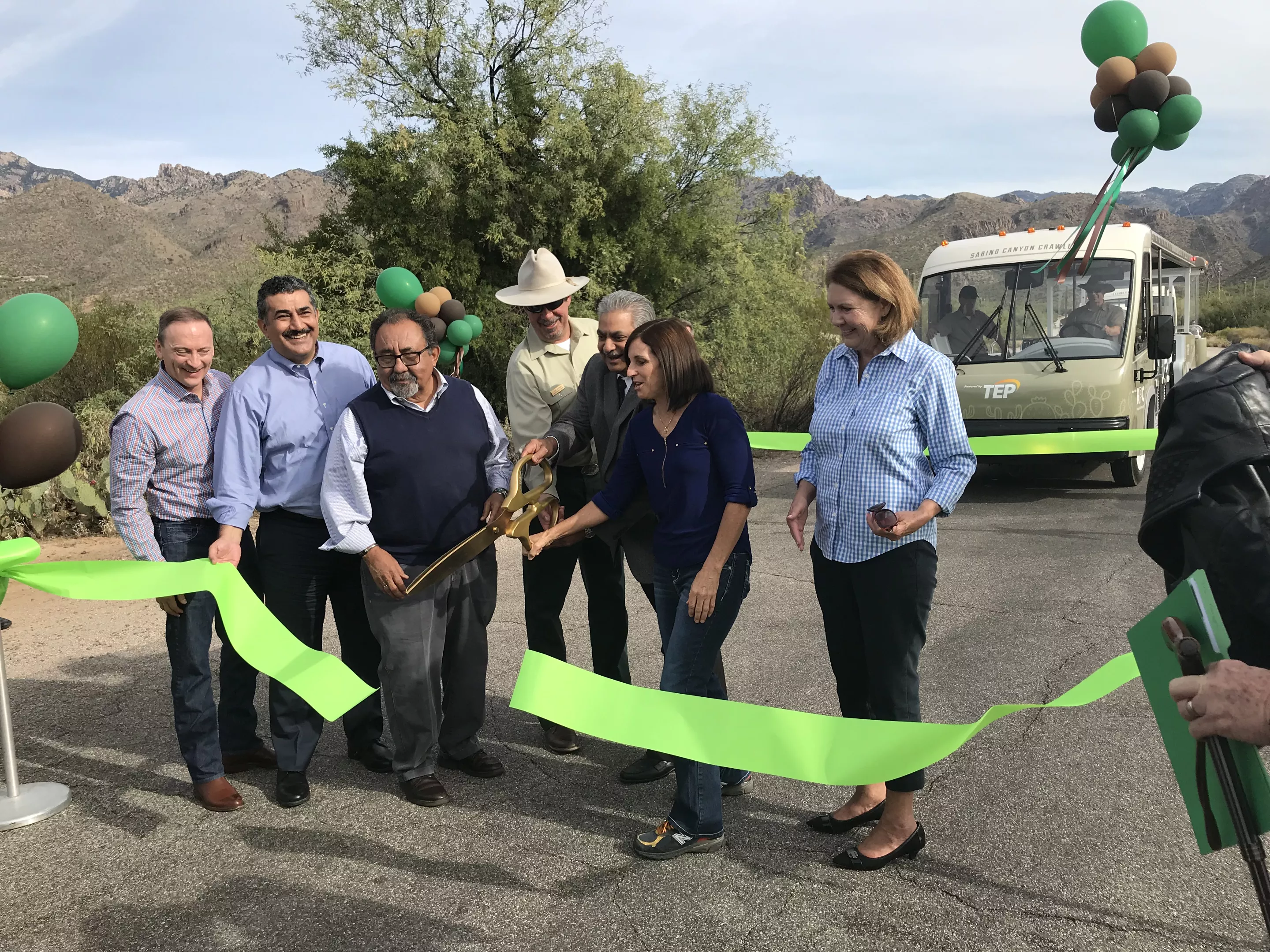
“It took a decade of work, coordinated efforts and common vision, but now you can enjoy the sounds of nature,” said Forest Service Regional Forester Cal Joyner at the inaugural run of the new Sabino Canyon Crawler, an emission-free electric shuttle service.
By going electric and replacing older, noisy diesel shuttles, an estimated 15,000 gallons of gas per month will be saved representing a reduction of 400,000 pounds of carbon monoxide annually, according to Satish Hiremath, chairman of the nonprofit Regional Partnering Center managed by the Pima Association of Governments.
RPC owns the shuttle service in partnership with Tucson Electric Power and the U.S. Forest Service. Total Transit Enterprises/Total Ride will operate the service.
The new Crawler transportation system was funded in part by a $1.5 million contribution from Tucson Electric Power, along with a $1 million, 10-year, interest-free loan.
“Transportation is the largest greenhouse gas producer and this electric vehicle project toward cleaner and greener is another step in the long march we’ve been taking toward a more sustainable energy future," said TEP’s CEO David Hutchens. "Today marks the latest milestone in our efforts to reduce our community’s carbon footprint.”
The Sabino Canyon Shuttle Launch took place during Native American Heritage month and emcee Hiremath included that observation in his remarks.
“This area has sustained Native Americans for generations and remains culturally and spiritually significant today," he said.
RFP Vice Chair and Pascua Yaqui tribal official Peter Yucupicio also spoke about the project's significance.
“This project helps show respect for the land originally cared for by native cultures and ensures this natural treasure can remain unspoiled well into the future for many others to enjoy.”
Hiremath said that the new shuttle supports the region's priorities, referred to as their "3 Rs: relationships, recreation and restoration."
“This service honors the wishes of the community for a ‘greener’ transportation service in the canyon," he said. "It highlights new working relationships and the continuing importance of volunteers who help steward our lands, and it augments a vision for a transportation system benefitting both the public and the environment.”
Arizona’s congressional delegation was well represented at the launch with Sen. Martha McSally (R) and Reps. Ann Kirkpatrick (D-CD2) and Raul Grijalva (D-CD3) in attendance.
“We hiked here as kids when this was just a dirt path with no infrastructure,” said Kirkpatrick. “Now people who can no longer hike can still enjoy the beauty of the canyon. We hold this land in trust as sacred, to be returned to the next generation better than we found it, and I feel that’s what’s happening today.”
McSally also commented on the benefits the shuttle can bring.
“All the way around, this is a real win for the entire community, and as a runner, I’m looking forward to finally experiencing a run in peace and quiet," she said.
Five custom-made electric shuttles will operate on the Sabino Canyon route, limited to a maximum speed of 15 miles an hour. (Another six gas-powered, enclosed shuttles will operate on the Bear Canyon route). Free earbuds are provided for a professionally narrated tour guide that explains the canyon’s cultural and geological history as well as its diverse plant and animal life. Audio noise will be reduced so that hikers can enjoy the sounds of nature free from the previous service’s obnoxious loudspeaker narrations.
Shuttles are powered by a 384-volt battery system that is recharged nightly at an onsite charging facility. The shuttles and their trailers are equipped with multiple braking systems that allow control on steep downgrades. The vehicles, manufactured by the world’s foremost builder of trams, feature 4-wheel steering to allow negotiation of sharp turns and narrow-bridge water crossings.
A new website, www.SabinoCanyonCrawler.com, will allow visitors to reserve and pay for shuttle seats in advance of their visit while an onsite shuttle fee drop box at vendor kiosks will also accept payment via credit or debit card. In-person ticket sales are also available at the Sabino Canyon Recreation Area Visitor Center gift shop. Roundtrip adult price is $12 or $4 for a one-way hop-on when space is available.
Tags: Sabino Canyon , shuttles , emission free , Sabino Canyon Crawler , Forest Service , Native American Heritage , Image
Friday, November 8, 2019
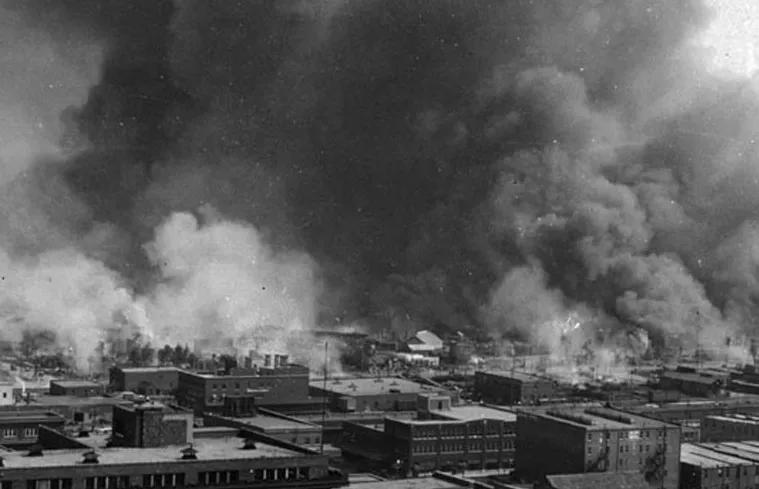
The main reason I began watching HBO's new series, Watchmen, was because I heard the show incorporated the 1921 Tulsa Race Massacre as a central part of its narrative. (And, I should add, I'm a fan of comic-book-noir television series.) The show is set in Tulsa, Oklahoma, in an alternative present where descendants of the Massacre receive reparations — you know right there it's an alternative reality — and an underground group of white supremacists is waging war on the city's black population and the police.
The Tulsa Race Massacre is one of many horrifying chapters in this country's racist history. It is made that much more shameful by the fact that it has been purposely omitted from our historical narrative, as have many similarly horrific events. The 1898 Wilmington Massacre was misrepresented for decades as a victory of whites over a black uprising, when it was spoken of at all. The more recent 1968 Orangeburg Massacre was largely ignored and misrepresented by the contemporary press and has been little spoken of since.
I didn't know about the three events until recently. I would feel more ashamed of my ignorance of these and, I'm certain, other examples of large scale, racially motivated violence, except that I can't really blame myself for not knowing about what has been blacked out of the historical record. That being said, I willingly accept the collective guilt and shame for the white, "history is told by the winners" rendition of history which has glossed over, misrepresented and left out some of the greatest outrages perpetrated against minority groups in this country.
I have been working to remedy my ignorance for at least a decade. I posted about the Wilmington Massacre last year when I stumbled on a mention of it and did some research. Watchmen was my link to the Tulsa Race Massacre. I only learned of the Orangeburg Massacre a few days ago by chance when I was reading some biographical information on one of my favorite newspaper columnists.
Below are brief summaries of the three incidents with links to more complete histories.
The Wilmington Massacre, 1898
In the late nineteenth century, Wilmington was the largest city in North Carolina and home to a large, reasonably affluent and educated black populace. The state's Republican Party, which at the time deserved the label "the Party of Lincoln," had joined with the Populists to form the Fusion Coalition. By 1894, the Fusion party had taken the governorship and every other statewide office. Blacks served in local and state governments.
Tags: The Wilmington Massacre , The Tulsa Race Massacre , HBO's Watchmen , The Orangeburg Massacre , Eugene Robinson , Image
Thursday, November 7, 2019
This week's Skinny looks at the political dynamics here in Arizona surrounding the impeachment inquiry into President Donald Trump's Ukrainian shakedown, noting Sen. Martha McSally doesn't have any kind of response whether Trump's quid-pro-quo was a legitimate use of presidential power.
CNN is among the news outlets trying to get McSally to let the American people know where she stands—and, true to form, McSally is dodging another tough question. From yesterday's report:
Several Republicans have avoided answering questions about whether it's OK for Trump to ask Ukraine to probe his rivals.Kinda reminds me of Brave Sir Robin...
One, Sen. Martha McSally of Arizona, took the long route — around the Capitol and around parked cars — to avoid cameras. Her aide stepped in front to say: "No comment."
Tags: McSally , impeachment , Republicans , CNN , Ukraine , Arizona , politics , Image
Tuesday, November 5, 2019
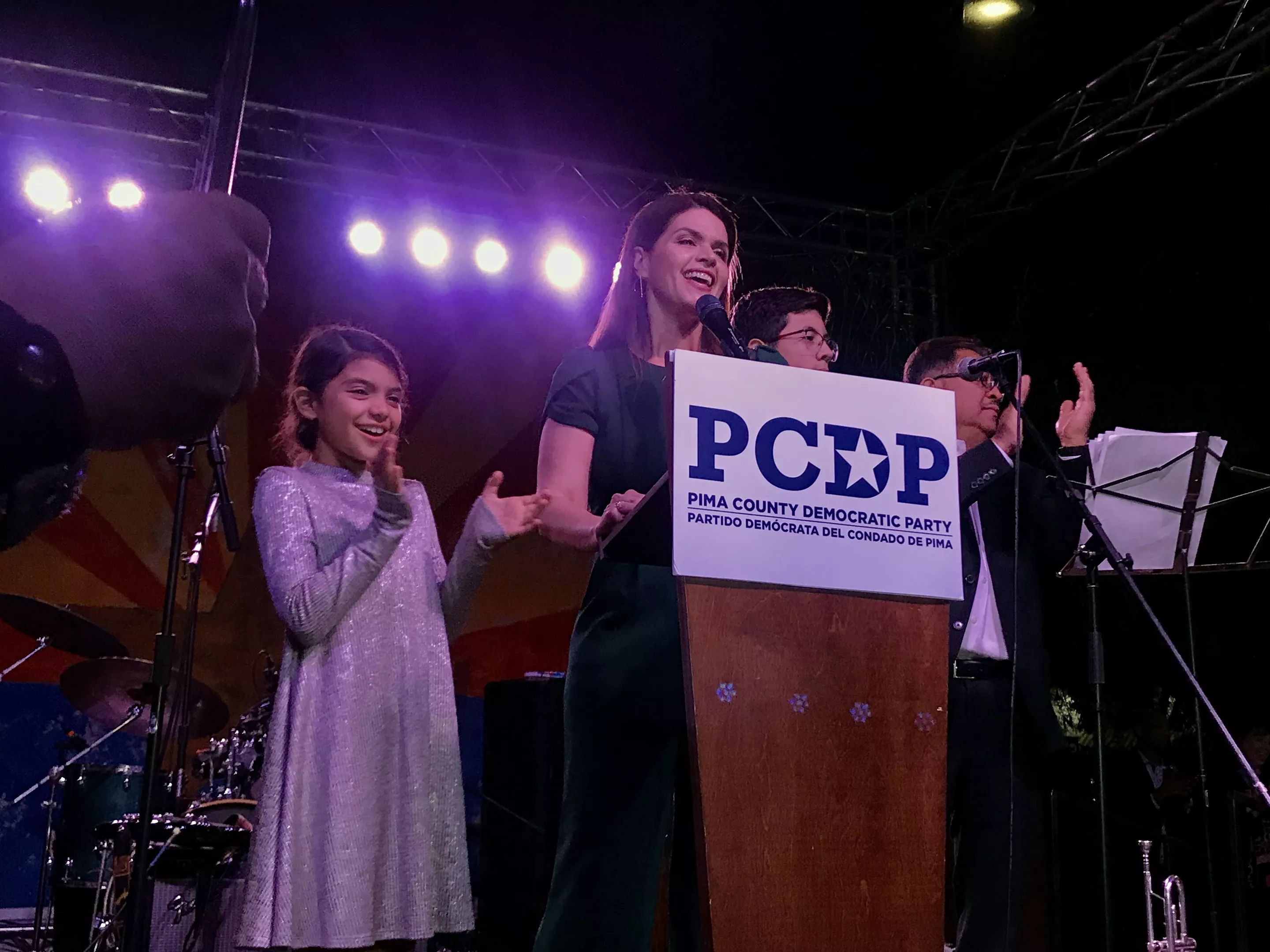
Hundreds of Tucsonans filled the patio of Hotel Congress on Tuesday evening to watch Democratic Regina Romero claim victory in Tucson's mayoral race.
After a high-energy performance from local band Santa Pachita, the results showed Romero with a commanding lead over independent candidate Ed Ackerley and Green Party nominee Mike Cease.
Romero, who had represented Ward 1 for 12 years, launched her campaign to replace Mayor Jonathan Rothschild after he announced he would not seek a third term. She had 56 percent of the vote, compared to Ackerley's 40 percent and Cease's 4 percent.
“As important and historic as this night is, let me tell you what excites me tonight,” Romero told the crowd. “The people of Tucson have said loud and clear that it’s time to take our city to the next level of progress and prosperity, that we’re ready to act boldly on climate, they we believe in fighting for social and economic justice for all Tucsonans. Regardless of what differences of opinion we have, we will always be one Tucson. Somos uno.”
Romero will be Tucson’s first Latina mayor. Congressman Raúl Grijalva was in attendance to introduce Romero, saying the night’s results “reflects who we are as a city.”
“It sends a wonderful message across not only the state of Arizona, but across this nation, that Tucson is part of the change in this country,” Grijalva said. “That Tucson believes in issues. That Tucson looks beyond their noses about what the future should be for themselves, their children and the generations to come.”
Romero's fellow Democrats had a good night, sweeping the council races. Ward 1 candidate Lane Santa Cruz, a former aide in Romero’s office, had 58 percent of the vote against Republican Sam Nagy and Green Party candidate Matthew Smith.
“It’s been so important for me during this campaign, having been born and raised here, that we build capacity with our young people, because they’re going to carry us into our future,” Santa Cruz said. “That’s been a big part of our campaign, it’s one of the things I’m going to keep pushing in the office, making sure that we have youth voices leading from the ground up.”
Incumbent Ward 2 councilman Paul Cunningham won another term, capturing 60 percent of the vote against Republican Ewart Williams and Green Party candidate William Peterson.
“We made history tonight, but it’s a part of a start of a history,” Cunningham said. “Tonight in Kentucky, the governor is now a Democrat. Tonight in Virginia, the state Senate is now Democrat. One year from tonight, the White House will be Democrat … This was our dry run, this was our rehearsal. I want to put the conservatives on notice, to quote my friend Ricky Bobby, we’re coming for you, alright?”
Ward 4 candidate Nikki Lee, who previously ran a campaign for a state representative seat, won 57 percent of the vote against Republican Mike Hicks and Green Party candidate Cara Bissell.
“I’m excited to work with this amazing group of people and continue to move Tucson forward, so thank you,” Lee said.
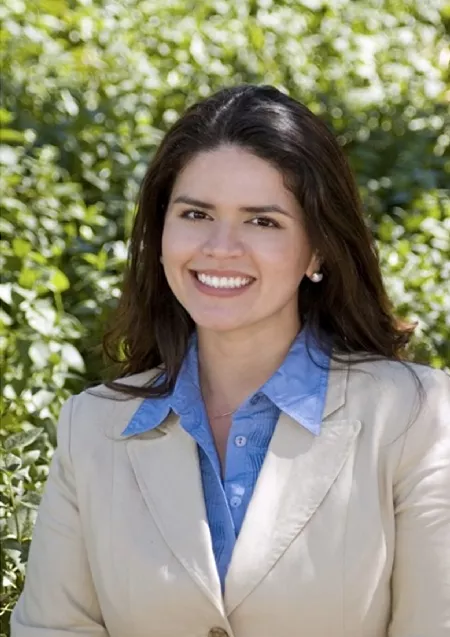
“Tonight’s results affirm that Tucsonans are ready for bold leadership that will take our city to the next level of progress and prosperity,” Romero said in prepared remarks. “At a time when our national politics have been sown with division, Tucsonans remain united by our shared desire to promote a safe, just, and sustainable city that provides economic opportunity for our families and future generations. This movement is open to everyone—whatever your background, whatever your party, whoever you voted for—let’s work together! We will always be one Tucson—somos uno.”
Meanwhile, Prop 205, aka the Sanctuary City initiative, is going down to defeat, with 71 percent of voters rejecting the proposal, which would have limited the ability of local police to inquire about immigration status and prevented federal law-enforcement agents from working with Tucson police unless they signed an agreement that would likewise limit their ability to inquire about immigration status.
In the Tucson City Council races, all the Democrats were safely ahead of Republican candidates. In Ward 1, Democrat Lane Santa Cruz had captured 58 percent of the vote against Republican Sam Nagy and Green Matthew Smith. In Ward 2, Democratic incumbent Councilman Paul Cunningham had 60 percent of the vote against Republican Ewart Williams and Green William Peterson. And in Ward 4, Nikki Lee had 57 percent of the vote against Republican Mike Hicks and Green Cara Bissell.
But none of them are going to see a pay raise. Prop 409, which would have raised salaries for council members, was also headed to defeat, with 60 percent of the voters rejecting it.
The 2019 National Assessment of Educational Progress (NAEP) results are out. The standardized tests, given to a national sample of 4th and 8th grade students, are considered by people across the educational spectrum to be the most accurate assessment we have of student achievement in reading and math. That doesn't mean they should be taken as gospel, but they succeed at their assigned task far better than the high stakes — and highly prepped and highly gamed — state tests, which should only be taken seriously when sprinkled with copious grains of salt.
Some takeaways from the 2019 NAEP:
• The national results aren't encouraging.
• The Arizona results are somewhat better.
• The white-minority gap is shrinking.
• The educational inequality is growing.
• Trump's queen of education, Betsy DeVos, hearing achievement is at a standstill and schools are starving for funds, replied, "Let them eat choice."
Let's break it down.
The National Center for Education Statistics administers and analyses the NAEP. According to associate commissioner Peggy Carr, "Over the past decade, there has been no progress in either mathematics or reading performance, and the lowest-performing students are doing worse."
The math and reading achievement scores have been basically flat since 2009. Actually, they've been flat since Bush's No Child Left Behind began in 2002, when the president and the Congress decided the answer to our educational problems is testing students within an inch of their lives. Students had been making measurable progress since 1972, a period which is often thought of as the bad old days of education. We were dubbed a "Nation At Risk" because of our terrible schools, and we had to do something to fix it. What we did was turn our schools into test-prep and test-taking factories, which stalled whatever educational progress we had been making before NCLB.
Arizona, however, has done better than the nation as a whole. The state's test scores are still either at the national average or slightly below, but they have been creeping upward while the nation's haven't budged.
Why are Arizona's scores improving? No one knows. Some people say it shows money in education isn't all that important. Others say it's our dedicated teachers. Still others say our growing charter school sector is upping the state's education game. The state Department of Education says, think how much better we'd be doing if we had enough funding.
Me, honestly, I have no idea why the state scores are on an upward trajectory, other than it's a good thing.
Tags: National Assessment of Educational Progress , Betsy DeVos , Math scores , Reading scores , High stakes tests , Image
Wednesday, October 30, 2019
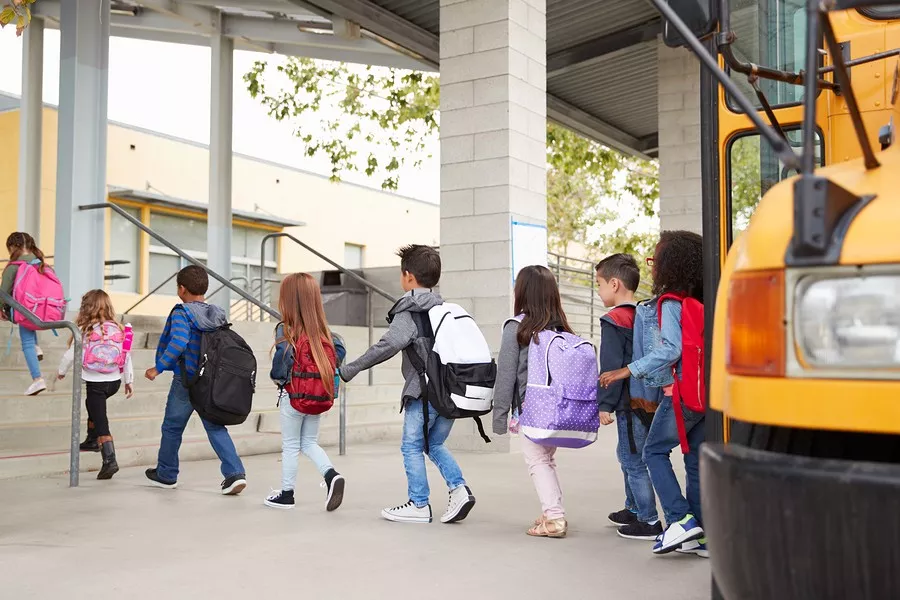
When Obama came to office in 2009, he was faced with two possible approaches to improving K-12 education. One was to put the blame for poor test scores on individual schools and figure out ways to force them to up their game. The other was to look at the world outside schools for factors affecting students' successes and failures, then try to improve the quality of students' lives as a path toward improving their school achievement. This isn't a binary choice, of course. Most people understand that good schools and a better environment outside of school contribute to students' attitudes and achievement. It's a question of emphasis.
Obama's education advisor during his 2008 campaign was Linda Darling-Hammond, a college professor and author who put a great deal of emphasis on improving students' lives outside of school. Instead of elevating her to Education Secretary, Obama chose Arnie Duncan, one of the people he brought with him from Chicago. Duncan had been the CEO of Chicago Public Schools and focused on the role of schools, public and charter, in helping or harming student achievement. Putting Duncan at the education department helm meant continuing the policies of the Bush administration: emphasizing high stakes testing, heaping praise on "great schools" while shaming schools with low test scores, and increasing the number of charter schools.
Since 2009, faith in the value of high stakes testing has faded and charter schools have lost their "new kid on the block" luster. Democrats' education policy emphasis has moved away from the Obama years. You can see the change on the national, state and local levels, but the clearest way to put a spotlight on current K-12 policy proposals is to look at positions taken by the leading presidential candidates.
I went through the K-12 position papers of Joe Biden, Elizabeth Warren and Bernie Sanders. I haven't read the positions of all the other candidates — too many candidates, too little time — but those I have read are less detailed than the three front runners but not different in overall emphasis.
Tags: K-12 education , Democratic party , Presidential candidates , Joe Biden , Elizabeth Warren , Bernie Sanders , Integration , Early Childhood Education , Free lunch programs , Community schools , Teacher salaries , Charter schools , Image
Friday, October 25, 2019

It's been a strange couple of days on the college loan front at Betsy DeVos's Department of Education. The department was held in contempt of court for screwing over students and parents who owe money on loans they are not required to repay. During the same week, a high ranking department official proposed student loan forgiveness on a massive scale.
The Ed Department has been held in contempt of court and ordered to pay a $100,000 fine. The reason: It continued to bill ex-students of the for-profit Corinthian College chain, even though it had been established that the colleges defrauded the students.
Obama's Ed Department created the process of forgiving the loans, and Trumpsters are duty-bound to trample on Obama's legacy. Combine contempt of Obama with the Trump administration's preference for the free-est of free market capitalism at the expense of the consumer, and you have two reasonable explanations for the decision to keep the loan payments flowing.
DeVos's department has a different explanation. It says it shouldn't be held in contempt, claiming billing those 16,000 students was simply a mistake. It seems they would rather be considered incompetent than ill intentioned, though I suspect a combination of the two. The department is in the process of refunding payments and, when necessary, fixing damaged credit ratings of students and their parents.
In another student loan-related story, a high level appointee in the Office of Federal Student Aid decided, after seeing the loan situation up close, we need to "stop the insanity" of burdening students with loans. Wayne Johnson proposes forgiving the first $50,000 in student debt. For people who have already repaid their loans, he proposes a tax credit of up to $50,000. For new students, he proposes a $50,000 government voucher which wouldn't need to be repaid.
Don't expect the proposals to be taken up by DeVos & Co. Johnson resigned from the Ed Department.
Tags: Betsy DeVos , U.S. Department of Education , Student loans , Corinthian College , Wayne Johnson , Elizabeth Warren , Image
Thursday, October 24, 2019
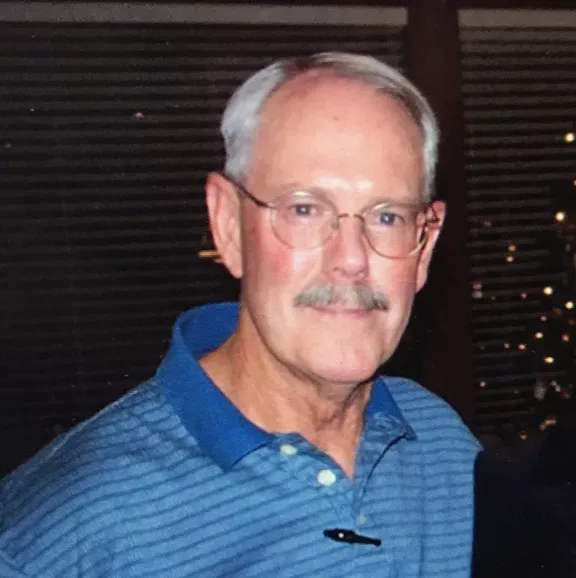
Busch is reported to be 6 feet tall and weigh approximately 175 pounds with blue eyes and gray hair. He was last seen walking while wearing a tan shirt, dark shorts and a baseball hat.
Anyone who has seen Busch or has any information as to his whereabouts is asked to call 9-1-1.
Tags: missing persons , police , Pima County Sheriff , Image
Wednesday, October 23, 2019

The Koch Network — formerly known as the Koch Brothers until David Koch died in August — is looking for a new way to ease into K-12 education.
Let's not fight, the Koch Network says. Why can't we all just get along?
Welcome to the Network's new, conciliatory educational brand.
This kumbaya moment comes from an 800 ton gorilla which spends hundreds of millions of dollars so it can sit anywhere it wants. The Network has bought seats at the table in congress, state legislatures, universities and school boards across the nation. We have our own outpost at UA, The Freedom Center, purchased and overseen by some of the Network's high rolling contributors.
The Network has only made half-hearted attempts at moving into the world of K-12 education, so it hasn't had much of an impact thus far. Now it has begun to put more money and energy behind its efforts.
In June, the Koch Network created a new group, yes. every kid., whose purpose, according to one of its spokespeople, is to "move away from the 'us versus them' framing in K-12" and work together across political and educational lines.
It's strange to hear these folks claim they want to make friends with the same educators the Kochs have worked against from their earliest days as political activists. Back in 1980 when David Koch was the vice presidential candidate for the Libertarian Party, the brothers weren't interested in getting along with the education community. The Libertarian Party's platform called for an end to free public education.
"We advocate the complete separation of education and State. . . . Government ownership, operation, regulation, and subsidy of schools and colleges should be ended."The Kochs haven't strayed far from their privatization goals in the decades since. It's still vouchers first and charter schools second. They believe publicly funded and governed schools will lose out in a head-to-head competition with free enterprise-based education. The traditional school system, they hope, will simply wither away.
So why is the Network saying it wants to play nice all of a sudden? It's because the political winds in education have begun to shift away from privatization.
Until recently, the privatization/"education reform" movement looked like it was winning the education wars. Charters have grown steadily, and an increasing number of states have adopted voucher programs. Even Democrats looked like they were coming on board. They seemed to agree with the "reformers" that our public schools are failing and we need something new — certainly more charter schools, and maybe private school vouchers as well — to offer children an alternative to their local schools. The privatization movement even had a Democratic champion in the White House. President Obama was acting like the Education-reformer-in-chief.
It looked like smooth sailing toward privatization. Then something went wrong.
Tags: Koch Network , "yes. every kid." , privatization , "education reform" , Image

