

Wednesday, June 26, 2019

Last week I wrote that Arizona's open enrollment policy is one of the three major factors leading to the decline in TUSD enrollment since 2000, the others being charters schools and a slowdown in Tucson's population growth. I estimated somewhere between 1,500 and 3,000 students living inside district boundaries attend schools in other districts.
It looks like I low-balled my estimate. The actual figure appears to be at least double what I came up with, meaning the impact of open enrollment on TUSD's loss of students, and on Arizona's education landscape, is more significant than I realized.
Since Arizona's new open enrollment policy was put into operation in 1995, students can attend any public school that has an empty desk. In district, out of district, it doesn't matter so long as parents can find a way to transport their children to the schoolhouse door. Students inside a school's attendance area and inside the district get first shot at going to a school, but after that, it's open to everyone.
So how many students living in the TUSD attendance area go to schools in other districts? In my post I arrived at a range of students by the back door. I looked at the number of open enrollment students in the Catalina Foothills School District — a whopping 3,000 out of a total student population of 5,200 — along with anecdotal information from Vail School District and used that to arrive at an estimate of 1,500 to 3,000 students. I was pretty sure that was low, but I wanted to stay on the conservative side.
A few days after I finished the post, by one of those odd coincidences which happen all the time, an Arizona Charter Schools Association piece came across my desktop with figures about how many students participate in open enrollment. In the study it cited, 31 percent of students in 9 Maricopa County school districts went to public, non-charter schools which weren't their neighborhood schools. That's twice the 16 percent who attend charter schools.
Tags: Open enrollment , TUSD , Charter schools , Arizona legislature , Arizona Charter Schools Association , Image
Tuesday, June 25, 2019

The extension will extend the Painted Hills Trails Park, as well as restoring the neighboring Enchanted Hills trail system, according to a release.

Both trails abut the Tucson Mountain Park on the western fringe of Tucson, with the newly-revitalized Painted Hills system featuring four miles of trails, while Enchanted Hills will have seven miles.
The restoration work at Painted Hills (3950 W. Anklam Road), will occur between 6-10 a.m. on Saturday, July 13.
Work at Enchanted Hills (Western end of 36th street, west of South Mission Road), will happen throughout the summer.
Anyone interested in helping at either site can reach Neil Stitzer, at 520-724-5239, or by email at [email protected].
Tags: Tucson Mountain Park , Trial Building , Pima County , Tucson , Arizona , Pima County , Image
Thursday, June 20, 2019
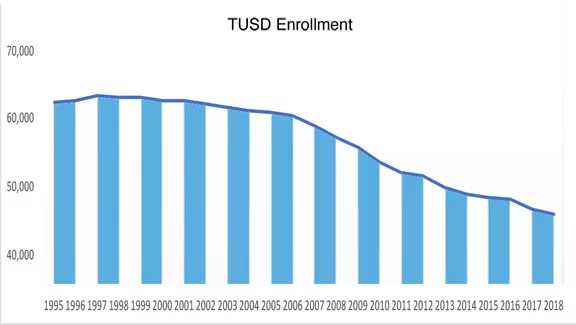
Tucson Unified School District has been losing students steadily since 2000. Lots of students. At its turn-of-the-millenium high point, the district had 62,500 students. This school year, the number was 46,000. That's a loss of 16,500 students, over 900 a year.
Why is TUSD losing students year after year? The answer you're most likely to hear is, the district is the problem. It's the administration. It's the teachers. It's the curriculum. It's "D," all of the above. Fix the administration, fix the teachers, fix the curriculum, and the numbers will climb.
But the standard answer is far too simple. The district may deserve part of the blame for declining enrollment, but most of the drop was inevitable, created by changes in Arizona's educational landscape and a slowing of Tucson's population growth.
For the sake of argument, let's start with the assumption that TUSD is no better or worse now than it was at its 2000 high water mark of 62,500 students and see what else is causing the district to lose students.
I see three factors beyond the control of the district as the major reasons for the enrollment decline.
Two of the factors were created by the Arizona legislature's push for "school choice." The first is the emergence of charter schools. The competition for a limited pool of students means that every student inside the TUSD boundaries who attends a charter is one less student in the district. The second is the state's open enrollment policy, which lets parents send their children to schools in nearby districts. Open enrollment gets far less attention than charter schools, but it is a significant force pulling students living inside the TUSD boundaries to suburban school districts with more affluent, whiter populations.
The third important factor is the slowdown of Tucson's population growth. Students lost to charter schools and open enrollment haven't been replaced by an influx of new students.
Let's look at the factors one by one.
Charter Schools
Arizona's first charter schools opened their doors in 1995. They grew steadily, but since they started from zero, it took awhile for them to have an impact on school districts' enrollment numbers.
In 2000, 50,000 Arizona students were enrolled in charters. I don't have any direct data on how many of those charter students lived inside the TUSD boundaries, but a reasonable estimate is about 3,500. TUSD students made up about 7 percent of the state's public school population in 2000, and 3,500 is 7 percent of the state's charter school population.
Tags: TUSD , Charter schools , Open enrollment , Population growth , Arizona legislature , Image
Tuesday, June 18, 2019
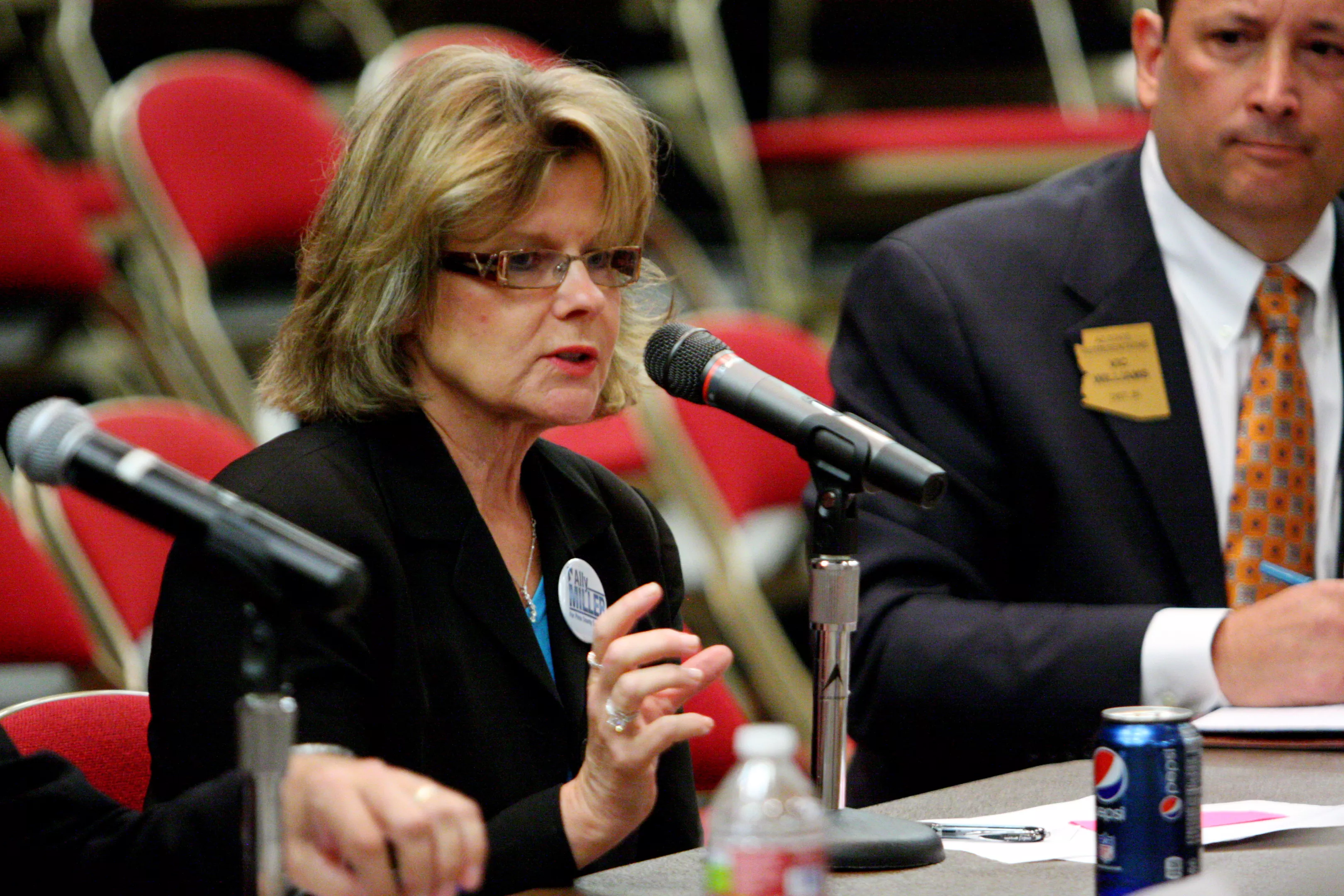
Supervisor Ally Miller successfully convinced a majority of her colleagues to "sharpen their pencils" and come back with a budget that doesn't include increases in the primary and secondary tax rates, specifically for the library and flood districts. The county has a $1.3 billion spending cap.
"If one of them goes up that's okay, but we have to find money somewhere else," Miller said at the meeting. "That's what my tax-neutral budget is all about."
With new libraries expected to open in the future, it is likely that the library district tax will have to increase. Miller wants to scale back funds in other areas of the budget to make up for the difference.
In order for taxpayers to see zero change in their bottom line, the county needs to find about $10 million from somewhere within current revenues.
Miller suggested putting a freeze on hiring within the county, since there are already many vacancies that are having difficulty being filled. The budget already includes a two percent salary adjustment for existing employees as well as an increase in the hourly pay range for sheriff's deputies from the previous $23.50-$29.84 to $25.50-$32.94.
She estimates that move could generate $8 million in two months.
Supervisor Ramón Valadez said that some of the $10 million the county is now trying to come up with can be attributed to decisions made at the state level, such as an increase in costs for the Public Safety Personnel Retirement System.
"The reason this is not property tax-neutral is because the state's costs transfer," he said.
Supervisor Richard Elías provided the sole "no" vote to continue the hearings, since he rejected the proposals Miller brought forth.
"We've been unfair to our employees for over 10 years, our staff works to terrible ends trying to get that done," he said. "Many left the county because they could see no improvement coming from us."
Elías also wanted to see money included in the budget to fund high quality child care for low-income families in Pima County, but the other supervisors were not as welcoming to the idea.
According to Arizona statute, the board has until Monday, Aug. 5 to adopt a final budget. If they can't come to an agreement by then, last year's tax rates will be applied to next year, which show a $17.7 million reduction in what was proposed for this year.
Tags: budget , pima county , board of supervisors , ally miller , ramon valadez , richard elias , property tax , tax neutral , Image
Thursday, June 13, 2019

The announcement, which was proclaimed by Donald Trump on Twitter today, comes after Huckabee Sanders' continued lack of press conferences, going 94 days without a media briefing, according to the New York Times.
Trump not-so-subtly hinted at a new career path for Huckabee Sanders, in the second of two tweets, saying she should follow in the footsteps of her father, Mike, by running for governor in the state of Arkansas.
....She is a very special person with extraordinary talents, who has done an incredible job! I hope she decides to run for Governor of Arkansas - she would be fantastic. Sarah, thank you for a job well done!
Tags: Sarah Huckabee Sanders , resignation , President Trump , White House Press Secretary , Arkansas , Image
Tuesday, June 11, 2019
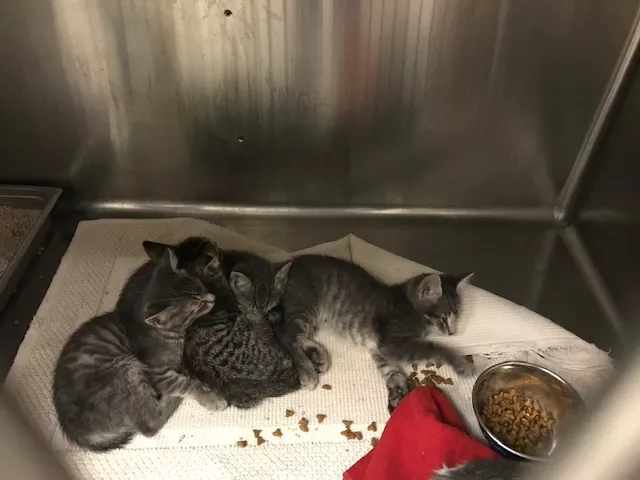
PACC was called on June 4 by a resident of the Southern Pima County enclave who reported that she and several of her cats had encountered a possibly rabid skunk.
The run-in reportedly occurred two weeks prior to the woman's call to PACC, according to the release, with 15 cats/kittens and two dogs removed from the property by animal protection officers.
Four of the kittens died, with two of the four testing positive for rabies, according to the release. The other kittens are in a 120-day quarantine due to not having a vaccine. The two dogs exposed will be placed in a 45-day quarantine, as they have been vaccinated against the disease.
The skunk is still on the lam, having evaded capture after its encounter with the four-legged compadres.
PACC Chief Veterinarian Dr. Jennifer Wilcox said anyone living in the Amado region that comes into regular contact with pets and livestock should remain under close examination, looking for changes in their health.
For more information or to report someone that's been exposed, contact the Pima County Health Department at (520) 724-7797.
Monday, June 10, 2019

"The charter school movement is in trouble." So begins an article in the Washington Post. I think that's an exaggeration. Charter schools aren't in trouble as such — their numbers are still on the rise — but they may be cresting. Their once-shiny reputation is tarnishing. Charter proponents' mouths have made too many promises the schools can't keep, and people are beginning to take notice.
Some folks who have read my charter-related posts think I'm opposed to charter schools. Not so. I support any school — district, charter or private — with good teachers, a good curriculum and a strong overall educational philosophy. Plenty of charters fit that description. I would have no problem recommending a charter school to parents if I thought it was a good fit for their children.
What I'm against is the charter school PR machine, part of the ridiculously well funded "education reform"/privatization movement. Hundreds of millions of dollars are spent every year demonizing public education while praising charters as the answer to our educational prayers, then propping up the schools with funding above and beyond what they get from the state.
District schools deserve criticism, but not the "failing schools" slam they get from privatizers, and charters hardly deserve the lavish praise they receive from their financial patrons. That's why I go heavy on charter criticism. With all the money and effort perpetuating the myth of charter school superiority, I feel it's my duty to debunk their myth-making whenever I can.
The first charters began in the early nineties. Arizona's charters opened for business in 1995. The schools have had nearly 30 years to prove their worth. Yet when you look at legitimate studies comparing charters and district schools, the results are pretty much a wash. In one state, charter school students have better scores than similar students in district schools. In another state it's the district schools that have the edge. Charter students may have higher test scores in fourth grade math while district schools top charters in eighth grade English, or vice versa.
People on both sides of the argument can cherry-pick the data to fit their narrative, but when you look at the numbers as a whole, the differences in student achievement are so slight as to be insignificant. If parents choose well, they can send their children to excellent charter schools, but if they fall prey to false advertising, they might end up sending their children to some of the worst schools you'll find anywhere.
Tags: Charter schools , "Education reform , " School privatization , NAACP , Image
In April, an ABC15 investigation found that many cell doors inside the Lewis state prison in Buckeye did not have functioning locks, which resulted in assaults on inmates and corrections officers. ABC15 reported that at least two inmate deaths have occurred as a result of the broken doors.
At the same prison, video surveillance showed inmates lighting fires outside of their cells, while correctional officers watched and did not intervene, due to a fear of having to report the incident to the Arizona Department of Corrections.
At the state prison in Douglas, the Arizona Republic reported inmates being given bottled water after the facility experienced low water pressure over the weekend.
KJZZ reported pregnant women in Arizona prisons being subjected to "deficient and dangerous prenatal and postnatal care," with some women giving birth alone in their cells or having miscarriages due to inadequate or nonexistent healthcare services.
In response to these concerning events, Governor Doug Ducey's office has indicated to press that they plan to investigate the Arizona Department of Corrections, but over a month has passed since then and no investigation has commenced.
The Tucson-based American Friends Service Committee, a nonprofit that works to promote criminal justice reform among other causes, has requested a meeting with Gov. Ducey to "convey the urgent concerns of incarcerated people and their families about the failed leadership of ADC Director Ryan, and to offer a new perspective for the way forward."
“If Gov. Ducey’s goal for ADC is to reduce recidivism and rehabilitate people, then he must acknowledge that Charles Ryan is unfit to lead the Department in that direction,” Caroline Isaacs, AFSC-AZ’s Program Director, said in a press release. “Ryan is one of the last vestiges of an outdated and ineffective culture of strict ‘custody-and-control’ prison management.”
Tags: Arizona Department of Corrections , ABC15 , Chuck Ryan , AFSC , American Friends Service Committee , Doug Ducey , Prison , Criminal Justice , Image
Wednesday, June 5, 2019

Arizona's Department of Education may begin taking a more active role in charter school accountability, thanks to some terrific investigative reporting from the Arizona Republic, which woke people up to the potential for corruption and profiteering in the charter sector, and a Department of Education headed by Superintendent Kathy Hoffman who cares about such things.
Two connected southern Arizona charters, Lifelong Learning Academy in Tucson and Jack Thoman Air and Space Academy and Performing Arts Studio in Green Valley, have been denied alternative-school status by the state, the first denial in five years.
Getting alternative-school status is a big deal. Because the schools are supposed to serve students who are potential drop-outs, they don't get an A-F grade from the state.
That makes sense. Students enrolled in alternative schools are likely to be behind academically, meaning their state test scores will be low. As a result, the schools' state grades, which are mainly based on student scores, would usually be D's and F's even when they are serving their students well. Two F's in a row and a school loses its contract with the state. So, to allow alternative schools to remain in operation, the state doesn't give them grades.
The problem is, if no one is paying attention, a charter school doing a lousy job can slide under the radar by calling itself an alternative school. It looks like that's been happening. According to the Republic article, the number of students in alternative schools has increased 40 percent since 2010.
Tags: Charter schools , Arizona's Department of Education , Alternative schools , Lifelong Learning Academy , Jack Thoman Air and Space Academy and Performing Arts Studio , Kathy Hoffman , Image
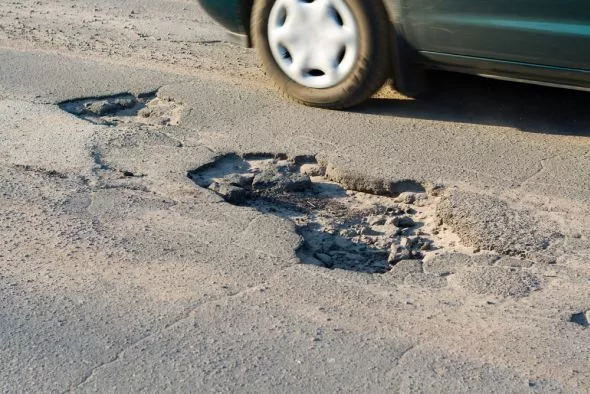
In anticipation of the Pima County Board of Supervisors' final budget adoption next Tuesday, June 18, the county's Department of Transportation has released a list of roads it intends to repair in the next fiscal year.
The department has $26 million to work with: $15 million from the county's share of Arizona's Highway User Revenue Funds, $6 million from remaining road bonds and $5 million from the general fund.
The Pima County Transportation Advisory Committee, which recommends transportation improvements to the supervisors, would like to see the $15 million "prioritize the local, arterial and collector road repairs," according to a county press release. The $6 million would go toward major roads and collector streets and the $5 million is for regional recreational roads that impact tourism, such as Kinney Road which leads to the Arizona-Sonora Desert Museum.
In a memo to the supervisors, County Administrator Chuck Huckelberry said this amount of road funding was a result of growth in HURF and Vehicle License Taxes, a reduction in debt service and cost savings in the transportation department's operations.
At yesterday's Board of Supervisors meeting, District 1 Supervisor Ally Miller said she was pleased with the $26 million.
"Is it enough? It never will be. This is going to be an ongoing problem and we'll be facing it every year," she told her fellow board members. "As we all know it's going to be an ongoing challenge, and this board will need to collaborate to find this money, even more money, to fix the roads as we move forward."
The Transportation Advisory Committee specifically recommended that the $15 million be allocated in equal amounts to each of the county's five districts. The supervisors could decide to go against that and put more money into certain districts than others.
Supervisor Steve Christy asked Miller at the meeting if she agreed with the committee's recommendation, to which she said "I'd like it all in District 1 ... If people feel very strongly that it should be evenly split and that's the way the board decides, I can live with that. As I said I'd rather not have that, but we have to make sure we accommodate everyone and treat everyone fairly."
Check out the list to see if any of your nearby streets could get fixed next year!
Tags: board of supervisors , roads , road repair , ally miller , steve christy , chuck huckelberry , HURF , pima county , Image

