

Monday, November 29, 2021

WASHINGTON – In the second holiday season of the pandemic era, goods may cost more, but Americans have more money to spend – and they appear to be eager to spend it.
That’s true in Arizona, where retailers say the holiday shopping season is already in full swing and residents are expected to spend anywhere from $590 to $1,558 on their shopping, according to one recent estimate.
And while Black Friday remains popular, experts say many shoppers started opening their wallets months ago. Katherine Cullen of the National Retail Federation said the Thanksgiving weekend rush is “not the kickoff to the season that it used to be.”
“We consider it more of the halfway point,” said Cullen, the NRF’s senior director of industry and consumer insights. “But it’s something that consumers really enjoy as part of their Thanksgiving tradition.”
Hitendra Chaturvedi said it’s an acceleration of a trend that was seen in previous holidays.
“That same trend that was happening even before COVID – where people are going online and a lot more Black Fridays are happening in September – just accelerated,” said Chaturvedi, a professor in supply chain management at Arizona State University’s W. P. Carey School of Business.
Friday, November 26, 2021
Wednesday, November 24, 2021

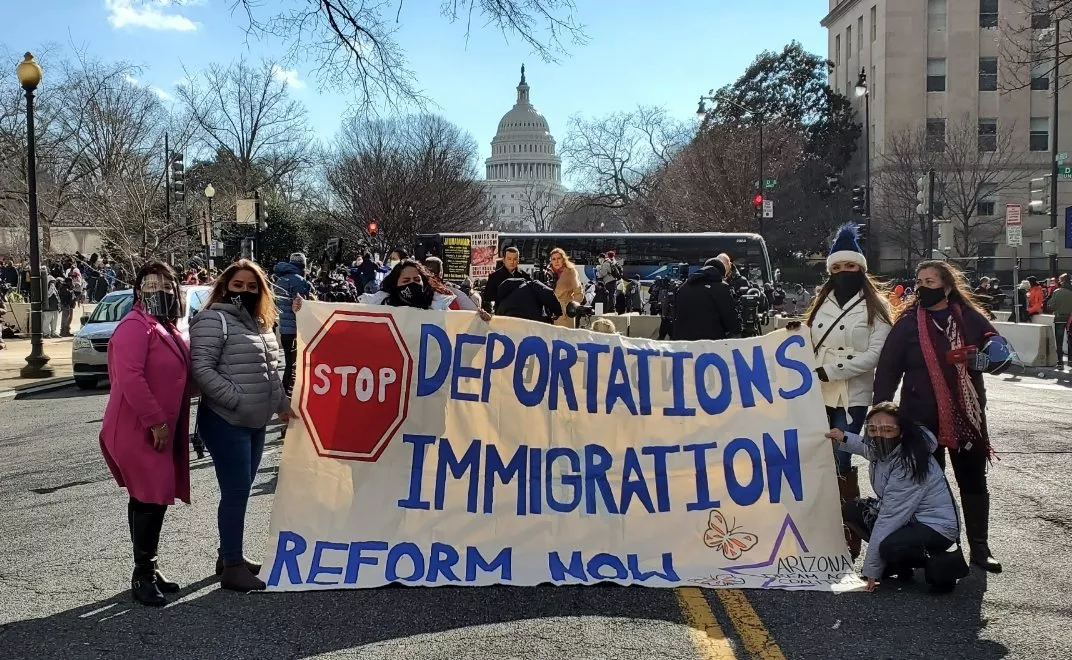
While a pathway to citizenship was nixed in the most recent version of the Build Back Better Act, a flagship legislation part of President Joe Biden’s agenda, the Congressional Hispanic Caucus and immigration advocates still welcome the protections from deportation expected to impact about 6.5 million undocumented immigrants.
Under the House version of the spending bill, Democrats included the third iteration of an immigration plan in the Build Back Better Act. A previous version of the legislation included a pathway to citizenship for certain undocumented immigrants, such as people brought to the country as children, essential workers, farmworkers and those with Temporary Protected Status. That provision was removed from the bill following a ruling by the Senate’s parliamentarian.
During a press conference on Monday, Rep. Raul Ruiz, D-Calif., who chairs the 38-member caucus, explained that legislators instead proposed a parole program that would provide temporary protections of deportation, a five-year work permit and driver’s license to eligible undocumented immigrants who pass a background check.
The driver’s license would be available in states like Arizona that currently don’t issue them to undocumented residents. The driver’s licenses will be required to meet federal requirements for identification in domestic airports, allowing immigrants to travel by air without fear of encountering federal immigration enforcement.
The version of the immigration plan in the budget legislation that passed the House applies to people living in the U.S. with no immigration status who arrived in the country before Jan. 1, 2011. They must also meet certain criteria related to criminal record, similar to the current requirements for the Deferred Action for Childhood Arrivals program, said attorney Ray Ybarra Maldonado in an explainer video posted on Facebook.
For months, immigration advocates have pushed federal lawmakers to pass citizenship for millions within the budget reconciliation process this year.

Tuesday, November 23, 2021
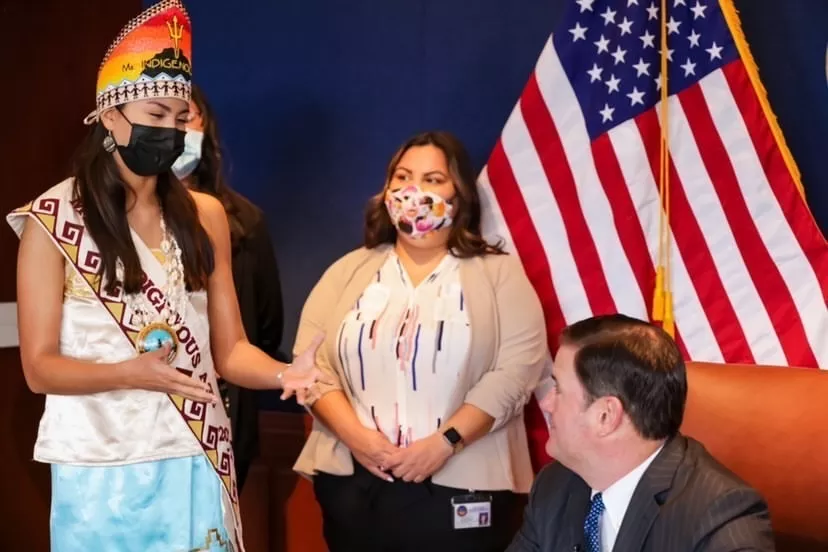
PHOENIX – Just minutes before her high school graduation in Gallup, New Mexico, three years ago, Dakotah Harvey was told to remove the eagle feather from her mortarboard or she would be escorted out of the ceremony and her diploma would be withheld.
Her grandfather had tied the feather to the cap’s tassel earlier that day, Harvey told Cronkite News. He loaned it to her after performing a Navajo prayer in celebration of her achievement.
“I didn’t have the heart to tell him I couldn’t wear it,” Harvey said.
To Navajos and many other Indigenous peoples, the feather of an eagle is an important and sacred component of many ceremonies and blessings.
In April, Arizona Gov. Doug Ducey signed legislation that public schools can’t prohibit Indigenous students from “wearing traditional tribal regalia or objects of cultural significance at a graduation ceremony.” The bill specifically includes eagle feathers or eagle plumes.
Cultural regalia includes hair buns, rug dresses, woven sashes, moccasins, beadwork and turquoise jewelry, including bracelets, belts and necklaces.
New Mexico does not have a similar law.
Monday, November 22, 2021
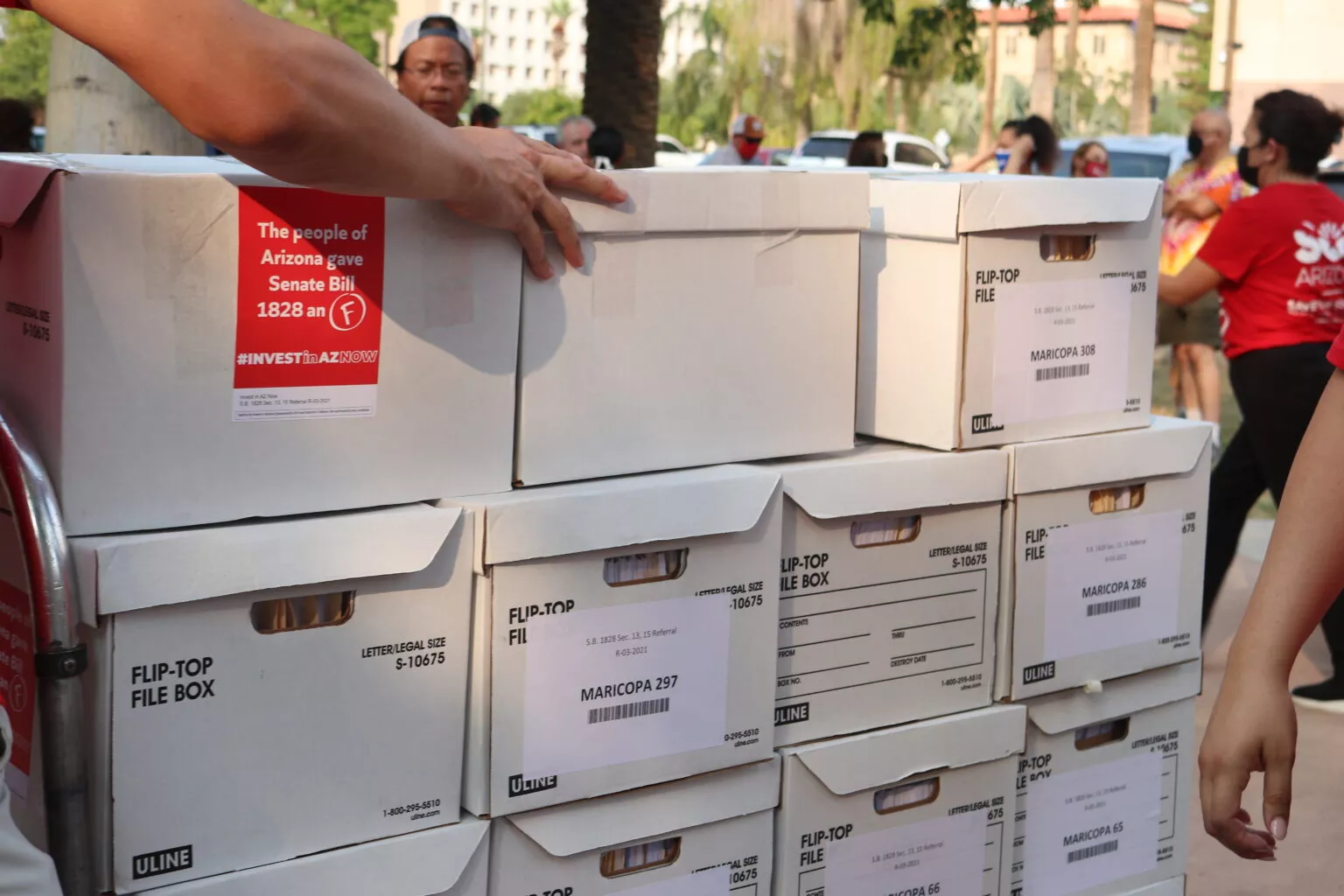
Arizona voters will get the final say on Gov. Doug Ducey’s legacy income tax cut package that was signed into law earlier this year, after a coalition of public education groups successfully forced a public vote in 2022.
The Secretary of State’s Office announced Friday that the referendum effort gathered more than the 118,823 signatures needed to block the tax cuts from going into effect unless voters approve them next year. It will be called Proposition 307, said Sophia Solis, spokesperson for the Secretary of State’s Office.
Ducey’s income tax cuts, which serve as his legacy policy achievement during his two terms as governor, dramatically reform Arizona’s tax system. Instead of a progressively graduated system with a maximum rate of 4.5%, Arizona will shift to two income tax rates: 2.55% for people who earn $27,272 annually and 2.98% for those who earn more than that. The tax law changes in Senate Bill 1828 also create a single 2.5% rate as soon as 2023 if state revenues hit certain triggers.
Legislative budget analysts concluded that it would cost the state about $1 billion annually. And while all taxpayers would see a reduction in income taxes, the wealthy receive the largest benefit: the poorest Arizonans would save $1 a year while the wealthiest would keep an average of nearly $350,000. The typical Arizona family would save about $42 a year, on average.
The tax cuts were designed to shield the wealthy Arizonans from the Invest in Education Act that voters approved in 2020. That voter-approved measure, also known as Proposition 208, imposes a 3.5% surcharge on income greater than $250,000 for individuals and $500,000 for couples, with the money directed to public schools to increase teacher pay and boost overall funding.
Prop. 208 will likely never go into effect. The Arizona Supreme Court ruled in August that it’s subject to the Arizona Constitution’s spending limits for K-12 education, setting the stage for a new trial court ruling that is expected to invalidate the measure.

