

Tuesday, March 26, 2019
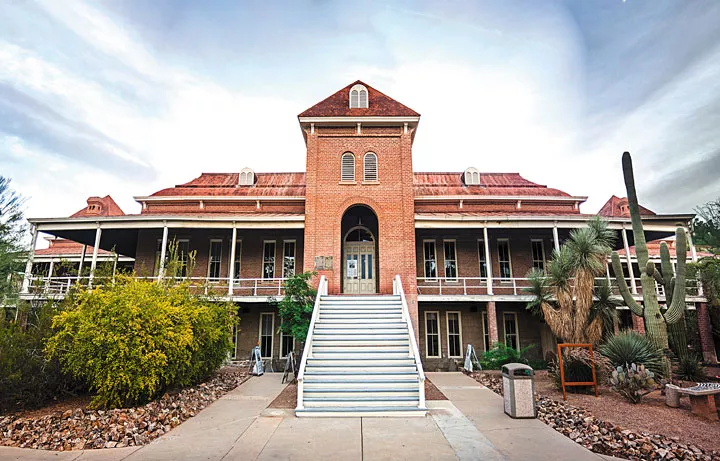
The University of Arizona hopes to position itself as a hub for research, programming and services related to gender-based violence, according to an official press release. Thanks to a $1.5 million donation from the Chris and Carrie Shumway Foundation, the university's Consortium on Gender-Based Violence is in the process of establishing a national model for "understanding and combating gender-based violence, improving support for survivors and eliminating cultural attitudes that re-create cycles of violence."
While people of any gender can be the target of violence, women, girls and LGBTQ+ individuals are far more likely to be harmed by men both in the United States and across the world. The Consortium aims to develop a "research-to-practice" model for violence prevention and response which can strengthen gender-based violence prevention efforts outside the university to reach the greater Tucson area.
The consortium was established by Monica J. Casper, a professor and associate dean for Faculty Affairs and Inclusion with the College of Social and Behavioral Sciences, and Melissa Vito, former senior vice president for UA's Student Affairs, Enrollment Management and Strategic Initiatives. The Shumways donated $500,000 to the cause in December of 2017, and have now contributed another $1 million to help the consortium expand its mission, according to the release.
With new director Elise Lopez—who received her PhD in public health from UA and is an internationally-recognized violence scholar—the consortium will introduce a grant program to help researchers fund projects for solutions. It will also provide support for the new Survivor Advocacy Program, which offers confidential support and advocacy services to student survivors of sexual and gender-based violence, according to their website.
"The UA becomes our students' home, and we cannot do our primary job educating them, allowing them to develop their minds and characters, and helping them to explore their interests and new relationships, if we do not create a safe environment," UA President Robert Robbins said in the release. "Violence of any kind, including violence based on a person's gender, has no place on a university campus, and we are all grateful for this generous gift from Carrie and Chris Shumway. The Shumways are giving us the opportunity to fulfill their vision of the UA as a national model for addressing and hopefully eliminating gender-based violence."
Carrie Shumway is a 1993 alumnus with a bachelor's degree in sociology. Her husband Chris is the managing partner of Shumway Capital, a Connecticut-based private investment firm valued at over $8 billion. Their philanthropy work is focused on "reducing the disparity of educational outcomes between low-income and high-income students," according to their website.
The UA recently hired former judge Ronald Wilson as the new Title IX director in an effort to address the university's compliance with the federal law after several lawsuits were filed by current or former students involved in university athletics who believe the school did not protect them from gender-based sexual misconduct and assault.
Tags: University of Arizona , Consortium on Gender-Based Violence , Title IX , Research , Grant , Sexual Assault , Survivor , Advocate , Image
Monday, March 25, 2019

Upon news of his passing, Gov. Ducey issued the following statement:
“Arizona is saddened by the loss of Don Diamond. Genuine, generous, and respected by all, Don displayed a deep love for Arizona and commitment to Tucson dating back to his earliest days. Through his business and real-estate career, Don — possibly more than anyone else —helped develop Arizona’s metropolitan areas into the growing cities they are today. He will also be remembered for his extensive philanthropic efforts, which included supporting causes such as promoting higher education, expanding access to children’s healthcare, and protecting natural habitats. No doubt, Don’s legacy will have a lasting impact on Arizona for many years to come. Our deepest sympathies and prayers go out to the entire Diamond family during this difficult time.”
Tags: news , Don Diamond , developer , philanthropist , Rest in Peace , Tucson , Pima County , Doug Ducey , Governor Ducey , statement , Image
Thursday, March 21, 2019

I have a column in the print edition of the Weekly discussing Edbuild's national study on per student funding. The fact is, Arizona does a reasonably good job of balancing its funding across districts, but Edbuild's study says Arizona's funding gap between predominantly white and nonwhite districts is the worst in the country — a $7,613 difference. That figure is wildly wrong.
This post is a short-version review of how badly Edbuild crunched the numbers. We're going to take a look at a hypothetical school district to see where Edbuild went wrong.
The Gulliver Valley School District is a small district with only two schools, Liliput School and Brobdingnag School. Because Liliput is in a sparsely populated area, it only has 47 students, and it spends $19,700 per student. That sounds like a lot of money, but it costs more to educate a small number of students.
Brobdingnag is in a more populated area. It has 2,425 students. Because of economies of scale, it is able to educate its students for $6,400 per student.
Here's a math problem. How much does Gulliver Valley District spend per student overall?
Now, you might decide to take the per-student funding number for each school and average the two. If you did, you would say the district spends $13,050 per student.
But that's not right. You can't just average the per student cost of two schools when one has 50 times more students than the other. It's more complicated than that.
If you weight the funding figures for the two schools based on the number of students in each school, you come up with a figure of $6,653 per student for the entire district. That's the right answer.
Edbuild, for some reason, chose the first, overly simplistic way of arriving at the average per student funding over a number of districts rather than the second. That's why Edbuild's numbers are so wrong.
If you want to know more, go to my column in the Weekly.
Tags: Edbuild , Funding per student , Methodology , math , education , funding , study , Arizona , schools , students , Image
Tuesday, March 19, 2019

According to a recent study by Edbuild, Arizona spends $7,613 more per student in predominantly white districts than predominantly nonwhite districts. That would make us the most inequitable state in the nation when it comes to funding our school districts.
Edbuild's study was picked up by media outlets across the country. You can read all about it in the New York Times, the Washington Post and hear about it on CNN and NPR, to name a few major outlets that carried the story. It's also been covered by Arizona media.
If the $7,613 figure comes from a reputable nonprofit which focuses on problems of funding inequality and segregation in the nation’s public schools and is repeated often enough in the media, it must be right. Right?
Wrong. As I explain in an article which will be running in Thursday's print edition of the Weekly, the figure is not only wrong, it's wildly wrong. Arizona may do a lousy job of funding its schools, but it does a reasonably good job of spreading the money out evenly across districts.
For almost 30 years, Arizona has used a funding equalization formula to distribute money to school districts. Before that, schools were funded primarily by local property taxes, which meant districts with expensive homes were rolling in education dough while districts with lower property values struggled to find enough money to run their schools.
Arizona's equalization system is far from perfect. Some school districts, mainly in high rent areas, find ways to game the system and bring in extra money for their students. But compared to other states, we do a fairly good job of evening out the money each district receives.
Instead of being labeled as one of the worst offenders in the way we distribute our education funds, we should be praised as one of the best.
Here are three reasons I know we're doing a reasonably good job of equalizing education funding:
Tags: Edbuild , District funding , Education funding equalization formula , schools , money , students , districts , funding , educaiton , Image

His job is to continuously review the jail's roster and case management system to identify individuals currently in jail for non-violent offenses who correctional officials believe, once released, would be unlikely to miss scheduled court appearances, according to a county press release.
Sheriff Mark Napier explained the necessity of the new hire in the release.
"My job is to not only make Pima County a safer place but to also ensure that we are spending taxpayer funds appropriately," said Napier. "Part of achieving both is ensuring that the right people are incarcerated in our jail for the right reasons. This will reduce costs and keep our county safer."
By consulting with the other agencies such as the county's Attorney's Office and public defenders, they can work with inmates who are willing to seek substance abuse or mental illness treatment, or get involved in housing assistance or social services programs. It's all about keeping the jail population as low as possible while still ensuring public safety.
Steber will also keep an eye out for other programs that can serve as a better alternative to being kept in custody.
"We don't want repeat business," PCSD Chief Deputy Byron Gwaltney said in the release. "In my experience, many people do better and are less likely to re-offend if they remain connected to the community and the social services available on the outside."
Steber's hire comes as the latest move by the county to address issues with incarceration. In April 2016, Pima County received a $1.5 million Safety and Justice Challenge Grant, provided by the John D. and Catherine T. MacArthur Foundation, to identify ways to reduce the jail population where necessary. Their goal is to reduce the population by 26 percent from 2014 to this year.
Tags: Pima County Jail , Pima County Sheriff's Department , PCSD , Incarceration , Population , Safety and Justice Challenge , Image
Thursday, March 14, 2019

Traffic can now travel over Interstate-10 and the railroad tracks after West Ina Road re-opened Thursday morning.
While work continues in the area, one lane of Ina Road is available in either direction, a major milestone in the interchange project. The posted speed limit is 25 mph.
According to a press release issued by the Arizona Department of Transportation, ramps connecting Ina Road with I-10 are expected to open “in the next few weeks.” Widening Ina Road from I-10 west to the Santa Cruz River and connecting with a new bridge over the river, the final parts of the project, are expected to finish up later this spring.
With the new, four-lane overpass in place, drivers will no longer need to wait for trains at Ina Road.
The $128 million project also includes replacing a single, two-lane Ina Road bridge over the Santa Cruz River with two bridges, doubling the road’s capacity west of I-10, and creating a bicycle path that connects with The Loop.
ADOT is overseeing the project, which is funded by the Federal Highway Administration, the Pima Association of Governments and the Regional Transportation Authority. Marana chipped in $7.9 million toward the cost of the new Santa Cruz River bridges.
Tags: Ina Road , construction , I-10 , opening , road work , bridge , interstate , overpass , Image
Wednesday, March 13, 2019

Some parents paid hundreds of thousands of dollars, even millions of dollars, to bribe and cheat their children's way into big name colleges. That means an equal number of deserving students were denied admission. Fifty people have been named in the scandal so far.
And that's supposed to be a big deal? The college admissions scandal of the century? You can't be serious.
Here's a genuine scandal: the number of "legacy" students at top colleges. Take Harvard as an example. Legacies make up 14 percent of the undergraduate population. One in seven undergrads strolling around Harvard Yard are there because one of their parents strolled down those same ivy-league walkways.
That's about 950 of Harvard's 6,700 undergrads. Next September, 280 new legacies will cycle into the school. And that's just one big-name school.
"Legacies" are students who have a parent who attended the college, which increases their chances of admission. If the parents put a little cash into the college coffers — a lot of cash is even better — admission chances are even higher.
People who work in Harvard admissions have said its applicants are so strong, the college could admit two freshman classes of equal quality. If Harvard got rid of the legacies, 280 more highly qualified students could be admitted.
To be fair, I'm sure some of the legacies have what it takes to do well at Harvard, but I'm equally sure the vast majority would not have made the freshmen class if they had to rely on their own merits. What are the odds that 280 of the top Harvard applicants each year just happen to be children of a handful of alumni?
Back to the college admissions "scandal of the century." All that's happened is the people involved in the scandal have taken the initiative to create their own "Make your own legacy" reality show. It's the same kind of privilege for the same class of people, with a felonious twist thrown in.
Tags: College admissions , Harvard , Legacy admission , scam , scandal , education , Image
Tuesday, March 12, 2019

Longtime Tucson residents Russ and Mac Perlich saw a dire need for access to the arts in Arizona schools. But instead of bringing arts and culture to the classroom, they found a way to get students out to experience it in the real world.
Launched in 2011, Russ and Mac Perlich started Act One, a non-profit dedicated to helping Arizonans of all ages have greater access to art.
Since 2011, Act One has managed a program called Culture Pass, originally created in 2009, which partners with 11 public libraries in Tucson and 50 libraries in other parts of Arizona. Any library cardholder can check out a pass, which gives them free admission for two people to cultural events hosted by 61 participating arts organizations across the state. Thousands of Arizonans are able to access museums, botanical gardens, cultural attractions and theater performances year-round for free, as long as a pass is available.
The success that the program has seen over the last few years prompted Pima Community College to join as the first educational institution to offer the Culture Pass in their Desert Vista campus library. Now, any PCC student or faculty member can check out a pass at that location and experience the arts at no cost to them.
"We're excited to be the first community college to participate in the program," Sol Gomez, head of the Desert Vista campus library, said in a press release. "Our students have already shown interest in the program and are excited to explore the arts with the Culture Pass."
In Tucson, nine cultural museums (including the Tucson Museum of Art, the Arizona-Sonora Desert Museum and the Museum of Contemporary Art) have general admission tickets up for grabs. Theater performances from Arizona Theater Company, Arizona Opera, the Scoundrel and Scamp Theatre, UA Presents and more are available as well, with passes distributed no more than two weeks prior to a show's debut.
"We are immensely proud and incredibly excited to announce Pima Community College as our newest partner in the Culture Pass Program," Geri Wright, president and CEO of Act One said in the press release. "We are committed to ensuring all Arizonans have inroads to the arts, and our Culture Pass Program allows us to continue our mission. This is an important growth milestone for us and, with the support of our library partners, we can bring arts access to even more Arizonans statewide."
The Desert Vista campus is located at 5901 S. Calle Santa Cruz. The Culture Pass is also available at the following Pima County public libraries: Joel D. Valdez, Eckstrom-Columbus, Himmel Park, Joyner-Green Valley, Kirk-Bear Canyon, Miller-Golf Links, Mission, Quincie Douglas, Valencia, Wheeler Taft Abbett Sr. and Woods Memorial.
Tags: Museum , Pima County Public Libary , Pima Community College , Desert Vista , Culture Pass , Act One , Image
It's been awhile since I've written one of these THREAT (Trump Human Rights Erosion And Termination) Watch posts, which I began writing a week after Trump's election.
It's definitely time for another one. Not because Trump has done anything unusually outrageous or frightening lately. He hasn't. He's been steadily outrageous and frightening in word and deed from day one. He continues to trod down the path he stomped out, campaign speech by campaign speech, tweet by tweet, beginning in the election season and continuing during his two years in office. Though he has done damage to the country and the office of the presidency in ways which may not be remedied in our lifetimes, he hasn't irreparably harmed the country.
Yet.
The only reason Trump hasn't done more harm is because the country's basic institutions have held him in check. The courts have reversed, delayed and curtailed much of what he wanted to do. Once in awhile Congress puts a check on one of Trump's schemes, usually in the foreign policy arena. Rarely, but it happens. And the media—Bless and keep the media, our first line of defense against tyranny!—has stayed strong and independent. The more Trump calls the truth-telling media the Enemy of the People and purveyors of Fake News, the harder reporters work to tell the truth.
Trump should also be held in check by the conventions of the office which say the president is bound by court decisions, by congressional laws and oversight and, possibly most important, by a sense of what's right. A president should have a reasonable amount of honor as well as a sense of shame. When he's done something wrong, or even worse, when he's been caught at it, he should say, "I shouldn't have done that. I'd better back off, maybe even try and make amends. I learned my lesson on that one."
And therein lies the greatest threat Trump presents to the country. He is unbound by the norms of law, society and human decency. He'll lie, cheat and steal, whatever it takes. When he's caught in a lie, he lies harder, repeating the lie more often and ever more outrageously. When the courts rule against him, sometimes he ignores them and other times he works around them, violating the spirit of the court's ruling, trying to find a way to do what he wants in spite of their pesky judicial meddling.
This is nothing new. He's always been this way. But it's gotten worse lately.
Some recent cases in point:
Tags: Trump , media , THREAT Watch , politics , President Trump , News , journalism , government , Image
Monday, March 11, 2019

The UA's Eller College of Management is a household name across Arizona, and its namesake Karl Eller is remembered by many after his passing on Sunday, March 10.
"Karl Eller was a true pillar of this community and an inspiration to the many people whose lives were positively impacted by his generosity, dedication and Wildcat spirit," said UA President Robert C. Robbins in a release.
Eller was born in Chicago in 1928 and grew up in Tucson. Growing up across the street from Arizona Stadium, Eller's mother rented rooms to UA students and Eller's connection to the university was born. He enrolled in the U.S. Army after high school and later attended the University of Arizona to study business.
About a decade after graduation, Eller founded Eller Outdoor Advertising. He later went on to lead the Gannett Company and Columbia Pictures as board chairman and CEO. In the early 1980's Eller took over the Circle K Corporation.
In 1998 the UA School of Business was renamed the Eller College of Management to recognize the legacy, philanthropy and impact Eller had on the school.
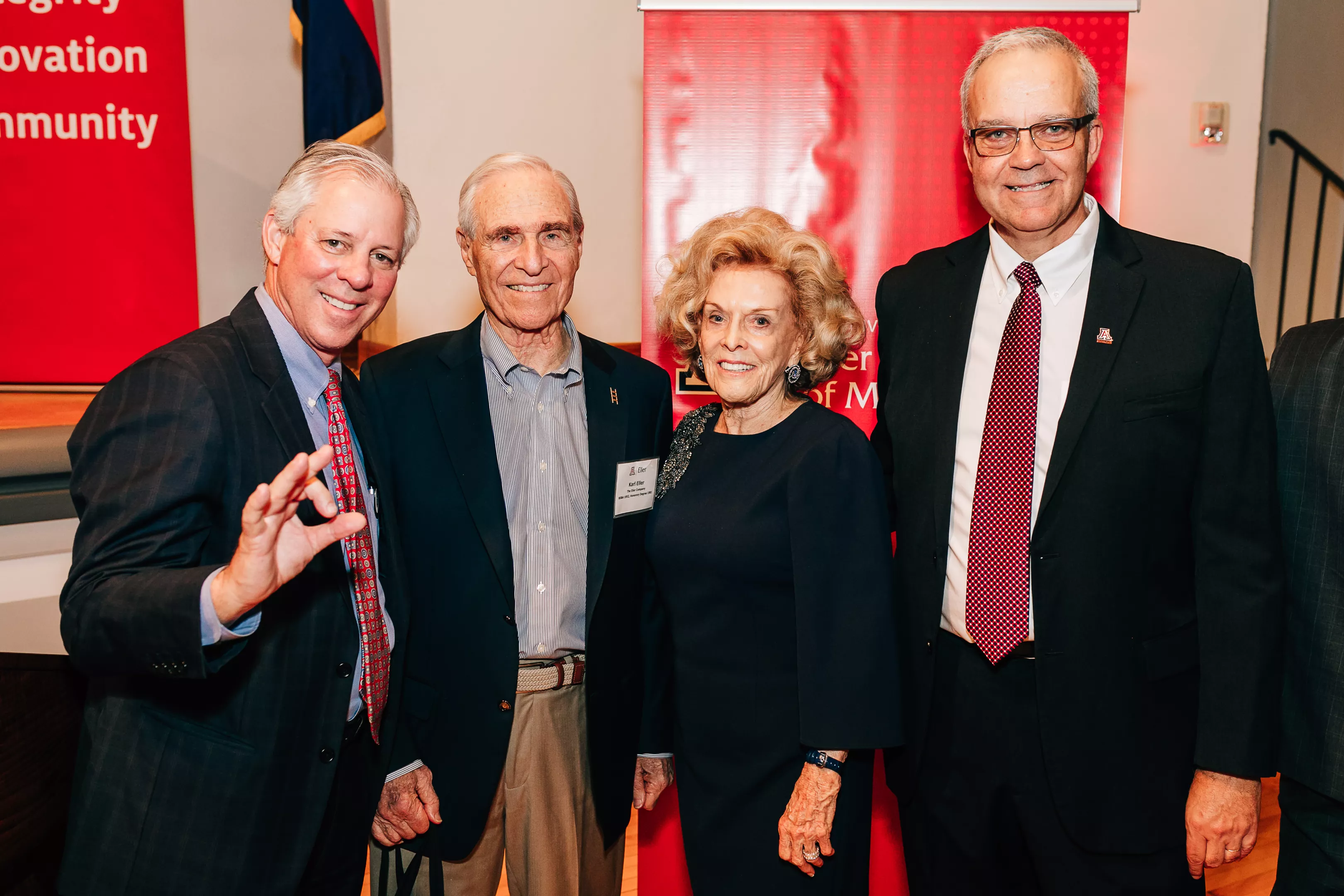
"What an honor it has been to know Karl Eller. He used his education, intelligence and a deep commitment to integrity to achieve the highest levels of success, while always keeping a little bit of Tucson ruggedness and authenticity," said Paulo Goes, dean of the Eller College of Management.
Over the course of his career, Eller and his wife Stevie donated millions of dollars to UA to develop the Entrepreneurship Program, fund student career development and more.

Eller was also involved with Arizona athletics, helping bring UA into the PAC-12 and the Fiesta Bowl to Arizona. The Fiesta Bowl released a statement remembering his impact.
Eller is survived by his wife, Stevie, their two children, six grandchildren and one great-grandchild. He is remembered and honored by many in Tucson and his legacy will live on through the Eller College of Management.
Tags: Karl Eller , UA , University of Arizona , Eller College of Management , RIP , Image

