

Thursday, August 16, 2018

Marana residents who live in the affected residential areas have been asking the Council to treat the tap water ever since news broke last month of two types of contaminants exceeding the Environmental Protection Agency’s health advisory levels. Marana had been sending out mailers informing Marana Water users of the contaminants since December 2016.
The contaminants, PFAs and 1, 4-Dioxane are unregulated compounds that Marana Water staff found in the two separate water systems that feed Saguaro Bloom and Continental Reserve. These compounds have been found in water sources all over the country, including elsewhere in the Tucson Metro Region.
According to the EPA, the risk exposure for the dioxane health advisory level is one in one-million, over a lifetime. Adverse effects include kidney and liver damage. Marana’s levels go as high as two-and-a-half times the advisory level.
Marana Water Director John Kmiec said the EPA is due to release new standards for soil and groundwater contamination this fall, but there’s no guarantee they will meet their deadline. Arizona currently has no set guideline, but some states have set their own, which vary widely. For example, the EPA’s health advisory level for 1, 4 Dioxane is 0.35 parts per billion, but Alaska set their standard at 77 parts per billion and New Hampshire’s is 0.25.
Several town residents spoke at the meeting, expressing concern over the water and satisfaction that the Council seemed on board for treatment as soon as possible.
Saguaro Bloom resident Joyce Reid called the contamination a health hazard and said she’s “happy to hear that there may be some light at the end of the tunnel.”
Shawna Larsen, a cancer survivor, said the low odds of risk exposure are no comfort to her.
“I heard the presentation using the phrase ‘one-in-million chance,’” she said. “Well my chance is over. That already happened. So what I’d really like to be able to tell my coworkers is, ‘I live in Marana. They had a problem. They put in a treatment facility. It’s working great. They’re testing it consistently. And we’re really happy where we’re at. We’re living in our dream home.’”
Vice Mayor Jon Post was the first council member at the meeting to say he thinks the town should build the treatment plants, followed by a chorus of applause. As far as a funding source, he suggested that an additional sales tax might be an option.
“Just one-tenth of a percent for the town of Marana is $1 million a year,” he said. “It’s not even something that people that shop in Marana would even notice. But yet, it would be a revenue stream that would guarantee us quality water for our residents.”
Two water treatment centers, built around the contaminated wells, would cost about $13.5 million to build and then run for 20 years, about $1.5 million less than a previous estimate the town manager shared with Tucson Local Media.
Marana and other local jurisdictions, along with the Arizona Department of Environmental Quality, are continuing to investigate whether the contaminants came from Davis-Monthan Air Force Base or another source, but so far no definitive source has been identified.
Councilmember Roxanne Ziegler said she’s definitely in favor of treating the water but not fond of creating a tax to pay for it. She suggested holding off on capital improvement projects to divert funds to cover the treatment centers right away, and hopefully recover the funds in the future.
“I don’t want to play the blame game right now, but I’m all for fixing this and then going back and recovering what we can if indeed it was Davis Monthan or some other area,” she said.
The contamination levels in a number of the wells has dropped since the town began testing the water in late 2016, though a few have slightly increased. Kmiec said there’s no way to know if the wells that are dropping will continue that trend.
Marana Water looked at other options besides treating the water, but advised against them. One of those options is “water blending,” which happens when a contaminated system is connected with a clean system.
One such project was already in the design stages, connecting the water systems that serve Continental Reserve and the Twin Peaks area, for the benefit of optimal water usage rather than to dilute contaminants. It should be completed in the next two years. But Kmiec said Marana Water found the blending technique had a low effectiveness rate at bringing the contaminants down to and maintaining a comfortable level.
The Northwest Recharge, Recover, and Delivery System is another project in the works, to be constructed in 2023. It’s a joint pipeline project with Marana, Oro Valley and Metro Water to transport water that all three jurisdictions have stored by the Marana Airport.
Another option is looking at accessing Central Arizona Project water, but would take a considerable amount of infrastructure, treatment and precaution. Kmiec said because of these challenges, this option “quickly fell off the radar.”
Town Manager Jamsheed Mehta said the town staff will put together a proposal on how and when to build the treatment centers, which should be ready to present to council sometime in late-September to early-October.
Mayor Ed Honea said the council wants to see the treatment facilities happen as quickly as possible.
“We have to work on financing and everything else, but that is not the most important issue,” Honea said. “The most important issue is cleaning up the water, and we’ll figure out the financing down the road. It may be from three or four different sources.”
Tags: water , contamination , chemicals , Marana , wells , action , Image
Wednesday, August 15, 2018

Doug Ducey and his Republican legislative cronies had $56 million in federal money waiting to be spent to help cover the cost of child care and early childhood education for low income families. They refused to spend it.
The state didn't have to put up a penny. All it had to do was add a $56 million line item to its budget, and more low income children would have access to child care services. Ducey and the Republican legislative leaders knew the money was there, they were urged to put it in the budget by child care advocates and by Democrats in the legislature. They just decided not to do it.
When a story in the Sunday Star brought the unspent $56 million to my attention, I contacted Michelle Crow, Southern Arizona Director of the Children's Action Alliance, for more details. Next I talked to Democratic Rep. Randy Friese, who represents LD-9, my legislative district, to find out why the money didn't make it into the budget. The more I learned, the worse things got.
In March the federal government included $5.2 billion in its budget to increase the quality of child care and early childhood education across the country. Arizona's cut of the funds is $56 million, which is supposed to be added to the $125 million Arizona already receives to subsidize child care and early childhood education for children from low income families.
Right now, there's not enough money to subsidize child care for all the children who need it. As bad or worse, the amount the state allocates per child doesn't cover the child care provider's costs. The state Department of Economic Security's "Reimbursement Rates for Child Care" schedule is based on what the services should cost. The problem is, the reimbursement rates haven't changed since 2000. The state is still using an 18 year old rate schedule created at a time when the minimum wage was $5.15 an hour. Today it's $10.50.
It's actually worse than that. The DES reimbursement is only 75 percent of going rate in 2000. It's no surprise Arizona has among the lowest reimbursement rates in the country.
Tags: Child care subsidies , $56 million , Department of Economic Security , Michelle Crow , Rep. Randy Friese , Rep. Pamela Powers Hannley , Image
Monday, August 13, 2018

Are you tired of all those political robocalls and calls from earnest volunteers? Did you know, they're tired of talking to you too?
Are you tired of all those glossy, oversized postcards from candidates touting their accomplishments — and maybe running down their opponents? Did you know, they're tired of sending them to you too?
Just vote. When campaigns find out you've sent in your ballot, they'll leave you alone. No more (or almost no more) calls. No more (or almost no more) oversized postcards. You can sit back with the beverage of your choice and watch the political circus unfold before your eyes, knowing you've done your patriotic chore. Better yet, volunteer for the candidate(s) of your choice and be one of those phoners or the doorbell ringers helping to get out the vote.
Send in your ballot!
Friday, August 10, 2018

Thursday, a post on Blog for Arizona by Larry Bodine sent minor shockwaves through the Democratic primary race for governor. Bodine wrote a scathing review of a book David Garcia wrote titled School Choice, which will be published September 28. According to Bodine, Garcia's book is pro-school privatization and, in the words of the headline "a Blueprint to Dismantle Public Education."
Bodine's post was the first I heard of the book. I asked him if he would share his review copy with me, and he did gladly. I read the book — or to be completely honest, I read the beginning carefully, then skimmed the rest of the 196-page book attentively enough to understand its content.
Bodine's depiction of the book is, in a word, wrong.
Of the people who have had a chance to read the book and comment on it in the media, I probably have the most experience reading education books. I have amassed a significant number of postgraduate units in the field, and I've continued reading education works, ranging from blog posts to articles to books, on a daily basis. Though I have expressed my support for Garcia, I also know how to read these kinds of texts for content and possible political leanings without letting my personal opinions interfere.
What Garcia has written is a book on the history of school choice beginning in colonial days and continuing through 2017. It is meant to be an objective overview of the subject, and it succeeds in that regard. If I had never heard of David Garcia and read this book, I wouldn't know his personal opinions on the subject. Though it is written for general consumption, it would be a valuable book to assign in any college course on the history of education, from Education 101 through graduate school.
I'm not the only one to arrive at the conclusion that Bodine's post is a distortion of the contents of Garcia's book. Brahm Resnik, one of Arizona's top journalists, came to a similar conclusion. So did Maria Polletta of the Arizona Republic. I'll quote some of what they wrote at the end of the post.
Tags: David Garcia , Blog for Arizona , Larry Bodine , School Choice , MIT Press Essential Knowledge Series , Image

Gun legislation in Arizona remains a hot-button issue going into election season. Gov. Doug Ducey’s proposed school safety plan, which was unveiled in March, was a contentious bill since Arizona lawmakers can’t agree whether “school safety” and “gun reform” are synonymous.
The bill was proposed as a proactive measure towards preventing any more school shootings like the February attack Marjory Stoneman Douglas High School in Parkland, Florida. The bill passed in the Senate with full support from Republicans and none from Democrats. But ultimately, the legislation stalled in the House.
“Governor Ducey was disappointed that the Safe Arizona Schools Plan was not passed by the Legislature, but that doesn’t mean that our work is done on the issue,” said Ducey Press Secretary Elizabeth Berry in an email. “School safety is a top priority and the governor is committed to fighting for the common-sense reforms included in the [bill].”
Ducey says that passing his school safety bill is one of his highest priorities going into the next legislative session, should he win re-election. But with his plan facing criticism from both Republicans and Democrats, he will have a challenge seeing it become law if he’s reelected.
Democrats cite the lack of universal background checks as one of the bill’s biggest pitfalls. Ducey’s plan intends to strengthen the existing criminal background check system, allocating $600,000 to do so, but that doesn’t take into account that person-to-person sales aren’t regulated because only federally licensed firearm dealers are required to perform background checks at the point of sale. This is commonly referred to as the “gun show loophole.”
Congressional candidate, Arizona Sen. Steve Smith (R-Maricopa), who sponsored the Safe Arizona Schools Plan, says that while he’s confident that Ducey will be re-elected, the issue is still important enough that it will be addressed—and fast—if he’s not. Smith also thinks gun reform should be addressed at the state level not nationally.
“This is not a gun bill; this is a school safety bill,” Smith said. “We’re talking about keeping people safe as it relates to mass shootings. We aren’t going to get into bump stocks and all of those other areas. If you want to have a debate about that, then run a bill about it.”
The Arizona House of Representatives voted 34-25 in February against a bill to ban bump stocks, House Bill 2023. Ducey’s bill initially had several types of STOP orders—Severe Threat Orders of Protection—that would allow both members of the public and law enforcement to petition Arizona courts to advocate for the removal of firearms from individuals exhibiting severe and imminent signs of threatening behavior.
The bill states that after law enforcement presents a judge with evidence that an individual is dangerous, the judge can require that the person in question undergoes a 21-day observation and mental health examination to determine whether or not the person is a risk.
The bill saw multiple revisions throughout April and was significantly watered down before it got to the floor for a vote. That final version removed the aspect of the STOP order that allowed concerned citizens to petition for one, allowing only members of law enforcement to do so.
Smith says that most people don’t know how to petition a court anyway, so removing that part will allow law enforcement to properly handle concerns.
The STOP orders are one of the most contentious parts of the bill, as Democrats argue that they won’t do enough while Republicans argue that they are an overstep by the government.
Republican gubernatorial candidate Ken Bennett says Ducey’s plan focuses too heavily on seizing guns and that the state should instead arm willing teachers to keep schools safe, referring to the oft-used slogan: “The best way to stop a bad guy with a gun is a good guy with a gun.”
Smith also argues that the addition of armed forces, whether it be through security resource officers or the arming of teachers, is necessary to keep Arizona schools safe.
“The majority of the people that talk to me want to see the schools be better protected, and inevitably that means that they want somebody on campus to be able to use force and have force available if needed,” he says.
Ducey’s plan would increase the amount of armed security resource officers on school campuses in Arizona. It also would allocate more funds for more trained mental health professionals on school campuses, with $3 million for behavioral and mental health specialists, according to Berry.
While Smith, Ducey and Bennett believe that it is necessary to arm more people to combat mass shooters, Democratic gubernatorial candidate David Garcia doesn’t believe placing more armed officers in schools would create the support system that is necessary to prevent school shootings.
“Those who firmly believe that a crisis would be resolved with a gun fight have been playing too many video games and watching too many movies,” Garcia said. “What we need is eyes, ears and communication . . . in the form of support, not enforcement.”
Garcia argues that in order for Democrats and Republicans to mend the division regarding topics of gun control, Arizona needs a governor who doesn’t receive praise from the NRA.
The NRA publicly supports Ducey’s school safety plan, which Smith praises.
Marissa Ryan is a University of Arizona journalism student and a Tucson Weekly intern.
Tags: guns , school safety , school shooting , officers , politics , policy change , Image
Thursday, August 9, 2018
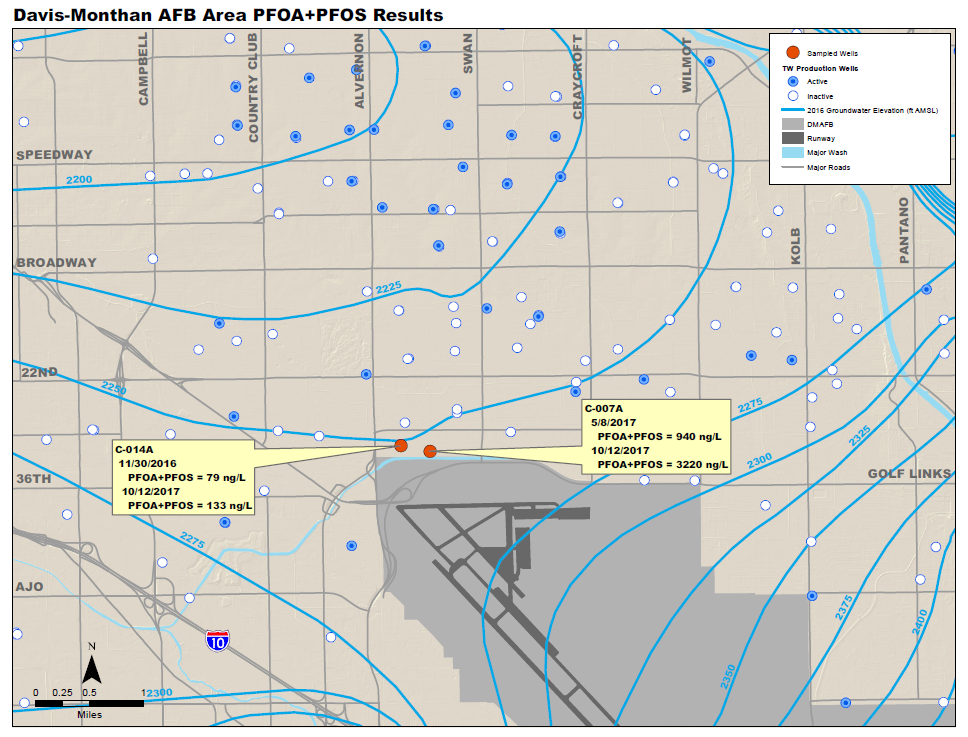
Tucson Water has shut down a third well near Davis-Monthan Air Force Base for safety reasons. Two others were closed last year due to elevated levels of chemicals, exceeding the Environmental Protections Agency’s health advisory recommendations.
Tucson Water Public Information Officer Fernando Molina said the third well, closed at the end of June, contains almost 30 parts per trillion of two per- and polyfluoroalkyl substances, PFOA and PFOS, or PFAS for short. PFAS has no federal maximum contaminant level for drinking water, but the health advisory level is 70 parts per trillion.
PFAS can be found in household products like stain repellent, non-stick pans, water repellent fabrics, polishes, waxes, paints and cleaning products as well as fire-fighting foams. The EPA said there’s evidence that exposure to PFAS have adverse side effects, such as increased cholesterol levels, low infant birth weights, effects on the immune system, cancer and thyroid distribution.
One well has PFAS levels of 2950 parts per trillion and was closed in June 2017. The other well has 97 parts per trillion and was closed in January 2017. These chemicals and another contaminate, a form of dioxane, were originally found at levels exceeding the EPA health advisory in two Tucson wells just north of D-M. Dioxane also has no federal maximum contaminant level for drinking water, but the EPA has a health advisory level of 0.3 parts per billion.
Tags: water , contamination , wells , Marana , Tucson , clean water , health , Image
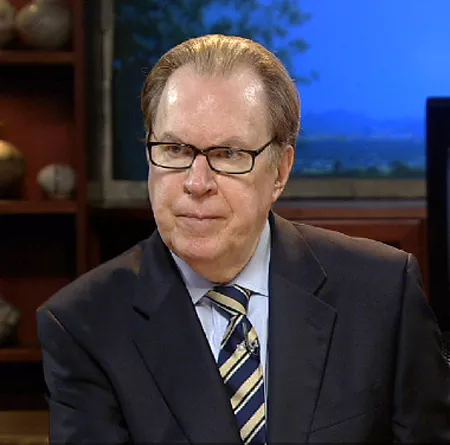
We finally know a little more about the future of the station—and it appears that the new owners are going to be giving local talk a big opportunity.
Once again proving that he has more lives than a wildcat, John C. Scott—who has hosted a local talk show on a variety of stations since the late ’80s in this town—will be returning to the airwaves from 4 to 6 p.m. daily. While the details are still being sorted out, Scott will also be helping develop new local talk shows at the station. He's in talk with various local political and sports personalities about hosting shows.
"Every time I pay for funeral expenses in advance, I kick myself," Scott told the Weekly. "I'm not dead yet."
Buckmaster, who had a long run as the host of PBS-6's Arizona Illustrated before moving on to talk radio in 2011, will continue to host his show from noon to 1 p.m., and morning talker Chris DeSimone is expected to keep his show, Wake Up Tucson.
"I am really excited about Dr. Bustos' vision for local talk radio in this town," Buckmaster told the Weekly. "This is a win-win for everyone involved with the big winner our community to have a radio station where all voices will be welcome on the air."
Tags: radio , local , talk radio show , KVOI , Tucson , Image
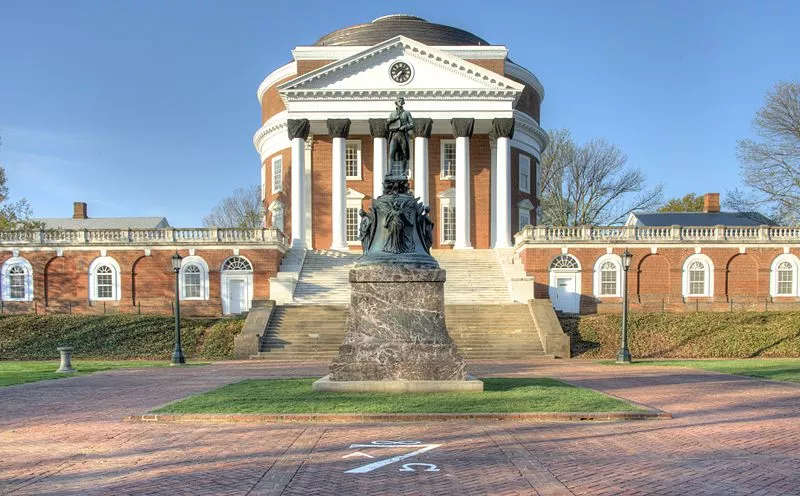
Here's my suggestion to UVA: Pay back by paying forward.
• Extend the meaning of "legacy student" from the children of UVA alumni to include the descendants of slaves who were forced to build and maintain the school.The first anniversary of the Unite the Right rally in Charlottesville, Virginia, home of UVA, comes in a few days. Coinciding with the anniversary is the publication of the final report of the UVA's Slavery and the University Commission, which began its work in 2013. Together, the two events put the issues of pre-Civil War slavery and present-day racism into stark perspective.
• Create a UVA fund dedicated to the educations of their descendants based on the monetary value of their ancestors' contribution to the university.
The racism of the Unite the Right participants is well known. The history of slavery at UVA, however, like the history of slavery in the U.S., is clouded by our national determination to paint our country's original sin in broad strokes and ignore its disturbing details. The UVA report is one of the recent attempts to bring the full, accurate history of slavery to light.
Based on the commission report, it's fair to call UVA the university that slavery built. According to the report, "Slavery, in every way imaginable, was central to the project of designing, funding, building, and maintaining the school."
The dollar value of the slave labor which directly contributed to the building and maintenance of the university is only one part of the story. The people who funded the building of the school were Virginians who owed their wealth to the state's slave-based economy, including the country's third, fourth and fifth presidents, Thomas Jefferson, James Madison and James Monroe.
Tags: University of Virginia , Slavery and the University Commission , Slavery , Unite the Right , Thomas Jefferson , Reparations , Image
Wednesday, August 8, 2018
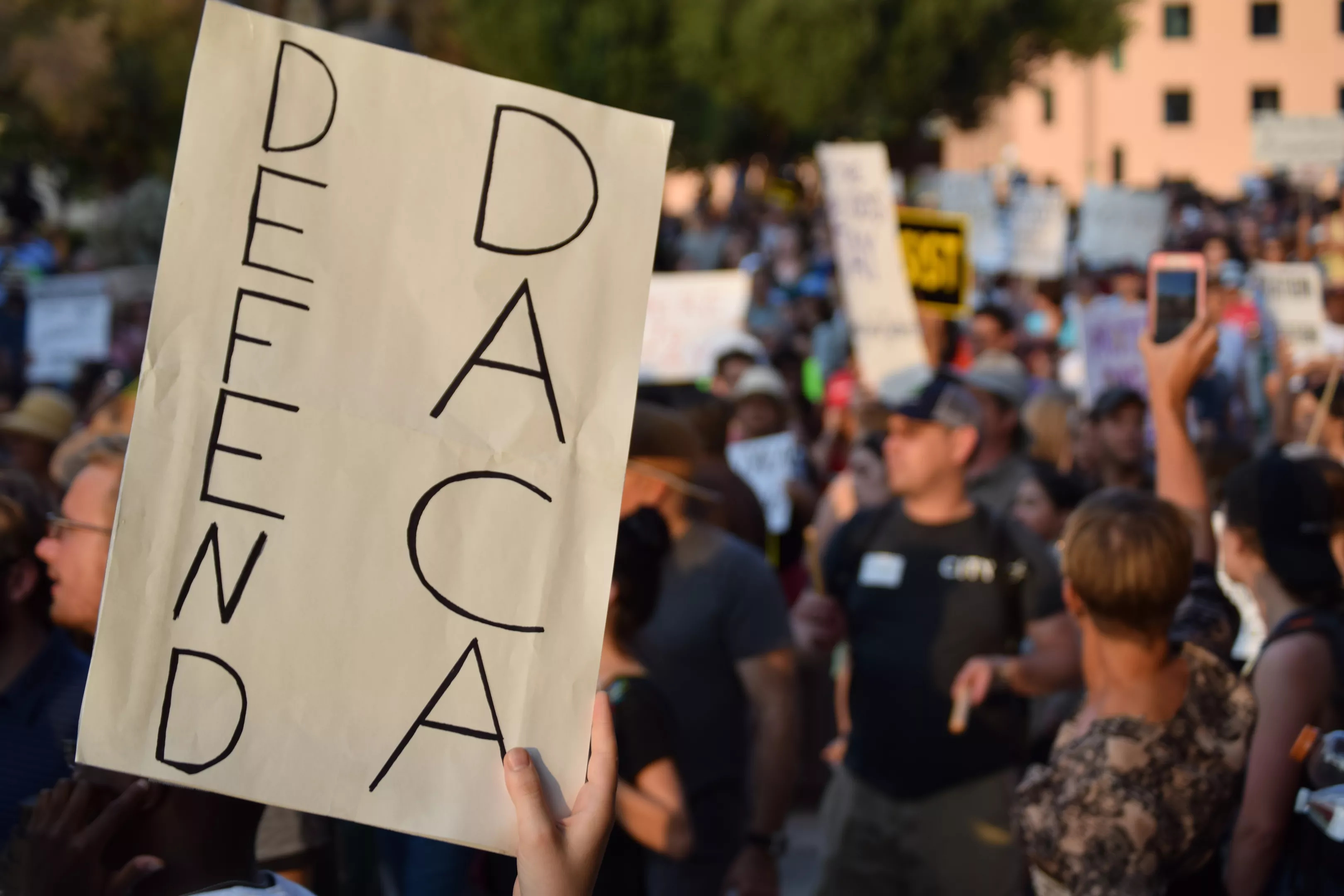
Less than a week after a court in Washington, D.C. ruled that the Trump administration didn't have the right to end Deferred Action for Childhood Arrivals, seven states filed a lawsuit to end the program that allows around 800,000 young people to work and live without fear of deportation.
Today, a federal court in Houston will consider the lawsuit brought by Texas, Alabama, Arkansas, Louisiana, Nebraska, South Carolina and West Virginia. Judge Andrew Hanen, overseeing the case, is well known for blocking the Obama administration from expanding DACA in 2015.
The American Civil Liberties Union says it's possible Hanen could order the end to the program anytime after today's hearing. The ACLU also has some recommendations for DACA recipients and says such an order would conflict with the D.C. court and courts in other states, which ordered the federal government to continue renewing existing DACA cases:
To be clear, such an order would be wrong: Not only is the DACA program legal, but if the Texas court were to strike it down, its order would directly conflict with the orders issued by the California, New York, and Washington courts. If the government were subject to such conflicting orders, it would likely seek relief from the Supreme Court quickly, and no one knows for certain how the Supreme Court would rule.
Because of the possibility that the Texas court will issue an unfounded order that leads to faster Supreme Court review, we recommend that DACA recipients who are eligible for renewal submit their applications as soon as possible. If the DACA program is struck down, you could lose your application fee, but applying sooner increases the chance that you will be able to renew while the program is still available.
Tags: news , politics , DACA , immigration , students , court , Image
Tuesday, August 7, 2018
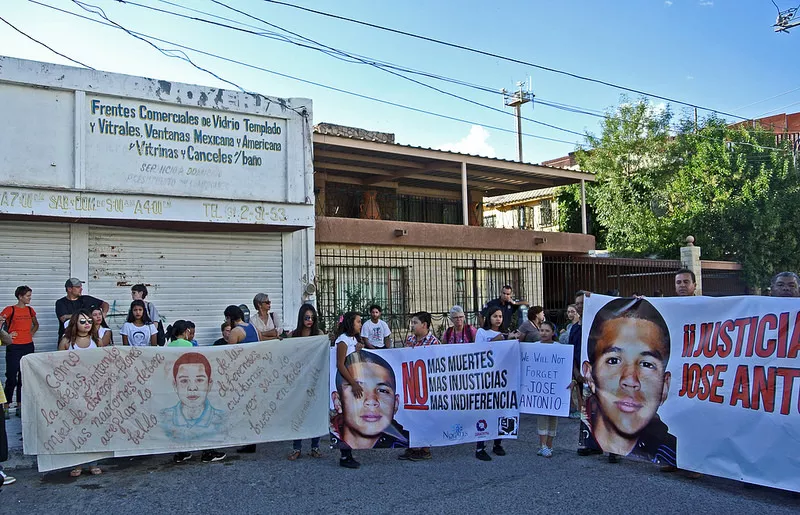
An Arizona federal appeals court ruled today that the mother of the 16-year-old who was shot and killed by a border patrol agent has the right to file a lawsuit. The agent tried to have the case dismissed, but the court opinion says “the agent was not entitled to qualified immunity.”
“It is inconceivable that any reasonable officer could have thought that he or she could kill [Jose Antonio Elena Rodríguez] for no reason,” the court opinion says.
According to court documents:
Shortly before midnight on October 10, 2012, defendant Lonnie Swartz was on duty as a U.S. Border Patrol agent on the American side of our border with Mexico. J.A., a 16-year-old boy, was peacefully walking down the Calle Internacional, a street in Nogales, Mexico, that runs parallel to the border. Without warning or provocation, Swartz shot J.A. dead. Swartz fired somewhere between 14 and 30 bullets across the border at J.A., and he hit the boy, mostly in the back, with about 10 bullets. J.A. was not committing a crime. He did not throw rocks or engage in any violence or threatening behavior against anyone or anything. And he did not otherwise pose a threat to Swartz or anyone else. He was just walking down a street in Mexico.The court finds that Jose had a Fourth Amendment right “to be free from the unreasonable use of deadly force by an American agent acting on American soil, even though the agent’s bullets hit him in Mexico.” They also found that his mother, Araceli Rodríguez, has a right to seek money damages.
“The court made clear that the Constitution does not stop at the border and that agents should not have constitutional immunity to fatally shoot Mexican teenagers on the other side of the border fence,” said Lee Gelernt in a statement, deputy director of the American Civil Liberty Union's Immigrants' Rights Project, who argued the federal appeals court case. “The ruling could not have come at a more important time, when this administration is seeking to further militarize the border.”
Earlier this year Swartz was acquitted of second degree murder charges in regards to Jose’s killing but is facing a retrial on a lesser manslaughter charge.
Tags: border , officers , border patrol , agent , trial , Image

