
Thursday, June 21, 2018

They say that "almost" only counts in horseshoes or hand grenades, but today, Congresswoman Martha McSally (R-AZ02) tried to add lawmaking to those exceptions.
After her hardline immigration bill gathered only 193 votes, Team McSally sent out a press release crowing: "McSally Legislation to Secure Southern Border Nearly Receives Votes Needed to Pass House."
Last we checked, that doesn't fall in the win column—although it does help McSally politically as she continues her flight into hard-right conservatism as she runs for U.S. Senate.
Anyhoo, here's McSally's canned quote:
I’ve been working tirelessly on this bill since September of last year and it’s unfortunate it fell short today because it represents an important step to keeping our country safe. As a representative of border communities in Southern Arizona, I have witnessed first-hand the security threats we face and the dysfunction of our immigration system. The provisions contained in this bill are thoughtful solutions to solve the serious issues that continue to impact communities in Arizona and the rest of the country. Like many pieces of legislation, this bill was not perfect and certain improvements that had been made over the last six months were left out. This large vote total represents a huge victory for those of us who believe the border must be secured and I remain ready to lead and help deliver legislation to the President’s desk that he can sign into law.
McSally's bill was never expected to pass because of cuts to legal immigration and other elements, reports The Hill:
House leadership had expressed pessimism on the chances for either Goodlatte’s legislation or a second compromise bill written with centrists, both of which come as the growing crisis at the border dominated headlines.
The hardline measure faced sharp pushback from both Democrats and moderates, who took issue with a number of provisions including its cuts to legal immigration.
Meanwhile, that compromise bill also doesn't have the votes to pass, so House Speaker Paul Ryan has delayed the vote until next week. Hey, why not? It might give lawmakers a chance to actually read the legislation before they vote on it.
Wednesday, June 20, 2018
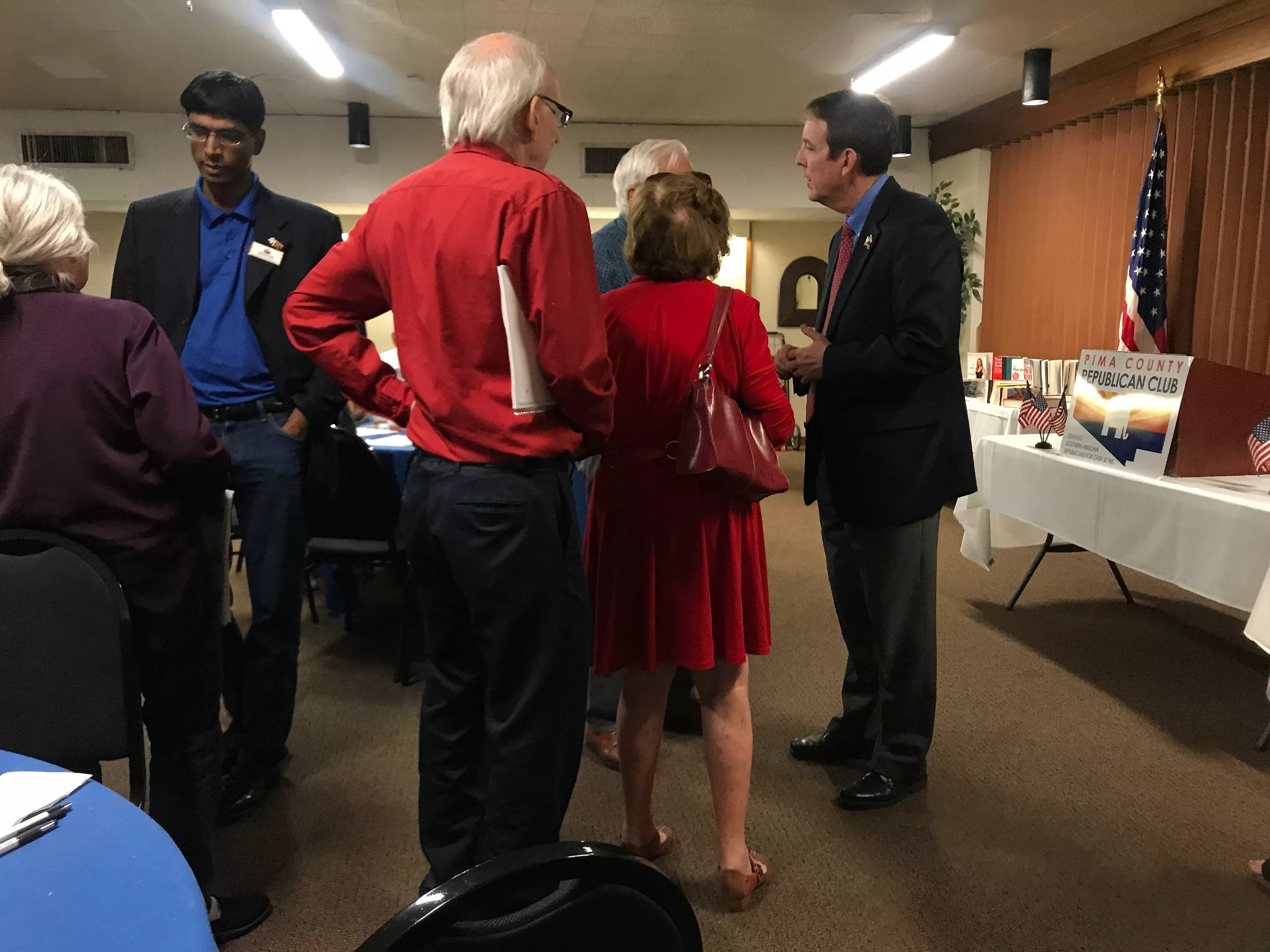
At yesterday’s Pima County Republican Club gathering, Ken Bennett told the crowd that when he saw Gov. Doug Ducey “cave” to the mounting pressure from K-12 educators and announce the “20x2020” plan, he knew he had to run for governor.
That was on April 12, so his team collected the 6,223 signatures required plus almost another 2,000 in a little over five weeks to qualify him for the Aug. 28 Republican primary.
Bennett, a fifth generation Arizonan from Prescott, served as Arizona’s Secretary of State from 2009 to 2015. Before that, he was a state senator from 1999 to 2007, including a four-year stint as Senate president. In 2014, he got 12 percent of the vote in the crowded GOP primary for governor that Ducey won.
Bennett claims the #RedforEd movement is a politically oriented undertaking aimed at turning Arizona into a blue state. He is skeptical that educators will be satisfied with the raises Ducey has promised.
“Every time you give a mouse a cookie, they’ll ask for a glass of milk,” Bennett said.
Tags: Ken Bennett , Pima County Republican Club , gun control , education , red for ed , McCain , Obamacare , ACA , campaign , primary election , Image
Tuesday, June 19, 2018
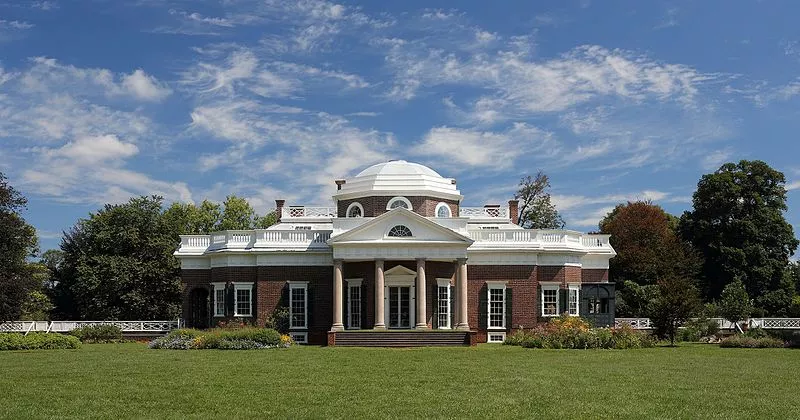
The newly opened space at Monticello, Thomas Jefferson’s palatial mountaintop plantation, is presented as the living quarters of Sally Hemings, an enslaved woman who bore the founding father’s children.The life of Sally Hemings, a slave owned by Thomas Jefferson, is an essential part of an honest recounting of the history of slavery and its importance in the early history of the United States. The two hundred year denial of her sexual relationship with Jefferson and her bearing of six children with him is historical witness to the unwillingness of the white majority to face up to the truth concerning this country's original sin. The reconstruction of Hemings's separate and unequal living quarters on the grounds and its inclusion in the tours of Monticello are a partial, far-too-late correction of the historical record.
I've spent a considerable amount of time in the years since I retired from teaching trying to correct the weaknesses in my own education. For instance, I finally read James Joyce's Ulysses a few years ago. I own that omission. The book was there all along, I knew its place in the literary canon since I was in high school, but I simply never bothered to pick it up. But I take less personal responsibility for the alarming gaps in my knowledge of the history of minorities in this country. The primary responsibility for my ignorance is the gap in the historical record created by historians who put on blinders when they wrote their many thousands of books on American history, which should be shelved in libraries in a section named, "History As Told By the Winners." The historical record has begun to be corrected over the past few decades. I'm trying to catch up as fast as I can.
A few years ago I read The Hemingses of Monticello: An American Family, by Annette Gordon-Reed. It is a history of Sally Hemings and her family before, during and after they were owned by Thomas Jefferson. The book shifts the usual focus of narratives about our country's founders, putting the Hemings family front and center and making Jefferson a secondary character who is discussed as he relates to the slave family.
Here's the short version of Sally Hemings's story: When Hemings was 16, in Paris with Jefferson to take care of his children, Jefferson impregnated her with the first of the six children they would have together. Jefferson denied his parentage and kept Sally and their children slaves at Monticello, only granting the children their freedom when they became adults.
For the longer version, I'm going to employ an unusual approach, starting from last Saturday and working backwards to Sally Hemings's birth.
Tags: Sally Hemings , Monticello , Thomas Jefferson , Annette Gordon-Reed , Elizabeth Hemings , John Wayles , Image
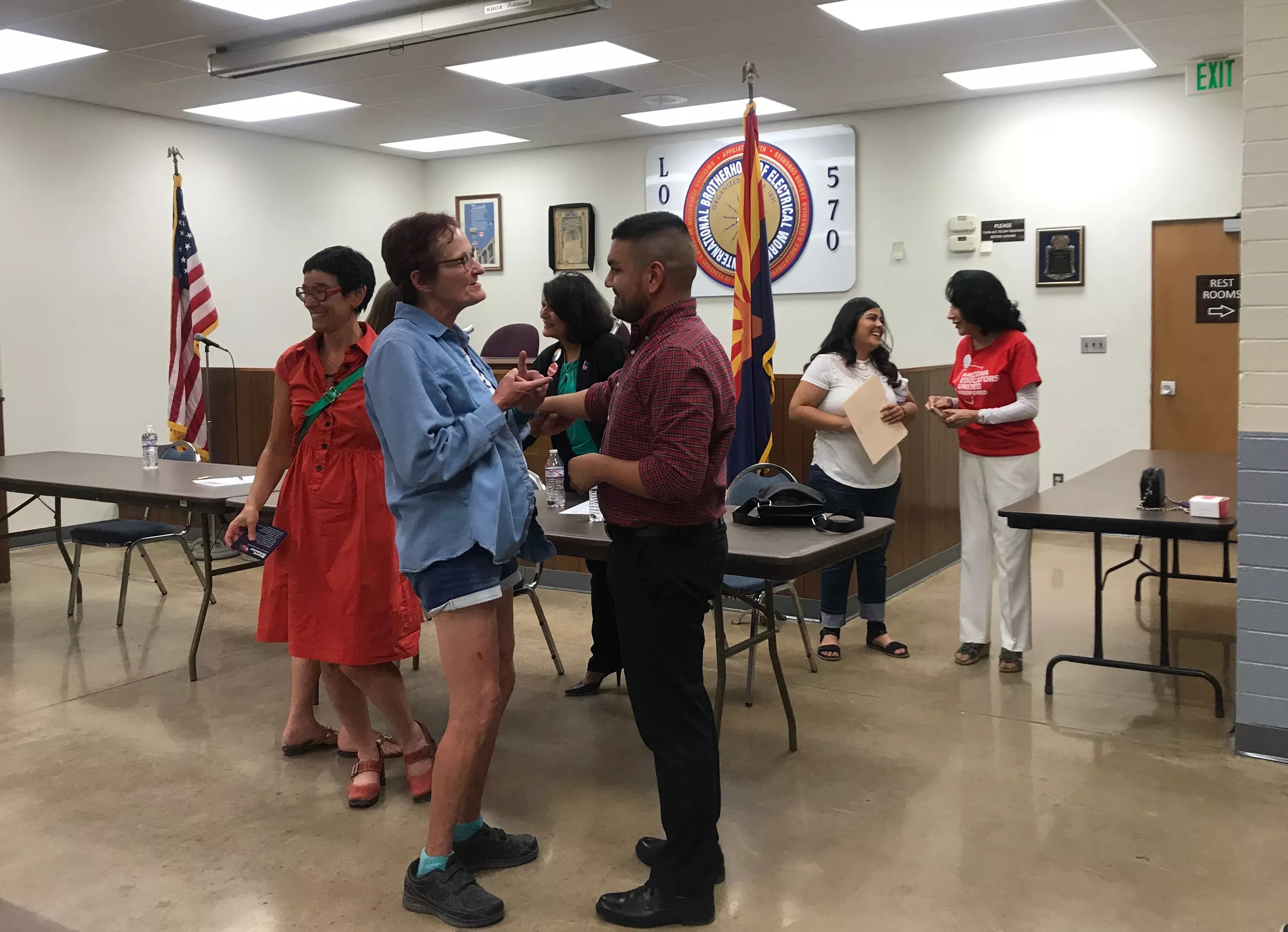
Andrés Cano was seven years old when environmental activists fought for his grandmother. She was poisoned by beryllium inhalation from a manufacturing plant in South Tucson during the early 1990s.
Betty Villegas was just out of high school when she and her friends drove people without transportation to the local polling place to cast their votes.
Sen. Olivia Cajero Bedford was settled into her third career in the tourism industry when she was exposed to the legislative issues of the time, which inspired her to change her career once again.
These events were the seeds that rooted a passion for public service in the three of the Democratic candidates for Arizona’s 3rd Legislative District, who spoke at a community forum hosted by UNITE HERE Local 11, CASE Action, Living United for Change in Arizona (LUCHA), Progress Now Arizona, Our Voice Our Vote (OVOV), Mi Familia Vota and Arizona Wins.
Tags: politics , elections , voting , LD 3 , education , housing , representation , democrat , candidates , LUCHA , Mi Familia Vota , Image
With a growing population in Arizona — 3.2 million new residents are expected to come in the next 30 years — plans are beginning to form regarding how Arizona will provide electricity to such a large number of people.
The Natural Resources Defense Council funded a study that compares two possible futures: one where Arizona Public Service and Tucson Electric Power build new gas-fired power plants, and one where almost every utility provider, except the Salt River Project, sources 50 percent of their energy from clean renewable mediums like solar and wind farms by the year 2030.
An energy firm called ICF conducted this study using their Integrated Planning Model and a few variables established by the NRDC. According to Dylan Sullivan, an senior scientist at the NRDC, the IPM is a big deal.
“IPM is a detailed model of the electric power system that is routinely used by the electricity industry and regulators, including the U.S. Environmental Protection Agency, to assess the effects of environmental regulations and policy,” Sullivan wrote in his analysis of the study.
He explained that this model is designed to consider almost every possible factor of the electricity system and the effects of its operations. Capacity of power plants, technology performance and maintenance, public demand, government policies, prices of resources, the weather — you name it. From there, it finds the most cost-effective way to meet the needs of Arizona’s growing customer base.
According to the study released in early June, when the 50 percent renewables plan is in effect, the IPM predicts the following:
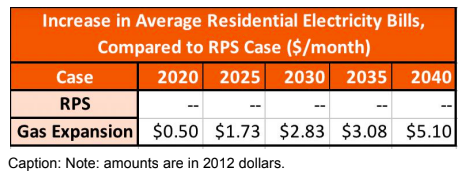
- The average electricity bill would be $3 lower each month in 2030, and $5 lower each month in 2040. Combining these savings from across the state would total to more than $4 billion. That’s $4 billion going back into our economy.
- Arizona would meet future electricity needs with solar projects that are built and run in-state rather than using gas plants that rely on imports from other states. This will create jobs for Arizona residents.
- The investment in renewable energy and storage can reduce the carbon footprint. It would lower annual carbon dioxide emissions in 2030 by 4.6 million tons, which is the same as the annual emissions from 900,000 cars.
Tags: Natural Resources Defense Council , Clean Energy for a Healthy Arizona , renewable , energy , solar , wind , gas , pollution , environment , air , cost , Arizona , savings , policy , Image
Monday, June 18, 2018
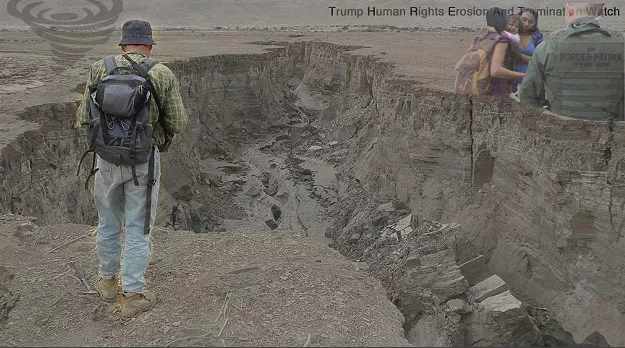
Based on what is going on right now at the U.S./Mexico border, the Trump administration has gone beyond the threat of eroding and ending human rights in the country. It has moved into action. We are staring directly into the abyss.
Anyone who condones or rationalizes what the administration is doing at the border to infants, toddlers, boys and girls up to the age of 18, and to parents whose children are being torn away from them, is aiding and abetting the destruction of this country as we know it. I'm sorry, but if you claim that you can retain your sense of decency and not condemn what is being done to children and families in our name, you have already lost part of what makes you a decent human being. You share the guilt with the monsters who put this zero tolerance immigration policy into motion and the border guards who are implementing it.
I have to be honest and admit, as a citizen of this country, I share the guilt and shame as well, even though I condemn what is going on with every fiber of my being.
Tags: Trump , Families , U.S./Mexico border , Image
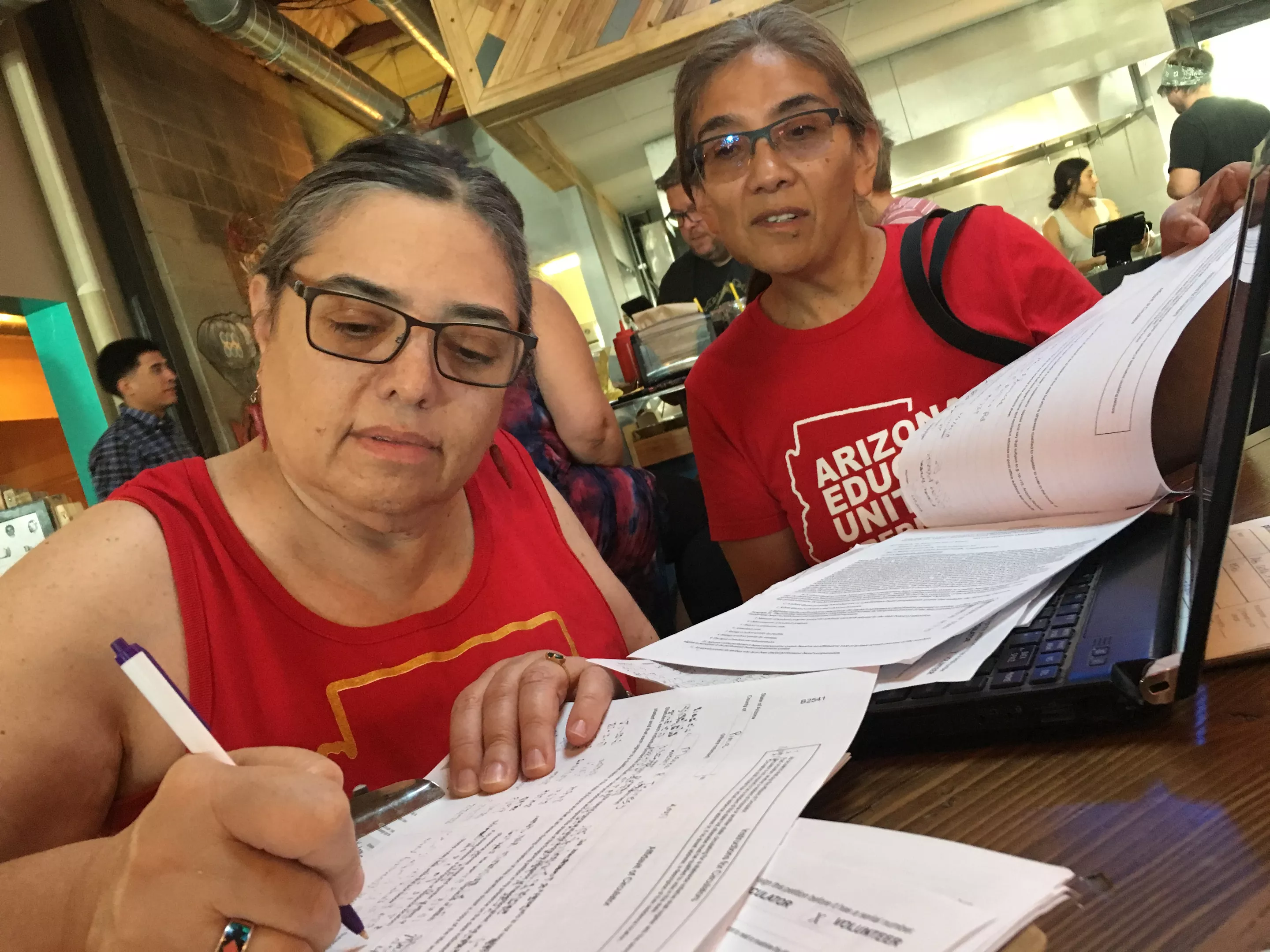
Marea Jenness, a Tucson High School biology teacher, keeps a megaphone in the trunk of her Mercury Mariner. With the Red for Ed movement becoming a staple these days, she stays ready in the event of more protests.
Jenness is one of thousands of Southern Arizonans who support a citizen-led ballot initiative that increases tax rates on high-income earners to address underfunding in public schools.
Proponents estimate the increase would raise $690 million annually. The proposal would increase taxes on individuals who earn more than $250,000 a year and couples who earn more than $500,000.
The coalition needs 150,642 valid signatures by July 5 to place the Invest in Education Act on the November ballot, but they’re shooting for at least 200,000. David Lujan, director of The Arizona Center for Economic Progress, said the group is on track to getting the signatures they need by the deadline.
Invest in Education organizers hadn’t released a statewide count, as of this week, of how many signatures they had gathered so far. But if they can get enough signatures to put it before voters in November, they stand a decent chance of winning at the ballot box, according to a recent poll discussed at a June 6 INVESTinED news conference in Phoenix with the Children’s Action Alliance and other education advocates.
Tags: education , red for ed , legislature , community , schools , teachers , Arizona , Image
Friday, June 15, 2018

I rarely find people I disagree with more fundamentally than John Huppenthal and the Koch Brothers. But sometimes the universe allows for rare moments of alignment. I'm putting these odd moments of agreement with Huppenthal and the Brothers Koch into one post even though they concern very different issues to amplify the weirdness of the moment (also to spare myself the task of doing this twice). And—this is a plus for me—I find our similar positions are at odds with people and organizations I disagree with as fundamentally as I usually disagree with Hupp and the Kochs.
First, John Huppenthal. A story on public radio station KJZZ talks about one of the major downsides of the letter grades Arizona gives to its schools, namely, schools with lower income students tend to get lower grades, which stigmatizes the students, the teachers and the schools. One of the few nearly undisputed facts in educational research is that no matter where you go, students from lower income families tend to do worse on standardized tests than students from higher income families.
Or, as John Huppenthal put it in the story,
"Here we have this letter grading system that comes in and is beating, to put it bluntly, beating the hell out of schools that are serving the most at-risk populations."John, I couldn't have said it better myself. To be honest, you said it a hell of a lot better than I did.
Huppenthal's statement is followed by one from Lisa Graham Keegan, who thinks the grading system is not perfect but pretty good. Keegan, like Huppenthal, is an ex-Arizona lawmaker and education superintendent. She has continued to be a player in Arizona's education politics, pushing her destructive privatization/"education reform" agenda forcefully and successfully with a succession of Arizona governors and legislatures. So for a brief, happy moment, I find myself allied with Huppenthal against Keegan. (John, who is a regular commenter here, will most likely rain on my parade and explain how I'm distorting his and Keegan's positions, but I'll savor this rare moment of apparent confluence until the two of us lock horns again.)
Then there's the Charles Koch Institute, which — spoiler alert — is on the same side as I am, lined up against the Goldwater Institute. Imagine my surprise.
Tags: John Huppenthal , Koch brothers , State school grades , Lisa Graham Keegan , Goldwater Institute , School of Civic and Economic Thought and Leadership , Image
Thursday, June 14, 2018

Revolutionary Grounds Coffee and Books, the small storefront on Fourth Avenue near the corner of Fifth Street, is closing its doors for good on Sunday, June 17. But a revival may be on the horizon.
Usually invisible to the average tourist, the store’s red brick walls housed a vibrant local community for the past decade. The place has a collection of leftist and progressive books that are sourced and sold by the owners, Joy Soler and her husband, attorney Paul Gattone.
You can find paperbacks about Marxism, sustainable food sourcing, feminist memoirs, the Civil Rights Movement and much more stacked on the shelves, adjacent to a comfy seating arrangement with faces of famous activists accenting the wooden tables.
Soler received a letter earlier this month from her landlord, Andy Fried, announcing that their rent has been increased, again. The monthly bill has risen to a point where her family can no longer afford it.
“Our landlord sent a letter saying that he had increased [the rent] back in January and we hadn’t been paying it, but he never told us he increased it back in January.” Soler said.
The letter Fried also said he will be increasing the rent again this month, and he expects back rent to be paid from January through May on top of this increased price.
“He wants us out, so he told us if we leave by the 30th he’ll forgive one month’s rent,” she said.
Soler and Gattone have spent the last decade building up their business at 606 N. Fourth Ave. She told me they have been paying on a month-to-month basis, and although Fried has been slowly raising the rent in the last couple of years, it has never been this drastic until now.
Fried, who also owns the connected buildings where Tallboys and Myztic Rootz are located, told the Weekly he increased the rent because Pima County increased the value of the property, and therefore his property tax.
Records from the Pima County Treasurer’s Office showed the property tax was $8,636 in 2017, compared to $7,856 in 2013.
Soler’s regular customers are understandably upset about this news, which she announced through the store’s Facebook page a few weeks ago. Revolutionary Grounds hosts a lot of niche community events and outreach activities that can’t be found elsewhere.
“A lot of people feel like [Revolutionary Grounds] is a safe space on the Avenue for folks who don’t have many safe spaces to go to,” she said.
Tags: Fourth Avenue , Revolutionary Grounds , The Rent Is Too Damn High , Tucson , Downtown , Image
Wednesday, June 13, 2018

I just read another one of those stories that scare the crap out of me every time I see them. The headline on the latest article in Education Week: "How (and Why) Ed-Tech Companies Are Tracking Students' Feelings." A few hundred words into the story, you learn that Facebook CEO Mark Zuckerberg and his wife Priscilla are sinking hundreds of millions of dollars into "whole-child personalized learning." Oh, and the Bill & Melinda Gates Foundation have decided to team up with the Zuckerbergs. For all I know, Mark and Bill's wives are genuine sentient beings, but the two men are beta version androids, strong on smarts but weak on understanding of what makes humans human. They'd most likely fail the human/replicant test in Blade Runner.
Here's how the Orwellian world of computerized "personalized learning" works. A student uses, say, an online math learning program. The software keeps track of the student's every keystroke, pause, fast forward and rewind, and of course every right and wrong answer. If the program is sophisticated and invasive enough, it may record facial expressions and eye movements as well. The information is stored in an individual folder on the company server. The next time the student logs on, the software uses what it has "learned" about that child to personalize the lesson to the student's academic and emotional learning style.
Best case scenario: The lessons are better suited to individual students, increasing their levels of interest and comprehension.
Worst case scenario: As the student interacts with educational programs in a variety of subjects, and maybe plays a few games and takes a few fun quizzes ("Which do you like better, playing video games or playing sports?") as a reward for time spent or points earned, the software company amasses a growing file of psychometric data. Year by elementary school year the data accumulates, creating an intimate, multi-dimensional personality profile. Humans come and go, but computer data lives forever. During their school years, young people's data and psychometric analysis can be used to make them "better" students — more attentive and interested maybe, but also more compliant and conforming. For the rest of their lives, it can be sold to people who think they can gain monetarily, or politically, from knowing what individual buttons to push on millions of human beings to elicit the desired responses.
Big Data Is Watching You. And Evaluating You. And Manipulating You.
Tags: Personalized learning , Mark Zuckerberg , Bill Gates , Computer software , Image