

Wednesday, February 14, 2018

But nothing Trump proposes, or says, or does, no matter how ridiculous or mendacious, can be considered dead so long as congressional Republicans buckle and bend the knee whenever it's time to show some independence. They're like a character in The Sopranos saying, "Sure I hang around with Tony Soprano sometimes, but I'm my own man. I know when to say no." Uh huh. Sure you do.
So let's look at Trump's DOA, or DBIA, proposals for the education budget, because everything that comes from his mouth or his tweets or his office matters, to the shame of his weak-kneed enablers.
Trump proposes to cut about 5 percent, or $3.6 billion, from education spending.
First, the education budget losers. Here are programs which would end.
• $2 billion for teaching training and class size reduction efforts. Gone.
• $1.2 billion for after-school programs. Gone.
• $400 million for districts to use for a variety of purposes including health-related programs and improving access to technology. Gone.
• $340 million to help get low-income and first-in-their-family students prepare for college. Gone.
• $250 million for states to develop preschool programs in low income areas. Gone.
• $190 million for grants supporting reading programs. Gone.
• $140 million for educational research programs. Gone.
• $73 million for pairing academic programs with health and related services. Gone.
Tags: President Trump , Education budget , Image
Tuesday, February 13, 2018

Teleos charter is part of the Great Hearts charter chain which has 23 schools in the greater Phoenix area. The schools say what clothing and hair styles are acceptable in their handbook, and if students violate the rules, they're sent home. At Great Hearts, boys aren't allowed to have shaved heads, Mohawks, rat’s tails, pony tails, or braids. They also can't have long hair or dye their hair in non-natural colors.
Yawn. Next education story, please?
As the story developed, I realized I was suffering from a case of white blindness. All the other prohibited hair styles are societal statements or personal fashion choices, and reasonable people can debate whether or not they're appropriate in a school setting. But hair braids are part of an African American cultural tradition, and to deny that hair style is to disrespect the traditions and culture of a group of people who have suffered disrespect and far worse since they set foot on this continent. So this is more than a generic dress code issue. Hair braids for an African American male are a different matter entirely from the other prohibited choices.
After first defending the school's actions to the press, the superintendent of Arizona's Great Hearts charters reversed course and issued a statement saying the student is welcome at the school, braids and all. "This event has triggered an internal review," the statement said, "to determine what changes may be needed to ensure this policy is sensitive to the cultural diversity we are proud to have in our academies."
Great Hearts deserves credit for doing the right thing in this case. But there's more to the Great Hearts story which puts this example of racial insensitivity in perspective.
Much like the BASIS charter school chain, Great Hearts charters generally have a rigorous academic curriculum and cater to high achieving students. In most of their Phoenix-area schools, the vast majority of the students are Anglo and Asian. The one exception is Teleos Preparatory Academy where the student's hair braids became a problem. Teleos is 6 percent Anglo and 1 percent Asian. Most of the other students are African American and Hispanic.
Tags: Teleos Preparatory Academy , Great Hearts charter schools , Diversity , Image
Friday, February 9, 2018
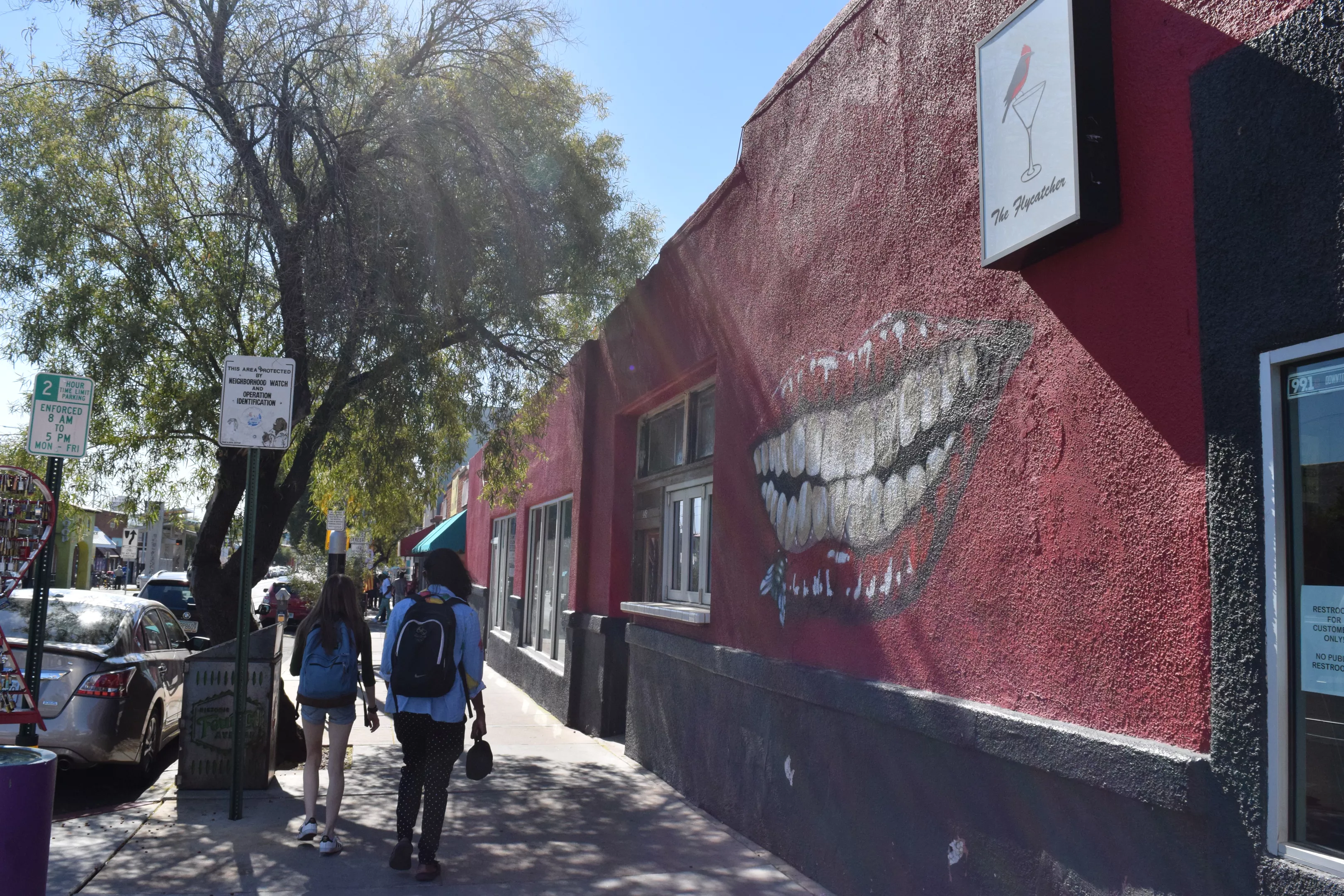
The Flycatcher bar on Fourth Avenue may be torn up for student housing as early as this summer.
The downtown hotspot is under contract with student-housing development company out of Memphis, Education Realty Trust Inc., or EDR. A neighborhood meeting was held on Wednesday, Feb. 7, where legal representatives for the company told local residents and business owners the seven-story project would not be student housing—an assertion that was met with skepticism from Tucson City Council member Steve Kozachik.
“They are trying to thread the needle and rent these rooms in a way that makes it look like it’s not student housing,” says Steve Kozachik. “They’re not being upfront with people.”
EDR, who also built the District on 5th, is a student-housing development company. But they are avoiding the “group dwelling” designation, used for student housing and requiring the approval of mayor and council.
By renting units by the room rather than by bed, EDR could have more flexible development options and skirt parking, loading and landscaping standards, which include dimensional requirements and height increases—although the rooms will likely not be affordable to locals but only students living on their parents’ out-of-state paychecks.
The developers are using the more flexible designation of “multifamily dwelling” according to Fourth Avenue Merchants Association Executive Director Fred Ronstadt. The timeline EDR representatives laid out at Wednesday’s meeting had the groundbreaking set for sometime this summer.
Thursday, February 8, 2018

Governor Ducey came in at one-tenth of that, $100 million. At the latest Koch brothers summit, Ducey said to the assembled multi-millionaires and billionaires, “I didn’t run for governor to play small ball. I think this is an important idea.” But that "important idea" in his pitch for campaign cash wasn't public education. It was private school vouchers, which are near and dear to the Koch network's hearts and wallets. When it comes to increasing public school funding, Ducey plays the smallest ball he can manage and still call himself "the education governor" with a straight face.
But education groups and a sizable number of business leaders say, if we're going to give our teachers a reasonable wage and provide the needed resources for our students, it's going to take an extra billion dollars in this budget and every budget in the future.
So who is this radical group that recommends we add $2 billion a year to the school budget? And a one-time allocation of $1.3 billion to make up for past budget shortfalls? And get rid of the law requiring a two-thirds majority in the legislature to increase taxes so all it takes is a simple majority to add to our revenue base?
All those radical proposals come from a not-so-radical group of participants in the 110th Arizona Town Hall held last November. The Arizona Town Hall's topic changes each year. For 2017, it was "Funding preK-12 Education." Community town halls were held in 15 locations around the state, each attended by a few dozen to a hundred participants, and each group submitted a report with findings and recommendations. Then in November, about a hundred people representing community members, business people and educators gathered for three days at the Hilton Hotel in Mesa. (The Hilton venue is an indication of the un-radical nature of the organization, as is the makeup of its executive committee, which includes wealth advisors, realtors, engineers, and even Lea Marquez Peterson, recent CEO of the Tucson Hispanic Chamber of Commerce and current Republican candidate for the CD-2 House seat occupied by Rep. Martha McSally.)
The Town Hall produced a 17 page report explaining why Arizona's current education funding is inadequate and what needs to change. The crowdsourced set of recommendations does a better job of recognizing what it will take to meet the financial needs of our K-12 public schools than just about any other document I've read, including its understanding that we need to get rid of the two-thirds majority the legislature needs to get a tax hike through the legislature.
Here's the short version of the report's recommendations.
"In simple terms, we need to invest at least $1.3 billion (to be updated to reflect the current need) on a one-time basis – and at least $2 billion annually, with annual increases for inflation in the future – to position our preK-12 education system to meet the educational goals that we have identified for it."
Tags: Arizona Town Hall , PreK-12 Education funding , Doug Ducey , Koch Brothers , Image
Tuesday, February 6, 2018

Instead, the board voted down a resolution which declared that teachers have been freed from the racist restrictions which forbade them from using elements of the dismantled MAS program. The three members who formed the majority made a wrongheaded, possibly even shameful, decision.
Let me give the board majority the benefit of the doubt and assume they misunderstood the meaning of Judge Tashima's ruling. He didn't rule on the value of the MAS program itself. His ruling said the state legislature and the Department of Education used unconstitutional means to suppress the educational rights of a minority group. It was part of a long, proud tradition of our country moving toward granting civil rights to individuals and groups regardless of their ethnicity, race, religion, gender or sexual orientation. In this case, the issue was racism. Thanks to the ruling, the racists lost. That's what the victory is all about.
And that's what the governing board needs to acknowledge, publicly and formally. It should state that the judge's ruling is an affirmation that the education of Tucson Unified students should not be dictated by racists, that the district will decide what it believes is the best way to give its students the best possible education, and it will always strive to respect their civil rights and their right to freedom of speech.
Tags: Mexican American Studies , Judge Wallace Tashima , ARS 15-122 , TUSD school board , Image
Thursday, February 1, 2018

I was browsing through education news last week and came across an op ed in the Houston Chronicle praising Education Savings Accounts, which is the generic name for what our legislators have redubbed Empowerment Scholarship Accounts. As I looked to see who wrote it, I experienced a simultaneous sensation of familiarity and surprise. The author is Matthew Ladner, who I know well from long arguments we carried on in the comments section of my posts when I wrote on Blog for Arizona and Ladner was a vice president of research at the Goldwater Institute. The surprise came when I read the bottom of the op ed and found out he's now "the senior research fellow at the Charles Koch Institute." I knew Ladner had left GI, but last I heard, he was working on policy and research at Jeb Bush's Foundation for Excellence in Education. Since I don't see him mentioned on the current FEE website, I guess Ladner isn't wearing hats in both places. It looks like he's left Jeb for Charles Koch.
The employment and adventures of Matthew Ladner create a series of connected dots where the last dot connects back to the first. Taken together, they offer a revealing snapshot of the very formidable, very influential, very affluent "education reform"/privatization movement.
Tags: Koch brothers , Koch donor network , Education Savings Accounts , Empowerment Scholarships , Matthew Ladner , Goldwater Institute , Foundation for Excellence in Education , Charles Koch Institute , Doug Ducey , Proposition 305 , Image

The Sanctuary Movement has grown from 400 to 1,100 congregations nationwide since Donald Trump’s election.
Sanctuary congregations aid immigrants and the immigrant community in a variety of ways, including hosting legal clinics, advocating against and taking actions to stop deportations and housing immigrants in danger of deportation.
“ICE is attacking us as leaders and activists at the local and national level,” said Ingrid Encalada Latorre, an immigrant and activist currently in Sanctuary in Colorado. “They don’t want us to lead, but they won’t silence us because we too have rights as immigrants in this country.”
In the months after Donald Trump’s election, the number of congregations offering sanctuary to immigrants under threat of deportation doubled from 400 to 800 nationwide. The movement continues to grow, across 25 states. And the number of Sanctuary coalitions have grown from 12 to 40 since 2016, according to a new report, “Sanctuary in the Age of Trump,” released by a coalition of faith leaders, including Rev. Alison Harrington, a pastor in Tucson’s Southside Presbyterian Church.

North Carolina currently has more people in sanctuary than any other state, with five. And their movement continues to grow, with six more congregations working on becoming sanctuary churches and more calling each day, said Rev. Julie Peeples, senior pastor at Congregational United Church of Christ, in Greensboro, North Carolina.
“It is really growing rapidly here,” Peeples said. “My congregation and I continue to be inspired by the courage and strength of those in sanctuary and their leadership. They are teaching us how to love our neighbor and how to honor our nation’s pledge of ‘liberty and justice for all.’”
The report also says that it’s no longer just cities with large immigrant population that have congregations in the Sanctuary Movement, but more rural areas with a recent influx of immigrants, in states like North Carolina, Ohio, Oklahoma and Virginia.
Congregations gave sanctuary to 37 people facing deportation, in 2017. Nine received some sort of temporary reprieve from deportation. Today, there are 36 people in public sanctuary, nationwide, according to the report.

The Sanctuary Movement has grown in direct response to the ramping up of deporting immigrants whose only crime is being in the country illegally, many of whom were registered with Homeland Security and allowed a stay of deportation under the Obama administration, given they participated in routine check-ins with ICE.
In 2011, Immigration and Customs Enforcement Director John Morton released a series of immigration directives that came to be known as the Morton memos. These memos limited the immigration enforcement to a subset of convicted criminals, as well as blocking immigration enforcement to crime victims, witnesses and “individuals pursuing legitimate civil rights complaints,” a measure that allowed immigrants to report crime without fear of deportation.
Today, ICE searches these people out, although they are well known to the government and have complied with their regular check-ins. The new report details the arrests of several immigrants with deportation stays who are immigrant rights activists, including immigrate-rights activist Ravi Ragbir, who was detained during a routine check-in meeting with ICE officials in Manhattan, on Jan. 11.
Ragbir was one of a number of immigrants vocal in the movement arrested by ICE in January. His arrest sparked protest that ended with 18 arrests, including two members of the New York City Council.
On Monday, Jan. 29, U.S. District Judge Katherine Forrest ordered his release, saying his detention was “unnecessarily cruel.” He is still facing deportation.
“I am appalled to see the growing attacks on immigrant leaders,” said Ragbir’s wife Amy Gottlieb. “Ravi was detained at a regularly scheduled check-in with ICE, even though nothing had changed in his legal case. It is clear that he is targeted because of his outspoken challenges to our unjust immigration system. It is devastating to see my husband and so many others locked up in county jails, their liberty taken away from them, while private companies and others profit from our suffering.”
The faith leaders who contributed to the report said they plan on expanding the movement in the Southwest and Midwest and hosting trainings and strategy meetings.
“Sanctuary is needed more than ever,” the report says. “People of faith from many traditions recognize the increased need for Sanctuary as the harsh anti-immigrant, anti-refugee, anti-black and anti-Muslim policies come to life under the Trump Administration.”
“Sanctuary in the Age of Trump” also details stories of several immigrants who and sought sanctuary, more examples of ICE ramping up intimidation tactics, and 10 policy recommendations.
Tuesday, January 30, 2018

When the Koch brothers, Charles and David, began their push to change politics and economic policy in the U.S. in the 1970s, an important part of their strategy was stealth. Spend millions of dollars, they decided, hundreds of millions of dollars, but stay in the background. Create and help fund multiple organizations, think tanks and college centers, all with lovely sounding names like Americans for Prosperity, Heritage Foundation and The Freedom Center, to help push their version of libertarianism into the center of American life in a determined effort to make this country a better place for the obscenely rich to live—but keep the Koch name out of it. Hold huge donor summits in posh resorts, but don't let the reporters in. Only allow the Koch name into the spotlight when donations are made to causes like cancer research or New York's Lincoln Center for the Performing Arts.
Things have changed over the past few years. The brothers been outed. Their names are regularly featured in the media and Democratic campaign pitches, and people have figured out ways to sneak recorders into their secretive donor summits. So they've emerged from the shadows, a bit, anyway. The spider web of interconnected groups they fund still have the same lovely, Koch-free names, but the Kochs have been forced to give in to the inevitable.
Case in point: The Koch brothers' three-day donor summit in Indian Wells, near Palm Springs, which ended Monday. They let reporters in, with the understanding that they could report on the proceedings but not reveal the names of the 500-plus donors at the summit without the donors' permission. Reporters, however, were allowed to reveal the names of politicians on the guest list, which included two governors: Matt Bevin of Kentucky and our own Governor Doug Ducey.
At the summit, the Koch network announced plans to spend at least $20 million to make everyone love Trump's massive tax cuts for the rich (which included the occasional bone thrown to the non-rich, until the bones go away in a few years). They also plan to spend $400 million on the 2018 midterm elections, more than the RNC, the NRA and the Chamber of Commerce combined. Ducey, a shining star in the Koch firmament, is certain be a recipient of their campaign largesse. A little will be donated directly to his campaign and reported in the light of day, but most it will be in the form of dark money.
On another related front, the Koch brothers plan to dismantle the country's current system of public education and replace it with something more to their liking.
Tags: Doug Ducey , Koch brothers , Koch donors summit , Empowerment Scholarship Accounts , Proposition 305 , Image

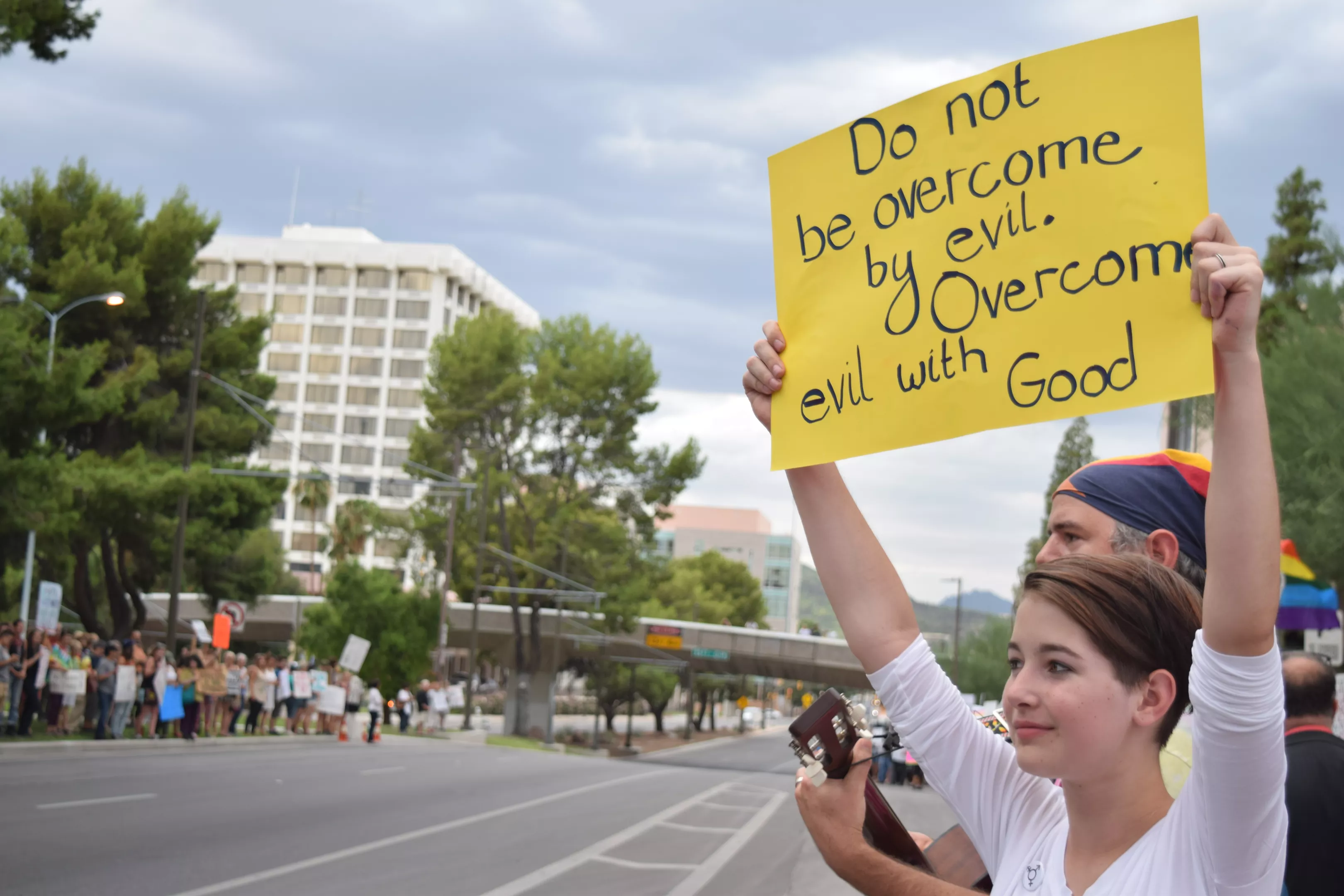
The Phoenix Police Department said they're working on better communication, regarding the launching of pepper ball ammunition and tear gas into protestors during President Donald Trump's August 2017 rally, according to a PPD internal review released on Jan. 29.
The American Civil Liberties Union of Arizona responded by saying PPD "did not protect the First Amendment rights of protesters and caused many people to go home with cuts, bruises, and other injuries."
"There are many videos of officers attacking protesters with pepper spray and projectiles at dangerously close range," said ACLU of Arizona Legal Director Kathy Brody in the press release. "It is shocking and disheartening that the department determined this excessive use of force was justified."
Brody also asked whether the police could have used less volatile methods such as better
amplification equipment to announce "adequate orders before using chemical irritants," why they denied using foam batons on protestors and why the prolonged delay in releasing the report.
"Chief Williams has said that her officers made sure everyone went home safely," Brody said. "The truth is many peaceful protesters went home with injuries caused by her officers. The police are supposed to ensure people can fully exercise their First Amendment rights. On this occasion, the Phoenix Police failed to do that."
Police Chief Jeri Williams wrote in the internal review that communication could be improved on, adding that the police did what they could, and there were minimal injuries and little property damage.
Friday, January 26, 2018
I learned about the site from an NAACP magazine I receive along with my membership, which I began soon after Trump was elected.
Non-educators who want to know more about the topic will find the material valuable as well. However, I have to admit, I've only scanned the site. I find it too unsettling to see pictures or even read detailed descriptions of this horrific part of our history. I don't think teachers below the high school level would use the entire site with students, though it would certainly give the teachers the background to discuss lynching with younger children if they felt it was appropriate. I also imagine teachers using this material would warn students about the nature of the contents and give them alternative ways to fulfill class assignments.
Here's how the "About" page describes the site and its purpose.
The Equal Justice Initiative believes we need to change the narrative about race in America in order to advance our collective goal of equal justice for all. As part of this work, we extensively researched the period between the Civil War and World War II, when over 4,000 African Americans were lynched in this country. We published our findings in the report Lynching in America: Confronting the Legacy of Racial Terror, the most comprehensive work done on lynching to date. Many racial terror lynchings, however, went unreported and their victims remain unknown.The entire report is included on the site.
Much of the funding for the organization and this project came from Google, which has contributed $2.5 million to EJI.
Tags: Lynching , "Lynching in America , " Equal Justice Initiative , NAACP , Google

